
Growing up
Siblings in Childhood: Attention, Comparison and Conflict
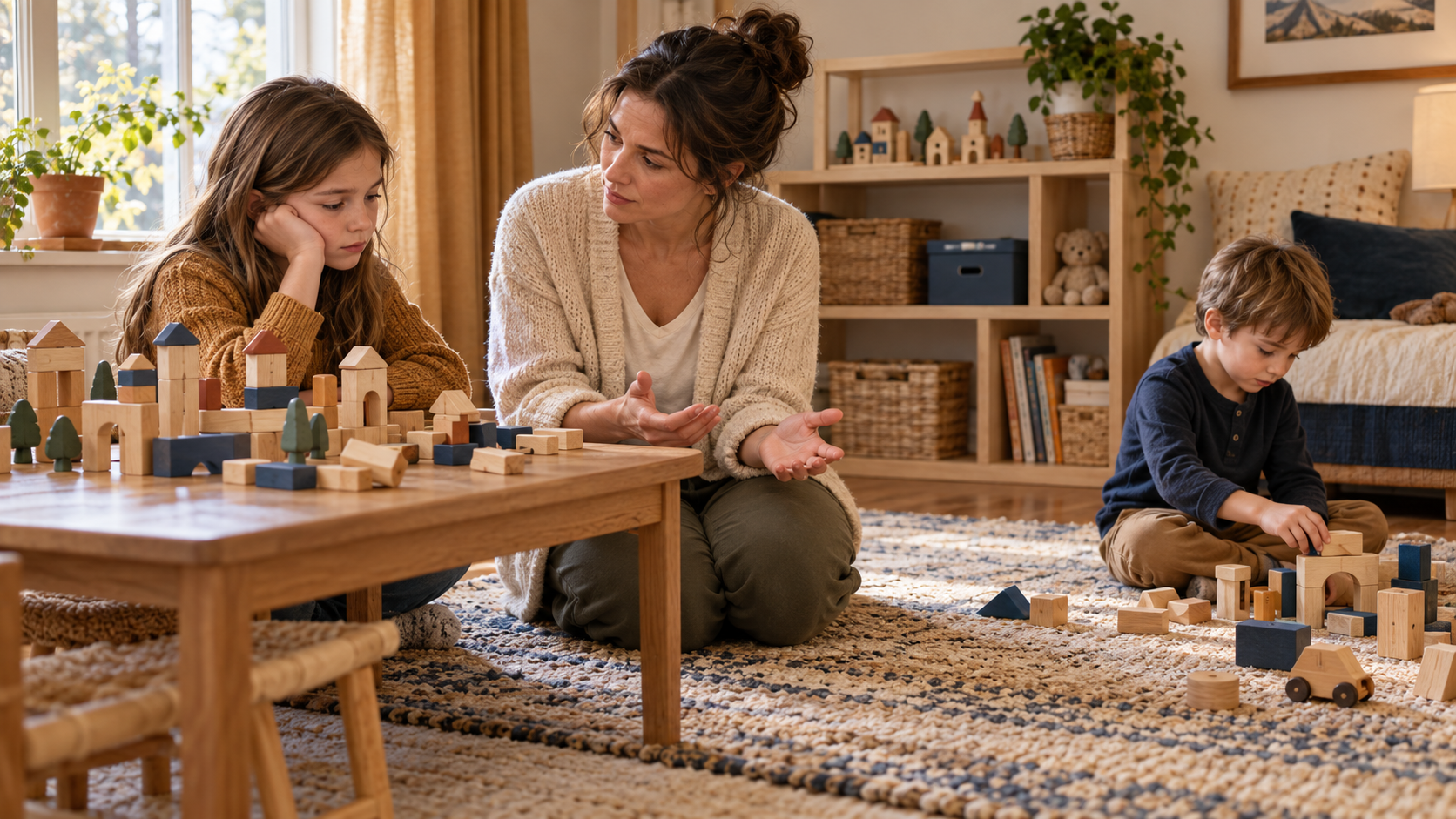
Nine-year-old Anya builds a town while five-year-old Misha sleeps. He wakes and knocks down its tower. An adult asks his sister to give way because she is older. Later, Misha is told to learn from Anya because she can draw quietly. Both have entered a comparison they did not…
Epigraph
“he was angry…”
Luke 15:28, a fragment concerning the elder son, King James Version. In the parable, the father comes out to him. This religious narrative describes no universal childhood quarrel and assigns a child no duty to forgive. Context, 15:25–32.
What this article explores
Nine-year-old Anya builds a town while five-year-old Misha sleeps. He wakes and knocks down its tower. An adult asks his sister to give way because she is older. Later, Misha is told to learn from Anya because she can draw quietly. Both have entered a comparison they did not choose. This invented family helps us examine how a dispute about an object becomes a dispute about belonging, and what can change without demanding immediate affection.
The article is for adults around children and teenagers recognising their own burdens. We distinguish attention from a reward, fairness from sameness, and disagreement from treatment requiring protection. Being older does not make a child a parent; being younger does not remove responsibility for manageable actions. No lifelong friendship is guaranteed. Even with little space, money or time, one rule and one adult responsibility may become clearer. Actual danger needs more than a family conversation.
I. Several questions may lie behind the fallen tower
Begin with what our scene establishes. Misha knocks down the construction, Anya becomes angry, and an adult asks her to give way. We do not yet know that he intended humiliation, that she dislikes her brother, or that the parents have permanently chosen a favourite. Those conclusions exceed the event. Equally, calling it trivial because the pieces cost little ignores her work. She invested time and wanted to preserve something. What was destroyed was a particular creation, rather than an abstract willingness to share.
Adults can separate immediate questions: what needs stopping, what happened to the object, what each child wants, and which rule already applied. This need not become a spoken questionnaire. It helps the adult avoid answering a request for protection with a judgement of character. If Misha continues breaking things, stop the action first. Establishing his full intention cannot be a precondition for preserving the remaining pieces and allowing the children some distance.
Anya may also ask why she is always expected to understand. Another construction set cannot settle that question. Yet neither should one fallen tower automatically stand for her whole family history. Return to the repeated pattern separately: which requests recur, which activities get interrupted, what was promised? A child should not have to prove an entirely unjust life before one incident can be discussed. Nor must the adult either defend every previous decision or declare themselves permanently bad.
Misha may need attention without being entitled to obtain it through destruction. Naming a possible need neither identifies his motive nor cancels consequences. Offer another activity, then consider whether he wanted to join, borrow a piece or provoke a response. Anya need not design a suitable game while upset. She may participate, but the adult’s task cannot depend on her immediately becoming a caring older sister.
The first outcome may be modest: the destruction stops, Anya’s work is acknowledged, and neither child must resume playing together. Resentment may remain. What becomes clearer is the distinction between an action, a feeling and the distribution of care. That allows a specific next question: repair part of the town, change storage arrangements, or acknowledge that today’s shared game has ended and another plan will be needed later.
II. Fairness does not always look identical
Misha needs help getting dressed; Anya can manage alone. Different amounts of assistance do not by themselves establish unequal love. But “You understand, don’t you?” does not tell Anya when she can have time with the adult. Necessary assistance and attention to a person are distinct. Independence in one task does not remove a child’s questions, interests or wish to be heard without interruption. The adult can recognise both children without pretending their immediate needs are identical.
The distinction becomes especially important when one child needs treatment or continuing support. That need is no offence against a sibling. The other child does not have to hide loneliness to demonstrate kindness. Adults can describe an actual constraint without blame: today’s journey took a long time and the promised walk did not happen. This differs from falsely claiming that everything was equal, or demanding pleasure at repeatedly postponing one’s own needs.
The American Academy of Pediatrics discusses individual attention alongside family time, including opportunities within ordinary routines. This is a practical orientation, not evidence that a prescribed number of minutes removes jealousy. AAP, Sibling Relationships. In our scene, Anya might talk while the adult hangs washing or show a drawing without it becoming a comparison. No purchase, special outing or compulsory expression of gratitude needs to accompany that opportunity.
Promises also need to fit capacity. If tomorrow evening cannot be guaranteed, name what is known instead of offering certainty to end a complaint. When a promise fails, return to it without waiting for the child to demand attention more loudly. Anya should not have to monitor adult fatigue, keep a time ledger or identify an opening in the family schedule. Arranging care remains adult work even when the available result is small.
Identical presents cannot answer every fairness question either. One child needs shoes; another wants to choose an activity after dinner. The expenditure can be explained while the wish is separately heard. Not every wish is affordable, but refusal need not imply disappearance from adult attention. A clear limit concerns a resource: this purchase is unavailable now. It need not rank entitlement to love or make the other child responsible for every family constraint. Acknowledging disappointment can coexist with a limit that remains in place.
III. Comparing a result should not define a person
Anya’s drawing has many details; Misha quickly loses interest. Hoping to praise her, the adult tells him to see how properly to make an effort. Her work becomes an instrument for correcting him. He may begin defending his family reputation rather than discussing the picture; she may feel obliged always to set an example. These effects are not inevitable or established by one sentence. Yet the object of the praise has changed: recognising an achievement now diminishes somebody else.
An adult can describe what they actually notice: Anya invented differently shaped windows; Misha found an unusual colour. This does not require equal praise measured in words. Artificial symmetry can obscure the event too. One drawing may receive attention without an immediate consolation contest. The important boundary is that a particular achievement does not become a permanent table of abilities, assigning one child intelligence, another humour and another the job of being convenient.
Comparison sometimes serves a specific decision: who can use a tool, who is ready for a task, who needs help. Scope and conditions matter. Checking capacity to act safely differs from deciding who is better as a person. Anya may read independently for longer while Misha needs an adult. She need not become an unpaid teacher to equalise his result. He need not damage her book to obtain his own opportunity for attention or learning. Their needs require adult consideration rather than competition for a single approved identity.
Children may enjoy familiar roles. One genuinely likes making jokes, another organising things. Every recognisable description need not be prohibited. A difficulty emerges when there is no exit: the serious child cannot decline responsibility; the funny child’s distress is dismissed. Notice when an old picture replaces today’s report. Anya’s usual reliability does not disprove her statement that she cannot cope. Misha’s earlier mistake does not make a new offer of help pointless before he has tried.
No tribunal over every old family expression is required. Start with one repeated phrase. The adult can stop using the daughter’s drawing as a rebuke while continuing to enjoy it. A teenager can distinguish an expectation of permanent success from a particular school or household responsibility that still needs discussing. There remains room to learn, make mistakes and enjoy a task without defeating a sibling or relieving everyone else of their difficulties.
IV. Sharing space does not remove everything personal
Anya and Misha share a room. Insisting on separate bedrooms solves nothing when they are unavailable. Limited space nevertheless does not make every possession common or every conversation public. Distinguish shared objects, personal objects and unresolved arrangements. A common construction set might have turn-taking rules; a drawing or a gifted notebook raises a different question. Being older or a sufficiently good sibling does not automatically grant somebody else permission to take it.
Personal space may mean a box, a shelf or a period when unfinished work is left alone. None guarantees compliance. Some families lack even a free shelf: consider a feasible way to preserve one object rather than blame children for poor organisation. Upholding the rule must not fall entirely to whoever has less power. If Misha cannot stop his sister intruding, he needs an adult response, not another lesson in describing his boundary more calmly and persuasively.
A rule can apply to both while support in following it differs. A five-year-old may need reminders and demonstrations of asking permission. A nine-year-old can also invade someone’s space and answer for that action. Equal dignity does not imply an identical ability to hold every condition in mind. Adults need not pretend age is irrelevant. They should avoid making it either an automatic excuse for harm or a permanent appointment to endure intrusion for the sake of household peace.
In the Analects XV.XXIII in Legge’s numbering, reciprocity concerns refraining from imposing what one would not want oneself. Selected text. Our limited application asks an adult whether they would accept their work being destroyed to occupy somebody else. This is no ancient instruction about children’s belongings. Adult preferences also do not reveal a child’s wishes. One wants shared play; another wants to finish alone. Respect cannot require identical enthusiasm for sharing.
Shared space can still be enjoyable. Children might invent a town where one builds roads and the other draws signs. They need not divide every object equally or perform an adult’s ideal collaboration. Their agreement may be temporary and changeable. If playing together stops being enjoyable, ending it does not establish a failed relationship. Keeping room for another invitation may matter more than continuing until the adult receives visible confirmation that the children are finally being friends in the approved way.
V. The older child is not a reserve parent
Anya can warm food and sometimes help Misha find clothes. Participation itself need not be harmful; she may enjoy it. The question changes when an adult leaves for a long time and assigns every consequence to her: she should have watched, soothed, taught and prevented tears. A manageable task differs from an ongoing position of responsibility. Apparent maturity alone cannot settle that difference. Consider the task, capacity, duration, available assistance and who answers when something exceeds the agreement.
Requiring flawless care to preserve an adult’s calm adds another burden. Anya might feel unable to complain because her mother is already exhausted. Recognising adult fatigue must not require children to conceal their own limits. The older child cannot be appointed the sole person who understands the younger one, maintains family peace and protects the parents’ reputation. Adults struggling is a real difficulty. It does not establish that a child must become convenient enough to supply a missing resource through endurance.
Paid assistance may be unavailable. “Just hire someone” can leave the same workload plus additional guilt. First identify the task that lacks provision, who can be responsible and which external possibility actually exists. Mentioning a relative, school employee or service does not establish access. A responsible adult needs to check the conditions and limits. Children should not have to assemble that support system themselves before being entitled to say that something is difficult or unsafe. Their account deserves consideration even if no immediate replacement is available.
A small revision might be to stop assuming Anya has permanently agreed to entertain Misha whenever the adult is busy. Ask about a particular period, identify an available alternative and avoid punishing an answer through a family label. Responsibility cannot, however, be transferred by leaving a young child without necessary supervision to teach a lesson. An unresolved gap requires adult action. Better wording does not create another person; one agreement cannot solve every family’s circumstances.
Misha can gradually take responsibility for manageable actions: return an object, help collect scattered pieces or call an adult instead of hitting. This gives him no adult authority. Asking for help and considering another person can coexist. Teaching an unfamiliar task should not fall entirely to his sister. When she voluntarily helps, acknowledge it without turning thanks into a commitment that she must always enjoy the work and surrender her own chosen activity.
VI. Disagreement and the need for protection are different
In one scene children argue over choosing a game. Both can withdraw, say no and approach an adult. In another, one repeatedly locks the other in, threatens retaliation for reporting or inflicts pain. Kinship does not make these situations equivalent. This article offers neither a diagnosis nor a home investigation. A concrete report of harm deserves adult attention without first proving that the reporting child is sufficiently kind to a sibling or has never been angry with them.
Adult involvement in an ordinary dispute can be limited. Where children can safely separate and seek a solution, immediately appointing a culprit and winner is unnecessary. AAP relates intervention to age, capacities and well-being. That does not authorise waiting for injury in the name of independence. The same AAP page. Observe conditions without treating every raised voice as danger or every quiet interval as proof of safety.
When an action is causing harm, protection comes first. Insisting on hearing both sides immediately may delay stopping someone who is still hitting or restraining another. Stopping an act does not establish the entire history; circumstances still need examining afterwards. Equally, responsibility should not automatically be divided in half to look neutral. One child may have broken the turn-taking rule and another inflicted pain. Those actions need separate consideration. The first neither authorises the second nor disappears because their consequences differ.
The Convention on the Rights of the Child addresses protection from violence. Article 19. This provides a normative reference, not a verified local route. If adults at home fail to protect, another accessible responsible adult or service may be needed. No confidentiality, institutional response or universally safe reporting method is promised here. Immediate danger requires help appropriate to actual circumstances. A child should not have to finish a fairness discussion or obtain the harming person’s agreement first.
Children or teenagers recognising their own boundary violations need not receive a permanently bad identity either. Responsibility means stopping the action and seeking help if they cannot stop alone. The person harmed need not become their instructor, keep a secret or forgive quickly to improve the atmosphere. Closeness can be considered later and is not guaranteed. A request for change must not become another burden on someone already carrying the consequences, or replace actual cessation with an attractive explanation of motives. Understanding what happened remains valuable, but cannot do the work of preventing its continuation.
VII. Repair need not end with an embrace
After calming down, Misha might help collect the pieces. Anya may accept or prefer to do it alone for now. Neither response settles her capacity for sisterly love. Repair concerns what was damaged: returning an object, restoring what is possible, acknowledging an action or changing the next game’s conditions. A compulsory reconciliation scene may produce smiles for the adult while leaving intact the rule under which one child takes and the other endures.
An apology can be brief and specific. A long account of feelings or a public confession of inferior character is unnecessary. Words spoken under threat do not establish that the rule was understood. Later, an adult can check a manageable action without secretly testing sincerity. Anya need not certify sufficient remorse. Her right to preserve a drawing cannot depend on graciously accepting an apology or allowing another approach to the construction that same evening. Declining immediate contact is not automatically a demand for permanent punishment.
Sometimes restoration is impossible: a picture is torn, a birthday has passed, trust is absent. Acknowledge that loss rather than promise a replacement is better and therefore ends permission to be sad. Life need not remain entirely about the violation either. When safe and wanted, children can return to another activity. Constant reminders need not fix someone in the role of destroyer or victim to preserve a moral lesson. Specific responsibility leaves room to notice present actions without erasing the earlier event.
Relationships also need moments that teach nothing according to a plan. A shared joke, a found object or a failed cake can matter without becoming a cooperation exercise. The Convention separately recognises rest and play. Article 31. This creates no duty to spend leisure with a sibling. Playing alone can be ordinary life too. Rest should not be granted only after children convincingly demonstrate friendship, gratitude and compliance with an adult timetable for enjoyment.
An adult can repair their own action: acknowledge automatically requiring the older child to yield, then explain a different rule. This appoints no child judge over all parenting decisions. It removes the need to pretend adult words were always exact. Subsequent actions matter: is the construction protected, is promised time revisited, can shared play be declined? An adult apology purchases no immediate trust. It becomes part of care when responsibility continues, rather than introducing a new request to comfort an upset parent.
VIII. Closeness should not become a family competition
In the parable of the younger son’s return, the elder remains outside the celebration and the father approaches him. A separate voice exists beside collective joy. Christian mercy cannot become a demand that a child forgive any treatment. The narrative determines neither toy allocation nor the psychological cause of a particular jealousy. Our contemporary question is narrower: can one complaint be heard without declaring another person undeserving of joy? It requires an actual subject, rather than a verdict about who is kinder.
Closeness can change form. Today children enjoy one activity; tomorrow they want different company. An older child may want time without the younger one; the younger may decline the older one’s favourite game. This predicts neither estrangement nor automatic resolution. Attend to present conditions: can they refuse and seek help, are possessions protected, is attention obtained by diminishing another, and who actually carries adult responsibility? These questions are more available than knowing the whole future of their relationship.
A parent may mourn the friendship they imagined their children would have. That feeling need not be denied. Yet children do not owe an adult a beautiful family story. Help can concern safe meetings, particular agreements and enjoyable moments without requiring identical affection. This need not devalue sibling ties. It leaves them room to develop through actual involvement rather than continuous proof that common origins have already resolved every question. A modest shared experience can matter without certifying permanent closeness.
For an adult reader, the topic may clarify an earlier burden. No immediate conversation, renewed contact or verdict on every memory is required. Childhood history and present relationships raise different questions. Notice one role treated as self-evident and one action no longer requiring automatic self-assignment. If discussing the past is unsafe or unwanted, declining does not remove the right to understand one’s life. Further support, if needed, can be considered separately according to real access. It should not become another examination in being a good family member or a condition for recognising that responsibility was misplaced.
What this means in practice
Choose one repeated, non-dangerous event: a turn in a game, damaged work, a school comparison or interrupted adult attention. Begin with the action, subject and person able to change a condition, rather than a ranking of love. An adult might discontinue one automatic phrase about seniority. A teenager might distinguish an assigned task from responsibility that belongs to adults. A private note requires no family consensus and need not be presented when inappropriate or unsafe.
Identify one feasible change. A finished construction is not dismantled without permission; listening to one child does not become a rebuke to another; help with a younger child has a clear limit. Separate rooms, money and free evenings are not prerequisites for respect. Consider one object, a little available attention and an honest account of constraints. Do not promise a date merely to secure quiet. When a child cannot enforce a rule alone, repeated violation remains an adult concern, rather than proof of a poorly explained boundary.
Later, check that condition. Is permission clearer? Has the older child’s task changed? Did promised attention happen? Silence may mean a child has stopped asking; dissatisfaction does not necessarily mean a rule has failed. Sometimes the useful result is recognising that no workable provision exists yet and other help is needed. This is an editorial exercise, not treatment or a method proved effective for every family. It guarantees no friendship, but can keep a particular issue from becoming a ranking of children’s worth.
Where there are threats, restraint, inflicted pain or fear of reporting, do not make this a compulsory family experiment. Protection and appropriate actual assistance are needed; a child need not organise them perfectly before being heard. In safer circumstances, leave room for a pause, separate play and a later invitation. Belonging does not have to be earned by becoming a convenient sibling. Adults need not guarantee ideal closeness to fulfil one specific caring responsibility today.
Key quotation
“thou art ever with me…”
Luke 15:31, a fragment of the father’s response to the elder son, King James Version. Selected context. A line within a parable guarantees neither a parent’s availability nor a duty to accept injustice.
Connections between traditions
In Luke15:25–32 the elder son describes the celebration for his brother as unfair: he has served without receiving comparable joy. The father answers both about the elder son's place beside him and about the lost younger son's return. In Analects XV.XXIII the answer to a question about a lifelong rule directs a person towards what they would not want others to do to them. The connection between these particular passages is attention to another side of a situation when one's own hurt or joy is already clear. The father does not disappear from the conversation with the elder son; reciprocity challenges the automatic transfer of one's own wishes to someone else.
Their grounds differ. The Christian parable concerns mercy and the return of the lost; the Confucian saying concerns ethical reciprocity. They establish no identical family procedure. Applying them to children's possessions, attention and play is our editorial move: an adult can hear a child separately and examine a distribution rule. Neither passage requires a child to feel happy, forgive harm or guess another person's needs. Differences in age and dependence remain; the adult retains responsibility for care and protection.
Contemporary AAP guidance proposes individual attention and proportionate adult involvement; Convention Articles12,19,31 provide normative references for voice, protection and play. The practical connection is that a separate conversation matters alongside an adult's ability to change an actual rule and stop harm. Guidance does not prove an outcome for every family, and an international norm does not verify local assistance. These roles support the comparison without making the sources one proven method.
Primary texts and sources
- Luke 15:25–32, King James Version. Complete selected passage read on 23 October 2026; two brief fragments attributed to narrator and character. No study of childhood relationships.
- Confucius, The Analects, James Legge translation. Book XV, Chapter XXIII in this edition; complete selected saying read during this task. Not the whole work or modern child protection guidance.
- American Academy of Pediatrics, Sibling Relationships: How to Help Your Kids Build Healthy Bonds. Main text and page information read on 23 October 2026; updated 6 April 2026. Limited use: individual attention and proportionate adult intervention. No clinical conclusion or guarantee adopted.
- Convention on the Rights of the Child, UNICEF text. Articles 12, 19 and 31 read during this task. Normative references for voice, protection and play; local implementation not verified.
Tags
siblings, childhood, growing up, attention, comparison, fairness, older child, younger child, family roles, jealousy, personal belongings, shared space, consent, manageable help, adult responsibilities, parenting, safety, child participation, play, rest, apology, repair, dignity, belonging, family closeness, limited resources, conflict, Luke, Confucius, child rights, United Wisdom
About the authors
Andrey Zarinsh is the author and founder of United Wisdom. He explores inner transformation, the unity of traditions, intercultural dialogue and contemporary spiritual discipline. Instagram: @andrey.zarinsh.
Maria Evilkut is a co-author of United Wisdom. Alongside her research, she seeks to test these ideas in practice and observe how principles of unity and mutual understanding work in real life between people and cultures. Instagram: @ilkutki.