
Growing up
When Someone Close Has Died: Talking with a Child and Continuing Care
A child asks who will read the bedtime story now. A teenager is angry because everybody speaks only well of the person who died. An eighteen-year-old daughter is dealing with documents after her mother's death and hears that she must now hold the family together. Different…
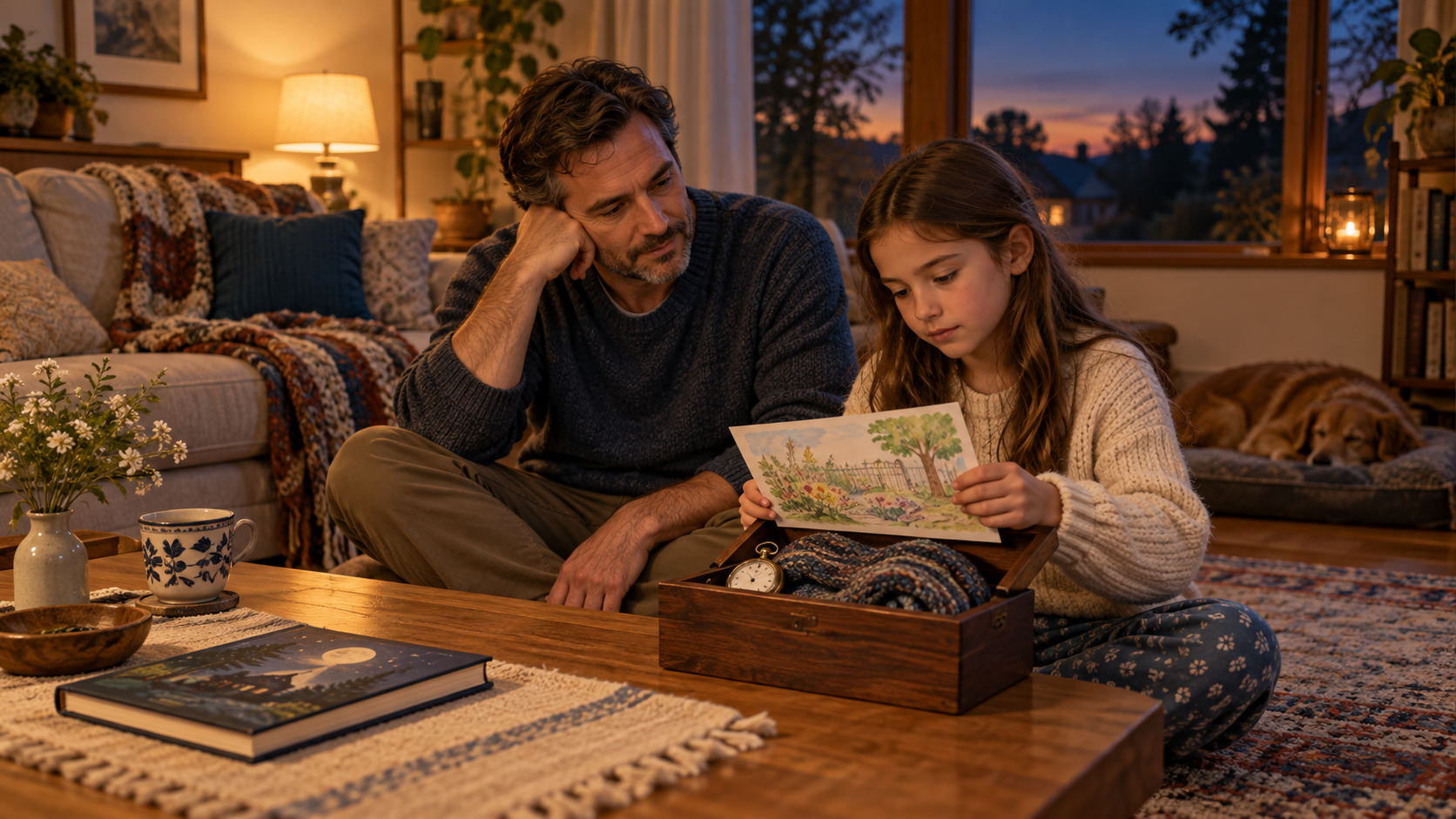
“a time to weep, and a time to laugh”
Ecclesiastes3:4, World English Bible, British Edition. This poetic pairing sets no timetable for grief.
What this article is about
A child asks who will read the bedtime story now. A teenager is angry because everybody speaks only well of the person who died. An eighteen-year-old daughter is dealing with documents after her mother's death and hears that she must now hold the family together. Different questions can follow the same loss. A beautiful explanation of death is not enough: people need truthful words, room for their own feelings, and someone who actually undertakes available care. This article addresses caring adults and young adults18+ looking for language for a conversation. It does not ask a child to repair the family, diagnose grief, or comfort everybody else.
The subject is a reliably established death outside war. Illness, sudden death, and unknown circumstances need different explanations; lack of contact alone does not establish that someone has died. The aim is modest: distinguish knowledge from guesses, information from consolation, and participation from obligation. There is no required emotional journey, exercise for acceptance, or promise of a quick return to ordinary life. Unsafe behaviour or talk about harming oneself or others calls for immediate appropriate help; immediate danger calls for local emergency assistance. Reading must never delay that help.
I. Establish the limits of what you know
Before speaking, an adult can ask which fact is confirmed and by whom, what is still being clarified, and what the child might already have heard. A relative's message, medical information, and a rumour in a chat do not become equally reliable because they are frightening. This article cannot establish death or teach a child to check for it in someone who may still need medical assistance. If a living person's condition causes concern, obtain appropriate help for that person rather than searching for words about death. When the report itself is uncertain, clarify it through an appropriate available source before presenting it as established.
A confirmed death can coexist with an unknown cause. “We know that Grandad died. I do not yet know everything about why” leaves a difficult space, but does not require defending an invented illness later. An unconfirmed accusation, medical guess, or alarming message should not become the sole account of what happened. A child needs to understand where knowledge stops. An adult may promise to share a verified update if one becomes available; they cannot promise to obtain every answer. Some details may remain unknown, while care must continue. Admitting this limit is different from making the child responsible for finding the missing information.
Also distinguish the child's need for an understandable explanation from a supposed duty to share every detail with every relative. If a teenager saw an alarming message, ask what they want clarified without requiring them to repeat its graphic content. If a younger child knows nothing, do not make them guess from your expression. Prepare a short opening and someone genuinely available to listen. A perfect room and complete composure are unnecessary; enough attention and actual safety matter more than staging. If speaking alone is too hard, arrange another appropriate adult's participation in reality rather than merely naming a future helper.
II. Say “died” with care
UNICEF recommends clear language rather than expressions that can confuse children. “Died” is more precise than “fell asleep” or “went away.” This concerns communicating an established fact, not adopting a harsh tone. You might begin: “I have very sad news. Grandma died.” Then pause and answer the nearest question. Our examples are wording to adapt, not a therapeutic script with a proven outcome. A well-chosen sentence cannot guarantee immediate trust or remove fear. UNICEF
A young child may need a simple explanation of permanence: the person who died will not come home, eat with us, or talk with us. Choose detail according to the question and available understanding rather than delivering all the biology at once. This does not teach children to establish death from breathing, stillness, or appearance. If an adult previously spoke of sleep, they can correct themselves: “I did not say that clearly. Ordinary sleep ends with waking up; I meant that he died.” The child is not at fault for understanding an expression literally. Correcting it does not require them to become calm or confirm that everything now makes sense.
Older children and teenagers need not hear a graphic account either. The ability to reason does not remove the right to stop. Ask whether a particular answer or someone's presence would be more useful now. Name a known illness where relevant; do not invent one. If you cannot continue, say so and arrange a return with support. Avoid disappearing after the news with an indefinite “we will talk later.” Offer a realistic nearby time, or explain who will remain available, and verify that arrangement. The aim is a truthful conversation with care around it, not a flawless speech that leaves the child alone afterwards.
III. Do not assess understanding from one reaction
A child hears the news and asks about sports practice. This does not establish indifference or wellbeing. It may be the only understandable part of tomorrow they can ask about. Another child repeatedly asks when the person will return. Rather than testing them with “I already told you,” repeat what is known in accessible words. Offer a chance to ask later without requiring a daily discussion. You may ask what the child understood, but to notice confusion rather than obtain an exact recitation. Silence also does not permit adults to decide that the matter has been settled forever.
Age helps with language, but it does not prescribe a uniform response. A child with different communication needs may ask in another way or need a different pace. Use familiar means of communication and seek help from someone who understands those needs. That is different from postponing all truth until an imagined state of complete readiness, or discussing death only over the child's head. A teenager may prefer writing to speaking before relatives. Such an option must consider device privacy and whether you can actually respond. Do not promise continuous availability you cannot provide; there should be an understandable real option for an urgent need.
Children in the same family may ask about a funeral, breakfast, or nothing at all. Do not turn this into a competition in maturity. Individual attention does not require contradictory secret accounts: the known facts can remain consistent while timing and detail differ. A new question months later does not necessarily expose an earlier failure. Age, circumstances, or the meaning of the loss may have changed. Adults may still lack answers, but children do not have to earn renewed attention through tears. The conversation can remain possible without being required to occupy the centre of family life at all times.
IV. Remove misplaced responsibility without inventing a cause
“I shouted at him, and then he died” joins events through guilt. Do not ridicule the thought or demand an inventory of bad behaviour. Respond to what was said: “Your angry thought did not control Grandad's illness.” Adjust that wording to actual knowledge rather than inventing a medical account. Removing a child's misplaced responsibility does not mean declaring that nobody could have any responsibility. A death may raise questions about treatment, safety, or other people's actions; appropriate adults and professionals address those questions. The child must not be expected to resolve them by producing the right emotion.
A child may remember missing a call, leaving a present unfinished, or wanting time alone. Acknowledge regret without making it causation: a missed conversation can be sad without making the child responsible for the death. There is no need to insist that the relationship was perfect and nobody was ever angry. That story may prevent honest speech about a complicated person. If the person caused harm, death does not require forgiveness, withdrawal of protection, or silence. A disclosure of abuse needs a safe adult response rather than a demand to complete a respectful period of mourning before being heard.
“I should have saved her” deserves attention to circumstances, not a rescue assignment imposed on the child afterwards. This article neither evaluates a particular incident nor reaches a legal verdict. Heavy guilt, interference with ordinary life, or concern about the child's condition can justify professional support without first winning an argument. Help is not a reward for agreeing with reassurance. An adult can say they want appropriate assistance in understanding what happened and will continue care now. A consultation cannot be promised to remove guilt, but you can check that the request was received and that the next step is genuinely understood.
V. Allow tears, play, and different memories
Tears do not measure love; laughter does not disprove it. A child may move into play and back into sadness without authorising adults to declare grief finished or trivial. A photograph of a crying child need not be posted in the family chat to prove that they care. Concerned relatives do not acquire ownership of the child's experience. Describe a practical need without making a public record: quiet, a familiar person, or permission not to answer visitors. Agreement to one conversation is not agreement to circulate its contents. Care can be coordinated without turning private feeling into evidence for an audience.
Different relationships allow different memories. One child remembers kindness, another fear, a third barely knew the person. A shared surname does not establish equal closeness. Do not ask an older child to manufacture an exclusively happy account for younger siblings. Adults can choose manageable, truthful language and keep complex details in an appropriate setting without denying the child's experience. A new feeling does not erase yesterday's: relief after a long illness may coexist with longing, anger with affection. This article neither diagnoses that mixture nor requires a child to experience every feeling mentioned. Their actual experience matters more than matching an example.
Ecclesiastes places weeping and laughter beside each other in a poetic sequence of times. For an adult reader, this can invite restraint in assigning one permitted visible feeling to the family. That is our limited comparison, not an explanation of a particular death. It does not justify saying that the time for tears has expired. Nor should joy be forbidden as disloyalty to memory. If an adult notices serious difficulty, respect for different feelings must not prevent help. Acceptance of varied reactions and attention to suffering are compatible. Children need not look sufficiently sad to be heard or sufficiently calm to take part in ordinary life.
VI. Describe belief without presenting it as established fact
A family may believe in resurrection, rebirth, connection through prayer, or no religious explanation. Indicate the basis: “We believe…,” “In our tradition…,” or “I do not know.” This distinguishes a known death from a conviction about what follows it. Do not promise the person's return home to bring temporary calm. If relatives hold different beliefs, the child need not choose the winner or support whichever adult is crying most. Acknowledge differences without staging a dispute before the child or punishing a question. Shared care does not depend on every family member reaching the same account of what happens after death.
In John11, Jesus weeps before Lazarus's tomb; the chapter concerns faith and resurrection. This is a specific Christian setting, not a general medical account. An adult may read it as a reminder that an important bond does not require tearless composure. It cannot justify promising the same outcome to a bereaved child, or explaining a person's failure to return as the family's insufficient faith. The image does not replace clear words about the actual death. If it is frightening or confusing for a child, it need not become the compulsory route to consolation. John11
Gibran's poetic discussion in “On Children” distinguishes love from possession of another person's thoughts. Here it helps an adult leave room for a child's separate beliefs and memories. It is neither contemporary parental law nor permission to withdraw care. You can explain and sustain a family tradition without purchasing agreement through access to food, closeness, or assistance. A spiritual adviser can participate if wanted and appropriate, but gains no authority to determine a diagnosis or prohibit medical contact. Declining a proposed consolation does not mean rejecting love for the person who died. The child's question can remain open without being made a test of belonging.
VII. A caregiver's death requires actual new care
Who will prepare food, collect the child, know about prescribed medicines, and stay in the evening? Such questions do not diminish the person who died. They describe life continuing without that person's participation. If adults say “we will all help,” clarify who agreed to which task and can actually perform it. Sending a message, receiving a promise, and handing over care are different events. A failed arrangement needs another available step, not an explanation that the child must suddenly become more independent today. Lacking an extended family is not a moral failure, but it makes appropriate accessible support important.
An older minor does not become a parent to siblings, translator of every document, and emotional person on call. A young adult18+ may also be invited to help without being treated as an unlimited resource. They can say what they can do and ask for assistance with what they do not know. An adult daughter might agree to bring documents to an appointment without promising to resolve debts, housing, and everybody's condition alone. This article does not allocate inheritance, custody, or legal powers. Those issues require competent local help; kinship and the loudest family voice do not establish authority over another person's property and information.
An ordinary routine may provide predictability, but need not be preserved at any cost. If the school journey or person at home changes, explain the available fact and acknowledge inconvenience. Do not promise an unchanged world. A child may ask a surviving parent, “Will you die too?” Immortality is not a truthful promise; an answer can concern today's care and a real arrangement for absence. That conversation need not catalogue every possible disaster. If fear is severe, seek support separately rather than making the child custodian of the family's emergency plan. Adult planning can protect without handing its entire burden to a young listener.
VIII. Offer participation in memory and ceremonies
A child might want to attend a ceremony, make a drawing, keep an object, or choose nothing yet. NHS guidance describes different ways to talk and remember; here these remain options, not a mandatory programme. Explain roughly what will happen, who will be nearby, and whether the child can leave. This article gives no general instruction to view a body, teaches no handling of remains, and selects no ritual. Actual conditions, local rules, and the child's needs require separate adult consideration. NHS
Agreeing to participate does not permanently remove the possibility of changing one's mind. If a teenager promised to read before guests but cannot, adults can take back the organisational task. The refusal should not become a public hearing about love. Offer another manageable form and accept that no choice may be made. A missing photograph or possession does not mean memory is damaged or that the family must urgently create a substitute. Nor does a purchased memorial object demonstrate greater respect. Differences in resources and customs should not become a moral ranking of relatives. A practical limit can be named without turning it into a judgement about attachment.
Discuss information for school around a specific need: who should know to support the child, and what the child is ready to say. This is not a universal confidentiality promise; applicable duties and rules must be checked locally. Individual support does not require an announcement before the class. The child need not represent the family story at every event. If they wish to speak, discuss what answer feels manageable and whom they can approach if questions become difficult. Adult support should remain available after the first wave of public attention fades. Returning to class is an event in life, not a certificate that bereavement has ended.
IX. The adult also needs someone nearby
A caregiver can grieve, cry, and have no idea how to get through tomorrow. Pretending to have no feelings is unnecessary, but stopping those feelings must not become the child's job. “I am crying because I am sad. Adults remain responsible for your care” can name both realities. Those adults must actually be available, or appropriate help must be requested. Words alone are insufficient when necessary care cannot continue. Someone may help with food, travel, or presence without first requiring a detailed account and thanks for every action. The parent's support matters for that person too, beyond its usefulness to the rest of the family.
In Letter63, Seneca discusses remembering a dead friend while also prescribing limits to tears and urging an early end to grief. Reading him honestly means recognising both a thought about memory and the limits of his advice. His severe ideal does not become a standard for childhood mourning; the letter's shaming and gender judgements are not accepted here. An ancient author cannot authorise calling prolonged sadness foolish or requiring a replacement for the person who died. Historical philosophy may be part of an adult conversation without becoming power over a child's experience. Seneca, Letter63
A practical request may be more precise than “support us”: someone at a particular time, help with one call, or company at an appointment. Handing over a task requires the other person's agreement and capacity. If the resource is missing, say so to the service you contact rather than treating difficulty as proof of weakness. Rest for a parent still requires actual ongoing care; the child must not silently replace everybody. Organisation cannot promise to make loss bearable, but a workable agreement can reduce one uncertainty, and you can check whether it happened. Tomorrow's step may need a new conversation rather than automatic reliance on today's arrangement.
X. Help need not wait for any deadline
Grief alone does not establish a disorder, while calling it natural does not cancel serious suffering. One drawing, a silence, or play cannot establish a diagnosis. NIMH identifies lasting changes, substantial distress, and interference with everyday life as reasons to seek assessment; they are not three conditions to collect simultaneously. An adult who is concerned can describe observations and the child's words to a doctor or appropriate child professional. Unsafe behaviour or talk of harm to oneself or others requires immediate suitable help; immediate danger requires local emergency assistance. NIMH
“I want to die and be with Mum” cannot be left as merely a poetic expression of love. Do not first debate seriousness, wait for an anniversary, or complete an exercise. Urgency concerns the help needed rather than the quality of a family explanation. This article offers no home risk scale, self-harm methods, or treatment. Physical pain and acute illness must not automatically be attributed to sadness either: medical assessment may be needed, with urgent help for a serious acute condition. This is not an exhaustive list of emergency signs. Adults do not have to determine a diagnosis before asking for appropriate advice.
For a non-urgent contact, check age eligibility, language, cost, waiting time, consent, and information sharing. A referral is not a booking, and a booking is not received support. Ask where to turn if things worsen during a long wait, while continuing actual care. Explain that speaking is difficult for the child rather than forcing a polished account beforehand. If the first contact did not help, clarify the next available route. An unhelpful visit does not prove that someone refuses to move forward. Support cannot promise a former state by a particular date, but should leave a clear next action and adults who understand their responsibilities.
XI. Closeness without a report of acceptance
An invitation can be small: “Would you like to ask about what happened, remember him, or have time without talking?” This is not a compulsory choice among three buttons. The child may suggest something else or not answer. If they agree to read together, stop where a question arises rather than completing the article as a procedure. If they decline, necessary care continues. A useful conversation need not end with gratitude, relief, or agreement with family belief. Its possible result is a more accurately heard need and one completed action, not established healing. The listener does not have to produce evidence that your effort worked.
Memory can change as a person grows. A teenager hears a new story, a young adult understands an old conflict differently, a younger child starts asking what they could not previously express. The earlier bond does not become false. Someone can keep what was good and acknowledge harm, miss the person and build other relationships. Nobody must remain the family's most visibly bereaved member forever to prove love. Living people are not replacements, and new interests need not erase the dead from life. Nor does this article prescribe a daily memorial action. Remembering can have room to develop without being either a permanent duty or something adults command a child to finish.
Adults need not know how to answer every question about death. Responsibility is not omniscience: it can mean an honest limit, available presence, and help when personal resources are insufficient. The right conversation cannot restore the person who died; it can avoid leaving a child with false hope and other people's duties. Naming an established fact, hearing one question, and arranging actual care is a concrete result today. It does not cancel loss or prove that every following day will become easier. Tomorrow you may return to the conversation, revise an arrangement, and request help again without declaring today's care a failure.
What this means in practice
If danger is immediate, seek local emergency help first. Unsafe behaviour or talk of harm to oneself or others calls for immediate appropriate help without waiting for reading, a period of grief, or agreement with consolation. For an ordinary conversation choose one step: distinguish established information from uncertainty, prepare a short explanation, or check who can actually be with the child today. There is no need to complete every suggestion or produce a written report.
Begin with an honest sentence of your own, then ask which question matters to the child. Offer shared reading rather than assign it; stopping and changing one's mind are allowed. Present beliefs as beliefs. A ceremony, memory object, and professional conversation perform different roles and do not automatically replace each other. Severe distress, interference with life, concern about the child's condition, or inadequate support can justify assessment and assistance. Check local access, consent, and confidentiality. A verifiable next result is an actual care arrangement or a received request for contact, not a promise of completed mourning.
Key quotation
“Jesus wept.” — the complete verse John11:35, World English Bible, British Edition. Within the Christian account of Lazarus, tears coexist with faith. Here it offers a limited reminder to an adult that presence can include sadness; it does not demand tears, provide medical evidence, or promise the return of someone who died.
Connections between traditions
| Both specific positions | Overlap and actual disagreement | Meaning here and limits |
|---|---|---|
| In John11:33–36, Jesus weeps beside those close to Lazarus, within a Christian narrative that later includes resurrection. In Letter63, discussing a friend's death, Seneca allows tears but calls for restraint, turns towards memory, and at points presses for grief to end quickly. | Both readings allow a valued connection to coexist with loss. Yet a narrative of tears is no rule of restraint: Stoic instruction and the Gospel scene do not give one answer about how someone should grieve. The difference matters rather than treating two quotations as agreement. | An adult here may cry honestly while seeking their own support, without appointing a child their comforter. We do not transfer demands for a quick ending, shame, gender prescriptions, or replacing the deceased into care for a child. Tears become neither a compulsory response nor a clinical indicator; Lazarus's resurrection promises no family outcome. These texts establish no assistance method's efficacy and require no faith in exchange for care. |
| Ecclesiastes3:4 places a time to weep alongside a time to laugh within a poetic sequence of activities. UNICEF's selected bereavement guidance describes varied child responses and no compulsory order of stages. | Their bounded overlap is refusing to infer an entire inner life from one visible feeling. A child may cry, play, or ask ordinary questions at different moments; laughter need not diminish a bond. The poetic pair does not explain a reaction's cause, while contemporary guidance does not prove the ancient text's account of the world. | In contrast to demanding a quick end to sorrow, we set no family deadline, identical stages, or obligatory display of mourning. Poetry is no calendar; UNICEF offers general guidance rather than an individual child's assessment or a guarantee of wellbeing. Continuing support needs depend on circumstances; harm-talk or unsafe behaviour must not await its supposed season. |
These connections retain distinctions between genre, faith, philosophical prescription, and contemporary help. A child's own thoughts can differ from a family account without losing care. Neither accepting nor declining an image establishes local rights, a diagnosis, or a duty to forgive a deceased person who caused harm.
Primary sources
- UNICEF, How to talk to your children about the death of a loved one. Full main text read24October2026; no revision date shown. Clear language and different responses; a particular cause-of-death example, trust guarantee, and age generalisations are not universalised.
- NHS, Children and bereavement. Full main text read; reviewed9January2023, review due9January2026 now past. Separately dated2025 video not watched. Memory options and adult support; UK contacts not exported.
- NIMH, Children and Mental Health. Main text read earlier in this same task; revised2024. Grounds for help, without home diagnosis or US numbers.
- Ecclesiastes3, WEB British Edition. Full chapter and public-domain notice read. The English translation is used, not the Hebrew original.
- John11, same edition. Context11:1–52 actually read, especially11:17–44; no claim to have read the chapter's ending. A religious narrative, not clinical evidence.
- Kahlil Gibran, The Prophet, On Children. Complete selected section read; English original1923, Knopf, Gutenberg58585. Not the whole book; rights outside the US not separately established.
- Seneca, Moral Letters63. Full letter read; Richard M.Gummere translation, collection title information1918/1925 checked. Critical comparison rather than acceptance of all prescriptions.
Tags
childhood grief, death of someone close, talking about death, caring adults, young adults, clear language, known and unknown, age differences, repeated questions, child guilt, mixed feelings, play, memory, voluntary participation, ceremonies, family belief, cultural differences, child privacy, actual care, parent support, responsibility boundaries, school, professional help, urgent help, Ecclesiastes, John, Gibran, Seneca, compassion, United Wisdom
About the authors
Andrey Zarinsh is the author and founder of United Wisdom. He explores inner transformation, the unity of traditions, intercultural dialogue, and contemporary spiritual discipline. Instagram: @andrey.zarinsh.
Maria Evilkut is a co-author of United Wisdom. Alongside her research, she seeks to test these ideas in practice and observe how principles of unity and mutual understanding work in real life between people and cultures. Instagram: @ilkutki.