
Growing up
When the future feels uncertain: hope without a promise of success
Sixteen-year-old Dasha is asked for a preliminary school-project choice. In our invented school, the answer is due next week. She hears something larger: her whole future must be decided now, or no good path will remain. Her father wants to reassure her that everything will work…
Epigraph
“Which road is right?”
John Dewey, How We Think, ChapterI§3, complete question. The example read concerns choosing a road and examining grounds, rather than predicting an entire life.
What this article is about
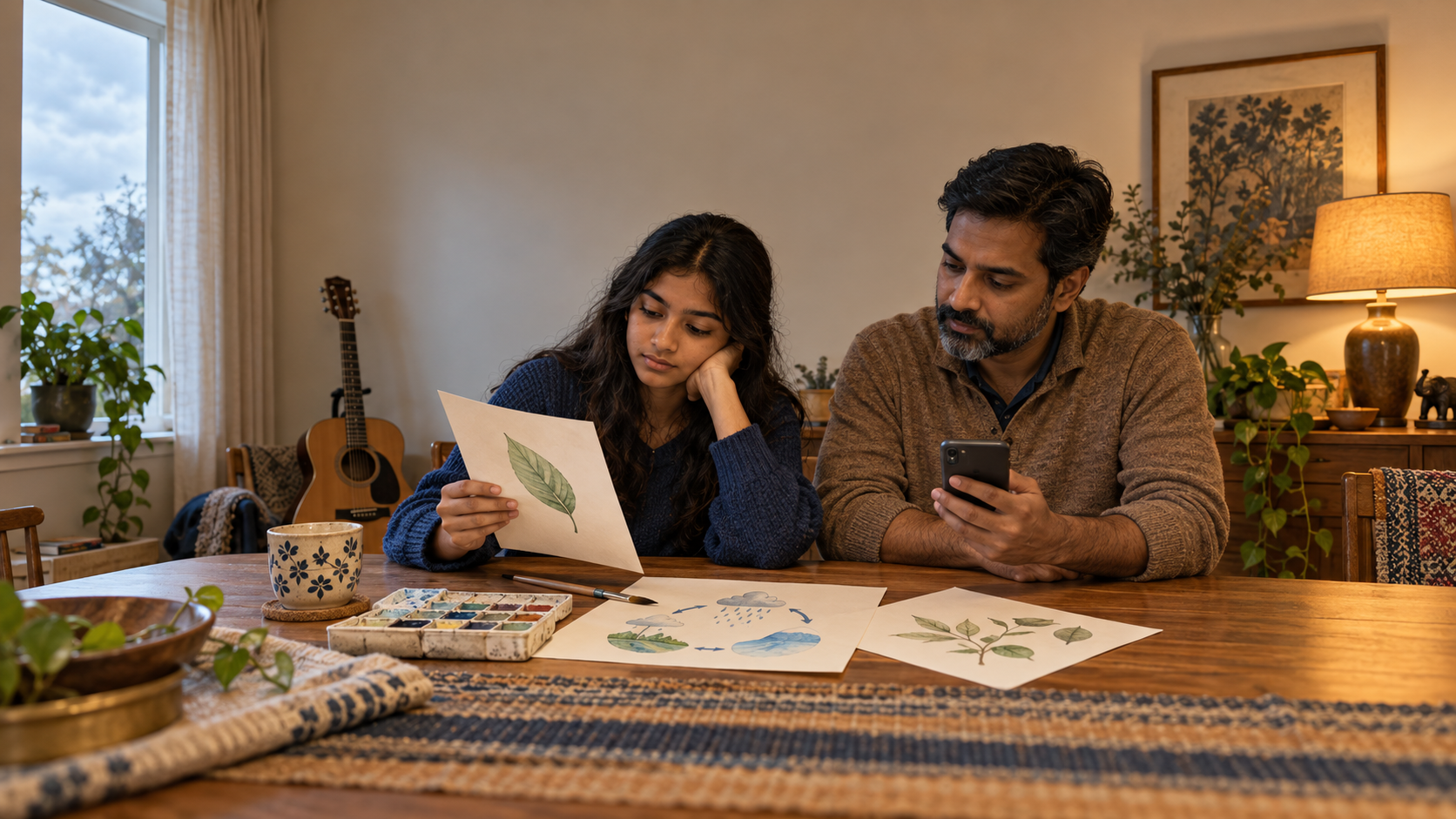
Sixteen-year-old Dasha is asked for a preliminary school-project choice. In our invented school, the answer is due next week. She hears something larger: her whole future must be decided now, or no good path will remain. Her father wants to reassure her that everything will work out. But he knows neither her future work nor every condition of the coming years. Between a definitive prediction and withdrawing help is another response: acknowledge the unknown, clarify today's choice and name available support.
This article addresses parents, other caring adults and young adults aged eighteen and over. A child's perspective supports discussing uncertainty together. We distinguish hope, desire, prediction, plan and promise. There is no guaranteed success, compulsory optimism or requirement to settle one vocation forever. The aim is room for a meaningful future alongside honest uncertainty and present care. A child need not rescue the world, secure family stability or earn help through the right attitude. Ordinary enjoyment need not await final clarity.
I. Today's choice need not choose an entire life
A father's first question may concern the assignment rather than a profession: what does the school ask to be chosen, for how long, and what does a preliminary answer mean? These are invented conditions, not current rules of an institution. Actual conditions require clarification from an appropriate adult under current requirements. A project may concern one learning stage. A decision may also have real consequences no reassurance can cancel. Until information arrives, promise neither total reversibility nor irreversible destiny. Either confident story may conceal the actual object.
Dasha may want an interesting project while fearing a wrong choice. These positions can coexist. Anxiety need not disappear before her perspective matters. An adult can invite her to name what attracts her in one option, what is unclear in another and what help makes the assignment understandable. A complete map of abilities is unnecessary. Enjoying invented explanations is already a preference rather than an insufficiently serious answer. It guarantees no profession and needs no such guarantee to matter today.
An actual opportunity's deadline and a general calendar of a proper biography have different grounds. Responsibility matters too. Dasha need not check every school, travel and budget condition herself. Her father can undertake clarification while she participates accessibly if wanted. A deadline can close one opportunity without establishing that an entire future has failed. Conversely, “it's never too late” opens no closed registration. Each conclusion requires its own object and ground rather than a date being made to explain everything at once.
Clarification sometimes brings an unwelcome answer. An option is unavailable, help limited, a deadline genuinely near. No better outcome should be promised to decorate the loss. Acknowledge fewer choices than wanted and consider remaining possibilities without demanding enjoyment. Dasha can regret what was lost. Her father need not prove every limit benefits character. One closed condition need not become a verdict on a person. The next step may be a question, changed format or temporary decision with honestly named uncertainty.
II. Hope, prediction and promise do different work
A wish concerns something wanted: interesting work, close people, a chance to learn. A prediction concerns what may occur on available grounds. A plan describes chosen actions under conditions. A promise adds responsibility for a particular commitment. Here hope is considered as room for a wanted possibility not yet known as an outcome. This is a working ethical distinction rather than a psychological scale or the only permissible definition. These words clarify which answer an adult is offering and what it cannot honestly supply.
Her father can want good opportunities for Dasha without knowing the profession to choose or how her life unfolds. He can plan to clarify a requirement and promise his available step. That support should not become a guarantee of admission, earnings or happiness. Even a reasonable plan depends on circumstances and others' actions. Lack of a guarantee does not make planning meaningless. It limits the conclusion: we know what we intend to check and who takes responsibility; we do not own the whole result.
Poetic hope is no prediction either. In the complete Hope read here, Dickinson uses a bird heard amid a storm. It is a speaker's image rather than proof that everyone always has an inner support. It can offer conversational language or be unsuitable now. A child need not recognise themselves, remain resilient without help or consider requests for necessities an unnecessary burden. A metaphor cancels neither food, safe space nor support. Someone else's beautiful account establishes no correct emotional norm for Dasha.
This distinction matters when an adult struggles with an uncertain answer. Replace “everything will be fine” with something precise: “I can't promise that result; I can clarify the condition and help with an available part.” No wording fits every conversation. The help must be real rather than another way to end an uncomfortable subject. Sometimes the adult does not yet know a route either. They can acknowledge this and undertake appropriate information-seeking. Honest uncertainty removes no duty of care and makes no child solely responsible for an unknown future.
III. Care need not await a favourable prediction
Dasha may need to hear that help does not depend on a choice making her father proud. This promises no fulfilment of every wish. Families have actual resources, obligations and limits. But necessary care is not purchased through future success, and support creates no debt to succeed. Discuss resources for this project rather than whether a whole person will pay off. The distinction leaves room for demanding work and respecting its maker. An assignment mistake removes neither being heard nor needed protection.
An adult can name a narrow part: ask about a requirement, check materials, explain known information, return at an agreed time. If delayed, explain what happened and what remains unknown. This differs from quietly passing everything to a daughter after an attractive conversation. Dasha can remind or ask without persistence having to purchase each answer. Silence does not establish absent need. Where the need is unknown, an understandable way to communicate can be offered without a compulsory emotional report.
The NSPCC guidance read here proposes listening, age-appropriate explanation, acknowledging unknowns and returning to difficult questions. These are practical references rather than guarantees of calm or agreement. Convention Articles12 and19 give normative references for children's voice and protection. They verify no particular school professional or local service. Connect promises to action an adult can actually undertake rather than promising other people's help because it appears in a general description. A significant unknown retains its name and needs appropriate checking.
A caring adult can fear the future too. They can seek support and discuss practical tasks with appropriate adults. Dasha need not become the only comforter, recipient of every financial anxiety or guarantor of a successful family story. Acknowledge concern to the necessary extent without making it her duty. “I don't know either” means something different alongside an adult step rather than a demand for an immediate rescue plan. Togetherness does not equalise adult and dependent-child power, resources or responsibility.
IV. A small step answers a small question
Suppose clarification makes one sample assignment available. Dasha wants to know whether explaining a topic through pictures interests her. A modest trial can be offered where wanted and accessible. It need not prove she found a profession or that the whole future remains possible. Its question is narrower: is the format understandable, is the work interesting, where is help needed? Mixed answers are possible. Drawing interests her, gathering material is difficult, continuing today is unwanted. These concern a particular experience rather than an ultimate ability to live in uncertainty.
In How We Think ChapterI, Dewey examines choosing a road: uncertainty directs attention towards grounds. We apply this philosophical and educational reasoning within limits. A nearby question can support today's decision without revealing the entire future or replacing appropriate help. The modern school project is our scene rather than Dewey's. Dasha is not assigned to investigate every frightening thought or establish that fear is unfounded. Actual harm requires a different scale and must not await mastery of a correct reasoning technique.
A trial can require means, time and other people's work. Name actual resources before promising free courses or equipment without grounds. Sometimes only oral discussion is possible; sometimes even suitable time is absent. Inability to act now establishes neither absent hope nor absent interest. An adult can honestly name a limit and their next search without making a child obtain resources. Small scale is useful for clarity, rather than being assumed cost-free and suitable for everyone regardless of life conditions.
Afterwards continue, postpone, change an option or leave a question open. These decisions differ and need consideration in context. Stopping is not automatically defeat, nor continuing proof of courage. Dasha may discover interest in another part; her father may have misunderstood a condition. Revision requires neither condemning a previous attempt nor inventing hidden benefit. A clearer current decision and remaining unknown can suffice. One action need not redeem time, reassure a whole family and establish a favourable forecast together.
V. The unknown can coexist with an actual loss
Consider another invented situation. Eleven-year-old Kirill hears the family may move, with timing and conditions unclear. His concern is friends, a familiar courtyard and school rather than an abstract career. An adult may know some arrangements without a final answer. Separate information rather than promising a better place. Kirill can miss present life in advance. Sadness establishes neither rejection of family, inadequate flexibility nor obstruction of adults' proper hope about possible change.
A child may ask whether contact with a friend remains possible. There is no ground to guarantee unchanged closeness or constant communication where conditions are unknown. Check a real possibility considering both families and actual resources. This need not become entirely Kirill's task. Even an available option does not restore the old courtyard or remove lost proximity. Help can be partial. A partial answer should not require sadness to end: contact may be possible while the change still matters.
Hope need not refute loss. A good thing may be wanted in a new place without knowing when or in what form. A child may decline discussing a new life while still needing care arranged. A beautiful attitude towards moving is no condition of help with school, travel and ordinary routines. An adult can explain significant information accessibly without disclosing every financial and administrative concern. Honesty differs from passing all unknowns to the person least able to govern the situation.
Dasha may face a genuinely closed opportunity too, rather than merely a mistaken thought. An unsuccessful result, unavailable option and changed conditions can limit a path. Every door cannot be promised to reopen. But a closed condition concerns a particular possibility, rather than all human worth. Acknowledge where no suitable continuation has been found. Hope does not become a compulsory smile; it leaves room for a meaningful future without reporting that loss became a gift. Care remains before a beautiful next step is found.
VI. Real danger requires action rather than optimism
If particular people frighten Kirill or necessary care is missing at home, the answer exceeds thinking positively. Consider what matters and undertake available protection first. A poetic bird, small plan or good question supplies no safe place. A child need not prove hope convincingly, assemble perfect evidence or remove danger independently before receiving attention. A caring adult seeks suitable help for the situation. This article verifies no working local service and permits no declaration that a real threat disappeared after one conversation.
Other significant difficulties can exceed an ordinary project choice. If worries substantially interfere with daily life, they require appropriate attention rather than a verdict on attitudes to uncertainty. This article establishes no cause, diagnosis or treatment, and its scenes cannot determine a particular child's condition. Hear what became difficult and seek appropriate support, retaining necessary information and confidentiality limits. Promise neither absolute secrecy nor immediate results. Asking for help does not establish inadequate self-belief.
Rejecting false reassurance requires no brutal catalogue of every possible disaster. Honesty need not become frightening forecasts poured out by an adult. Explain what matters to today's decision, separating fact, assumption and what still needs checking. Dasha can decline another general prediction while retaining an actual school question. Kirill can ask about travel without attending every adult moving discussion. A voice does not appoint a child as a constant listener to an uncertain world. Adults still choose a manageable scope for conversation.
Where resources are limited, name that without promising a universal solution. Small help can matter without being presented as a complete answer. A child need not find enjoyment despite absent basic support to ease an adult's feelings. An adult can seek task-sharing and help where actually possible. Unknown availability becomes no verified service through an attractive name. The exercise has an honest boundary: distinguishing questions replaces neither arrangements, risk checking nor necessary action on an appropriate scale.
VII. Life today is more than preparation
After talking, Dasha may want music, a funny drawing or play with a younger child. This need not avoid responsibility. Retain a particular deadline alongside time without future-usefulness accounting. This article does not promise rest will restore calm or correct a choice. Ordinary enjoyment can have room itself. Every game need not train flexibility, every friendship supply a career resource or every interest reveal destiny. Added assignments can conceal the content of life already present.
Convention Articles29 and31 retain normative room for developing abilities, rest and play. They do not require every talent to become a profession or make tomorrow's usefulness the only justification for today's enjoyment. They supply no missing time or material automatically either. An adult can seek a modest accessible format: a brief shared activity, familiar story or quiet pause. Absent opportunities establish no failure of attitude. Dasha need not construct a perfect life balance as another task to complete before interest in her future is permitted.
Enjoyment need not be constant. One pleasant episode does not establish every difficulty is over; a hard evening cancels no good thing altogether. Several facts can coexist without one general mood. Kirill enjoys talking with a friend and regrets a possible move. Dasha likes drawing and does not know which project to choose. These combinations are not a logical error requiring correction: they concern different objects. Notice pleasure without declaring a child cured of uncertainty or demanding gratitude for an available good moment.
A poem can be an option rather than a remedy. The bird image may offer words for someone's experience; someone else prefers an ordinary question or silence now. Appreciation of a text need not grade maturity. Hope here has no single correct outward sign. A child can discuss a wanted future, doubt, seek help or leave it undiscussed for now. Life exceeds a conversation about choosing. An adult needs no inspirational image for every state to retain honest care and appropriate action.
VIII. An open future needs no endless planning
Suppose her father clarified the condition, Dasha examined an example and no final wish emerged. A bounded decision under known requirements, another question or acknowledgment of unappealing options may follow. Discussion need not continue until every doubt disappears. Repetition supplies no complete guarantee. Agree who undertakes necessities and when returning makes sense. This is no compulsory family reflection calendar, but an example of a clear enough stopping point after which the rest of life remains.
Conditions may change later. New information arrives, help changes, another part interests Dasha. Revision need not establish that she was previously wrong about everything. Examine actual consequences and retained promises. An opportunity may stay closed or participation change form. Hope requires no assertion of endlessly available paths and forbids no actual limit. A limit needs its own ground rather than a general verdict that a person missed the single correct life.
Someone else's confident account makes no future known either. A classmate can name a profession while Dasha hesitates; this establishes no better life. Learn a preparation method without taking an entire biography as a deadline. No counterexample where uncertainty inevitably wins is required: that would promise results again. Compare a particular object: a skill wanted, an experience actually known, what cannot yet transfer. Dasha need not defeat another person's confidence to deserve support.
A young adult aged eighteen or over may personally undertake some checking, expenses and promises. Guaranteed luck is still unnecessary for considering an accessible action. Interest, cost and revision can remain. This does not automatically transfer to a dependent child. Identical words about freedom and responsibility supply no identical resources. Consider who decides, who obtains information and who provides necessary care. A child does not become adult because the future sounds serious and passing the whole question on would be convenient.
Hope without promised success can be quiet. We do not know the whole road but can distinguish knowns, wishes and responsibilities now. Leave room for meaningful continuation not yet found without presenting it as fact. Acknowledge loss without ordering immediate growth beyond it. Help without bargaining for future gratitude. This guarantees no outcome for Dasha or Kirill. It arranges today's discussion more honestly: uncertainty does not make care meaningless, and a child need not turn an entire future into proof of today's adult words.
What this means in practice
An adult can offer one ordinary question about a nearby choice at a suitable time. Name what needs deciding and what is unknown. Separate wishes, grounded forecasts and help actually undertaken. Promise no institution's or other person's result. Writing is optional; private notes need not prove trust. Name who clarifies an unknown condition. Having no ready answer gives no permission to leave everything to a dependent participant.
Where a small trial is accessible and wanted, choose one question rather than proving an entire future. Retain missing resources in the conclusion. For shared reading, an adult can offer a teenager an invented example: “I want interesting work, but this school project cannot promise it. I can understand the task now; an adult will clarify the condition.” Discuss wish, forecast and plan, suggest a question or decline. The adult neither grades hope nor requires enthusiasm.
Afterwards name what is clearer, what remains open and who undertakes the next necessary step. Stop without a perfect answer and continue ordinary life. Actual threats, missing necessary care or significant difficulties require protection and appropriate help beyond this practice. Hope, fear, music and poems must not replace them. A sufficient outcome is more honestly named uncertainty beside real support, rather than promised calm, success or a final life choice.
Key quotation
“Yet, never, in extremity, It asked a crumb of me.”
Emily Dickinson, Hope, SeriesTwo, I.Life, VI, final complete independent clause. Todd/Higginson historical edited version; line break replaced by a space. “It” is hope as a bird, described by the speaker. This does not require a child to go without food, care or requests for help. Text read.
Connections between traditions
In the complete selected Hope, Dickinson's bird persists amid a storm without scheduling a future result. DeweyI§3, within the readI§§1–4, turns uncertainty at a crossroads towards grounds for choosing. Their limited connection is that a wanted possibility is not knowledge, while a nearby question needs no entire life known beforehand. Our contemporary application leaves room for hope while naming a checkable question and adult help for a current decision.
The grounds differ. Poetry offers an image of experience; philosophical pedagogy considers inquiry. They do not provide two confirmations of one psychological theory of hope or promise that a plan removes fear. A bird cancels no actual resources; investigation is not assigned to a child instead of protection. Dasha and Kirill are invented contemporary scenes rather than source episodes. The metaphor or trial can be declined while necessary care remains. Historical illustrations and hierarchies are not adopted as current developmental norms.
Convention12/19/29/31 retains normative roles for voice, protection, development and rest; NSPCC offers practical, understandable, honest conversation guidance. Their connection is an adult distinguishing knowns and unknowns without replacing help with guaranteed success or an order to hope. A norm verifies no local service, guidance proves no effect of our practice, and poetry is no treatment. Distinct grounds form no compulsory optimism method.
Primary texts and sources
- John Dewey. How We Think,1910, ChapterI§§1–4. Full selected reading for GROW153 in this continuous task reused; no second full reading claimed. Epigraph: completeI§3question. Neither career prediction, clinical method nor equal child/adult responsibility.
- Emily Dickinson. Poems, SeriesTwo, Hope, I.Life, VI, Project Gutenberg2679, editors Mabel Loomis Todd and Thomas Wentworth Higginson. Title, author, editors and all12lines/three stanzas read. Historical edited version, not manuscript or Franklin1999; the ebook update on 5 April 2020 is no composition date. Key: complete last clause167–168. Not the whole collection; universal rights not established.
- Convention on the Rights of the Child, UNICEF. Complete12/19/29/31 previously read in this task, exact reading reused. International normative references, rather than a ready local support procedure or promised career.
- NSPCC Learning. How to have difficult conversations with children, updated 27 August 2024. Full main material and page information read for GROW153; exact reading reused. Practical guidance, rather than diagnosis, treatment or an outcome study of this article.
Tags
future, uncertainty, hope, growing up, child, teenager, parents, care, desire, prediction, plan, promise, choice, project, deadline, interest, support, resources, loss, moving home, friendship, protection, rest, play, ordinary enjoyment, revision, responsibility, Dickinson, Dewey, child rights, United Wisdom
About the authors
Andrey Zarinsh is the author and founder of United Wisdom. He explores inner transformation, the unity of traditions, intercultural dialogue and contemporary spiritual discipline. Instagram: @andrey.zarinsh.
Maria Evilkut is a co-author of United Wisdom. Alongside her research, she seeks to test these ideas in practice and observe how principles of unity and mutual understanding work in real life between people and cultures. Instagram: @ilkutki.