
Growing up
A parent's expectations and a child's own interests
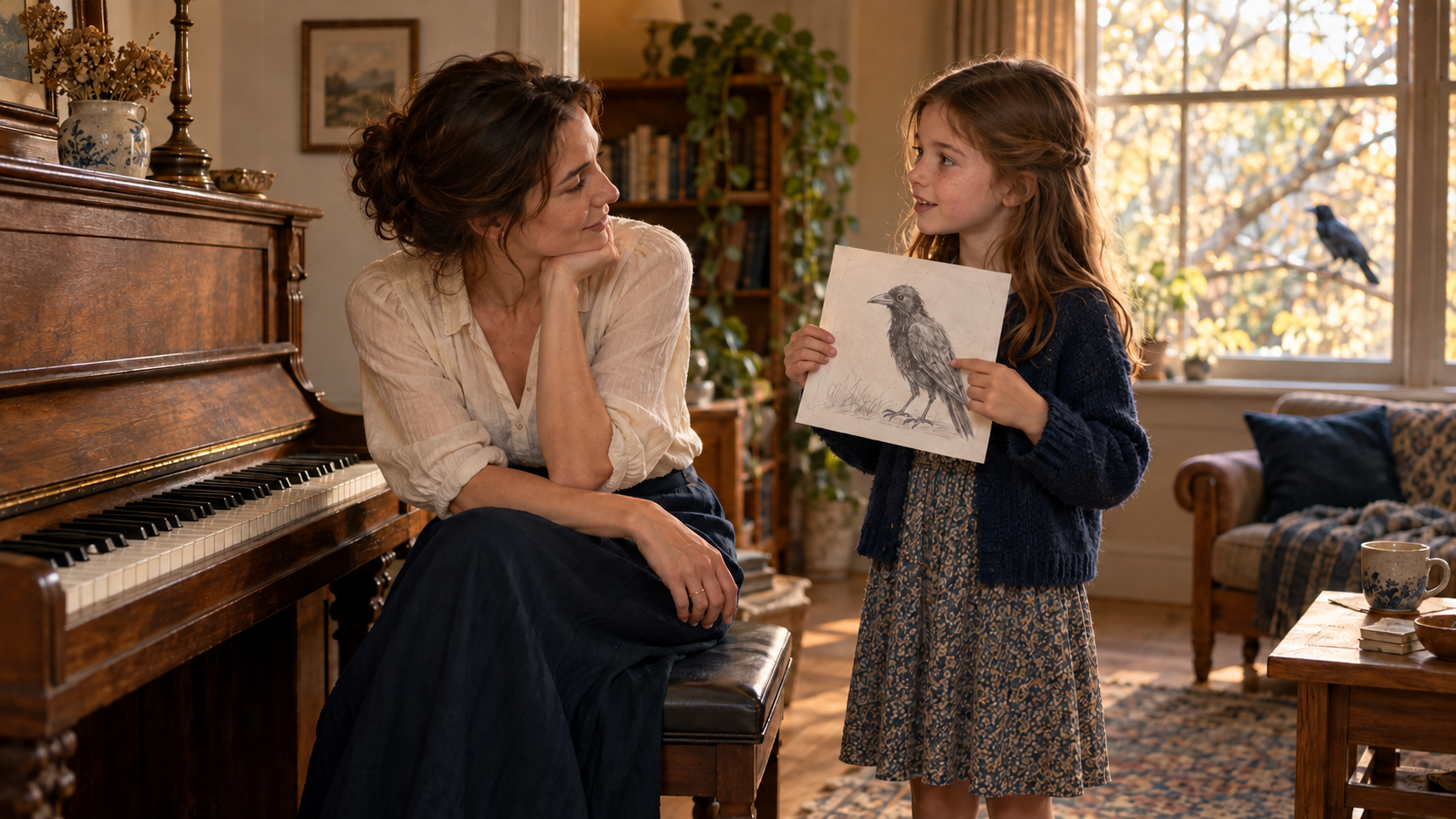
Imagine a fictional scene. Nine-year-old Mira comes home from a piano lesson and places a small drawing of a bird beside her sheet music. Her mother asks how many times she played the difficult passage. Mira describes a crow pulling a thread out of a fence. Her mother asks about…
Epigraph
Children are born persons.
Charlotte M. Mason. Home Education, fifth edition, 1906, Preface, principle 1. A historical educational position, rather than a current diagnostic criterion; the Russian version is our translation.
What this article is about
Imagine a fictional scene. Nine-year-old Mira comes home from a piano lesson and places a small drawing of a bird beside her sheet music. Her mother asks how many times she played the difficult passage. Mira describes a crow pulling a thread out of a fence. Her mother asks about the piece again. She did not intend to hurt her daughter: music once opened a whole world for her, and she wants to give her child the same opportunity. Yet two different subjects have met in today's conversation: an adult's plan and whatever actually caught the child's attention. One of them has become almost inaudible.
A parent's expectation may contain love, experience, concern about the future and quite real family constraints. It does not become wrong merely because an adult formed it. However, hoping to see a particular future does not yet tell us what interests the child now. This article distinguishes an invitation to new experience, necessary adult responsibility and a demand to confirm an image chosen in advance. Its subject is a child who needs age-appropriate support and safe conditions, rather than someone who should receive all an adult's freedom and responsibility. An interest does not promise a future career; parental care need not demand that promise.
I. The future enters the conversation before the child does
Sometimes an adult already knows what it would be good for the child to become. Perhaps they notice an ability; perhaps they recall an opportunity they themselves missed. Those grounds deserve separate consideration. Music lessons can introduce an art, prepare for a particular school or continue a family history. The schedule may look identical while the adult's purpose differs. If Mira's mother wants to offer an experience, trying it can remain an experiment. If she needs confirmation of her own story, deciding against continuing may feel like rejection of the mother herself. That is a possible development of our fictional scene, rather than an established hidden motive.
It helps to notice where a large conclusion about the future appears. One successful drawing does not establish an artistic vocation. One awkward lesson does not prove a lack of ability. A child may enjoy an activity that never becomes a profession and learn necessary things without feeling particularly enthusiastic. Much remains unknown between today's attention and a whole life story. An adult may think about later education while keeping a prediction as a prediction. This leaves room for new information that need not immediately answer the question of the child's entire future.
In our scene, a modest starting point is available: Mira drew a bird and wanted to talk about it. That is all we know so far. We need not declare music alien to her and nature her true calling. Nor must we immediately find a course, competition or teacher for a new enthusiasm. Sometimes the first step is to hear the story before proposing another route. The adult remains nearby, can organise time and may return to lessons later. But the conversation ceases to be a test of how far the child has moved today towards an image selected before she could answer.
II. Interest appears in action, but cannot be read without error
Questions, returning to a subject and trying to discover or make something independently may tell us about a child's attention. Mira notices birds on the way home, examines pictures and asks where they sleep. These events offer a way to get to know her interest. Yet a few signs do not give an adult precise access to an inner life. The child may have wanted company, copied a friend's activity or simply enjoyed an evening. Several reasons may coexist. Observation is better begun with an event and an accessible question than with a ready-made account of character that will later explain every new action.
It is especially easy to mistake confident performance and the approval it receives for interest. Skill matters, but ability and a wish to continue are different. Someone can perform well without wanting to compete, or draw poorly for now while enjoying the search for a shape. This is no invitation to ignore learning or difficulty. It asks what we are assessing: an acquired skill, a mark, pleasure in the process or a wish to discover more. Calling everything talent can conceal the fact that the child wanted only to try something and has acquired a new duty to keep proving exceptional ability.
There is an opposite difficulty too: silence need not mean no interest. Some children find it easier to show an object than explain its significance to an adult. Mira may bring a drawing without answering a long series of questions. We can invite her to talk or simply look together, without turning the occasion into an examination of sincerity. The adult need not obtain a confession of a true desire at any cost. The conditions for conversation, age, tiredness and familiar ways of communicating also matter. While no answer is available, uncertainty can remain uncertainty. It should not automatically be filled by either parental hope or an opposite assumption of concealed protest.
III. An invitation opens experience; an assignment narrows the answer
A child need not already know everything they might enjoy. An adult's suggestion therefore has value of its own. Mira's mother can introduce music, show her a museum, suggest a walk or help find a book. If the child has never encountered a subject, not asking for it does not yet mean rejecting it. The distinction emerges later: can the experience lead to different responses? An invitation allows curiosity, limited participation and no wish to continue. An assignment demands one outcome: the child must love the proposed activity because the adult has already judged this route right and invested in it.
An experiment is not always free of conditions. There are timetables, costs, group rules and other people's work. The adult can explain a reasonable introductory period and what has already been agreed. That need not be coercion. However, conditions are better explained before enrolling, as far as the child's age allows, rather than discovered after the first request to stop. A nine-year-old need not understand contracts or manage a family budget alone. An accessible explanation is enough: this format is available to try now, and later we will discuss what comes next. The adult remains responsible for resources; the child contributes a voice and experience.
Nor should we promise that a real interest always survives initial difficulties. Experiences vary. Tiredness, an unsuitable way of teaching, a group conflict, the difficulty of a skill and a change of desire are different possible subjects of conversation. If Mira does not want to attend a lesson, we can ask about a particular event without treating every refusal as laziness or making every refusal proof that lessons are harmful. Sometimes a format needs changing, sometimes participation needs to end, and sometimes ordinary difficulty needs support. A general article cannot decide for a family. It proposes considering the situation without requiring confirmation of a route approved in advance.
Where a teacher is involved, they may have an observation of their own: Mira manages the exercises but participates less after a particular point. That is additional information, rather than a final answer about her wishes. Adults can discuss the lesson's organisation without talking about the child as though she were excluded from her own story. Mira's manageable involvement depends on age and the subject being discussed. She need not hear every adult detail. Yet a simple explanation of the proposed change differs from a secret decision after which the child can only display the required mood and confirm the success of the adults' chosen measure.
IV. A child's personhood does not begin with a useful outcome
In Home Education, Charlotte Mason builds her educational position around the child's own significance as a person. This is a historical text: the selected fifth edition appeared in 1906, and its account of education also involves Christian thought and the formation of habits. A short fragment cannot establish that the entire work agrees with current ideas of children's autonomy. It contains assumptions about age, religion and gender that require their own consideration. Here the limited question is whether we see the child before judging how useful an activity is to an adult's plan.
For Mira's mother, that may mean a drawing deserves attention even if nothing profitable comes of it. The girl need not prove an interest's seriousness with a future diploma or early achievements. Yet respect does not require an adult to approve every way of acting. Birds can be watched from an accessible, safe place; walking alone into a dangerous road for a better view does not become acceptable because curiosity is strong. The significance of an interest and the conditions of an action differ. Care can preserve the first while the second needs limiting or organising differently.
An adult who assesses only the result may miss the subject of the child's attention. Mira has drawn the bird inaccurately but wanted to show how it turned its head. Correcting the shape is one possibility; asking about the observation is another. They need not exclude each other, but neither must happen immediately. Sometimes an adult can first find out what the child tried to convey. This is an editorial suggestion for an ordinary conversation, rather than a proven teaching method. It leaves room for a difference: the mother may know more about drawing, while Mira knows more about the event she wanted to depict.
V. Support does not purchase the required interest
An adult's family involvement often requires time, money and effort. Buying an instrument, travelling to lessons and helping with preparation are real actions that need not be dismissed. However, they do not oblige a child to experience a feeling planned in advance. A child can be responsible for caring for an object and participating in an age-appropriate way without owing anyone love of the subject. If the mother has spent a substantial sum, that matters to the family's resources. Adults can address it without turning the daughter into someone who must repair a financial decision by proving enthusiasm and lifelong gratitude.
This does not mean earlier conditions disappear at the first sign of reluctance. A performance involving other children may already have been agreed. In that case, the particular commitment, actual circumstances and available next action need attention. But completing one agreed stage and promising years of continuation are different things. The adult need not buy a new course; the child need not want it just because the previous one was paid for. Each decision has its own subject. Gratitude for help can then remain distinct from an indefinite duty to confirm someone else's image of the future, while responsibility does not dissolve into a general declaration of freedom.
Comparison with other children can add another possible debt: proving that the family is no worse than the neighbours. When Mira's peer wins a competition, her mother may feel an opportunity has been missed. That feeling can be acknowledged, but another child's competition does not establish Mira's task. Competition itself need not be condemned; the child may want to take part. The question is whose goal is being discussed and what the result means. A worthwhile experiment need not give the family an advantage in an imagined ranking. A disappointing result should not become evidence that the child has let loved ones down by being who she is today.
Sometimes the organisation of the day impedes an interest more than the absence of another purchase. When all spare time has already been allocated, drawing becomes something to squeeze between useful activities. We can examine the timetable and ask what is necessary and what only maintains an adult's image of being busy. This is no universal recommendation to reduce demands: circumstances vary, and some tasks are compulsory. Yet the question makes the cost of an expectation visible in hours and actions. A small change may be available to the family, or it may not be available yet. Such a decision need not first depend on proof that watching birds will produce an outcome worthy of a place in the schedule.
VI. Adult responsibility remains alongside respect
A child and a parent have different capacities and responsibilities. Nine-year-old Mira should not set the entire routine, assess risks or fund her activities alone. Her voice is not the sole ground for every decision. The adult considers safety, age, necessary tasks and available means. Yet different roles need not require ignoring her experience. A limit can be explained alongside a question about what matters to the child within it. If money for an expensive course is unavailable, the refusal describes a resource. It need not be accompanied by a claim that the interest is unserious and therefore deserves no place in life.
Another route may sometimes be available: a library book, a walk together, a drawing at home or a conversation with someone who knows the subject. These are possibilities, rather than a demand to find a free replacement for every inaccessible activity. A family may lack time, safe space or suitable materials. Such a limit deserves an honest name. A shortage of resources does not prove a lack of love, but good intentions do not create an unavailable capacity either. The child can receive an understandable explanation without the full adult history of financial difficulties. She should not have to comfort a parent or solve a family problem to earn a right to her interest.
Safety deserves separate attention where threats, humiliation or harm are involved. Naming different preferences and suggesting a calm experiment are then insufficient. Appropriate protective action and help in the relevant locality are needed; a child should not be assigned a dangerous conversation to test another person's goodwill. This article does not establish a professional route or provide a legal opinion. It preserves a simple boundary: children's curiosity does not remove an adult's responsibility for safety, and care does not make harm an acceptable way to obtain the right interest. The child's experience remains significant while an adult addresses a necessary practical matter.
VII. Contemporary support has a particular scope
In an American Academy of Pediatrics article on sharing media, Megan Moreno recommends learning about children's interests, observing and asking open-ended questions. Age-appropriate limits and stopping an unacceptable situation are also included. This is professional guidance about digital interaction, rather than an experiment confirming every parental conversation. Mira's example involves another activity; the general question of attention serves as an editorial comparison. Keeping the source's boundary prevents a recommendation from becoming a promise that adult curiosity will necessarily secure a child's trust or agreement in every circumstance.
Oğuzhan Çelik's 2024 study analysed questionnaires from 427 adolescents aged 14–19 in Türkiye. Its model reported associations between perceived autonomy support, psychological need satisfaction and academic motivation. The author explicitly limits the conclusions: data were collected once, relied on self-reports and do not establish causation. This is neither a prediction for nine-year-old Mira nor proof that the experiment proposed below is effective. The study helps retain the difference between a question that can be investigated and a result that cannot be promised to a particular child on the basis of an association.
These sources do not establish that an interest should be left entirely without guidance or that every adult requirement is destructive. That would extend beyond the material read. In this article, the subject of support matters more: a child can encounter new things and learn what is necessary while retaining an opportunity to describe their experience. An adult can support that process instead of seeking the required answer as the sole proof of good parenting. Educational reflection, a research model and a family conversation rest on different grounds. Comparing them does not turn an editorial article into a clinical programme or a universal rule for all ages.
VIII. Patience includes someone who does not yet know
A child may have no stable answer about a favourite activity. Birds interest her today, a bicycle's workings next month. This does not yet prove superficiality. Nor must every change be declared evidence of a particularly creative nature. Sometimes we simply have incomplete information about someone getting to know the world. An adult can propose a manageable sequence and discuss finishing what has been started. Childhood need not become a continuous search for a final calling. Trying something can have a modest outcome: discovering something new, understanding one difficulty, wanting to return, or not wanting to return for now.
In the Analects, II.15 brings learning alongside one's own thinking; II.17 distinguishes what is known from what is not. This is a Confucian moral and educational context, read in James Legge's translation, rather than a modern theory of freely choosing activities. Its family and social hierarchy differs from today's discussion of a child's voice. A limited connection is possible for our question: an adult too can avoid treating an assumption as knowledge. The traditions do not speak with one voice here. Comparison preserves their differences and does not turn historical demands for submission into a rule for present-day parenting.
If Mira's mother does not yet understand her interest, she can acknowledge that without losing her adult role. Uncertainty need not immediately be repaired with advice or a new entry in the timetable. She can look at the drawing again, hear part of the story and decide only today's question. Patience does not mean delaying a necessary task indefinitely. It means not filling every open space with a final conclusion about the child. Sometimes the immediate decision is clear enough: today's lesson ends at six, and there is a little time for a walk afterwards. The future can remain open to the extent that it has not yet been established.
IX. Revising an expectation while keeping your own story
The mother need not abandon music to hear her daughter. Her own history can retain its significance. She can describe what she liked about lessons, play a favourite piece or invite Mira to listen. Yet telling someone about an experience differs from requiring them to reproduce it. Mira may find something different in music or be uninterested for now. This difference can disappoint the adult; it does not oblige the child to remove the disappointment immediately. A parent can seek a place for their feelings among adults without assigning the daughter the task of confirming family closeness by choosing the right activity.
A revision can be specific. Perhaps the mother will stop asking only about the completed piece and sometimes ask what Mira noticed on the way. Perhaps they will discuss the introductory period for music and the real options afterwards. The girl may like both music and birds but feel tired of comparison with competitive pupils. These are possible developments of the scene, rather than a promised outcome. We need not choose a story of happy mutual understanding in advance. It is enough to allow information that previously had no room in the conversation and consider whether it changes one decision within the family's available conditions.
Nor must a parent approve of themselves only after a flawless conversation. They can notice a familiar hope, ask a mistaken question and return differently. If the adult has already dismissed the drawing, that action can be acknowledged without asking the child for comfort or immediate forgiveness. Repair has a subject: making room for the story again, changing the conversation or revisiting an inappropriate condition. It does not guarantee immediate trust. Your own story can be kept without requiring the child to continue it; responsibility can be accepted without making the child answer for an adult's inner relief.
An adult can also give their own interest a separate place. The mother may play herself, listen with friends or continue learning if that is available. This need not become a demonstration of what the daughter is missing. A parent's own life should not become advertising for a compulsory childhood route. When an adult pursues what they enjoy on their own behalf, they can offer an introduction without requiring someone to join. This is a possible way to organise family space, rather than a means of guaranteeing that an expectation or hurt will disappear. Its significance is that two stories receive different grounds: the mother continues her experience, while Mira is still discovering music's place in hers.
X. A drawing can remain a drawing
Return to the beginning. Mira brought a picture of a bird while her mother was thinking about a difficult musical passage. Neither subject must disappear. Perhaps they will return to the lesson later, while the daughter now shows the movement of the beak she wanted to capture. The drawing need not immediately become a sign of future talent. It can remain today's story, which found some attention. For the parent, this is a small change: seeing the child's activity before assessing its match with an expectation. It does not promise to resolve every disagreement, but it changes the question the adult asks in this event.
A child's own interest can have a place alongside learning, family conditions and necessary care. It should neither be idolised nor dismissed for lacking a useful outcome. A child can still try, make mistakes, return, remain uncertain and need help. An adult can offer new experiences, organise what is available and make decisions within their role. A living difference remains between them; it need not be eliminated in advance by the right image of the future. Practical precision begins when a parent can say: this is my hope, this is the child's observed action, and this part of their experience is something I can still learn about.
What this means in practice
For a small, optional experiment, choose an ordinary, safe activity that does not involve an urgent professional matter. First write down your own hope separately: what you think the activity should teach or lead to. Then name only what was observed: what the child did, asked, showed or returned to. Mark what remains unknown. This note is no test of talent, autonomy or parenting quality. You can skip it, keep it private or reduce it to one question to yourself. Do not secretly test the child, withdraw support or create a difficulty to obtain more striking information.
If a conversation is appropriate, invite the child to show or describe something specific. Consider age, tiredness and whether they want to talk now. Do not seek a promise to love the activity for ever. Then consider the nearest available experiment and the conditions of adult involvement: time, a safe place, resources and a clear point for revisiting the question. You can retain a necessary limit while changing how it is explained. A clear invitation does not guarantee agreement, and an answer heard attentively does not establish a future career. Sometimes the outcome is simply that an adult stops confusing their own hope with knowledge already acquired about the child.
Where pressure, harm or a serious safety matter is discovered, a simple experiment cannot replace appropriate help and protective action. Do not assign a child dangerous contact or adult responsibility for the decision. With an ordinary difference, you can leave the question open, acknowledge a resource limit or reconsider one format. You need not cancel your own history, abandon every activity or find an ideal parenting model in an evening. Today, Mira and her mother may find room for two subjects: adult care about accessible learning, and a child's story that need not yet confirm someone else's future.
Key quotation
Children should be encouraged to watch, patiently and quietly…
Charlotte M. Mason. Home Education, 1906, Part II, section V, p. 57; fragment. The author's own educational writing about observing living creatures, rather than a current guarantee of an outcome; the Russian version is our translation.
Connections between traditions
Mason considers the child as a person within a historical Christian pedagogy that retains adult authority, habits and religious education. The Analects, II.15 and II.17, offers a moral perspective on learning, reflection and acknowledging uncertainty; its hierarchical context differs from today's discussion of children's participation. Çelik's study analyses associations in adolescents' self-reports; the AAP guidance concerns shared digital experience. These grounds do not constitute one proven law of parenting. The editorial connection is limited to a question: how can we get to know a child's experience without treating a previously chosen adult expectation as an already known truth about them?
Sources
- Charlotte M. Mason. Home Education. Fifth edition, revised and enlarged. London: Kegan Paul, Trench, Trübner, 1906. Project Gutenberg 71087. Metadata, selected Preface material and Part II, section V, pp. 56–59 were read; the entire work was not. Historical physiological, gender and religious positions are not carried into present-day recommendations. Rights UNKNOWN; only two short reader fragments are used.
- Megan Moreno. Why Co-Viewing Is Important: Tips to Share Screen Time With Your Kids. American Academy of Pediatrics / HealthyChildren.org. Current page updated 25 June 2026. The complete main text and author, update and limitation information were read. Professional guidance about digital interaction, rather than a separate experiment. Rights UNKNOWN, with copyright stated; no direct quotations.
- Oğuzhan Çelik. Academic motivation in adolescents: the role of parental autonomy support, psychological needs satisfaction and self-control. Frontiers in Psychology, 2024, 15:1384695. Article and DOI 10.3389/fpsyg.2024.1384695. The abstract, selected methods and findings, limitations and rights information were read; not the entire article or raw data. Cross-sectional study, Turkish convenience sample and self-reports; causation is not established. The page explicitly states CC BY; this is not permission for unlimited borrowing.
- The Analects of Confucius. Translated by James Legge. Project Gutenberg 3330. Metadata and selected Book II context, including 15 and 17, were read; the printed basis of this electronic edition was not established. A historical moral text, rather than a study of parenting outcomes. Rights UNKNOWN; short paraphrase only, without direct quotations.
Tags
parental expectation, child's interests, parenting, childhood, child, parent, trying, curiosity, attention, observation, learning, personhood, music, drawing, support, adult involvement, boundaries, responsibility, age, safety, choice, uncertainty, family resources, talent, future, hope, conversation, autonomy, pedagogy, Mason, AAP, Confucius
About the authors
Andrey Zarinsh is the author and founder of United Wisdom. He explores inner transformation, the unity of traditions, intercultural dialogue and contemporary spiritual discipline. Instagram: @andrey.zarinsh.
Maria Evilkut is a co-author of United Wisdom. Alongside research, she seeks to test these ideas in practice and observe how principles of unity and mutual understanding work in real life between people and cultures. Instagram: @ilkutki.