
A
Disabled Since Childhood: My Life Does Not Begin With Loss
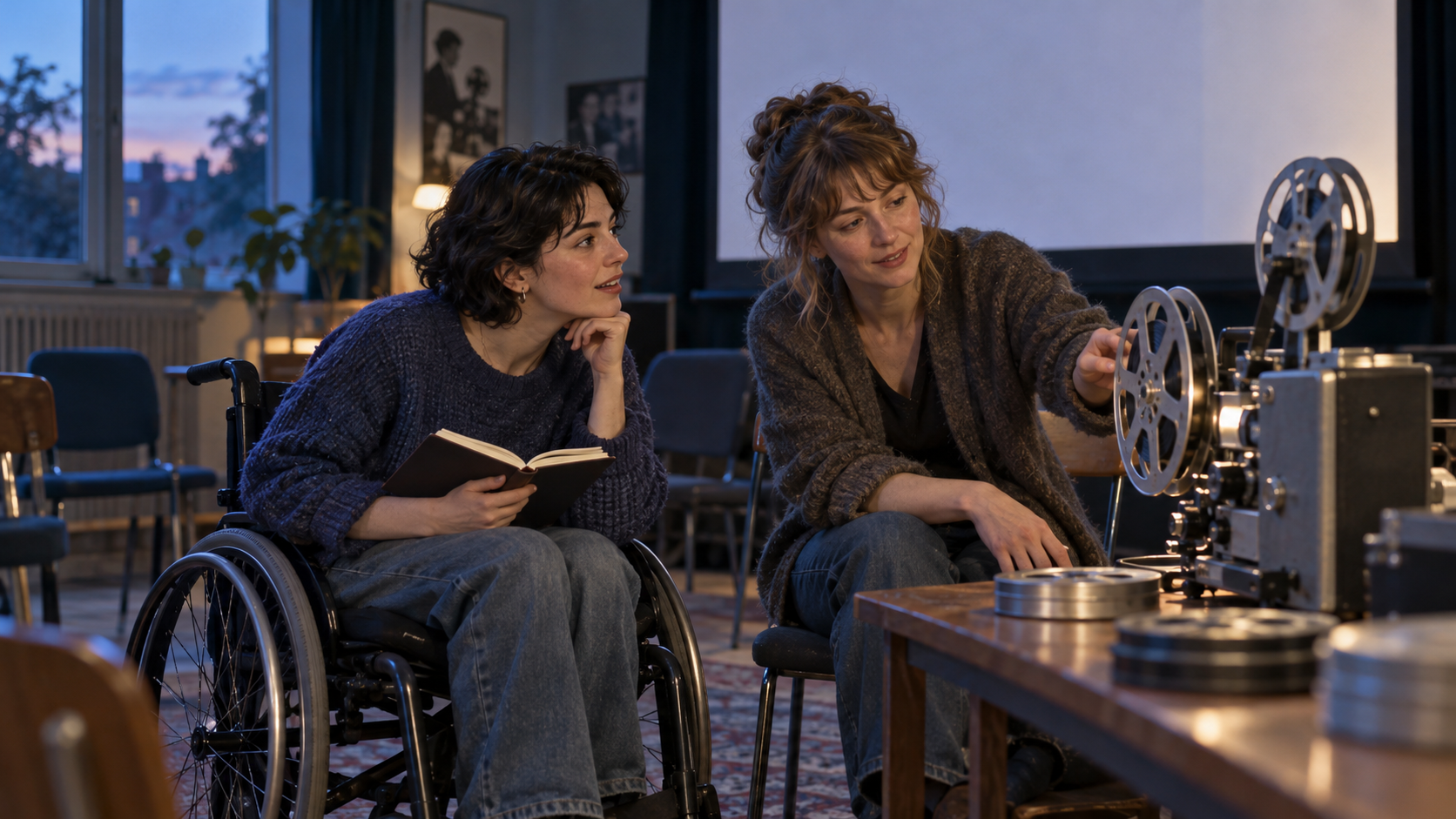
Imagine two adults meeting. Daria, who has used a wheelchair since childhood, arrives at a film history class. A new acquaintance sympathetically asks how she coped with losing her normal life. For a moment Daria cannot identify the earlier life she is being asked to remember. She remembers school, a friend, unwelcome morning preparations, and choosing her own music. That biography included limitations and barriers, but it did not begin with a passage from one authentic life to an incomplete replacement. A kindly question can still be organized around somebody else’s past.
Epigraph
I do not teach; I only relate.
Michel de Montaigne, Essays III.2, “Of Repentance,” Charles Cotton translation, William Carew Hazlitt edition, 1877. Montaigne is describing his own changing life, not making a rule that another person must tell their story.
What this article is about
Imagine two adults meeting. Daria, who has used a wheelchair since childhood, arrives at a film history class. A new acquaintance sympathetically asks how she coped with losing her normal life. For a moment Daria cannot identify the earlier life she is being asked to remember. She remembers school, a friend, unwelcome morning preparations, and choosing her own music. That biography included limitations and barriers, but it did not begin with a passage from one authentic life to an incomplete replacement. A kindly question can still be organized around somebody else’s past.
This article concerns adult life with congenital or early-acquired disabilities. How can personal experience be distinguished from an imposed story of loss? How can someone discuss a familiar body, support, change, and ordinary wishes without demonstrating compulsory pride? We compare personal testimony, philosophical self-description, shared life, and religious language about embodiment, retaining their differences. The purpose is room for a person’s actual answer, including a complicated or unfinished one, rather than prescribing an identity or a position on treatment.
I. A biography may lack the “before” a listener expects
A story of acquired limitation often turns on an event: before illness, after injury, what was possible and now is not. This can accurately describe someone who experienced that change. It is not the common form of every disability. In our imagined scene, Daria has no adult experience of walking to recall. When someone expects a story of returning to her former self, they offer a biography that never happened. Sympathy can consequently miss the person: it addresses an imagined loss while actual events remain unnoticed. An account borrowed from one life may become a poor question about another.
This distinction does not cancel difficult childhood experiences. There may have been painful procedures, inaccessible schooling, separation, humiliation, or missing assistance. There may also have been friendship, curiosity, play, and people around whom the body required no constant explanation. Neither a happy nor a tragic version can be selected beforehand. A person may name what was difficult without agreeing that their entire life is a loss. They may decline to discuss childhood at all. Answering today’s question about a class need not first require presenting a biography to a panel of sympathetic listeners.
Distinguish an actual past from a possible alternative. Daria may think, “With different conditions, I would have attended another school.” That can express meaningful regret about a missed opportunity. It differs from remembering, “I attended that school and then lost it.” Both can matter, but their language differs. An imagined life does not become a compulsory standard for assessing the actual one. Otherwise every current interest becomes a poor substitute for what supposedly should have happened. Having a biography includes the possibility of refusing that continual comparison, while still acknowledging a real opportunity that was denied.
Her acquaintance could revise the question: “What interests you about this course?” Or, when the subject is relevant and Daria wants to discuss it, ask about her experience without prescribing a plot. This does not require permanent silence about disability. Sometimes that is precisely what someone wants to discuss. The difference is whether the answer was selected before the conversation. Open interest allows actual events and meanings to emerge. It also permits a brief “I do not want to discuss that,” followed by a return to the film. Respect concerns willingness not to appropriate a past, rather than guessing it all correctly.
II. A familiar body need be neither enemy nor object of admiration
A body someone has lived with for a long time can be a familiar way of being in the world. Daria knows her habitual movements, workspace, what assistance she prefers to request, and what she prefers to do herself. This knowledge makes no difficulty imaginary. Familiarity does not mean an absence of pain, fatigue, or reliance on help. Yet the external description “she battles her body every day” may not fit. Today the chief irritation may be an awkward schedule, rather than her own existence. Nobody must accept a battle metaphor merely because an observer finds it intelligible.
The opposite requirement is equally restrictive: a lifelong disability must mean complete bodily love and no wish for change. Relationships with oneself can be complicated and variable. Someone may value a familiar life and want a particular suffering relieved; value cultural belonging and discuss medical support; lack an overall settled attitude while knowing they want to sit more comfortably or have quiet. They need not first choose a camp between pride and self-rejection. A particular need does not await final philosophical reconciliation. Recognizing this space does not prescribe an intervention or explain a symptom; it simply leaves wishes open to the person concerned.
In Stella Young’s letter to her sixteen-year-old self, embodiment, friendship, and intimacy belong to a complicated personal story, rather than only an outward performance of overcoming. It is her testimony addressed to herself. We do not transfer the letter’s promises to every reader or prescribe her route toward pride. What matters is another possible perspective: living in one’s body may contain things an outsider’s deficit story misses. The consequence is a question for a listener, not a universal instruction to love oneself or to adopt the same language.
Daria might say, “This is my familiar life. I want to talk about something else now.” Or, “Some things are difficult, but the story that my real self must be found somewhere before disability does not fit.” Neither sentence requires denying anything unpleasant. It clarifies the conversation’s subject and boundary. If speaking or writing is difficult, an answer may be conveyed through a chosen method or an agreed person. Lacking a long explanation does not authorize others to fill silence with their story. A general relationship to oneself can remain unfinished while a preference in this conversation is already clear enough.
III. Lifelong experience does not mean everything is settled
Long experience is easily mistaken for completed adaptation. “You have always lived this way; it must be easier for you.” Familiar conditions, however, do not automatically create an accessible adult world. Moving home, work, relationships, parenthood, a new service, or a change in condition can pose new questions. Daria may know her home route well and encounter an inaccessible college building for the first time. That neither cancels her skills nor proves insufficient adjustment. Experience concerns particular conditions; a new environment requires new inquiry. Nobody signs a lifetime promise to manage every future arrangement merely by growing up with a disability.
There can also be actual losses, which the article’s title must not forbid. A lifelong disabled person may lose someone close, accessible work, health, or assistance. They may grieve precisely what really existed. “My life does not begin with loss” means neither “I have nothing to lose” nor “I never regret possibilities.” It rejects an automatically imposed starting point. An actual event deserves its own name and scale. If everything is already called the tragedy of disability, an individual loss may become even harder to see. A broad account of a life should not erase what changed within it.
Preferences may change too. As a teenager, Daria appreciated a relative explaining her support arrangements. Now she wants to answer herself or choose what to delegate. A communication method that suited her previously may be replaced. These changes belong to growing up and a particular life, not necessarily rejection of the family. Gratitude for earlier assistance does not forbid revising a present role. A new need does not make a former arrangement wrong in every circumstance either. Preserve assistance’s history without turning it into permanent permission to direct someone. The question is what has been agreed now, not whether past care deserves recognition.
Nor must the person demonstrate an unchanging public image. Someone may discuss disability publicly at one time and want privacy at another; join a community, leave, return, or lack energy for discussion. This is no universal explanation of every change and cancels no responsibility for agreements. It allows noticing that a current wish differs from a previous one. Rather than an accusation of inconsistency, clarify what changed and what needs revision. Experience supplies material for answering; it does not remove the possibility of encountering a new situation without knowing what to do. An unfamiliar question is not proof that someone has failed to live competently with a familiar body.
IV. An adult participant need not remain the family’s child forever
Parents and relatives may remember years when they genuinely made decisions for a child and organized necessary assistance. That history is real. Adult life nevertheless raises a question about the person’s involvement now. Imagine a course employee addressing Daria’s mother, who came only to help with transport. An accompanying person’s former role quietly becomes present authority to answer everything. Pause to establish who selects the course, who is being asked, and which help was agreed. Recognizing parental work does not require excluding the adult from today’s conversation. The past explains an established habit without automatically justifying its continuation.
Extensive support needs make precision particularly important. Independence should not be measured by the number of operations performed unaided. An adult may need almost continuous assistance and still have preferences, significant relationships, and ways to answer. Equally, a distant article cannot determine an individual’s capacities or a legal decision’s validity from an ethical formula. Actual authority requires applicable grounds. Our subject is avoiding the substitution of physical assistance for an answer about the whole personality. Support and representation require distinction rather than automatic expansion of one role into every domain. Needing someone present is different from appointing them to supply every preference.
Those close to someone may also be anxious, exhausted, or short of resources. They need not be declared enemies because a new arrangement is difficult. An explanation of anxiety does not, however, settle what may be done on someone’s behalf. Discuss a particular risk, available assistance, and limits without making care unconditional authority. Professional involvement may sometimes be relevant to the situation; this article sets no universal process. It makes visible a difference between a habit of speaking for someone and an established need for particular assistance. Those grounds can differ even within one loving family and one well-intentioned interaction.
A practical transition can be small. “Please ask me about that. Mum helps with the journey.” “I want him to write down the answer, but we have not decided.” “I need more time for my way of responding.” These formulations neither assess legal capacity at home nor guarantee an institution’s response. They identify roles in a particular encounter. A person may request support for this conversation instead of proving adulthood by refusing all help. Lacking an available ally is not their personal failure. Missing conditions remain missing conditions even when changing them alone is difficult; an unanswered request must not be rewritten as insufficient will to be an adult.
V. An ordinary wish has value without comparison to another body
Daria chooses the course because early cinema editing interests her. An acquaintance praises her for “keeping busy with something.” The praise quietly removes the subject: the important thing is no longer film but the fact that a disabled person is active. This view can obstruct ordinary conversation even when warmly expressed. Someone may want a precise discussion of interests instead of low expectations. They may also want to be a beginner, do dull work, make mistakes, or abandon an activity without having it symbolize a general failure at life. None of these requires becoming a story about disability before it can be understood.
At the beginning of “Of Repentance,” Montaigne takes his ordinary private life and its changes as the subject of writing. This is not a contemporary disability-rights manifesto. The literary gesture helps pose another question: why must a particular life justify itself through an exceptional plot before becoming interesting? Daria need not prove that her day resembles everyone else’s. Her own question needs room. Ordinariness is not a consolation prize for inaccessible heroism. It contains the details in which someone lives: tastes, expectations, amusing mismatches, and decisions that may look small to another person.
A wish need not be confirmed by achievement either. Someone can love music without performing, enjoy a game without winning, or choose friendship without describing social rehabilitation. This claims no universal accessibility of every activity. Format, resources, and actual possibilities require separate inquiry. A limited outcome does not make the original wish unreal. If Daria cannot attend the course, acknowledge both her interest and the remaining barrier. Disappointment need not be replaced by a story that she has already won the most important inner battle. That interpretation may be hers if she chooses it; it is not automatically issued with a failed arrangement.
Refusal can be ordinary too. Daria changes her mind about a film or declines a question about her body. She need not use disability to justify every “no,” and others need not infer her condition from every refusal. Refusing an optional activity differs, however, from a situation involving an unmet vital need. Preserve the question’s scale. Here, an everyday preference need not become a moral examination. Wanting something else does not become legitimate only after proving that the previously chosen path is completely impossible. A person can revise taste or interest without turning that revision into an account of declining health or successful acceptance.
VI. Relationships can concern shared life, not only help
An acquaintance proposes friendship and immediately lists the assistance they can offer Daria. The offer may be kind and useful, but relationships need not be exhausted by services. People can discuss cinema, disagree about an ending, laugh, or be bored together. In Nicomachean Ethics IX.12, Aristotle connects friendship with shared activities. We take a limited perspective rather than his whole moral order. His classifications of worthy people and the gendered ranking of grief in neighbouring IX.11 do not become rules for this reader. Closeness requires neither identical function, eloquence, nor independence from support.
Assistance can belong to friendship without establishing intimacy by itself. Unequal amounts of physical activity do not prove intimacy absent either. One person organizes more of the journey, another notices more in a film, and sometimes neither wants to count contributions. What matters is which relationship is chosen and how each participates. This does not demand immediate repayment for care through talents or emotional service. Someone needing extensive support need not be permanently pleasant to retain dignity. A friend need not promise unlimited resources to prove friendship. Particular limits are discussed separately from the value of either person, without turning every meeting into an accounting of moral debt.
In adult intimacy, a person remains a participant in desires and boundaries. Another person’s attention should not automatically be classified as charity, or gratitude demanded for the relationship’s existence. Nor can love, partnership, or freedom from rejection be promised to everyone. Recognizing dignity does not dissolve the complexity of actual relationships. Another boundary matters here: lifelong disability gives others no prior authority to determine what someone may want or which relationships they should consider sufficient. This supplies no universal advice to preserve or end a relationship. It makes room for the person’s question, including an answer others did not expect and a boundary that requires no inspirational justification.
Some confident advice in Young’s letter is addressed to her own younger self. It becomes no compulsory ladder of confidence for others. Someone may be lonely, doubtful, or uninterested in intimacy and still deserve respect. Support should not await a beautiful personal narrative. Daria can request an accessible meeting without proving that she has already learned self-acceptance. She may want to talk with someone sharing experience without making that community a compulsory circle. Choosing relationships includes not explaining disability at every introduction and discussing it in detail where needed. An ordinary friendship may contain assistance, disagreement, common pleasures, and privacy without one of those meanings erasing the others.
VII. Different grounds for dignity cannot be collapsed into one story
In Psalm 139:13–18, using English numbering, the speaker addresses God about embodied life before birth. This is biblical poetry read within Jewish and Christian traditions, not a medical explanation of congenital characteristics. Such language may ground a believer’s sense of existence’s worth. It cannot establish that suffering was specially assigned, every treatment is wrong, or someone must love their body in a prescribed way. A personal religious reading is not a requirement for another participant in a conversation. The poem can be approached within faith without making its interpretation a condition of receiving help.
Montaigne’s self-description and the biblical address have different centres. One writer observes a changing private life; the psalm’s speaker understands the self in relationship with God. They can be placed beside one another around the question of why life must answer to an external model. They cannot be declared one doctrine or an established agreement about contemporary disability. Daria may find meaning in either, both, or neither. Her request concerning course conditions does not depend on accepting a religious explanation. A shared conversation can continue despite different grounds. The comparison opens possible questions instead of producing an answer everyone must adopt.
The modern Convention on the Rights of Persons with Disabilities, Article 3, provides normative language about respect for difference and human diversity. This is another kind of grounding. It confirms neither Montaigne’s nor the psalm’s metaphysics and establishes no actual local implementation. In our discussion, cultural, philosophical, and legal grounds must not erase the person’s voice. An accessible format can be discussed with someone who does not share another’s faith or aesthetic ideal. Action does not always require prior agreement on every meaning of birth, body, and a good life. What grounds a personal interpretation and what grounds an institution’s action remain distinguishable.
Recognition of dignity can itself become a command: “You are already a whole person, so stop complaining.” Normative worth does not remove pain or cancel a request to change conditions. Someone may recognize their life as their own while resenting how they are treated; want help without agreeing that their whole self needs repair; refuse consolation while valuing the person offering it. These combinations are not automatically contradictory. They show that a living position is more complicated than a successful phrase meant to conclude the conversation for someone else. Dignity can accompany an unfinished complaint rather than being used to silence it.
VIII. A personal account can begin in the present
Daria need not correct every idea her acquaintance has. She can choose the scale: one correction, a change of subject, a detailed conversation, or a pause. “I did not have the former life you are asking about. This class matters to me now.” That sentence resolves no social problem of perception and guarantees no understanding. It identifies the nearest subject without making someone a permanent teacher of their dignity. Lacking energy to explain does not invalidate experience. Not every encounter must become a successful lesson for other people, including when the same misunderstanding has occurred many times.
Another adult may choose a very different answer: discuss a painful childhood, name an actual loss, speak about desired treatment, or request assistance. The title forbids none of these. It protects the place from which a person begins speaking. Lifelong disability creates no common biography, just as a shared diagnosis establishes no identical wishes. The practice therefore examines whether a present preference has been retained, not whether an identity is correct. Outward resemblance makes no one’s story a template for another’s life. Even closely shared experience supplies no authority to finish that life’s account without asking the person who lives it.
Resources for a personal account can be scarce: no money for a separate service, accessible community, trusted person, or convenient way to write. A next step may then be a short spoken response, an agreed signal, a request for one question at a time, or declining to continue. This article establishes no individual communication system and promises none already exists. If a suitable method is unavailable, that is a separate unmet need, not insufficient determination. A right and an actual channel of expression are different. Recognizing a missing channel matters more than praising imagined independence or insisting that someone should simply speak up.
At the imagined encounter’s end, Daria talks about the film. Or leaves because the conversation does not suit her. Or chooses to explain more. None of these outcomes measures her life’s worth. The useful distinction came earlier: another person’s imagined biography stopped being the only permissible beginning. One’s own life may contain losses, pleasure, dependence, choice, and an unknown future. It need not first demonstrate resemblance to a nondisabled person’s life. Sometimes the nearest conversation requires room for one actual wish already present here, rather than only a comparison with who someone might otherwise have been. The story remains the person’s, including where it is ordinary and where it is not settled.
What this means in practice
Recall one recent conversation in which a plot was selected for you: loss, heroism, permanent childhood, or complete acceptance. If recalling it is unwelcome, use a simple present request instead. Name what does not fit and what you want to discuss now. You need not disprove every belief, disclose painful experiences, or establish that childhood was happy. One distinction is enough to begin; the exercise is optional rather than a test of whether you can defend your life eloquently.
You might say, “That is not my story. Choosing a meeting time matters to me.” Or, “I need help with this; please ask me about the other matter.” If speech is inconvenient, use an already available, chosen response method or ask an agreed person to convey precisely that sentence. An absent helper cannot be assigned, and an app cannot be made a condition of having a voice. If no channel exists, do not blame yourself: access remains a task, rather than adulthood an examination you failed.
Clarify the arrangement’s scale. What changes: the conversation’s subject, a communication method, an accompanying person’s role, one occasion? What remains unknown? You may want change without currently having resources to achieve it. You may accept particular help while disagreeing with the explanation attached. For treatment, care, or legal representation, this practice does not replace relevant grounds or determine them from an everyday example. It keeps the question specific enough to identify what needs another kind of answer.
Consider the result without demanding victory. You were heard, but conditions remain unchanged; a question was conveyed, but no reply has arrived; you chose to stop the conversation. Accuracy preserves the difference between preference, agreement, and actual implementation. Assistance for a real urgent threat does not await this exercise. In ordinary conversation, a biography may remain complicated and unfinished. Naming today’s wish does not require first writing a final explanation of an entire life.
Key quotation
For friendship is a partnership.
Aristotle, Nicomachean Ethics IX.12, a short clause, W. D. Ross translation. The context concerns shared activities. It requires neither equal physical contributions, usefulness, nor independence from assistance.
Connections between traditions
| Comparison | An actual intersection of questions | Boundary |
|---|---|---|
| Montaigne III.2 ↔ Stella Young’s testimony | A personal life contains more than a convenient external plot. | Sixteenth-century literary self-description is not contemporary disability rights; one testimony establishes no universal route. |
| Aristotle IX.12 ↔ ordinary adult disabled interests | Relationships can concern a jointly valued activity. | Ancient friendship ethics contains restrictions and hierarchies not adopted here as rules of human worth. |
| Psalm139:13–18 ↔ Montaigne III.2 | A particular embodied life can warrant serious attention. | Relationship to a Creator and observation of a changing self are different grounds; resemblance proves no common metaphysics. |
| Convention Article3 ↔ religious and philosophical interpretation | Dignity should not await conformity to an externally ideal story. | Contemporary rights, faith, and an author’s argument have different grounds; local implementation was not checked. |
Four rows, rather than the five-to-eight guideline, match the sources actually used. This is editorial comparison, not an established history of borrowing or evidence of identical teaching.
Primary sources
- S1. Stella Young. A letter to my younger self, ABC; original column October2013, republished2018. Entire letter body read. Personal testimony, not a prediction for readers. A book mentioned within the letter was not thereby read.
- S2. Michel de Montaigne. Essays III.2, Of Repentance, Charles Cotton translation, William Carew Hazlitt edition1877; Project Gutenberg3600, updated2023. Opening III.2 through the epigraph sentence read, not the whole essay or volume. French original not separately compared.
- S3. Aristotle. Nicomachean Ethics IX.11–12, W. D. Ross translation. Both sections and context read; no whole-book claim. The ranking of grief responses and a “better” human type in IX.11 are not adopted as recommendations.
- S4. Psalm139:13–18, King James Version, English numbering. Selected biblical poetry read, not the whole psalm. An identified religious perspective, not an account of medical causation.
- S5. United Nations. Convention on the Rights of Persons with Disabilities, Article3, official English text published by Japan’s Ministry of Foreign Affairs. Articles1–3 read within this assignment; narrow normative grounding used. Local law and implementation were not researched.
Tags
lifelong disability, congenital differences, adult life, biography, personal voice, familiar body, support, dignity, choice, loss, self-description, preferences, growing up, family, boundaries of care, accessibility, friendship, intimacy, ordinary interests, privacy, community, change, resources, Montaigne, Aristotle, Stella Young, biblical poetry, human rights, participation, United Wisdom
About the authors
Andrey Zarinsh is the author and founder of United Wisdom. He explores inner transformation, the unity of traditions, intercultural dialogue, and contemporary spiritual discipline. Instagram: @andrey.zarinsh.
Maria Evilkut is a coauthor of United Wisdom. Alongside her research, she seeks to examine these ideas in practice and observe how principles of unity and mutual understanding work in real life between people and cultures. Instagram: @ilkutki.