
H
When the main helper suddenly becomes unavailable
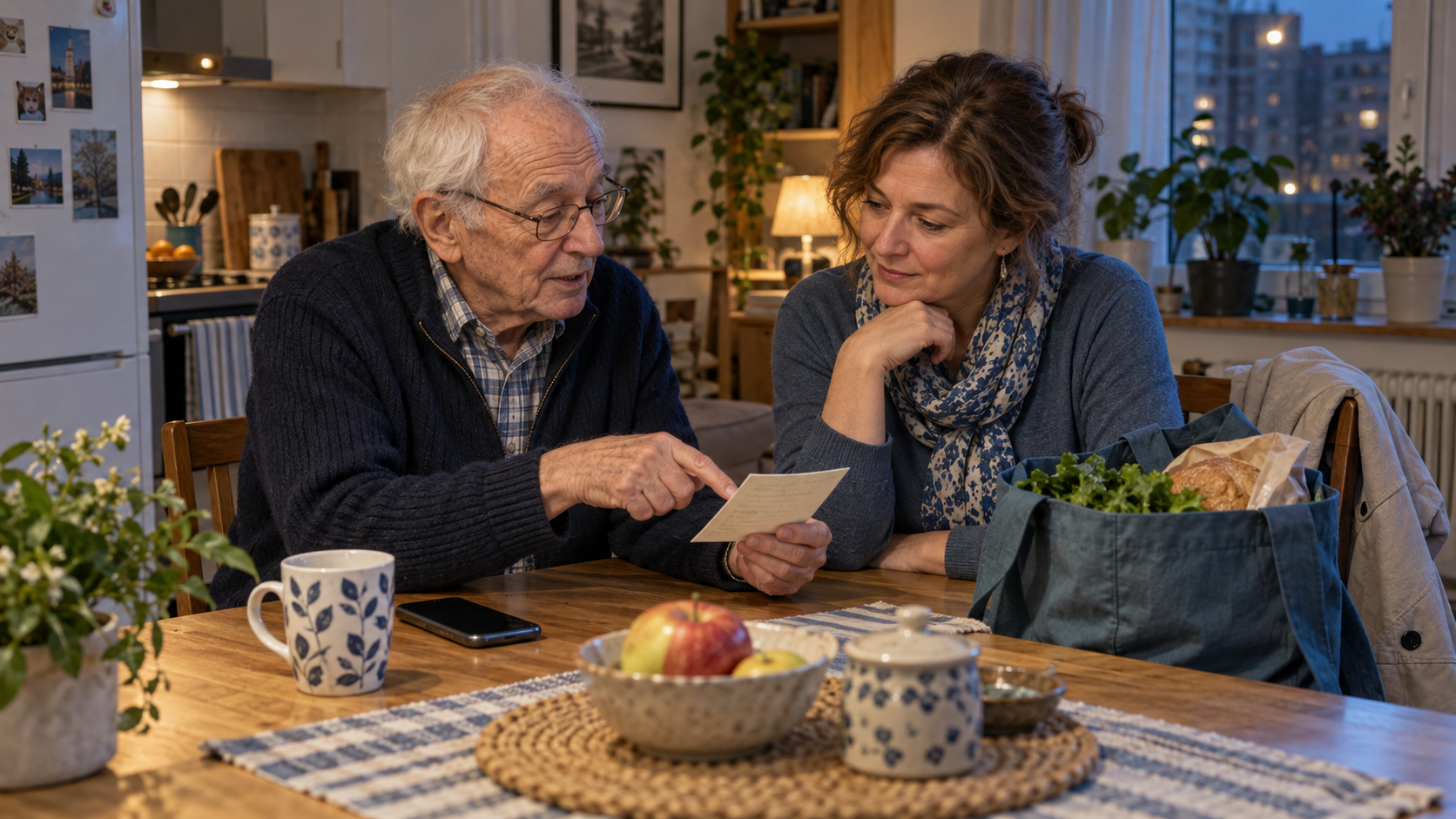
Irina helps her ageing father, Lev, at particular times. He does many things himself, while some daily assistance is already necessary and agreed. One day Irina is admitted to hospital and cannot visit. The family chat quickly fills with sympathy, telephone numbers, and confidence that somebody will manage. The approaching evening, however, does not become covered through the number of messages. Who will actually come, what they can do, and how they will obtain the information they need remain unclear.
Epigraph
“Take care of him.”
Luke 10:35, the Samaritan speaking to the innkeeper within the parable, KJV. An instruction in a religious narrative, rather than a modern care contract or medical guidance.
What this article is about
Irina helps her ageing father, Lev, at particular times. He does many things himself, while some daily assistance is already necessary and agreed. One day Irina is admitted to hospital and cannot visit. The family chat quickly fills with sympathy, telephone numbers, and confidence that somebody will manage. The approaching evening, however, does not become covered through the number of messages. Who will actually come, what they can do, and how they will obtain the information they need remain unclear.
This scene is fictional. The article examines an interruption to familiar help: distinguishing a list of possible people from an actual replacement, preserving the recipient's voice, and avoiding leaving all coordination with someone who now needs assistance themselves. It neither diagnoses Lev nor predicts ageing or establishes relatives' authority. We consider preparation, handover, and checking what happened. R38 addresses the broader organisation of care; R-14-N04 concerns discussing the future before a crisis. Our narrower question is what happens to assistance already needed when its usual provider suddenly cannot be there.
This interruption can happen at any age: a partner becomes ill, a personal assistant does not arrive, a friend stops answering, or the only familiar person who understands a communication method is far away. A family chat or money for an immediate replacement cannot be assumed. Calling may be difficult for the person needing assistance; that does not mean they have nothing to communicate. Establish an accessible way to respond, without expecting them to rebuild a failed arrangement alone. Information about how they communicate may be as necessary for the encounter as the arrival time.
I. The person is absent; the need remains
When a familiar caregiver becomes unavailable, the family first thinks about them: what happened, when they will return, and how to help. That attention matters. Another person nevertheless has a day connected with particular assistance. Lev may know his daughter cannot visit without knowing whom to tell about an unfinished matter. Supporting Irina and arranging Lev's help are related but distinct tasks. Resolving one does not establish that the other has been resolved.
In our scene, some tasks can wait while others concern needs already established. The family should not decide which is which solely through whichever relative happens to be free. First establish what was arranged for the coming period: what assistance is required, when, what Lev does himself, and which information exists. A medical need is not redefined in family messages. Existing instructions and safety questions require appropriate professional support rather than confidence supplied by proximity or kinship.
II. A contact list becomes a backup after a response
Irina's phone contains a neighbour, a cousin, and a service she once called. These are three possible routes of enquiry rather than three ready replacements. The neighbour may visit briefly but be unable to provide the assistance needed. The cousin may live nearby and be away today. A service's name may concern another kind of support. Until somebody answers a specific request, the family has contact information rather than confirmed participation.
Carers UK's guidance on contingency plans recommends discussing a plan with the recipient and the people proposed as emergency contacts. This is practical guidance from a British organisation, not an effectiveness study or a guarantee of a local service. The relevant step is from a familiar name to a discussed role. Once allowing someone to telephone in difficulty does not establish acceptance of the entire care arrangement.
III. A new participant needs information for the task
Irina is accustomed to knowing details without writing them down. Lev prefers a particular way of communicating; the entry system does not always work; a visit time recently changed. These are ordinary parts of her day but unknown conditions for someone new. Giving them an address may get them to the building without enabling the necessary task. Missing information should not later be explained automatically as insufficient effort. A handover includes the conditions needed to perform the work.
Oxford Health NHS's brief Emergency Plan identifies backup contacts, a recipient's needs, information about existing support, and safe storage. The page belongs to a carers' handbook that includes a mental health context. It does not determine how long this reader's relative may be left alone or how they should be treated. Its limited relevance is that prepared information must be accessible to an appropriate participant rather than held only in one person's memory.
IV. Temporary assistance does not remove the recipient's voice
Lev learns that somebody else will come instead of his daughter. Relatives may feel that changed circumstances leave nothing to discuss: someone has been found. He still has knowledge of his own day, preferences, and questions about the new assistance. He may want another time, know a problem with the proposed method, or prefer doing part himself. A sudden change should not automatically turn him into an object allocated between helpers.
The United Nations Principles for Older Persons distinguish independence, participation, care, and dignity. Principle 14 retains privacy and participation in care decisions. This provides a normative ground for respectful treatment rather than a finding about a particular person's ability to make a specific decision. Neither age nor receiving help by itself establishes relatives' legal authority. When such questions genuinely arise, applicable local arrangements are needed rather than convenient family assumptions.
V. Confirm that replacement assistance has begun
Finding a helper can describe different events. A number was obtained. Someone answered. A time is being discussed. Participation was agreed. Someone arrived and began the accepted task. There are intervals between these states during which Lev may still be waiting. A single label cannot jump across them. Error becomes particularly easy where each relative completes one small step and assumes somebody else will finish the handover.
In the fictional scene, Irina's cousin arranges for a neighbour to visit, while Lev's son assumes she is already there. The neighbour is waiting for the time to be clarified. An elaborate family control centre is unnecessary. One specific question needs an answer: who will establish that the agreed assistance has begun, and whom will they tell if it has not? That limited coordinator acquires no authority over Lev's whole day. They accept a particular unresolved part of the transition and know when it is complete.
VI. Temporary replacement has a duration and a limit
The neighbour managed to come today. Tomorrow the family may find it easier to think the problem is solved, although no new promise exists. A temporary measure readily becomes permanent when it works the first time. A successful evening does not establish availability for every following one. The participant needs to know how long their agreement actually applies. Lev also needs to understand who is coming next rather than learn of each change at the door.
A period may be bounded by an event rather than a date: until today's visit ends, until a service confirms the next arrangement, or for two agreed evenings. Irina's uncertain return cannot be used to give the neighbour an indefinite role until everything settles down. Uncertainty should remain explicit, and the next required answer should belong only to someone who accepts it. Continuation needs discussion before yesterday's assistance becomes the sole basis of tomorrow's expectation.
VII. The absent caregiver needs assistance too
Irina is in hospital while her telephone keeps ringing. Where is an item, whom should somebody contact, what does an old note mean? She may be able to answer one significant question. If the entire transition nevertheless requires her continuous direction, the family has replaced the hands while retaining the former organiser. That may still be work she cannot do even though nobody asks her to travel. Her own situation does not become insignificant because she knows more than everyone else.
A prepared record helps at precisely this point by reducing dependence on one person's instant response. Even without one, finding known information can be shared, an important gap identified, and clarification sought from somebody actually able to provide it. Each relative need not ask Irina the same question separately. Where communication is available, one channel and a limited question can be agreed. Where it is unavailable, a response from hospital cannot become the test through which she must prove she cares.
VIII. Handing over care does not mean disappearing from a relationship
In the Samaritan parable, Luke 10:30–37, assistance includes stopping beside a wounded person, bringing him to an inn, and addressing the innkeeper while leaving money. Continuing help is not reduced to the first helper's necessary personal presence every minute. This is a religious narrative about mercy and being a neighbour, rather than a description of a modern service, a worker's qualifications, or a legal contract. It cannot establish that any delegation is sufficient.
The comparison helps distinguish continuing care from one person's endless physical presence. Irina remains Lev's daughter although another participant performs a particular task today. Her relationship has not been transferred along with it. Conversely, feeling love alone does not cover the evening's assistance. Her impossible presence need not be demanded while suitable replacement is still checked. These considerations can coexist when love is not made the only unit through which the arrangement is measured.
IX. Say clearly when no replacement has been found
The hardest search outcome may be no suitable person rather than a poor agreement. Relatives cannot come today, a service has not confirmed availability, and Lev still needs assistance that remains uncovered. Continuing to say generally that the family is dealing with it is particularly misleading here. A request for support needs to identify the actual missing part and approaching period, rather than present completed calls as delivered care. The efforts are real, but the outcome is still different.
An appropriate local service can receive a limited factual account: the usual caregiver is unavailable, a necessary part is uncovered, and certain conditions are known. Unknowns remain unknown. If the caller lacks authority to decide for Lev, a call does not create it; consent and sharing information remain separate questions. Where danger is immediate, necessary emergency assistance must not wait for the ideal contact. We establish no country-specific number, queue, legal duty of a service, or guaranteed placement route here.
AnalectsII.17 links knowledge to acknowledging what is known and what is not. During a sudden absence, “I do not know how to do that” can be useful information rather than a failure of devotion. Luke’s Samaritan entrusts care to another participant; Confucius addresses honesty about knowledge. The comparison is limited and editorial: good intention should not conceal an unestablished ability. Someone who honestly accepts a food delivery may contribute more than someone who promises everything while leaving the medical question and the evening unanswered.
The UN Convention on the Rights of Persons with Disabilities, articles12,19,21–22, supplies a separate modern normative basis for participation, support with decisions and privacy. It neither continues an ancient or religious system nor confirms that a particular service is available. A person may respond through speech, gesture, chosen symbols or an agreed intermediary. Check that a response has actually been received; difficulty with conventional speech does not justify discussing someone’s life only among helpers. Support needs may change without diminishing a person’s status.
X. A caregiver's return does not automatically restore the old arrangement
A few days later, Irina leaves hospital. The family may immediately close the temporary arrangement, assuming the familiar participant is available again. News of her return and agreement to resume the entire workload are different information. Her actual capacities need to be understood alongside relevant professional advice where it exists. The article does not determine recovery. It prevents relief at a reunion from quietly transferring every former obligation before somebody can respond to them.
Lev may not want every earlier arrangement either. He has met another helper, discovered a convenient way to obtain some support, or realised he prefers a different sequence. This neither makes his daughter unnecessary nor proves a new service superior. Information exists that did not exist before. It can be discussed with Irina's limits without demanding gratitude in the form of fully restoring the old routine. Necessary assistance still needs continuity: ending temporary agreement requires a clear transition rather than a missing participant between two calendar entries.
What this means in practice
If there is no immediate danger and circumstances allow preparation, choose one approaching period when familiar help might be absent. Establish with the recipient what they do themselves, what assistance is already needed, and what remains unknown. Age is not a sufficient account of needs. Medical content, competence, and significant conditions should not be inferred from household guesses; use relevant current information and professional participation where required.
Select one possible replacement and check the actual response: what is accepted, for how long, and which information and agreed access are needed? Without an answer, retain an unconfirmed status. Discuss who will establish that assistance began and what remains unmet if the option fails. Do not fill every role with a name simply to finish the scheme. A record can be short; its content matters more than its form. Agreement to one action does not expand to all future care.
Keep necessary information accessible to appropriate people and protected, with the date last checked. Do not publish passwords, medical documents, or addresses openly. A new participant is not assigned to change professional instructions independently or try unfamiliar actions for a result. If necessary assistance is already interrupted, seek appropriate local support for the actual need; an ideal plan must not delay emergency help for an immediate threat to life. An application or conversation does not yet confirm a helper's presence.
After the first replacement, return to three questions: what did the recipient actually receive, what work did the absent caregiver continue doing, and when does the temporary agreement end? Address one gap found. Do not manufacture an absence or a failure of care as practice. The exercise guarantees neither services, safety, nor family agreement. Its limited outcome is clearer knowledge of confirmed participation, who holds the next unresolved question, and what still requires a separate answer.
If writing or using an app is difficult, name one recurring task orally or through an agreed accessible method. A complete spreadsheet is not required. Missing money, family or a suitable service remains a real limitation; a child does not become a substitute for adult care. Help with making the enquiry can be requested without claiming its result has already been obtained.
Key quotation
“Go, and do thou likewise.”
Luke 10:37, Jesus addressing his questioner after the Samaritan parable, KJV. Mercy is not equated here with one relative's limitless care, medical competence, or a guaranteed outcome.
Connections between traditions
| Comparison | Shared question | Difference and limit |
|---|---|---|
| Luke10:30–37 ↔ an accepted task | How can help cease to prove unlimited strength? | A classical or religious setting determines neither clinical adequacy nor modern authority. |
| ConfuciusII.7 ↔ material assistance | Does respect for the person remain behind the completed work? | Reverence within an ancient family hierarchy is not modern equality of rights; obedience is not imported as a rule. |
| ConfuciusII.17 ↔ known scope | What is known about the task and the ability to accept it? | Honesty about knowledge is not clinical authorisation; specialised action requires appropriate competence. |
| Epictetus1 ↔ effort and result | What can someone undertake without promising to control everything? | Stoic judgement does not remove illness, poverty, barriers or service responsibilities. |
| Convention12/19/21–22 ↔ assistance and voice | Does the person participate through an accessible method? | International norms differ from ancient ethics and religious belief; local law and actual access require separate checks. |
Sources
The earlier reading scopes below belong to the preserved research for AGE-086. New reading for this edition covers selected AnalectsII.5–8/12–17, Enchiridion1 and Convention articles; exact fresh specialist-page scopes are in SOURCES.json. Inherited sources are not represented as freshly reread.
- Carers UK. Creating a contingency plan. Main preparation/discussion text read, web lines 189–210; video, interactive tool, and PDFs not studied. Practical organisational guidance, not a clinical study. Main page revision date not established; read 19 October 2026.
- Oxford Health NHS Foundation Trust. Emergency Plan. Entire main text 28–39 read; reviewed 16 September 2025. Contacts, needs, and safe storage, rather than a personal risk assessment.
- NHS. Carers' breaks and respite care. Main text and review date, 1 May 2026, read during this work; replacement formats and Emergency respite care. British arrangements are not transferred to other countries.
- United Nations Principles for Older Persons. Resolution 46/91, 16 December 1991; official Welsh commissioner reproduction. All eighteen principles read; dignity, privacy, and participation provide normative support.
- Luke 10:30–37, King James Version. Entire specified passage read; epigraph from verse 35 and key from 37. The host's Public Domain label establishes no rights conclusion for every jurisdiction. Not a medical source.
-
Confucius, Analects II.5–8, II.12–17; James Legge. Selected passages read24October2026; scope and limits in SOURCES.json.
-
Epictetus, Enchiridion 1; Elizabeth Carter. Selected passages read24October2026; scope and limits in SOURCES.json.
-
UN Convention on the Rights of Persons with Disabilities. Selected passages read24October2026; scope and limits in SOURCES.json.
-
Carers UK, Getting help in an emergency. Additional specialist support for the organisational distinction; selected scope read24October2026. A bounded British example, not a promise of local services.
Tags
illness and disability, care, main caregiver, temporary unavailability, backup plan, confirmed participation, handover, continuity of care, recipient, consent, privacy, information, access, time, limits, coordination, family, caregiver support, replacement, temporary arrangement, unresolved question, competence, local support, dignity, independence, checking outcomes, Carers UK, Oxford Health, NHS, Samaritan
About the authors
Andrey Zarinsh is the author and founder of United Wisdom. He explores inner transformation, the unity of traditions, intercultural dialogue, and contemporary spiritual discipline. Instagram: @andrey.zarinsh.
Maria Evilkut is a co-author of United Wisdom. Alongside her research, she seeks to test these ideas in practice and observe how principles of unity and mutual understanding work in real life between people and cultures. Instagram: @ilkutki.