
I
After a stroke or brain injury: hearing the person beyond the changes
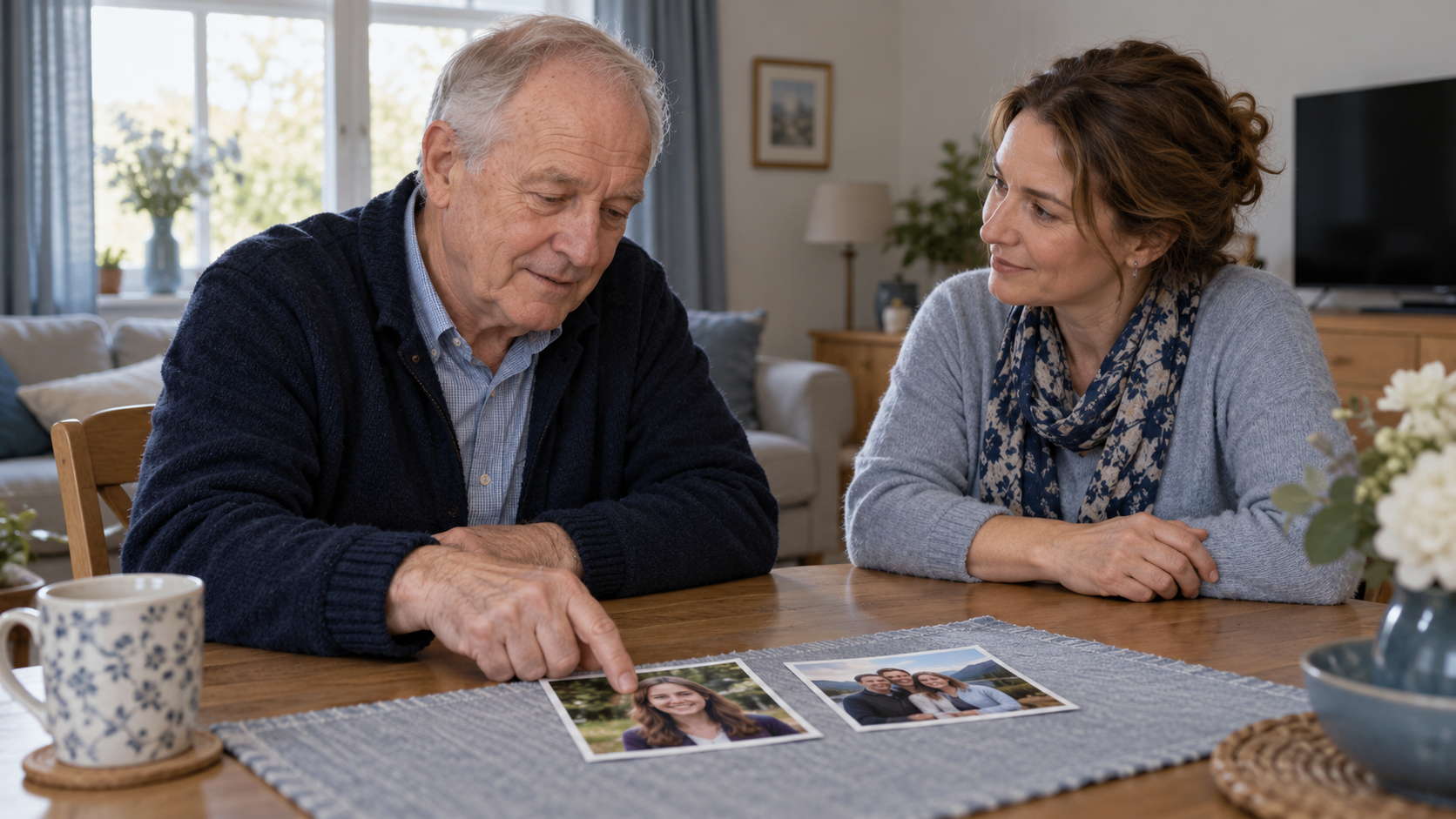
In an imagined scene, an adult has returned home after a stroke. Finding words takes time, and relatives discuss in front of them what they now understand. In another household, someone speaks confidently after an injury but gets lost when several tasks need to be carried out in sequence. Observers draw opposite conclusions: the first person is excluded from decisions; the second is not believed to need help. In both cases, one visible feature has become a description of the whole person.
“Is not RECIPROCITY such a word?”
Confucius, Analects XV, chapter XXIII in James Legge's numbering (15.24 in another common numbering), text consulted. A pupil asks for a lifelong rule. The answer continues by limiting what we impose on others.
What this article is about
In an imagined scene, an adult has returned home after a stroke. Finding words takes time, and relatives discuss in front of them what they now understand. In another household, someone speaks confidently after an injury but gets lost when several tasks need to be carried out in sequence. Observers draw opposite conclusions: the first person is excluded from decisions; the second is not believed to need help. In both cases, one visible feature has become a description of the whole person.
This article examines how to avoid that substitution. We distinguish movement, speech, understanding, attention, and everyday participation, then consider how to describe a difficulty and request an appropriate assessment. Locke's account of identity, Confucian reciprocity, and a Christian image of mutual care help question familiar judgments. This is neither diagnosis from behaviour nor a home rehabilitation programme. Sudden new symptoms require help before reading. After an established event, a different question matters: how can participation become accessible without denying real changes or reducing someone to them?
I. Naming the event does not map the needs
A stroke and a traumatic brain injury are different medical situations. Even within each category, a word in a report does not fully describe what a particular person can do now. Cause, characteristics, and consequences require professional assessment. A similar difficulty does not justify transferring someone else's diagnosis, prognosis, or exercises.
FDA describes traumatic brain injury separately and emphasises clinical evaluation. Its information does not justify attributing every instance of forgetfulness to trauma or resolving the question through one scan. Equally, recommendations after stroke do not automatically become instructions after every acquired brain injury. The shared subject here is conditions for participation, not equivalence between conditions.
Everyday life needs a map more specific than “they have changed”. What has become difficult: producing a word, understanding a long explanation, keeping track of a sequence, noticing part of a space, or carrying out a movement? What is known from professional assessment, and what is currently a relative's observation? Both can matter, but neither should pretend to be the other.
Imagine someone not answering a question about tomorrow's visit. The observation is: “There was no answer after a long explanation.” “They do not care” attributes a motive. “They understand nothing” goes further still. A more precise next question concerns how understanding can be assessed and an accessible response made possible. It can be addressed to the appropriate professional while preserving the person's place in the conversation.
The map need not be completed in an evening. It may begin with one barrier obstructing something important. Completeness serves suitable support, rather than an impeccable family report. If an observation cannot yet be explained, honest uncertainty is more useful than a confident label. It leaves room to investigate rather than assigning someone a new biography in advance. Describing a difficulty carefully is already different from deciding what kind of person they have become.
II. Speech, understanding, and movement do not march together
Different communication difficulties cannot be reduced to one scale in which fluent speech equals good understanding. NIDCD describes aphasia as a language disorder that may affect expression, comprehension, reading, and writing. It can occur alongside other speech disorders. Difficulty producing speech therefore establishes neither the preservation nor the absence of every other ability.
Both sides matter. A nonspeaking person must not automatically be treated as someone who does not understand. Nor can “they understand absolutely everything and simply cannot say it” be assigned to everyone. Respect requires appropriate assessment and accessible communication, rather than a comforting assumption. Otherwise, someone may be offered a choice they have not received in an understandable form, and their silence subsequently labelled consent.
In an imagined example, a woman can choose whom she wants to see that evening but cannot respond quickly to a long question containing several conditions. If the other speaker finishes for her, the distinction between her preference and their guess disappears. The team can be asked which way of presenting a question and confirming a response suits her. A familiar gesture may be useful; an untested nod cannot be treated as a reliable answer to every question.
Canadian Stroke Best Practices calls for communication assessment and training partners in supported conversation. The shift in who must change is significant. The person with an impairment is not the only learner. Conversation partners also need conditions in which meaning can be expressed and understood.
Participation is not measured by elegance of expression. Slow speech, writing containing errors, a picture, or another appropriately selected aid may convey an important position. The method needs to suit the person rather than the price of a device or other people's convenience. A new technology is not necessarily more accessible than paper; paper is not necessarily accessible to someone who finds reading or hand movement difficult. Useful support begins with this specificity instead of a hierarchy of supposedly superior ways to speak.
III. What is not visible may still get in the way
An apparently confident conversation does not establish equal access to planning, attention, and complex everyday action. One mistake does not establish a lasting cognitive impairment either. Between these extremes is assessment of particular tasks and the conditions under which they become difficult.
NICE NG236, section 1.5, addresses cognition, memory, and attention separately after stroke. These are professional recommendations, not a kitchen-table test for relatives. Their relevance here is permission to ask a precise question about assessment, not a licence to infer which brain area is damaged from misplaced keys.
An imagined man talks freely about his former job but loses track when a telephone rings, a television is playing, and a bill needs discussing simultaneously. A relative may interpret this as selective laziness: he remembers football, so why not the bill? That explanation joins unlike tasks. It is more informative to describe what works in a quiet conversation and where difficulty appears, then discuss those observations with the team.
Help is particularly easy to confuse with constant examination here. If every conversation becomes a memory test, home becomes an extension of a consulting room and relationships a sequence of scores. Observing a significant change for a useful discussion differs from repeatedly testing whether someone is trying hard enough. A relative may also be frightened, but fear does not make the examination appropriate.
An invisible difficulty is not therefore imaginary; a visible difficulty does not automatically explain its cause. These two statements leave space both for trusting a person's account and for investigation. If a difficulty changes, discussion with the medical team matters more than mechanically reusing the old explanation. Sudden new speech difficulties, weakness, or confusion raise a question of urgent care, not a domestic assessment of character. An existing diagnosis should not become a reason to overlook a new event or assume that everything is simply part of recovery.
IV. A rehabilitation goal needs to matter to the person
Measures of function matter to professionals, but life contains more than measurements. There is a difference in the level of the task between improving speech and telling a daughter that you want to attend her celebration. The second does not replace professional assessment of the first. It explains the participation for which support matters.
NICE NG236, recommendations 1.2.7–1.2.11, relates rehabilitation goals to meaningful activities, participation, and review. This is guidance for services in a particular health system, not a promise of identical provision everywhere. It nevertheless supports asking where a person's own priority appears in a proposed plan.
Imagine a family convinced that walking without assistance is the overriding priority. The person is more worried about not being able to refuse something or choose when a visit ends. Both may be important. The mistake begins when one is declared the only respectable topic and the other a whim to be addressed after complete recovery. Communication support does not have to wait for every other task to finish.
A meaningful goal need not be grand. It might concern an ordinary conversation, participation in household spending, or the possibility of being alone with necessary assistance available. Not every goal can be promised in the chosen form. Desired participation, the present obstacle, and a question about possible means can nevertheless be separated. Sometimes the method changes, sometimes when it is reviewed, and sometimes the intention itself.
A rehabilitation outcome is not a moral score for effort. Comparison with someone in a video overlooks differences in the event, condition, support, and resources. Not achieving that displayed result does not establish insufficient willpower. A reader need not become an inspirational story. Their task may be much quieter: ensuring that something important to them enters the plan rather than remaining outside its professional vocabulary. Being heard about a goal is distinct from being promised that it can be achieved.
V. Reciprocity does not mean that I already know for you
The Confucian term shu is often rendered as reciprocity. In Analects XV, it is expressed through a limit on imposing on others what one would not want oneself. This is an ethical orientation within a particular tradition of relationships, not a contemporary aphasia guideline.
Application requires care. “In their place I would want to do everything myself” does not establish this person's wish. “I would feel better if someone decided for me” gives no authority to decide for someone else either. Reciprocity can interrupt thoughtlessness, but it cannot replace discovering a particular preference. An imagined resemblance to oneself begins a question; it does not supply the answer.
In a nearby episode of Book XV, Confucius tells a blind musician where the steps and seat are and who is present. What matters here is a change in the host's conduct, rather than an attempt to make the visitor ordinary. The scene does not prove the effectiveness of modern rehabilitation. It gives a historical example of attention to the conditions of participation.
An imagined friend wants to include a person after brain injury and asks five questions at once. The intention is caring; the effect may differ. A more precise approach is to ask the team and the participant what way of communicating suits them, then actually wait for a response. Learning as a conversation partner is not condescension to a less adult person. It recognises that conversation is made by at least two people.
Reciprocity also concerns the helper, whose time, energy, and knowledge have limits. Naming these is better than promising permanent availability and later blaming the recipient for excessive demands. But a helper's lack of resources does not turn missing assistance into the patient's moral duty to manage alone. An unmet need must be named and actual support pathways investigated. Neither an omnipotent family nor an omnipotent will should be invented to make a plan appear complete.
VI. What is hidden in “They are no longer the same”?
That phrase may convey a relative's grief, new difficulties, changed habits, or fear of losing a relationship. It becomes unjust when it quietly means that there is no longer someone here to address. Acknowledging change does not require that disappearance.
In An Essay Concerning Humane Understanding, II.XXVII, John Locke distinguishes questions of identity and relates personal identity to consciousness extending to past actions. This is a philosophical argument about being the same person and attributing actions. It is not a neurological test. Its terminology must not become a reason to withhold respect from someone with memory difficulties.
For this situation, the useful move is to refine the question. Are “I no longer recognise our familiar conversation”, “a function has changed”, and “this person's interests no longer matter” equivalent? They are not: the third does not follow from the first two. Someone may miss an earlier closeness, recognise that the relationship now needs different conditions, and still address its living participant.
In 1 Corinthians 12:12–26, Paul develops an image of a body whose parts cannot declare one another unnecessary. Its original subject is unity and diversity within the church, not neuropsychology. The image permits a challenge to exclusion because of perceived weakness. It should not require an ill person to prove their usefulness to a collective. Care must not become payment for a contribution.
Locke and Paul offer different accounts: one investigates consciousness and responsibility, the other belonging in a religious community. Their encounter here preserves an uncomfortable question: why do we so readily turn a changed ability into a changed value? No single test resolves that question. We can, however, notice when a conversation about assistance starts passing around the person concerned, and restore its addressee. This does not deny real needs for help or decide a legal matter about a particular decision. It refuses to let a sweeping phrase substitute for either.
VII. A home is not a ready-made rehabilitation service
Coming home may be joyful and simultaneously reveal gaps that were less visible on a ward. Who answers a question after discharge? What happens when an aid is unavailable? Who explains a suitable, safe way for a helper to assist with a particular action? Discharge alone does not equip a home or train everyone in it.
NICE's organisation-of-care recommendations separately address information transfer, support needs, and transitions. Here they support questions, not guaranteed local entitlements. Contacts, professionals, and equipment need to exist in practice rather than only in an author's picture of a good system.
An imagined woman receives a long set of instructions and arrives home without anyone who can read them with her. Suggesting another app misses the problem if she cannot use it. The first request may concern one important point explained accessibly. Having no relative to assist should be named as a planning condition, rather than a personal failure.
Where assistance with movement, eating, or a device is needed, a general article must not provide a technique in place of individual instruction. Someone else's successful method may be unsuitable. Instead of guessing, ask who will demonstrate the relevant action and check understanding in the actual circumstances. Necessary care should not be cancelled to demonstrate independence.
There is also a family boundary. A child does not become the adult coordinator of care because they use the telephone best. Their relationship with a parent matters; organising adult assistance remains an adult and service responsibility. Naming absent support does not immediately supply it. It does provide necessary honesty. Without it, an attractive plan continues to count on the labour, safety, and money of people who have not agreed or cannot provide them. The person who needs support should not be asked to make those imaginary resources real by trying harder.
VIII. Another measure of returning
Recovery is often imagined as a journey back to an exact previous version of oneself. This is an understandable wish but an unreliable sole measure of life. Improved function, an adapted environment, and participation with assistance are different changes. One does not become unreal because another has not yet happened.
Someone expressing for the first time whom they want to see is significant regardless of the number of words spoken. When a conversation becomes understandable at another pace, the encounter has changed, not only the patient. Discovering that an instruction does not work at home also has value. It does not prove that assistance is complete; it can stop the repetition of an unworkable demand.
Respect does not require denying how difficult changes can be. Someone may be angry about restrictions, miss former activities, and not want to accept what has happened. Someone close may grieve a familiar way of communicating. Neither must immediately discover a bright side. Their pain must not become an argument that the person's position no longer matters or that others now know all their wishes.
Questions meet here, rather than doctrines merging. Confucian attention limits imposition; Paul's community image challenges the supposed dispensability of the apparently weak; Locke prompts a more exact account of what being the same person means. None provides an individual prognosis after stroke. Their value lies in questioning the hasty meanings that society places around a medical event.
In the opening scenes, one person was excluded because speech was slow, while another was refused help because speech sounded confident. A more precise measure does not ask how convincingly someone appears able. It asks what is accessible, where a barrier has arisen, and what conditions allow their own position to be expressed. Recovery may remain lengthy and uncertain. Being addressed as the person receiving care does not have to wait until it is over.
What this means in practice
Choose one important situation: understanding a message about an appointment, taking part in a household decision, expressing a request, or refusing something. Describe the observable difficulty without a diagnosis or character judgment: “When several tasks are explained together, no response follows,” or “Words are difficult; we do not yet know how to establish the choice reliably.” Add what is known from assessment and what remains a question.
The next request can be brief: “Please help us establish which way of explaining and responding suits this person.” Where a pathway is known, address the relevant team professional; where it is not, ask who is responsible for assessing the need. A private centre, available relative, and convenient messaging are not assumed. One spoken question at an accessible contact may be enough to begin.
A chosen helper needs to distinguish observation from the person's position. “I think they are tired” and “they communicated that they want to finish” are different. If the response method remains unclear, preserve that as unknown rather than filling it with consent. Do not organise a domestic examination or assign universal gestures, exercises, or activity levels.
Consider the cost of participation too. If every answer requires heroic effort, the question may concern the conditions rather than motivation. If an unsafe helper is present, confrontation is not required. An accessible, safe way to communicate the need to another reliable participant matters. An absent essential resource remains an unresolved barrier, not a promise of an easy solution.
Finally, distinguish life after an established event from a new acute situation. CDC identifies sudden speech difficulties, weakness, and confusion as possible stroke signs. Such new symptoms need immediate emergency help, even if they pass. Neither this article nor its exercise determines a safe waiting period. In an ordinary planned conversation, a clarified need, a suitable contact, or the person's confirmed choice can be the result. That is a concrete step, not a promise to restore everything.
Key quotation
“the parts may have the same concern for one another”
1 Corinthians 12:25, concluding clause, NABRE / USCCB. The text concerns the church community. The contemporary comparison addresses mutual care, not anatomy or a duty to be useful.
Connections between traditions
- Confucian reciprocity / supported communication. XV.XXIII in Legge limits imposition; contemporary communication support seeks a person's preference. Both raise the limits of a helper's guess. An ancient relational ethic is not a clinical method.
- Confucius / Paul. The blind musician episode in XV.XLI and the body image in 1 Corinthians 12 make participation dependent on other people's conduct visible. Ritual attention and unity in Christ have distinct foundations.
- Locke / Paul. II.XXVII examines consciousness and responsibility; 1 Corinthians 12 addresses belonging and care. Their difference helps keep a philosophical definition of a person distinct from the ethical decision to address someone respectfully.
- Locke / post-stroke assessment. Continuity with past experience differs from assessing memory, language, and attention. A resemblance in subject matter does not authorise diagnosis through philosophy or deriving present rights from an old treatise.
- Reciprocity / a rehabilitation goal. Imagining another person's position meets the requirement to ask about meaningful activity. The first may open a question; the second needs an accessible, particular response. A helper's imagination does not replace the participant's voice.
Primary texts and specialist materials
- Confucius, Analects XV.XXIII and XV.XLI, James Legge. Reciprocity and the musician episode read; numbering follows this edition.
- John Locke, An Essay Concerning Humane Understanding, II.XXVII, §§11–12 and 28. Passages on identity, not the entire work or a clinical standard.
- 1 Corinthians 12:12–26, NABRE / USCCB. Community image and editorial context read; a short clause quoted.
- NIDCD, Aphasia. Official patient information about language, assessment, and communication support, not individual diagnosis.
- Canadian Stroke Best Practices, Language and Communication. Recommendations 1–7 and clinical considerations read; underlying studies not claimed as independently read.
- NICE NG236, Recommendations. Sections 1.1, 1.2.7–1.2.14, 1.5, and 1.12 read in expanded search rendering of the document body; direct HTML/PDF access returned 403. Reading is limited to displayed provisions, not the whole guideline.
- FDA, Traumatic Brain Injury: What to Know. Causes, symptoms, and assessment read; not used to design rehabilitation.
- CDC, Signs and Symptoms of Stroke. Signs and urgent response sections read; the US telephone number is not transferred to an unidentified country.
Tags
stroke, acquired brain injury, traumatic brain injury, rehabilitation, communication, aphasia, speech, understanding, memory, attention, movement, participation, supported conversation, personal choice, assistance, relationships, discharge, accessibility, home environment, rehabilitation goals, personal identity, dignity, John Locke, Confucius, reciprocity, Paul, Christianity, ethics of care, uncertainty, emergency help
About the authors
Andrey Zarinsh — author and founder of United Wisdom. He explores inner transformation, the unity of traditions, intercultural dialogue, and contemporary spiritual discipline. Instagram: @andrey.zarinsh.
Maria Evilkut — co-author of United Wisdom. Alongside research, she seeks to examine these ideas in practice and observe how principles of unity and mutual understanding work in real life between people and cultures. Instagram: @ilkutki.