
The Person and the Inner World
The Devil as Shadow: Satan, Iblis, and the Edenic Menagerie on the Analyst’s Couch
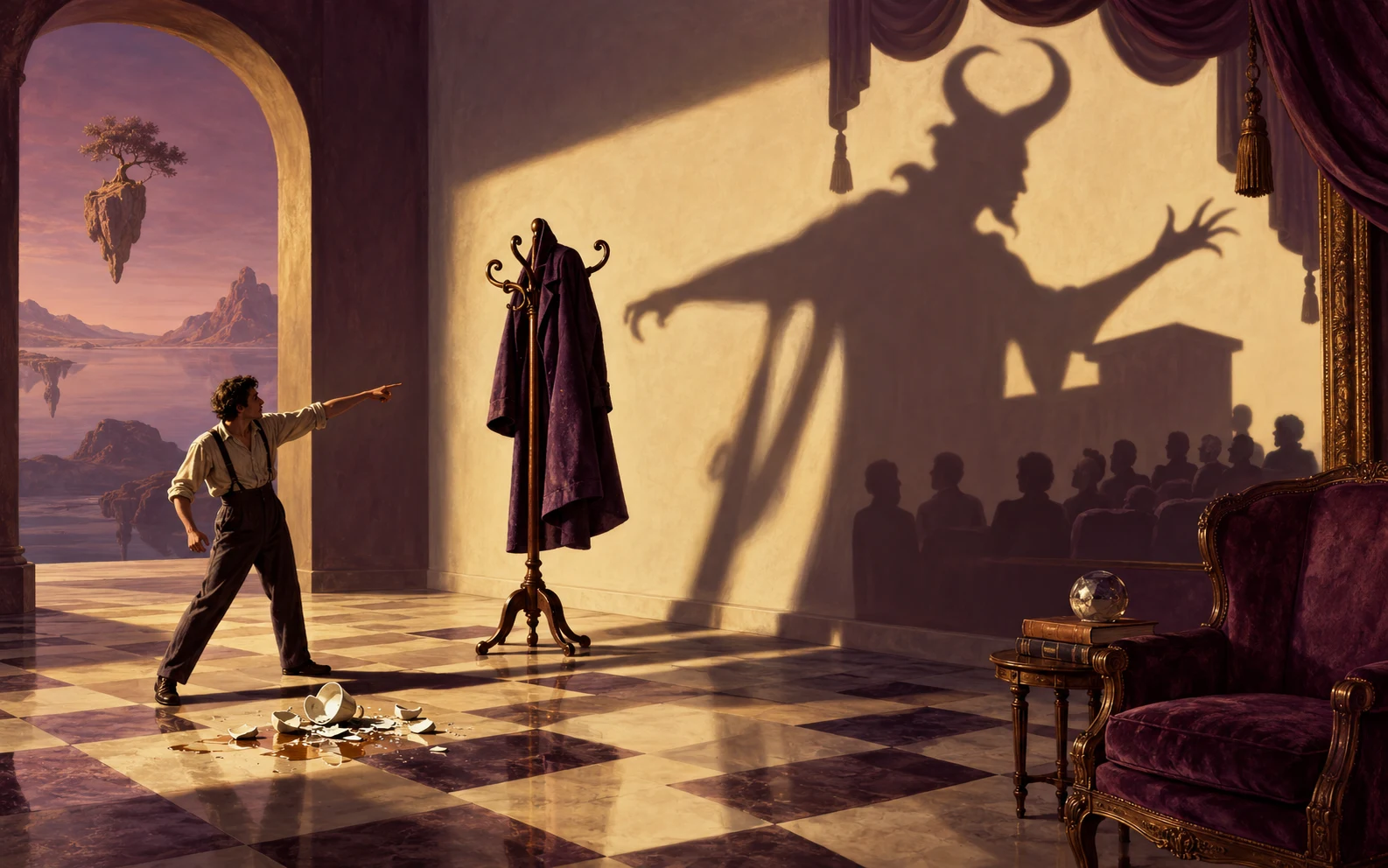
Human beings find it remarkably convenient to blame someone else. It is standard factory firmware: break a teacup in childhood, and “it fell all by itself”; lash out at a coworker in adulthood, and “the devil made me…
I. Where Religion Got Its Enemy
Human beings find it remarkably convenient to blame someone else. It is standard factory firmware: break a teacup in childhood, and “it fell all by itself”; lash out at a coworker in adulthood, and “the devil made me do it”. Naturally, across numerous traditions, a figurehead of Chief Saboteur makes his entrance: Satan, Iblis, Ahriman. Non-monotheistic systems showcase their own casts: the Norse pantheon has the trickster Loki running amok, while in Buddhism enlightenment is thwarted by Mara, the personification of illusions and base passions—though calling either Norse polytheism or Buddhist Dharma “monotheism” would require an acrobatic stretch of the imagination.
The average layman is addicted to a crude, popular woodcut: here stands the pious citizen, there gleam the pearly gates, and prancing on cloven hooves between them is an external evil spoiling all the fun. Yet brush the medieval soot off ancient scrolls, and an exquisite little detail surfaces: this “enemy” is suspiciously often a salaried civil servant on the payroll of the celestial bureaucracy, punctually executing operational directives and articulating with chilling precision precisely what an upstanding person is terrified to admit to himself even under the covers.
Let us immediately settle our terms: what follows is a literary and psychological lens, not an attempt to rewrite sectarian dogmas or peddle a cheeky metaphor as the historical bedrock of all world religions. Within Carl Gustav Jung’s authorial psychological framework, his view of the unacknowledged “shadow” offers a distinct vantage point: sometimes the “devil” turns out to be a cosmic mirror reflecting our very own disowned motives.
II. Śāṭān in the Hebrew Bible: An Official Job Title
In the original ancient Hebrew text, the word śāṭān is not an exclusive personal calling card for the Prince of Darkness, but the most pedestrian of job descriptions. The verb means “to obstruct,” “to accuse,” “to oppose”; the noun simply denotes an “adversary” or “accuser”.
King Solomon boasts of having no political adversaries—he uses the word śāṭān. David brandishes the very same term in the Psalms to dismiss ordinary mortal foes. Furthermore, in the Book of Numbers, the angel of the Lord plants himself on the road with a drawn sword before the prophet Balaam precisely as a śāṭān—that is, a fully legitimate adversary, dispatched from on high to bring an arrogant rider to a screeching halt.
In the books of Job and Zechariah, we encounter ha-śāṭān—the noun armed with the definite article. This is still not a proper name, but an official celestial vacancy: the state prosecutor, the district attorney of the heavenly tribunal. In the Book of Job, he strolls across the earth, clocks in for a routine morning briefing before God alongside the other angelic ranks, and squints with professional skepticism. Rendered into modern bureaucratic jargon, his formal memo reads: “Oh, come now, does Job fear God for nothing? Strip him of his portfolio, and let’s see what tune he sings.” Notice the pattern: the prosecutor does not stage a mutiny. He submits an internal inquiry, secures executive clearance from above, and operates strictly within divine regulatory limits.
In the Book of Zechariah, ha-śāṭān turns up once more at a court proceeding, standing at the right hand of the accused high priest. In 1 Chronicles 21:1, the noun appears without the article; it is often interpreted as the proper name Satan, though the precise reading of this passage remains a topic of scholarly debate. A missing article alone hardly issues a character a passport. The figure of an autonomous infernal sovereign is the byproduct of an agonizingly slow theological evolution, not the baseline biblical reality.
III. The Serpent in Eden: Field Fauna, Not a Fallen Seraph
Genesis 3 stages a scene that centuries later was charged straight to the devil’s account. Yet open the scroll and read literally what is written: Satan is nowhere to be found.
The serpent is plainly declared a “beast of the field” (hayyat ha-śadeh). A standard-issue creature plucked from the divine terrarium, merely endowed with exceptional wits. The ancient Hebrew word ‘ārūm does not inherently denote villainous malice—it can signify worldly prudence, cleverness, or sharp practical savvy. Genre-wise, this is a folkloric narrative featuring a talking animal that happens to supply etiological answers: why snakes crawl in the dirt, why humans harbor an instinctive revulsion toward reptiles, and why mortal existence is bogged down by agonizing toil and grief. Historical-critical biblical scholarship (including source hypotheses like the Yahwist “J”) dates the crystallization of this narrative to eras far earlier than the dawn of elaborate demonology. That said, canonizing the documentary hypothesis or literal folkloric etiology as the final, absolute truth is equally misguided: the text is thoroughly layered.
Later theological traditions welded the serpent onto the devil. In the Wisdom of Solomon 2:24, death enters the cosmos through the envy of the adversary, yet the serpent is not explicitly named. In Revelation 12:9, however, all subtlety vanishes: “that ancient serpent” is directly equated with the devil and Satan.
From a psychological vantage point, the plot is even less flattering to humanity: the reptile never force-fed the fruit to our primeval ancestors. The serpent merely articulated out loud what the humans were already itching to hear: the burning desire to achieve autonomy, to know good and evil, and to become “like gods”. In this literary interpretation, the intrigue plays out just as richly inside the human psyche; this does not invalidate other religious readings.
IV. Iblis in the Quran: Fire Versus Clay
The Islamic tradition provides its own profound and dramatic narrative, where the mechanics of the fall are laid out with uncompromising candor.
Iblis refuses to prostrate before the newly created Adam despite the Creator’s explicit command. In the Quran (Surah Al-Kahf, 18:50), it is unambiguously clarified that Iblis belonged to the jinn—creatures fashioned from pure, smokeless fire, endowed with free will—and was by no means a fallen sinless angel, even though he is present in the scene where the angels are addressed. The popular narrative recounting his elevation among the angelic ranks on account of his legendary piety belongs to exegetical commentary (tafsir), not to verse 18:50 itself.
When cross-examined about his insubordination, Iblis delivers an unadulterated manifesto of pure snobbery: “I am better than he. You created me from fire, while him You created from clay.” He does not dispute God’s existence; he breaches His direct order, rationalizing his defiance by claiming superiority over man. This is the quintessential sin of arrogance and conceited haughtiness (kibr).
From the standpoint of orthodox Islamic theology, one of the gravest transgressions is shirk (associating partners with Allah, polytheism). Yet it was Iblis’s blind pride that proved the fatal rot dragging him down to perdition. Granted an extension until the Day of Judgment, he operates as a shaytan—an agitator who whispers into the human ear the very idea that wrecked his own standing: “You are special, you are above the herd, rules are for the mediocre masses”. In this optic, the infernal foe invents no exotic, sophisticated vices—he simply turns up the gain on humanity’s overinflated ego.
V. Ahriman: The Contested Persian Footprint
Before wading into European grimoires, one must turn an eye toward ancient Iran. Zoroastrianism unfurled a monumental dualistic drama: the all-benevolent creator Ahura Mazda pitted against the ruinous spirit Angra Mainyu (later known as Ahriman).
Here lies an essential historical and theological nuance. First, the degree of equality between these two polar principles varied considerably across Iranian thought: ranging from a strict antithesis in certain versions to frameworks where both spirits originated from a singular source (as in Zurvanism), or where evil was deemed fundamentally ontologically deficient and preordained for destruction. Second, academic estimates for the lifespan of the prophet Zarathustra float across an abyss of nearly a millennium (spanning anywhere from the Bronze Age down to the 6th century BCE).
Third, the Jewish people were held not in “Persian” captivity, but in the Babylonian Exile (586–538 BCE), from which they were emancipated by the Persian king Cyrus the Great. The ensuing interaction with Persian culture under the Achaemenid Empire fostered an environment conducive to plausible influences on Jewish angelology and demonology, although the reality and extent of direct borrowings remain a battleground of ferocious dispute among historians.
Yet the structural distinction between monotheism and classic dualism remained intact: in Judaism, Christianity, and Islam, the opponent is never God’s equal. He remains a created being held on a short leash. Radical dualism is undeniably comforting for the everyday sinner (“I’m spotless; the dark god ambushed me!”), but monotheism drags the human conscience back to the interrogation room: if the cosmos was authored by a single Principle, where on earth did the pitch-black darkness in your own deeds come from?
VI. The Christian Escalation: Prince of This World
In the New Testament, the stakes rocket straight into orbit. Satan ceases to be a discreet investigator handling internal affairs. Jesus is tempted in the wilderness with concrete propositions: bread (utilitarian comfort), jumping off the temple pinnacle (spiritual narcissism and a craving for miracles), and dominion over earthly kingdoms (the ultimate ego trip). In the Gospel of John, the antagonist is branded “the father of lies” and “the ruler of this world”; for Paul, he is “the god of this age”; and in the Apocalypse, he reigns as “that ancient serpent” and the great dragon.
In parallel, an extravagant apocryphal literature blossomed, though tossing it into one indiscriminate heap is poor scholarship:
- In the early Jewish Book of Enoch, the fallen Watchers descend to mortal women and tutor humanity in destructive technologies and crafts.
- In the Book of Jubilees, Mastema commands the demonic factions, pleading with God for authority to test humankind; yet the serpent’s temptation of Eve in Jubilees is not ascribed to Mastema at all.
- The later Christian tradition of Lucifer as the resplendent angel cast down for overweening pride crystallized gradually, absorbing allegorical readings of the prophets Isaiah and Ezekiel.
Church Father Augustine of Hippo by no means regarded the devil as a figure nearly equal to God (that would have dropped him straight back into the anathematized swamp of Manichaeism, from which Augustine had spent years painfully clawing his way out). In Augustine’s theology, evil possesses no independent substance; it is privatio boni—a corruption, a parasite, the privation of good—while the devil is merely a fallen, strictly finite creature.
Down in the trenches of popular religious folklore, however, bled dry by perpetual pestilence, famine, and war, the phantom of the enemy ballooned into terrifying proportions. The Church condemned Manichaeism, Bogomilism, and Catharism as heresies precisely because of their dualism, yet the human psyche constantly yearned to hand the devil a cosmic monopoly over every wretched thing under the sun.
VII. The Shadow in Adversary’s Clothing
At this juncture, the theological drama translates smoothly into the vocabulary of Jungian analytical psychology. Carl Jung coined the concept of the “shadow”—the inventory of repudiated, unconscious, socially unacceptable traits and urges that the conscious ego tosses out the back door of its pristine facade. The professed pacifist is secretly choking on boiling rage, the miser hallucinates that he is a paragon of thrift, and the pious prude crusades against everyone else’s promiscuity while quietly smoldering with illicit fantasies.
What is shoved into the basement does not evaporate. In the Jungian model, the disowned can manifest, among other ways, via two familiar detours:
- Projection: one’s internal grime is pinned onto the neighbor, the infidel, or the ideological rival.
- Affective rupture: in a moment of stress, the psychological dam bursts, and the respectable citizen commits deeds that leave him babbling afterward: “Something just came over me”.
Religion supplies this drama with a gripping symbolic language. Muttering “the fiend led me astray” is psychologically infinitely cozier than admitting: “I was consumed by a feral craving for power, cash, or pure spite”.
From a psychological perspective, Christ’s temptation in the wilderness reads like a literary exploration of foundational human temptations: the intoxication of power, magical omnipotence, and the degradation of a spiritual gift down to visceral self-gratification. The dialogue with the serpent in Eden operates as the externalized staging of an internal dispute within an individual beginning to test the fences of the forbidden.
In this comparison, Iblis flunks a similar test: refusing the Creator’s order to bow before clay-bound Adam, he blows up his own “exceptionalism” to astronomical dimensions. Metaphorically speaking, the devil serves as the supreme ritual lightning rod for the human shadow.
VIII. What Piety Does: Repression Versus Integration
Across spiritual and moral life, two diametrically opposed behavioral paths emerge.
The first is wholesale repression. The individual constructs a soundproof stockade: “Everything holy is me and my tribe; everything filthy is outside”. If a sordid feeling stirs within, it must be kicked into the sub-basement of the unconscious, drenched in guilt, and sealed behind an iron lock. Hunting for a collective enemy can indeed forge tribal unity. But self-justification carries a hefty invoice: disowned impulses occasionally seep out as rank hypocrisy or sadistic brutality toward the sins of others. This is a possible risk, not an iron law of inevitable doom.
The second path appears in mystical traditions and requires the utmost delicacy. The Kabbalah contemplates the nature of the sitra achra (“the other side”) in the cosmic architecture; Sufism preaches the rigorous discipline and cultivation of the nafs (the lower animal self); Tibetan Buddhism visualizes ferocious wrathful deities as terrible aspects of the awakened mind, transmuting raw anger and ignorance; and Christian mysticism (exemplified by San Juan de la Cruz’s Dark Night of the Soul) teaches passage through a gut-wrenching inner void and crisis of faith.
Yet drawing an equal sign between profound mystical experience and a casual fifty-minute therapy session is an egregious error. Psychotherapy tailors its goals to specific modalities and patient complaints; mysticism undertakes the salvation of the soul, ontological transformation, or liberation from samsara. The singular commonality is this: what you stubbornly refuse to look in the eye may influence your actions from the shadows.
IX. Luther’s Satan: The Inkwell as Metaphor
Martin Luther—Reformation colossus, brilliant theologian, and master translator of Scripture—inhabited a mental landscape where the devil was almost tangible. Luther regularly documented nocturnal bouts of crushing sorrow, spiritual terror, and suffocating guilt, which he called Anfechtung (spiritual warfare, a brutal siege of existential despair).
The colorful folk tale about Luther chucking an inkwell at the Fiend in the Wartburg castle is pious legend and tourist marketing, not documented historical fact. Furthermore, slapping retroactive psychiatric diagnoses onto historical figures five centuries after the fact (“he clearly had clinical depression”) is unscientific, conceited nonsense.
Nevertheless, Luther’s method of cross-examining his adversary remains psychologically instructive. If we freely recast his spiritual brawl into the language of internal dialogue, the accuser whispers: “You are a vile, rotten sinner, and you are doomed”. In such a reading, Luther does not bother arguing that he is a spotless saint. He fires back: “Yes, I am a sinner, you got that right; but my hope rests not upon my merits, but upon the grace of Christ”.
In such an authorial psychological reading, this is the partition of responsibility: Luther outsourced paralyzing shame and self-flagellation, objectified them in the figure of the adversary, conceded his human imperfection, and found a point of support in faith.
X. When the Shadow Turns Social
If an individual who refuses to come to terms with his shadow turns into an insufferable domestic tyrant or an envious malcontent, collective blindness scaled to an entire society can contribute to catastrophe.
One possible mechanism in this model is projection: a community or nation proclaims itself the citadel of virtue while discharging all its ambient dread, aggression, and animal terror onto an appointed scapegoat. Yet attempting to explain monumental historical horrors—centuries of antisemitism, the witch pyres of the Inquisition, or totalitarian massacres—purely through “repressed sexuality” or Jungian projections is childishly naive. Historical reality is far grimmer: it is an interwoven tangle of economic pillage, raw political struggles for dominance, fanatical ideology, xenophobia, and organized institutional terror.
The Jungian shadow model is an exploratory heuristic for decoding mob psychology, not a universal courtroom verdict. It is crucial to remember: real-world evil and physical aggressors exist in flesh and blood; they are not merely daydreams of your subconscious. But when propaganda systematically dehumanizes a group of people, branding them “absolute evil,” it can expertly exploit this psychological itch: annihilate on the outside what you cannot stomach within yourself.
XI. The Alternative: The Book of Job and Jung’s Contentious Voice
Let us return to Job. In the dramatic prologue of the book, God and the Accuser engage in a crisp boardroom exchange, yet by the finale, Satan simply vanishes from the script. God addresses Job directly out of the whirlwind. And His answer is staggering: the Creator does not deliver an ethics lecture, nor does He apologize. He unfurls before the broken sufferer a panoramic tour of a wild, breathtaking, and perilous cosmos: sprawling constellations, the oceanic abyss, the ferocious Behemoth, and the invincible Leviathan. The universe refuses to fit into the cozy bookkeeping formula of “cookies for the righteous, a beating for the wicked”.
In 1952, Carl Gustav Jung dropped a bombshell monograph titled Answer to Job. In it, Jung championed a provocative modernist interpretation: the Old Testament God is presented as an unfathomable unity of light and darkness, an unintegrated unconscious wholeness, while the suffering, steadfast Job turns out to be morally more sensitive and discerning than the awesome, elemental divine force.
A clear boundary must be drawn: Jung’s reading is strictly his personal psychological hermeneutic of the mid-20th century, not the orthodox theology of Judaism or Christianity. Classical theology categorically insists on the absolute goodness of God, for whom evil is not an equal “dark half,” but a grotesque privation of creation. A believer has every right to uphold traditional dogma without being dismissed as an archaic relic. Still, Jung’s thesis violently exposes a literary chasm: one cannot cower behind the infantile delusion that the universe owes anyone a predictable, padded comfort zone.
XII. The Common Thread: Maturation Over Illusion
People adore “mindfulness” practices so long as they boil down to pleasant meditations scored to ocean sounds and airy chatter about “higher vibrations”. It is vastly more nauseating to discover that underneath the delicate film of decency lies a writhing knot of bruised vanity, spiteful schadenfreude, and cowardice.
In our authorial metaphor, an incandescent spiritual core risks collapsing like a house of cards if one remains blind to one’s own motives:
- You can sit in the lotus posture for hours, but if repressed venom is left unacknowledged, it may ricochet as toxic sarcasm aimed at your loved ones.
- You can recite the Stoics by heart and drill the faculty of rational judgment (prohairesis), but if core existential terror is never acknowledged, philosophy may degenerate into a defensive fortress of rationalizations.
Religious invocations—such as the prayer to be delivered “from the evil one” or the Islamic seeking of refuge in Allah against the whispers of Satan—take on an additional dimension under a psychological lens: they are a desperate SOS against internal self-sabotage. They represent a plea to keep our own foolishness, pride, and envy from hijacking reason and conscience.
XIII. What Remains
The modern educated cosmopolite smirks smugly at the mention of the “devil”. Naturally: a materialized red spirit brandishing a pitchfork is an antique borrowed from medieval carnival booths.
Yet alongside the junking of mythological imagery, one risks committing a monumental blunder: throwing out the very question of personal responsibility for disowned motives. When a person writes off malice as a “hormonal dip,” a “toxic environment,” or “just an off day,” evil does not pack up and leave. Self-justification can give it room to run rampant.
For centuries, religious iconography provided this destructive force with a face. Jung’s psychological model mapped it onto the mechanics of the unconscious. But the point is not to shop for the trendiest theory, and it is certainly not to anticipate an effortless liberation from human nature: automatic psychic cures simply do not exist. The challenge remains forever personal, stubborn, and uncomfortable: instead of endlessly scanning the horizon for enemies beyond the fence, do you possess the raw honesty to ask yourself—what is stirring right now in your own darkness?
Texts discussed
Genesis 3, Wisdom 2:24, Quran 18:50 and 4:48, Augustine, City of God, XI.17.