
Traditions and Worldviews
Maimonides: Why Your Cozy Little God Is Just an Inflated Boss, and Language Is Bursting at the Seams
It is physically painful for the human ego to utter the words: “I don’t know.” It feels infinitely more gratifying to put on an intellectual face and roll out a string of ponderous phrases like “infinite primordial…
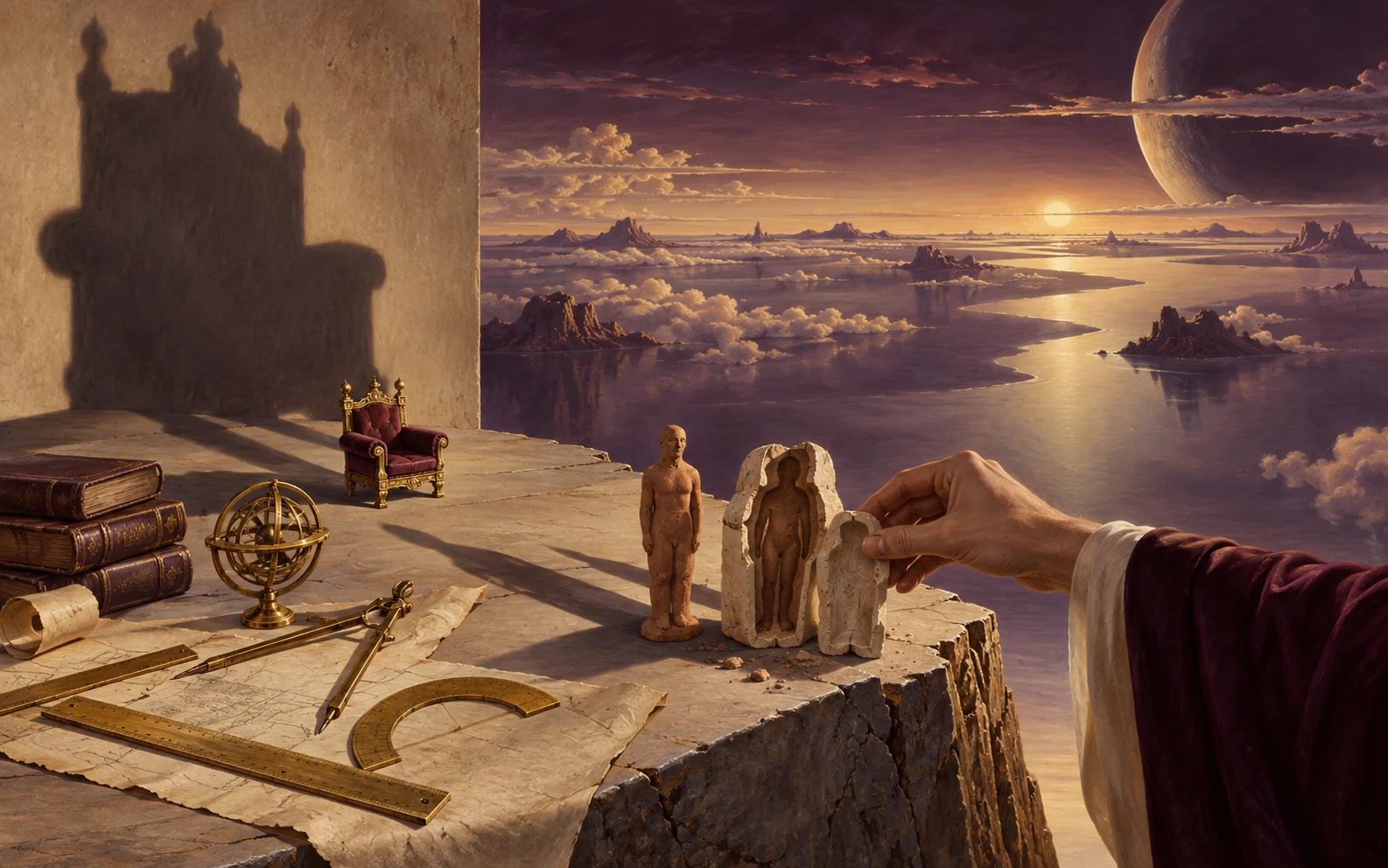
“It is impossible to truly apprehend Him.”
Maimonides, The Guide for the Perplexed, I.59, an English back-rendering of our Russian rendering of M. Friedländer’s English translation; CCEL. In context, this refers to the limits of apprehending God’s essence, not an abandonment of philosophical inquiry.
What This Article Is About
It is physically painful for the human ego to utter the words: “I don’t know.” It feels infinitely more gratifying to put on an intellectual face and roll out a string of ponderous phrases like “infinite primordial wisdom”—it sounds weighty, solemn, and completely hollow. Maimonides—a 12th-century Jewish intellectual—takes a scalpel and methodically investigates whether, under the guise of the Creator of the universe, we have merely slipped ourselves a human being inflated to galactic proportions, complete with a beard, nervous breakdowns, and royal pretensions. In The Guide for the Perplexed, he slams down an uncompromising barrier against every attempt to ascribe to God a physical torso, composite cogs, and psychological complexes. Here we unpack the paradox of negative theology, the dividing line between essence and actions, the status of biblical imagery, and the rigorous demarcation between a strict demonstration and a self-assured hypothesis. We will examine how knowledge can genuinely grow through the elimination of errors, why silence does not automatically guarantee depth, and how this thinker fundamentally restructures prayer. A quick caveat up front: Maimonides represents a specific philosophical project within the tradition; he does not speak on behalf of every single Jew throughout history. The practical exercise at the end invites you to ruthlessly dissect one of your own “ironclad” convictions to pinpoint where verbal bombast masquerades as real understanding—this is a modern mental training tool, not a five-minute parlor trick to prove the existence of God.
I. A Thinker at the Crossroads of Traditions
Let’s be honest: piling up a mountain of grandiose terms is vastly easier than candidly admitting your own incompetence. Utter the standard: “absolute goodness, ineffable might, supreme justice”—and listeners nod in solemn reverence, even though nobody in the room, speaker included, understands a single thing. Maimonides viewed such enthusiasts with undisguised skepticism. The operating principle here is straightforward: the more comfortable and familiar your mental portrait of God feels, the more scrupulously you need to verify whether you have simply traced an outline of a human being, tossed a halo on top, and slapped on the prefix “omni-.”
Moshe ben Maimon (1138–1204) set out from Córdoba, moved across the map, and eventually settled in Egypt, simultaneously juggling the codification of religious law, a medical practice, and rigorous metaphysics. To avoid spinning fables about his era, we rely on the academic analysis provided by Kenneth Seeskin in the Stanford Encyclopedia of Philosophy—which demonstrates clearly that religious law and logical rigor did not inhabit separate, parallel dimensions for him.
His magnum opus in philosophy—The Guide for the Perplexed—was written in Judeo-Arabic. And that title was by no means addressed to people suffering from procrastination who cannot decide which TV show to watch in the evening. Maimonides’ intended reader is someone who genuinely clings to sacred scripture while simultaneously taking up logic and metaphysics, only to discover that they are careening toward each other like two locomotives on a single track.
Lazy minds typically reach for one of two cheap escape hatches: either shut down the brain and proclaim that piety demands an absolute refusal to reason, or dismiss ancient texts as primitive rubbish in the face of progressive philosophy. Maimonides refuses both easy exits. He takes on the hard labor: investigating whether the reader has merely projected childhood fantasies onto the text, and just how demonstrable those philosophical hypotheses that everyone bows before actually are. The conflict often arises not between truth and faith, but between a crude literalist picture and an unexamined philosophical claim dumped into the same pile without distinction.
His conceptual toolkit is thoroughly steeped in Aristotelianism and Arabic-language metaphysical debates, but viewing him as a mere conformist translator of Greek ideas into religious idiom would be a profound blunder. He cuts into other thinkers' systems precisely where they lack rigorous proofs. Here, maintaining historical distance is vital: his medieval physics and cosmology do not constitute modern science, and a 12th-century philosophical syllogism is not a contemporary randomized controlled trial. Yet the obsolescence of medieval physics does not invalidate the logical rigor of his questions about language: if an argument rests on a false premise, no amount of pious or scientific-sounding labels will rescue it.
II. Why Familiar Imagery Can Lead Us Astray
In the first chapter of the Guide, Maimonides immediately pulls the rug out from under those fond of imagining the Almighty as an elderly bearded patriarch. Analyzing the phrase regarding the creation of man in the “image and likeness,” he categorically severs all corporeal associations: the reference points exclusively to intellect—the capacity to apprehend—not to the physical geometry of a nose, eyes, or spleen. Lesson number one: words operate in context, and dragging physical anatomy into the description of the First Cause is an intellectual dead end.
In living language, metaphors are inevitable. We casually say, “the idea ripened,” yet nobody in their right mind attempts to water it or check it for pesticide residue. We say, “the argument wobbles,” without reaching for a wooden shim to prop it up. A metaphor captures a single, specific relation. But the moment a crude imagination assumes that because Scripture mentions God’s “strong hand,” He must possess a shoulder joint, a bicep, and fingerprints, the circus begins. A botanical theory of cognition does not follow from “ripening,” just as an anatomical atlas of the Creator does not grow out of a biblical “hand.”
Maimonides’ rejection of literalism is not a bashful attempt to sweep awkward verses under the rug to appease skeptics. Quite the reverse: he regards attributing corporeality to God as a corruption of the object of faith. A person might beat their chest, imagining themselves a fierce defender of sacred tradition by clinging to every literal letter, but by zealously clinging to the pictorial representation, their fidelity to the image may turn out to be infidelity to the meaning.
Naturally, a snide objection arises: who appointed the judge? What guarantees that the philosopher isn’t simply stacking the deck, arbitrarily stamping “metaphor” on anything that fails to fit his tidy framework? The difficulty is entirely genuine. One cannot label any allegory “profound” merely because it sounds poetic. An interpretation must present a rigorous rule: why this specific meaning was adopted, and what within the structure of the text compels the rejection of the literal sense. Otherwise, we merely swap clumsy anthropomorphism for intellectual arbitrariness, where any inconvenient phrase is opportunistically declared a poetic figure of speech.
Maimonides is significant precisely because he does not issue free passes for unrestrained fantasizing; instead, he constructs a demanding discipline of interpretation. One may disagree with his arguments, but any meaningful challenge must grapple with his metaphysical foundations, not complain that he confiscated a familiar, comforting toy from the public.
III. Unity Signifies More Than the Number One
In simplified retellings, monotheism is often treated as mundane arithmetic: pagans had twenty gods, we have only one, yielding an obvious organizational optimization. To Maimonides, this formulation is laughable. Divine unity is not an ordinal ranking in a catalog; it is the radical absence of composition, division, and complexity. God is not assembled like a Lego set out of an outer chassis and internal components, or out of an underlying essence with auxiliary “skills” and passing moods bolted on.
In Part I, Chapter 52, Maimonides conducts a cold audit of our attempts to attach positive characterizations to God: a logical definition, a part of a definition, a quality, or a relation can aptly describe a composite entity in the terrestrial world, but attempting to nail them directly to the divine essence inevitably introduces composition where absolute simplicity was affirmed. The point here is not an absolute embargo on opening one’s mouth: Maimonides by no means outlaws every mention of attributes; rather, he disqualifies a specific mode of attributing qualities to essence, whereas the language of actions in Chapter I.54 entirely retains its practical and religious validity.
Consider your neighbor: he is strong, speaks Persian, and loves jazz. These qualities exist distinctly from one another, fluctuate over time, and could vanish completely without ending the man's existence. For describing a mortal creature, that is perfectly fine. But transfer that exact mechanism to the Creator, and you are no longer dealing with a First Cause, but with an underlying substrate bearing an assortment of external plugins and functions. Maimonides exposes the systemic glitch: the problem is not that you picked adjectives that were “insufficiently noble,” but that the very category of attributing qualities to essence shatters absolute simplicity into fragments.
Let us emphasize: this reasoning operates strictly within a specific framework of medieval metaphysics; it is not a self-evident fact dropped from the sky merely because Maimonides’ logic is exceptionally coherent. A reader has every right to ask why this concept of absolute simplicity must be accepted as an axiomatic premise, and how one is supposed to pray with it at all. But before waving your hands dismissively, grasp the core critique: Maimonides is not proposing to swap “good” qualities for “bad” ones; he is rejecting the very structure of a composite portrait.
Unity thus becomes a test of logical honesty. Chanting “God is One” at every corner while simultaneously depicting Him as a bundle of distinct emotional traits means verbally declaring one thing while conceptualizing its exact opposite. Similar dissonance crops up everywhere when people attempt to force elevated principles onto complex systems (though no earthly corporation or human psyche possesses Maimonidean absolute simplicity, of course).
IV. Why “Greater Than Us” Falls Short
When it is explained to people that God is fundamentally incomparable to human beings, they usually attempt to rescue the situation with a cheap trick: dialing the superlative setting up to the maximum. Sure, He isn't like us; He just knows everything, lives infinitely long, and moves mountains with superhuman power. In Part I, Chapter 56, Maimonides mercilessly cuts this trick down at its root: there is not, and cannot be, any common scale between Creator and creation.
Comparison along a shared scale works only when the items compared share a common physical or conceptual metric. Two people may know a different number of words, but their cognitive process of knowing belongs to the same order of being; a kettle can be hotter than a clothes iron because a thermometer measures the exact same molecular motion in both. But between human “knowledge” and divine “knowledge,” Maimonides denies any common metric whatsoever. Consequently, slapping an infinity sign onto a human concept does not resolve the logical error—it merely inflates it to cosmic scale.
A modern analogy: a computer stores in its memory far more records than a human could memorize in a lifetime, but multiplying the sheer volume of files proves absolutely nothing about whether the computer understands the text it holds. To be sure, this is merely a limited, heuristic illustration of incomparable scales: it establishes neither the presence nor the absence of consciousness in machines, and it certainly proves nothing about the inscrutable nature of God.
The line, “Well, we are fundamentally similar to Him, just on different scales,” is not humble reverence; it is the assumption of a common scale that Maimonides actively challenges. You have smuggled in the unexamined premise that God is essentially yourself, only enormously blown up. By expanding human traits to infinity, you do not arrive at God; you arrive at an overgrown monster.
And here the methodological crisis strikes: if words carry fundamentally different meanings, how can we open our mouths at all? Maimonides’ answer will center on negative definitions and the language of external actions. Yet do not expect an easy ride: his answer does not make the intellectual tension disappear; it merely stakes out the rigid boundaries within which reason can operate without degrading into idolatrous chatter.
V. Negation Eliminates Error Without Painting Essence
Since positive descriptions mislead, apophatic theology remains. In Part I, Chapter 58, Maimonides presents the concept of negative attributes. The purpose is not to insult the subject of discussion, but to systematically clear the ground. When we say “not corporeal,” we dump spatial dimensions into the trash bin; when we say “not dependent on a cause,” we exclude derived existence. Yet weeding a field does not mean you have erected a magnificent palace upon it: clearing away misconceptions does not hand you a positive portrait of the divine essence.
Everyday cognition trips over this immediately. In daily life, a negation is usually equivalent to a binary choice: if the light bulb is not on, we assume it is switched off; if Peter is not asleep, he must be awake. But God, in Maimonides’ system, does not sit inside the binary tables of our world. Saying “He is not mortal” does not mean automatically slipping in an endless biological lifespan. Negation shears off an unsuitable model; it does not shift God into an adjacent drawer of a familiar dresser.
Negative theology is therefore not an exhausted surrender along the lines of, “Well, whatever, we are completely mute.” It allows one to demonstrate with arguments precisely why a specific anthropomorphic absurdity is untenable. Nor is it an esoteric club where one first announces that “God is unknowable,” only to turn around a second later and narrate with a straight face what internal emotional dramas He is experiencing regarding sinners.
The central philosophical crux is this: does knowledge genuinely grow through pure elimination? Maimonides answers: yes, provided the eliminations rest on rigorous demonstrations and dismantle actual errors. The cost, however, is severe—you must permanently bid farewell to the cozy feeling of possessing an easily graspable mental image of the Transcendent. You have to learn to distinguish a sober certainty that a hypothesis is wrong from the childish illusion that you possess the full correct answer.
In ordinary life, this logic reminds us that demolishing someone else’s theory does not automatically make your own theory true. Having refuted a colleague’s guess, you have merely narrowed the field of conjectures; you have not demonstrated your own genius. The structural kinship in logic is obvious, though turning this caution into literal theology during a Monday morning office standup would be the height of absurdity.
VI. Actions Can Be Described Without Ascribing Emotions
If the divine essence is locked away from language, why is Scripture filled with accounts of His wrath, jealousy, and compassion? In Part I, Chapter 54, Maimonides sorts this out methodically: one must separate the observed outcome of an action from the psycho-emotional storm that typically drives a human being toward such an action. When the text says “merciful,” it refers to an order of things, as the thinker understands it, that preserves the vulnerable, not to the notion that the Almighty broke down and wept out of pity.
Imagine our heuristic scenario involving two surgeons in an operating room. One may genuinely empathize with the patient to the point of tears; the second may be coolly contemplating his mortgage while methodically executing a verified surgical protocol. The objective outcome of the surgery—a saved life—is identical. We judge by the action, but another’s inner mind remains opaque; matching outcomes guarantee neither identical motives nor full access to an internal state. This analogy merely illuminates the gap between an act and inner psychology, without turning God into a secretive physician with a stethoscope.
For Maimonides, this constraint is radical: any emotion represents an affection, a change of state, a reaction to an external stimulus—which entails vulnerability and composition, both unthinkable in God. Therefore, leave behind all notions of “divine psychology.” The language of actions is legitimate because it pertains to the operational order of the world as the thinker understands it, but it does not peer even a millimeter into the “inner life” of the Creator.
Naturally, pushback mounts: what about a warm, personal prayer connection, trust, and empathy? Doesn't Maimonides reduce living faith to an icy abstraction designed only to please intellectuals? This raises a serious question about religious thought. But the trick is to grasp his precise thesis: the thinker does not demand duct-taping your mouth shut; he demands that we stop confusing the poetic imagery of actions with the ontology of essence. And once again: Maimonides represents a brilliant, formidable branch of the tradition, but by no means the sole, monopolistic voice of all Judaism.
VII. Learning Ignorance Can Also Be Done in Different Ways
In Part I, Chapter 59, Maimonides tackles a tricky question: if God’s essence is equally inaccessible to everyone, what constitutes the difference between a sage and a fool? The difference is immense—it lies in the reasoned elimination of false attributes. The sage has spent years in inquiry and knows precisely why certain primitive concepts are false; the fool merely shuffles superstitions or flippantly waves his hand.
Maimonides’ disciplined ignorance has nothing in common with cynical apathy along the lines of “who knows, everything is relative anyway.” Behind the statement “I reject this argument on specific logical grounds” stands immense labor, whereas behind the casual “nobody can prove anything” lies commonplace intellectual laziness. Not possessing a final answer can mean very different things: one person is hopelessly lost among three trees, while another has carefully mapped the perimeter of the unknowable.
In that same chapter, an instructive episode is recounted concerning a man leading prayer who decided to shower God with lavish Eastern compliments, rolling out an exhaustive list of ornate epithets. The Talmudic sage Rabbi Hanina cut him off with a biting parable: imagine a king who possesses gold, and someone fawningly praises him for having a stockpile of silver. The crux of the scandal is not that the worshiper offered “too few” praises, but that he selected an entirely inappropriate category of excellence. Piling up flowery superlatives does not elevate; it merely multiplies the absurdity. Maimonides himself justifies the standard prayer formulas solely on the grounds that they are sanctioned by the text of the Torah and established by the institution of the Sages as a strict norm. Thus, the philosopher's silence is not a literary quirk for brevity; it is a metaphysical stop sign.
At the same time, one must avoid swinging to the opposite extreme and erecting a romantic cult of silence. Meaningful cheek-puffing and solemn eye-rolling are hardly marks of genius: one can remain silent from fatigue, from a sheer absence of thoughts, or from a self-serving desire to look like an inscrutable guru. Maimonidean apophaticism is ruthless analytics, not a parlor game of staying quiet.
In daily discourse, it is useful to aim a cynical testing question at grandiose declarations: what actual meaning did that loud epithet add? If words like “absolute” or “inevitable” contributed nothing beyond emotional emphasis, your argument hasn't become a grain stronger; the speaker has merely puffed out their cheeks. This is strictly our own contemporary everyday application of logical caution, by no means a claim that Maimonides was running media literacy seminars in the 12th century.
VIII. Reason Knows the Difference Between an Argument and a Demonstration
In Part II, Chapter 25, Maimonides opens with an unexpected concession: biblical passages concerning creation could, purely technically, be interpreted allegorically, precisely like the corporeal descriptions of God. However, the sheer abstract possibility of allegory does not resolve the question of the eternity of the universe. The author's first argument rests on the epistemic status of the proof: he considers the incorporeality of God to be rigorously demonstrated, whereas the eternity of the universe is not. A sufficient ground for one metaphorical reading does not automatically become a ground for another merely because the hermeneutical device looks identical on the surface.
The second argument targets the theological fallout of the theory. Aristotelian eternity, as Maimonides articulates it, carries with it an immutable natural necessity that tears up any possibility of miracles by the roots. The Platonic model, by contrast, is carefully distinguished by the thinker: it leaves room for miracles and avoids a direct, head-on collision with religious foundations, even though it likewise lacks conclusive demonstration. Thus, we face two distinct hurdles: the strength of the evidential foundation and the scale of doctrinal disruption to revelation. A convenient compatibility with faith does not substitute for a proof, but the absence of proofs does not make competing hypotheses equal in their destructive consequences.
In Part II, Chapter 24, the philosopher candidly exposes the astronomical discrepancies of his era. While his intellectual integrity is admirable, the modern reader must keep historical context in mind: the celestial spheres and his contemporary physical premises stand as monuments to medieval conjecture, not anticipations of modern astrophysics. Attempting to retrofit medieval physical assumptions onto modern scientific frameworks is simply pathetic.
Maimonides’ lesson is razor-sharp: it is never enough to announce that you dislike the literal text or that someone else’s metaphysical scheme looks elegant. You must prove why the underlying grounds compel reinterpreting the text in that exact manner. This protects against two extremes: a fanatical ban on all interpretation, and an unprincipled postmodern free-for-all where everything that inconveniences a pet theory is casually stamped as a metaphor.
An analog in our world can be found in mathematical modeling and forecasting. A generated projection can be valuable, but it leans upon a stack of baseline assumptions. If an analyst claims that a projection has “definitively proved” the future, they are engaging in manipulation. But if a critic shouts that all modeling is useless because of margins of error, they are a fool. Distinguishing the status of a hypothesis from the status of an established fact is a fundamental skill of cognitive hygiene.
IX. The Limits of Language Leave Work for Reason
Maimonides’ philosophy acts as a cold shower for those seeking cheap emotional comfort. He strips away the illusion that the transcendent can be grabbed by the beard and tucked into one's pocket. The familiar image of the Almighty feels warm and accessible solely because it has been cut to the exact dimensions of our own limitations. And a grandiose epithet seems accurate only because it papers over a logical incoherence. Thinking with Maimonides is not about building castles in the sky; it is about the merciless demolition of self-made shanties.
Negative theology is not a pungent sauce designed to brew a pseudo-mystical fog. It rests upon a rigid structural skeleton: absolute unity, an absence of composite parts, and complete incorporeality. If this system is reduced to the lazy shrug, “well, God is just unknowable, let’s wrap it up,” all genuine intellectual labor is tossed overboard: why specific words are barred, how the descriptions of actions in the world operate, and how knowledge advances through the methodical elimination of nonsense.
Such rigor comes at a high price. The human psyche naturally prefers clinging to visual imagery: it is far easier to weep, plead, and repent before an “inflated parent” than before an absolute, transcendent First Cause. Attempting to scrub language clean can feel like an amputation of emotional warmth. Maimonides does not mock believers, nor does he pretend that all traditions think identically. This is a specific, uncompromising intellectual project that generated centuries of intense controversy.
For those of us living many centuries later, the utility of his method remains obvious: it teaches us to respect the boundaries of knowledge without turning off our critical faculties. Honest ignorance can be the hard-won fruit of immense labor. A metaphor remains wonderful right up until it is mistaken for an X-ray of reality. Demolishing an error does not instantly bestow positive truth. And a plausible hypothesis remains very far from an established fact.
At the end of the day, a single, strict testing question remains: “On what exact ground am I asserting this?” If you possess a solid ground—speak plainly. If you lack that ground—find the courage to investigate further or candidly narrow your claim. For Maimonides, this intellectual asceticism served the contemplation of God. For us, it simply prevents us from turning into self-important blowhards who confuse their personal fantasies with reality.
What This Means in Practice
No esotericism, no therapy sessions, and no promises of enlightenment by next Tuesday. What follows is a mental training exercise designed to purge your own speech of pompous overconfidence. We will not be proving religious dogmas, nor will we be laying claim to saintliness. Select one modest phrase that you regularly utter with ironclad conviction: about work, personal relationships, or the behavior of those around you. Start small and mundane.
Write this phrase down on paper without editing. Now, ruthlessly highlight the universal magnifiers: “always,” “obviously,” “absolutely,” “any idiot knows,” “that’s just human nature.” Ask yourself: what is actually propping up this structure? A couple of personal grievances? A few posts you scrolled through on a feed? Or simply a convenient ideological posture? Any of these may have a place in life, but let’s distinguish weight classes: three anecdotal incidents do not create a statistical “always,” and personal belief does not become an experimental fact simply because you barked it in an authoritative command voice.
Separate the known from the discarded. What have you verified as a factual occurrence? Which conjecture were you able to bury? If one hypothesis fell apart, did you automatically award victory to the opposing theory for free, without a shred of evidence? For instance, if the theory that a colleague is plotting against you is unconfirmed, that does not prove he is your secret benefactor (or vice versa). The rigorous formulation sounds dry: “Hypothesis A was not confirmed; possibilities B, C, and D remain on the table.”
Dissect your metaphors. Are you mistaking an attractive mental picture for a physical law? “Our startup is one big family!” Wonderful, except families don't lay people off due to cash flow gaps, nor do they dock relatives' allowances over quarterly KPIs. The metaphor feels energizing while you're designing pitch slides, but when it’s time to settle accounts, you had better operate with numbers and binding contracts.
Rewrite your original phrase, stripping away all ungrounded bombast. The goal is not to mumble in indecisive hesitation, but to bring the strength of your assertions into strict proportion with the strength of your evidence. If a fact is proved—state it directly. A few days later, check in: during a disagreement with an opponent, has the emotional friction dropped? Refining your phrasing will not guarantee universal love and harmony, but it may help focus the debate on the merits of the case rather than the verbal froth.
Let us examine our heuristic scenario. A person panics and yells: “This project will fail catastrophically because the market is completely deaf to our concept!” Everything has been thrown into a chaotic blender: personal fear, a catastrophic forecast, and a sweeping diagnosis of humanity. Untangle the mess. Exactly how many prospective clients said no? Four? And how many never even opened the email? What specifically did they turn down—the core product or a clumsy presentation deck? Clarifying these points guarantees no happy ending; the project may very well crash, but now you are looking at actual obstacles rather than cosmic doom.
And beware the inverse trap: the fact that failure is not guaranteed does not prove an impending triumph. Replacing groundless despair with sugary optimism simply trades one foolishness for another. A sober posture sounds like: “These specific risks exist, these variables remain unknown, so we take the next measured step.” No guarantees about the future, just cold calculation.
Check whether you are passing judgment on someone’s essential nature based on a single discrete fact. Screaming “he is a pathologically irresponsible liar!” might trace back to one blown deadline. Document the missed milestone, state the consequences, and establish the necessary boundary—protect your boundaries without pronouncing metaphysical verdicts upon another person's soul. There is no forced holy tolerance here: protecting oneself must be firm, but there is no need to crown yourself an omniscient judge.
Leave room in your mind for revision: what concrete, verifiable fact would force you to concede that you were wrong? If no fact in nature could ever accomplish that—congratulations, you are voicing a chosen commitment or a personal limit, not presenting an objective analysis. That is entirely legitimate, as long as you call things by their true names.
And one final mirror: are you demanding an academic monograph with official stamps from others while casually forgiving yourself with “well, that’s just how it feels to me”? Place your own arguments and those of others on the exact same scale. If the standards differ—cut out the double standards. This exercise will not turn you into a medieval theologian, but it cleans out the mental pipes remarkably well wherever vanity and conceit attempt to pass wishful thinking off as reality.
Key Quote
“By means of negations.”
Maimonides, The Guide, I.59, the paragraph regarding humanly accessible knowledge of God, an English back-rendering of our Russian rendering of a short passage from Friedländer, CCEL. The phrase forms part of the assertion that such knowledge is attained solely through negations. The point concerns the reasoned elimination of an inappropriate attribute, not an arbitrary denial of everything. The epigraph and this concluding formula encapsulate the tension between the advance of knowledge and the ultimate limit of apprehension.
Cross-Tradition Connections
These comparisons are analytical. They do not demonstrate direct historical influence and they preserve the distinctions between the subjects addressed by the respective authors.
| Positions and Sources | Connection | Boundary |
|---|---|---|
| Maimonides, I.1, and Genesis 1:27 | Philosophical interpretation examines what the biblical image signifies. | This is an interpretive relationship within a tradition, not two independent assertions regarding God's external appearance. |
| Maimonides, I.54, and Schneur Zalman, Tanya, Chapter 7 | Action is examined in relation to the divine, but the inquiry is framed at different levels. | Maimonides explains God's actions without attributing human emotions to Him; Tanya examines the intentional orientation of human action. These are not two identical doctrines of intention. |
| Maimonides, I.58–59, and Daodejing, Chapter 1 | A conventional name or description fails to exhaust its ultimate referent. | Maimonides’ incorporeal God is not identified with the Dao; an identical limitation of language is not established. |
| Maimonides, II.25, and Rigveda, X.129.6–7 | The question of cosmic origins demands clarification of the degree of knowledge. | Distinguishing between a demonstration and an unproved theory differs from a poetic interrogation of beginnings; the authors’ answers do not coincide. |
| Maimonides, I.59, and Confucius, Analects, II.17 | Acknowledging a boundary can express the active work of understanding. | The Confucian demarcation between knowing and not knowing is not negative theology and does not presuppose Maimonidean metaphysics. |
Primary Sources
-
Kenneth Seeskin. Maimonides, Stanford Encyclopedia of Philosophy: academic context of his life, works, negative theology, and interpretive disputes; specific thematic sections read, not the entire bibliography.
-
Moses Maimonides. The Guide for the Perplexed, English translation by M. Friedländer, 2nd edition 1904, CCEL electronic version. I.1: image and likeness.
-
Same work, I.52: modes of attributing predicates.
-
Same work, I.54: actions and emotional attributes.
-
Same work, I.56: absence of a common scale between divine and human attributes.
-
Same work, I.58: negative attributes.
-
Same work, I.59: advance through negations, limits of praise.
-
Same work, II.24: difficulties of medieval astronomy.
-
Same work, II.25: demonstration, hypothesis, and the problem of creation. CCEL URL numbering does not always match chapter headings; verified headings are cited here. The cited chapters of the Guide were read as distinct chapters of a single work, not as eight independent studies.
-
Genesis 1:26–27, JPS 1917 English version on Mechon Mamre. Primary biblical text; excerpt read, role: object of interpretation regarding the image.
-
Schneur Zalman. Tanya, Chapter 7, core text with commentary by Yosef Weinberg, Kehot/Chabad.org. Section on intention and permissible material activity read; role: limited intra-traditional comparison.
-
Daodejing, Chapter 1, traditional attribution to Laozi, translated by James Legge. Chapter read; role: limitation of naming, without identifying Dao with God.
-
Rigveda, X.129.6–7, translated by Ralph T. H. Griffith. Full hymn read; role: poetic boundary of knowledge regarding origins.
-
Confucius and disciples. Analects, II.17, English version from the Internet Classics Archive; translator not explicitly credited on the page. Passage and immediate context read; role: knowledge and the acknowledgment of ignorance.
Tags
Maimonides, Rambam, Guide for the Perplexed, Judaism, philosophy of religion, negative theology, apophaticism, reason, language, God, incorporeality, unity, essence, actions, attributes, metaphor, image of God, Torah, demonstration, hypothesis, creation, medieval philosophy, ignorance, interpretation, precision, Laozi, Dao, Rigveda, Confucius, cognitive discipline, cross-cultural comparison
About the Authors
Andrey Zarinsh is an author and the founder of the United Wisdom project. He explores themes of inner transformation, the unity of traditions, intercultural dialogue, and modern spiritual discipline. Instagram: @andrey.zarinsh.
Maria Evilkut is a co-author of United Wisdom. Alongside research work, she seeks to test these ideas in practice and observe how principles of unity and mutual understanding operate in real life between people and across cultures. Instagram: @ilkutki.