
Meaning and the Path
The Perfect Mug Syndrome: How to Stop Beating Yourself Up Over an Unphotogenic Life
The modern internet has convinced us that unless your morning coffee is poured into an artisanal ceramic bowl costing half a paycheck, set against crisp bleached linen bedding, you aren’t actually living—you’re merely…
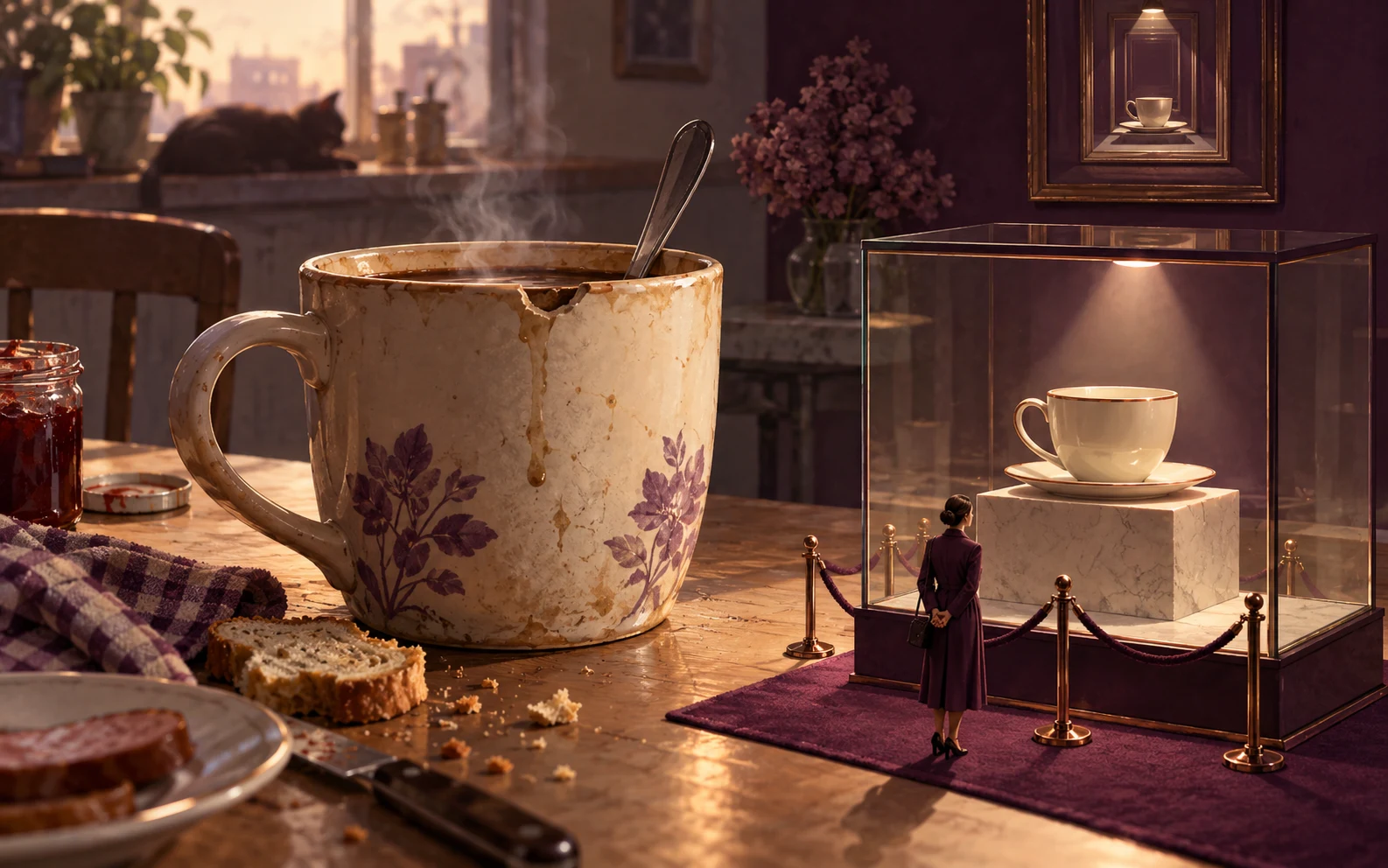
The modern internet has convinced us that unless your morning coffee is poured into an artisanal ceramic bowl costing half a paycheck, set against crisp bleached linen bedding, you aren’t actually living—you’re merely serving a sentence. It’s high time we pulled our heads out of interior design spreads and came back down to earth, where objects exist for human beings, not humans to service someone else's visual climax.
1. The Photogenic Still Life Cult vs. The Morning Sandwich
In the wild, there are two distinct ways to look at a kitchen table. The first belongs to the stereotypical interior influencer: wipe away the crumbs, stash the blister pack of painkillers out of frame, dial in the backlight, and turn the mug's tiny chipped rim precisely forty-five degrees toward the dawn rays. The second belongs to someone walking out the door in twenty minutes whose damn tea is scalding hot.
When we force daily life into constant cinematic alignment, we begin to resent our own existence simply because it contains charging cables, prescription meds, and remnants of last night’s dinner. Philosopher Yuriko Saito points directly to this trap: trying to turn every mundane detail into a museum spectacle destroys the very essence of the everyday. That is a philosophical inquiry into perceptual boundaries, mind you, not a clinical trial proving curative decor. A mug has every right to be nothing more than a vessel for boiling water without being coerced into delivering a daily metaphysical epiphany.
2. Tactile Truth: Pleasing to the Eye, Excruciating to the Touch
Design euphoria usually ends the moment physical contact begins. A door handle boasting sleek minimalist lines can dig painfully into your palm, a trendy chair twists your spine into a question mark, and a towel in a "sublime ash-grey hue" obstinately smears moisture across your skin instead of absorbing it. The visual pitch ought to be checked against real-world use.
In Art as Experience, John Dewey proposed grounding aesthetics back in living practice and bodily action. Once again, that is a philosophical line of thought, not evidence-based psychotherapy via ergonomic stools. Comfort demands a concrete person, not the idealized mannequin from a catalog spec sheet. One person needs an airy, featherweight vessel; another craves a solid, reassuring heft. Beauty is not ergonomics, nor is it under any obligation to be practical. You are entirely within your rights to love a fragile crystal goblet that is awkward to drink from and downright terrifying to wash. The crucial part is knowing the exact toll you're paying for that visual delight—and not forcing the entire household to perform acrobatic stunts just to have a morning cup of tea.
3. The Bagel Hole as Prime Value
We are accustomed to paying for solid matter, even though what we actually use is whatever isn’t there. What makes a cup useful isn't so much the kiln-fired clay as the empty volume where liquid goes. Fill a cup with solid ceramic right up to the brim, and congratulations: you own a useless cobblestone.
In chapter 11 of the Daodejing, a text traditionally attributed to Laozi, this imagery of the wheel, the vessel, and the room illustrates the utility of empty space. But take heed: an ancient treatise is a meditation on the nature of things, not an eviction notice ordering you to chuck all your furniture and squat in a stark concrete cube. An empty table might be handy for rolling out dough or just propping up tired elbows. Around the house, it helps to ask how open space genuinely serves living people; attempting to turn a half-bare room into proof of one's "elevated spiritual rank" is just plain interior snobbery.
4. Expensive Simplicity and Japanese Marketing
For some baffling reason, simplicity is assumed to be cheap and effortless. In reality, a rustic, ascetic look frequently demands gargantuan effort and ungodly sums of cash. Back in 1906, Okakura Kakuzō penned The Book of Tea, describing the tea room and its feigned artlessness while candidly recording the backbreaking labor behind that "casual" look. Just don't treat his turn-of-the-century essay as the monolithic, unvarnished voice of all Japan—it is an authorial, deeply subjective perspective of its time.
A case in point: the Black Raku tea bowl at The Met (accession 17.118.74). Hand-shaped, early 17th century, with any link to master Chōjirō regarded as purely tentative. It looks awkward and unpolished, but it carries a specific history of craftsmanship. That does not mean every lopsided clay bowl from a local crafts market is an instant masterpiece, any more than a dime-a-dozen supermarket mug deserves scorn. Cheap doesn't make you a saint; expensive doesn't make you vain.
5. Chipped Enamel: Zen Transcendence or Trash Can Material?
The craze for "patina" and "marks of time" has spawned a rather monstrous sentimentalism: crack a dinner plate and—gasp—behold the tragic drama of existence! A wooden spoon darkened by years of cooking can feel warm and pleasant; a jagged chip along the rim of a mug can slice your lip open. Wear and tear do not automatically become charming, let alone safe.
A thing's age doesn't warrant blind reverence. You can handle an object like a rational human being: repair it, tuck it away in a drawer as a personal keepsake, repurpose it as a planter, or toss it into the dumpster without the slightest shred of guilt. Likewise, an off-the-shelf purchase from a big-box store isn't "soulless plastic"—it’s a fresh slate. You are not required to pledge allegiance to the hoarders of vintage bric-a-brac, nor to the cult of unboxing cheerleaders.
6. The Kitchen Cabinet War: Memory vs. Someone Else's Sanity
Your grandmother's porcelain tea set may move you to tears because of the memories baked into it. But to your housemate or partner, it's twenty dusty monoliths hogging the only usable shelf. Personal memory makes an item priceless to you, but it doesn't transform it into a work of art for everyone else.
The darling advice to "keep only what sparks joy" implodes against the friction of shared living. If the cupboard is communal, you cannot unilaterally declare your emotional clutter sacrosanct while labeling theirs garbage. What’s needed here is mature negotiation over spatial boundaries and square footage, not the tyranny of reminiscence. Refusing to operate a domestic warehouse is not a betrayal of your ancestors, and clinging to an object offers no guarantee of keeping a living memory alive.
7. The Invisible Labor Lurking Behind "Cozy Aesthetics"
It is laughably easy to wax poetic about spatial harmony when someone else is dusting thirty whimsical ceramic figurines. That serene ambiance of immaculate order and fresh, plush towels endures precisely as long as somebody else’s hands keep scrubbing, scouring, and ironing.
In his lecture The Beauty of Life, William Morris tied the quality of home furnishings directly to the conditions of human labor (his personal stance, rather than an indisputable universal law). Caring for things can be deeply gratifying, but only when someone chooses to do so freely and possesses the bandwidth for it. When curating an aesthetic descends into an unpaid chore dumped on one family member, that cozy vibe stops smelling like Zen Buddhism and starts reeking of ordinary domestic exploitation.
8. The Aestheticization of Poverty and Drafty Walls
"Look at the poetic patina of the crumbling plaster in this historic building, and look how the light hits that antique floor tile!" murmurs a visitor, shivering inside their overcoat. "There's an arctic draft through every window frame, and getting to the bathroom means walking down an unheated corridor," the tenant shoots back.
Beauty has no business serving as an excuse for cold, cramped rooms, squalor, or inaccessible environments. Urging people to "find beauty in small things" turns into cruel mockery when directed at someone who simply cannot afford basic comfort or medicine. Catching a lovely reflection on a wall is perfectly fine. But an aesthetic experience doesn't strip away your right to demand decent heating, a ramp, and proper repairs. Noticing something pleasant is not an obligation to endure miserable living conditions.
9. The Conscious Consumption Machine
Marketers have brilliantly repackaged existential dread into glossy retail merchandise. We fool ourselves into believing that purchasing an overpriced matte stoneware tumbler, a linen napkin, and a cedarwood-scented candle automatically secures us a slow, unhurried Sunday morning.
Surprise: buying a cup buys you nothing but a cup. It doesn't bundle an extra hour of leisure, quiet work chats, or emotional peace. The hangover sets in fast: the mug sits on your desk, and your eye is still twitching with stress. Sometimes, instead of browsing a concept store, it's enough to adjust a lamp, drag an old chair to a better spot, or bluntly admit: "I am trapped in utter chaos today, and no five-hundred-dollar kettle is going to fix that."
10. The Right to Complete Indifference Toward Beauty
We are under zero obligation to live in constant, breathless awe of surrounding textures. There are weeks when you run on pure survival autopilot, sipping instant coffee out of a promotional bank mug, with no idea where the dawn sunlight fell. That fact alone says nothing about your capacity to appreciate beauty.
Everyday aesthetics is valuable as an open door, not as a mandatory civic duty accompanied by guilt whenever you fail to show up. Objects are allowed to fade back into unglamorous utility and slip into the background. Don't force yourself into reverent admiration—the universe couldn't care less, and you can stop cluttering your day with yet another scorecard for proper appreciation.
Voluntary Attention Practice (No Guaranteed Epiphanies)
This is a two-minute exercise in personal focus, not a psychologist-certified stress-busting methodology. If you're bored or simply can't be bothered, close this page right now.
-
Pick up whatever item is within arm's reach. Anything at all: a cheap ballpoint pen, your house keys, or that very coffee mug. Don't waste time hunting for the "ideal" object.
-
Evaluate its mechanics without poetry. Is it slippery? Heavy? Does it warm your fingers or leave them cold? Where exactly does your hand feel awkward holding it?
-
Consider the handling and maintenance. What feels effortless to do with it, and what makes you swear under your breath? Who washes or cleans it? Do you feel like repairing it, replacing it, shifting it aside, or just leaving it alone? If the item belongs to someone else—hands off without permission.
No guaranteed catharsis awaits. You might just realize the rim of your favorite mug is needlessly thick. That, too, is a perfectly solid conclusion.
Sources
-
Yuriko Saito. Aesthetics of the Everyday. Stanford Encyclopedia of Philosophy: https://plato.stanford.edu/entries/aesthetics-of-everyday/
-
John Dewey. Art as Experience. 1934. Publication scan: https://notesoncraft.org/assets/pdfs/Dewey_Art-as-Experience.pdf
-
Daodejing, Chapter 11. James Legge translation on Project Gutenberg: https://www.gutenberg.org/files/216/216-h/216-h.htm
-
Okakura Kakuzō. The Book of Tea. 1906. Full text on Project Gutenberg: https://www.gutenberg.org/files/769/769-h/769-h.htm
-
Black Raku Tea Bowl (early 17th century, accession 17.118.74). The Metropolitan Museum of Art collection catalog: https://www.metmuseum.org/art/collection/search/62898
-
William Morris. The Beauty of Life. Lecture excerpt: https://wehd.com/373/1076.html
Stop demanding that your kitchen look like an editorial spread and take a breath: that mug with the stupid logo from your former employer holds hot tea just fine without museum pedigree. Things exist to help us navigate this messy life, not to make us feel guilty in front of interior stylists. Allow objects to be comfortable, awkward, beloved, or thoroughly invisible—and finally free up headspace for something that actually matters.