
Relationships and Intimacy
Family tradition: the pie does not sign a contract for you
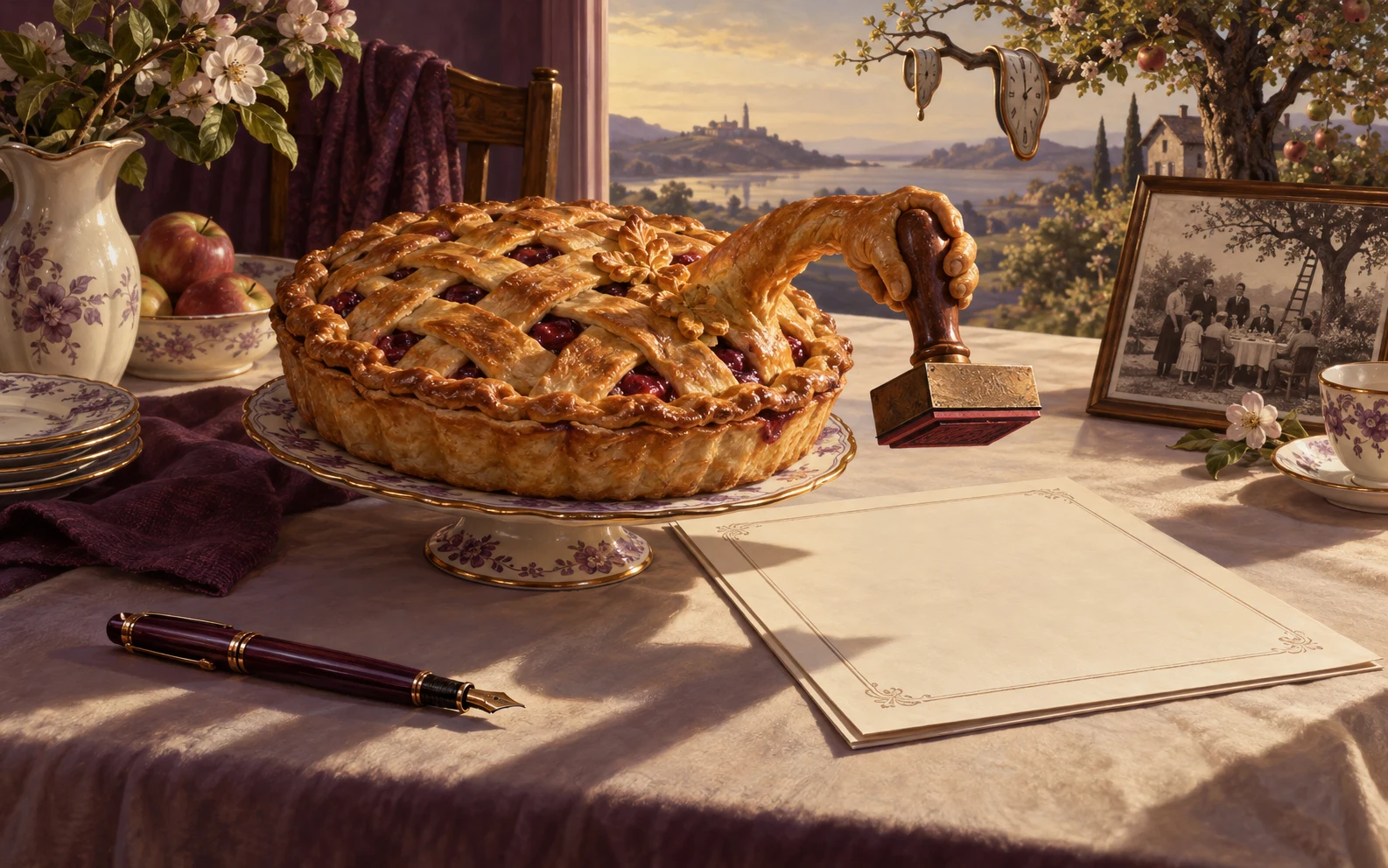
In our hypothetical story, Lida's family gathers at their country house on the first Saturday of every June: food together, a photograph by the apple tree, stories about earlier meetings. Her grandparents did the same.
Epigraph
“two temperaments, two consciences”
Edmund Gosse, Father and Son: A Study of Two Temperaments, chapter I, fragment of the first sentence. Different people within one history; the sentence's continuation is omitted.
Welcome to the family “Everything Is Compulsory” plan
In our hypothetical story, Lida's family gathers at their country house on the first Saturday of every June: food together, a photograph by the apple tree, stories about earlier meetings. Her grandparents did the same. Now Lida wants another day and no obligatory round of speeches. Aunt Tamara hears an application to resign from the family. Her brother Nikolai, meanwhile, suspects surrender in every retained element: bake the old pie and the revolution has been sold for filling. Lida wants neither the entire former script nor a declaration that her history was empty. This is a fictional family scene, not statistics or surveillance of your aunt without consent.
Memory, participation and accepting a rule are different things. You can continue an element, change it or leave it. A new form need not preserve the former meaning; the former form need not mean your agreement to the entire package. R-11-N01 examines gratitude to parents and an indefinite debt; our subject is the repeated arrangement itself. We promise no approval, closeness or reconciliation, prescribe no practice for dangerous relationships and determine no legal obligations. Tradition is not a mobile-phone plan in which agreeing to pie quietly activates a lifetime subscription to speeches under the apple tree.
I. First unpack the word “tradition”
Tamara says, “We've always gathered together.” Inside one word, however, sit the date, place, dish, photograph and everybody's obligation to make a speech. Lida is willing to eat and look at pictures, not to perform. If the package is indivisible, declining a microphone instantly becomes rejection of the relatives, the apple tree and civilisation itself. Elements can be distinguished without promising to retain them all. And without secretly dismantling a beloved gathering screw by screw while calling demolition care. The task is more modest: see exactly what is being offered before signing for the entire family lorry.
Not everything repeated identically. Grandmother changed the dishes, grandfather sometimes arrived late and speeches appeared after his death. Photographs, accounts and personal memory may supply those details. The family may not know an element's origin at all. “Always” is not a video recording of every past year. But discovering a later addition does not make it meaningless. It may have acquired genuine significance. The custom's history need not become a customs checkpoint: “Your tradition is only eight seasons old. Insufficient antiquity. Confiscated.”
Nikolai calls any demand to repeat the past a tradition. For Tamara it chiefly means people gathering. Lida discusses the speech; Tamara, the day; Nikolai, the right to decline. Three conversations have been passed off as one, and every reply now lands with the wrong addressee. The article appoints no editor-in-chief of the family dictionary. Understand the particular action. Clarification guarantees no agreement, but reveals what is being retained, changed and concluded too broadly. Without it, even a question about Saturday can arrive as an accusation of betraying the clan.
Several names can remain: the familiar day, a favourite dish, remembering grandfather, an expected speech. Their connections remain too. Sometimes people really want an indivisible observance; hear that without promising they will accept a partial version. Lida need not find the whole convenient because others dislike dividing it. Description begins discussion. It does not approve anyone's version as the shared arrangement. Even a neatly labelled box of “Family Unity” does not already contain the consent of everyone at the country house.
II. Family history explains what it means. It does not order the heir around
Tamara remembers the first summer day after a difficult family period. The table meant people could be together again. Lida did not see that day but can hear the account. Its meaning need not be invented because the old form does not suit her now. Understanding the story, however, does not accept every present rule. The storyteller's strong feeling does not decide the listener's participation. A precious memory remains a precious memory, not a notary's stamp saying “Inheritor Must Attend and Deliver Speeches Until Death”.
In chapter III of On Liberty, Mill considers custom evidence of experience that an adult interprets within personal circumstances. He does not propose throwing accumulated knowledge out and inventing the spoon again every time. His basis is the philosophical development of individuality. This is not research into country-house gatherings or proof that every refusal is correct. Mill issued Nikolai no scientific certificate saying “The More You Cancel, the More Adult You Are”, nor appointed himself a specialist in disinfecting family pies.
Lida may value seeing relatives without finding public storytelling a suitable form. Another person may accept the whole day after considering it. Difference for its own sake is not compulsory. A personal choice can also be mistaken: Lida might overlook consequences or a known promise. Past experience supplies grounds to think, not a way to ban the heir from thinking in the first place. Independence is no competition to throw Grandmother's recipe the furthest. Nor is it insurance that automatically pays out on every personal answer as faultless.
Tamara may regard the change as loss. She need not instantly rename pain “a splendid renewal of family closeness” and smile for the report. Lida can understand that loss without making it the sole condition of her decision. Disappointment carries human weight; it does not establish that every element must be repeated. History retains significance without authority to choose for someone else. Memory is an inheritance people may understand differently, not the chief dispatcher of every future Saturday. Real feelings need not become administrative power.
III. Sometimes the pie is your choice, not a white flag
Lida decides to bake Grandmother's pie. Nikolai asks why she is submitting again. But identical actions do not always have identical grounds. She likes the taste, remembers making it together and wants to share food. It can be her own choice despite the inherited recipe. Counting cancelled items does not measure freedom. Nor does her explanation reveal other people's motives: someone cooks from habit, another from obligation, another declines to defend participation before the family assembly. No need to install a capitulation sensor on every baking tray.
In The Analects, IX.3, Confucius accepts an economical change to a ceremonial cap's material but retains the earlier manner of bowing against a widespread change. Different elements are judged differently within proper ritual order. This is not an ancient course called “Live However You Like, the Relatives Will Survive”: ritual and hierarchy carry independent weight in the source. The cap changed; the ritual's grounds were not thrown away. You cannot dress this example in modern voluntary family choice and announce that Confucius has already approved everything.
The comparison reveals possibilities between “repeat everything” and “cancel everything”. But Lida's decision is not deduced from the ancient cap. She considers the dish, speech, date and her involvement herself. If the pie uses someone else's kitchen, money or an agreement, conditions matter too. Personal meaning creates no unlimited right to arrange the shared day. Spiritually self-aware pastry still cannot occupy another person's oven without asking. Personal acceptance of an element remains personal; shared actions need others' participation where they are actually affected.
Sometimes you can simply arrive without presenting the pie as a philosophical position. Not every voluntary choice needs defending at the microphone. But if arrival is understood as consent to speeches, clarify the limit where possible and safe. Otherwise one dish becomes grounds for an expanded assignment: “Since you're here, tell your story and pose for the statutory photograph.” The pie does not accept every norm of the gathering for you. Declining a speech does not deny every connection with those at the table either. Cooking is a poor substitute for precise consent.
IV. Moving it to Sunday does not necessarily preserve everything
Lida proposes Sunday. For her, meeting people remains; for Tamara, Saturday connects with the family's first shared return to the country house. Nobody can declare the meaning unchanged merely because the pie and apple tree remain. A change may retain one part and lose another. That does not automatically make it wrong, but it needs an honest description. Lida offers another option, not a certificate of zero loss. A calendar lets you drag an event easily. Someone else's memory need not move with it without objection.
Tamara may agree for practical reasons while still mourning the old day. Agreement establishes no inner delight. Lida can attend on Saturday this year without an obligation to every year following. Participation, preference and a future promise differ. The shared photograph enjoys a smooth picture; real people may not accept identical meaning and duration. A smile by the apple tree is no signature on “Everybody Agrees Wholeheartedly and Forever”. Cameras are poor readers of participation's fine print.
If Lida wants to remove the remembrance altogether while it is central for others, this may be a different gathering, not a cosmetic adjustment. It can be proposed without requiring everyone to call it the same custom. An honest new name sometimes shows more respect than “nothing is changing” while the day's central content is carried away. People need not accept the new under the old sign. This is not a family promotion saying “Entirely Different Product, Original Packaging Retained to Avoid Upsetting the Customer”. A difference is worth acknowledging rather than hiding behind the familiar name.
After rearrangement, the family day may work, remain disputed or be rejected altogether. Providing everyone with painless continuity is no compulsory extra job for Lida. It is more useful to see what carries over, what changes and whose consent is still absent. A similar dish or place does not prove identity; possible loss does not ban every choice. Do not predeclare either revived tradition or a destroyed family from one similarity of action. The apple tree issues no expert judgment, however consistently it occupies the same place in the photographs. A family upgrade need not proceed like installing an app with guaranteed compatibility.
V. Someone else's memory need not be rewritten before you decline
Lida remembers being made to entertain people with her school failures. Tamara remembers good-natured laughter. A shared event does not require identical judgments. Lida need not prove that Tamara privately enjoyed cruelty to dislike performing. Tamara need not deny what she hears in order to retain a pleasant memory. Different experiences establish no complete set of disputed facts. But they prevent appropriation of another's answer for a convenient family script. Stand-up imposed on a child without asking does not become fun for them through the total number of satisfied listeners.
The known action, personal assessment and another person's explanation differ. Lida knows a story was expected; she does not know everyone's thoughts. Tamara believes the intention good; that cannot assign Lida a pleasant experience. The article supplies no diagnosis or general verdict on the past. Sometimes naming an element someone now declines is enough. Every witness need not experience the event identically and unanimously endorse your assessment before you make your choice. The memory-approval committee may meet for a long time. Its stamp is no compulsory entry ticket to a personal limit.
Yet an unpleasant memory does not make every later conjecture reliable. “The whole gathering was always designed to humiliate” is a new claim requiring grounds. You can decline an action without assigning everyone a secret purpose. And name actual harm without compulsory gratitude for a good pie. Pie does not redeem harm like loyalty points; an unpleasant experience does not establish a universal conspiracy. Those facts do not eat each other. Precision promises no relief, but leaves the past complicated: neither an immaculate brochure nor a barren wasteland without one good episode.
Nor should the album become a court. Photographs can be kept without participation in the former format. Publishing requires attention to consent and personal information. Someone should not be cut out of shared history because their current choice is inconvenient. This article allocates no legal rights to photographs or documents. It distinguishes remembering what happened from assigning future action. An image does not require repetition; refusal does not make the past nonexistent. The family editor's scissors are poor tools for proving Lida never existed.
VI. Not every difference must end in a shared remake
At the start of Father and Son, Gosse recounts two people's divergence with respect retained. In the selected concluding context, the father's demand leaves no compromise and the son asserts inner independence. This is the author's retrospective account, not a neutral report on every religious family. Nor does it guarantee a preserved connection after your choice. The book issues no family insurance saying “Assert Independence, Relationship Guaranteed to Survive”. Someone else's historical ending does not become a promise about yours.
Tamara can keep Saturday without Lida. Lida can see a few relatives separately. These are several forms of participation, not a new arrangement everyone accepted. They need not be called an intermediate stage before complete unity. Separate meetings may remain; some contact may diminish. The actual state matters more than a sign saying “Reconciliation”. You cannot declare someone already in agreement because you badly want a finished story and the familiar picture back in its place. A family photograph should not kidnap consent for the sake of good composition.
Nikolai can retain a complete refusal. He need not accept Lida's partial option to prove maturity. But his no does not give her pie the concealed meaning of submission. Each has particular circumstances; shared actions need corresponding agreement. If Nikolai promised to transport things, the promise remains a separate matter. Rejecting the custom does not automatically cancel it. Choosing tradition matters, but supplies no universal answer to every relationship and consequence. “I Reject the Family Script” need not simultaneously function as the cancellation button for an agreed delivery.
Sometimes connection is limited or ends. No new common form is required at any price; ending contact is no compulsory conclusion either. Under threats or coercion, a joint conversation may be inappropriate and understanding your choice requires no risky announcement. Actual possibilities, dependency and local support are separate questions; this text establishes no family safety. A historical narrator's retained respect does not require a present-day person to tolerate danger. Do not hand them the book as a shield labelled “The Author Managed It. Your Turn.”
VII. Declining a speech need not declare everyone else an idiot
Lida can decline to speak without calling those who like speaking people without dignity. Her action and judgment of others' participation are separate subjects. Tamara can continue the remembrance circle for her own reasons. Respect does not, however, prohibit criticism of a particular demand. If a speech is imposed as a condition of belonging, that can be named. Neither humiliate every participant nor declare every arrangement they love good. Freedom requires no compulsory spit into the pie; respect need not award a quality mark to the mandatory microphone.
Nikolai proposes publicly mocking the gathering to prove independence. The task changes: your participation becomes an assessment of relatives before outsiders. Consequences for personal information and future communication need separate attention. This article neither forbids telling your story nor orders protection of family reputation at any price. It simply does not make public disparagement a compulsory stage of freedom. Declining a role need not require a press release saying “Everyone Still at the Table Has Irretrievably Failed Reasonableness”.
Tamara too can say, “The new version doesn't match my understanding of tradition,” without sentencing Lida. That is a particular disagreement. “You Are No Longer One of Us” operates on another scale, not one that follows automatically from a missing speech. Sometimes belonging really is tied to an obligatory arrangement; acknowledge that difference instead of painting over it. But the article does not adopt the arrangement as a universal norm. Nobody needs us to supply an additional test of human worth. The microphone by the apple tree is no instrument for establishing whether you are human enough.
Disagreement can remain sharp. Precision guarantees no polite reply. Lida can limit contact, keep a private note or leave her reasons undiscussed for now. A flawless explanation is no condition for her limit to exist. Yet her own decision reveals no hidden meaning in someone else's words either. If conversation is available and wanted, clarify the matter; otherwise continuing is no compulsory condition for a personal answer's legitimacy. The essay “Why I Don't Want to Speak” need not earn top marks from every relative. Even if Aunt Tamara has already produced the red pen.
VIII. The new free lunch can become the old conscription office
A year later, Lida arranges a small autumn lunch: come without a speech, leave when convenient. But a format convenient for her does not automatically become a common good. Nikolai dislikes group lunches, Tamara wants another date and someone is unready to host. If the new arrangement is declared the only mature, free one, people are assigned participation again. “You Must, for the Family” becomes “You Must, for Freedom”. Congratulations: compulsion has been rebranded. The proposal differs from the old pressure only where it genuinely can be declined.
The gathering can remain Lida's gathering without the compulsory shared name “Family Tradition”. Perhaps it becomes customary for several people; perhaps it remains one event. Repetition comes from actual participation, not a ceremonial announcement. Helping with food does not sign you up to cook every autumn. Coming once does not confirm every future date. Voluntariness must survive the first answer instead of vanishing after the invitation. Do not turn a trial lunch into an automatically renewed subscription with a hidden duty to chop salad until retirement.
The new version may be less convenient: costlier, fewer available dates, a lost favourite place. Your own proposal can be assessed too. Lida may learn a circumstance and change the plan without destroying her choice. Retaining a dish, agreeing to Saturday or meeting separately does not automatically restore submission. Freedom need not keep a fixed distance from every inherited object. Otherwise the old recipe still runs your life, now by forbidding its use. You can choose another answer on present grounds, not a tally of anti-grandmother achievements.
IX. Someone washes up behind the beautiful custom
Food, cleaning, invitations, travel—the familiar day requires real work. Tamara loves the gathering and is tired of doing everything alone. Discussing only her speech, Lida may miss that. Noticing the labour does not mean accepting all of it. It means distinguishing the attractive image from the actions sustaining it. Sometimes “Let's Preserve the Tradition” means “Let's Preserve the Result; We Haven't Asked the Provider Yet”. The unchanged picture hides the changed price for a particular person. The apple tree grows by itself. The salads underneath do not share that talent.
Tamara can decline to cook and still value the gathering. That too is not automatic rejection of the family. Lida can offer another dish or one part of help, not the whole day. Nikolai can decline the visit and the task. If their answers leave the former option unworkable, there is a real gap. “Someone Will Surely Do It” cannot darn it shut. A custom exists in actual actions, not the wish for a familiar result. An unclaimed task does not become completed through being declared sacred.
Work supplies no ready-made exchange rate for love. Two hours cleaning, money and presence do not automatically produce a ranking of family loyalty. A particular promise, result and available offer can be checked. A new option can be declined too. This is consideration of conditions, not a moral exam in belonging. R39 on unnoticed parts of family involvement is useful here; this article's limit is narrower: someone else's labour is not a natural property of the house. The kitchen is not a free-Tamara deposit from which salads are extracted regardless of her answer.
Sometimes there is no pie this year because nobody agreed to make it; the meeting is shorter because less time is available. Not every change develops family philosophy. Sometimes a resource ran out rather than civilisation collapsing. Name that ordinary ground instead of declaring someone destructive for lacking capacity. The smaller format may disappoint. An actual limit guarantees no acceptance, but disappointment discovers no concealed available worker. However sadly you stare at the absent pie, an agreed cook will not emerge spontaneously from the oven.
X. Returning to the country house does not repeal every old limit
The following June, Lida does come. Tamara thinks the argument over. But the visit may concern today's gathering without cancelling the speaking limit. If conditions suit, clarify that separately. Returning does not admit the former refusal was a mistake. A missing speech does not prove Lida attended merely as a formality. This article establishes no concealed motives. Retain the scope someone actually accepts now. The gate is no scanner that automatically wipes all previous conditions as you walk through.
Lida can bake a pie, hear a story, decline a photograph, leave early. Others may be dissatisfied. The result need not be called restored harmony. She better distinguishes what she continues, changes and declines; the family may have heard, or may not. A prepared speech, a retained album and an actual visit are three different facts. None confirms the entirety of someone else's consent. Do not stamp the family photograph “Everybody Finally Understands” when all you heard was the camera click.
The first Saturday has no pre-appointed winner. Lida's choice did not erase history; history's real significance for Tamara did not erase choice. Their compatibility is not guaranteed. You can name the inheritance accurately without presenting it as a compulsory script for your whole life. Continue for your own reasons, change while acknowledging loss, leave without requiring everyone to forget. None must become every relative's decision. The family may remain more complicated than a shared recipe. The pie need not deliver the final verdict for the entire clan. It should first manage not to burn.
In practice: one element, not a trial of every generation
If the subject suits, choose a date, dish, story, role or manner of participation for yourself. What history is known, what came from someone else's account, what remains unknown? No full family verdict is required. Distinguish its meaning for you, the action itself and a supposed future obligation. You can continue, change or leave the element without assigning everyone the same answer. Your notebook is no family printing press for mandatory decrees. It may simply help you see the particular matter you are considering.
When proposing change, name what remains and what may be lost. Guarantee neither the former meaning nor approval. Separately check an accepted specific promise, others' resources, personal information and the agreements needed for shared action. One visit is no lifetime obligation; declining one part does not deny the whole history. A calendar entry need not contain the complete family tree. Nor promise perfect continuity as a domestic service: “Saturday Moved. Nobody Will Hurt.”
You need not discuss the conclusion. Under suitable conditions, name your specific choice and hear disagreement without requiring delight or reconciliation. Under threats, coercion or danger, the exercise may not fit; it replaces no needed support and requires no risky announcement. There are no guarantees of closeness, safety or correctness. The aim is clearer personal involvement and grounds, distinguishing past history from current consent. Modest beside a family revolution. At least it requires no simultaneous signing by every relative of “Pie and Freedom Finally Reconciled”.
Key quotation
“the right to think for myself”
Edmund Gosse, Father and Son, concluding context, account of the son's demand, primary web line1360. A fragment of the author's account of his own objection, not a sentence from the father's embedded letter.
Connections between traditions
| Comparison | Shared question | Significant difference | Limit |
|---|---|---|---|
| Gosse and family arrangements | Can people of one history diverge? | A retrospective religious family history differs from present choice among customary elements. | No general portrait of believers or guarantee of respect or connection. |
| Mill and inherited experience | Who interprets a custom's applicability? | Philosophical defence of individuality is not assessment of a particular gathering. | No proof that every independent decision is correct. |
| Confucius and distinguished elements | Which forms change and which remain? | Choice within proper ritual order differs from a modern voluntary framework. | No ancient approval of every personal option or transferred hierarchy. |
| Memory and participation | What occurred and what is accepted today? | Retained history is not a promise to repeat an action. | Establishes no legal document rights or relatives' obligations. |
Sources
- Edmund Gosse, Father and Son: A Study of Two Temperaments, Project Gutenberg No.2540, English original. The beginning of chapter I and selected concluding contexts at web lines1289–1378 were read, including the father's letter and the author's conclusion. The whole book was not read; exact underlying printed edition not established. Both short quotations come only from Gosse's own narration, with Russian translations prepared for this article. Gutenberg's US availability is not declared universal permission.
- John Stuart Mill, On Liberty, chapter III, Project Gutenberg No.34901, English original. Selected contexts at web lines538–554 and597–609 on experience, custom, and individuality were read. The first distinction is used; no modern clinical, legal, or empirical recommendation is derived. Exact printed issue not established.
- The Analects of Confucius, IX.3, James Legge's English translation from Chinese Classics, PG No.3330. Context IX.1–9, primary introductory information, and I.11–12 were read. Ritual grounds and hierarchical limits are retained; no direct quotations. No full-corpus or exact printed-edition claim.
Tags
family, tradition, choice, custom, generations, history, memory, inheritance, form, meaning, consent, participation, voluntary involvement, change, continuation, refusal, celebration, gathering, ritual, respect, difference, promise, limit, closeness, Gosse, Mill, Confucius, independence, belonging, responsibility
About the authors
Andrey Zarinsh is the author and founder of United Wisdom. He explores inner transformation, the unity of traditions, intercultural dialogue, and contemporary spiritual discipline. Continue the conversation: @andrey.zarinsh.
Maria Evilkut is a coauthor of United Wisdom. She researches and practically tests approaches to unity and mutual understanding between people and cultures. Continue the conversation: @ilkutki.