
Relationships and Intimacy
A parent's expectations and a child's own interests
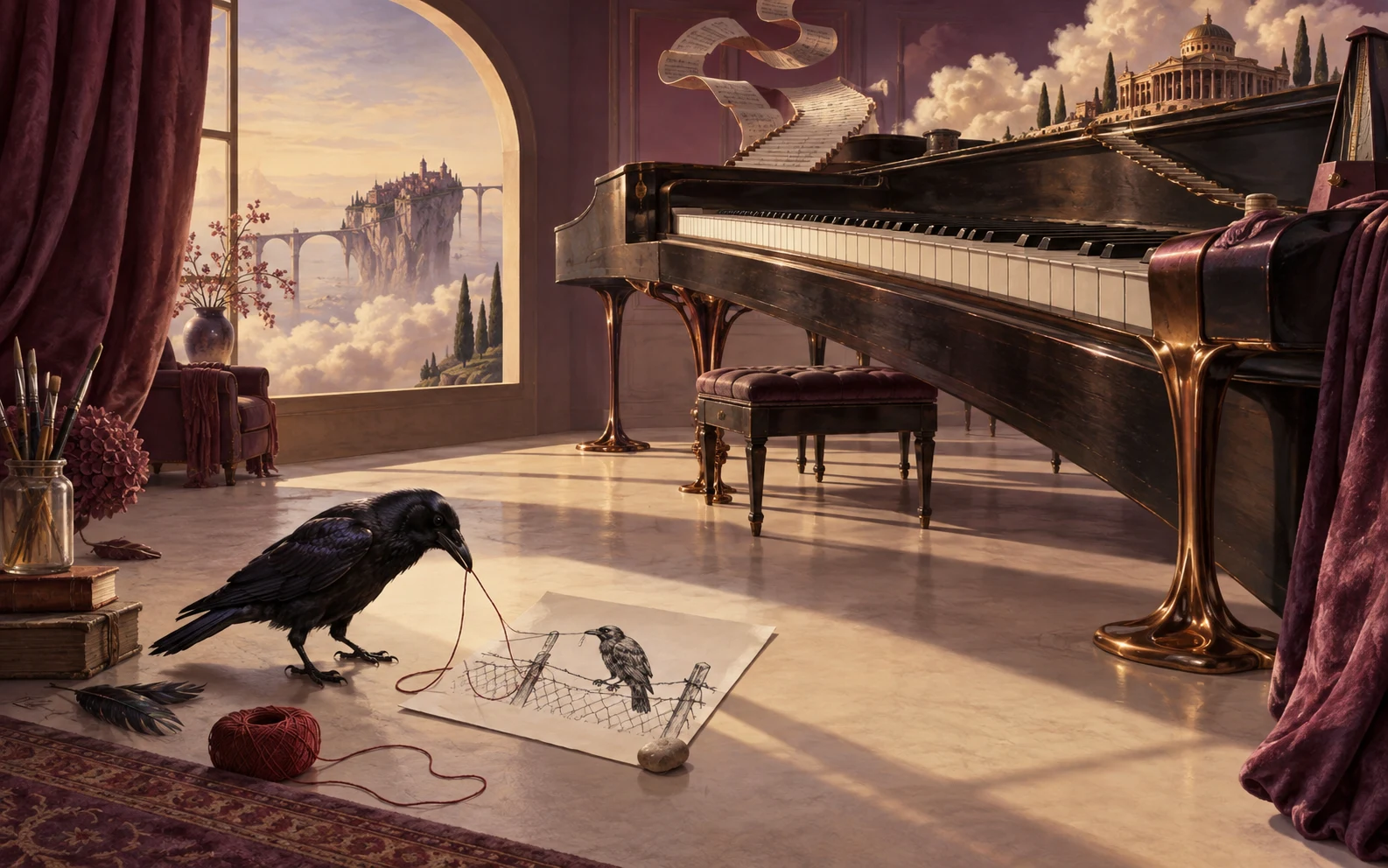
Picture the scene: nine-year-old Mira brings home a drawing of a crow passionately tugging a loose string out of a wooden fence.
Epigraph
Children are born persons.
Charlotte M. Mason. Home Education, fifth edition, 1906, Preface, principle 1. A historical educational position, rather than a current diagnostic criterion; the Russian version is our translation.
What This Manifesto Is About
Picture the scene: nine-year-old Mira brings home a drawing of a crow passionately tugging a loose string out of a wooden fence. Inside her mother’s head, however, what plays isn’t an avian squawk, but Rachmaninoff’s Piano Concerto No. 2. The mother doesn’t hear a peep about the bird; she launches straight into an interrogation: "How many times did you run that tricky passage?" There is zero malice here—just an adult desperately trying to force-feed a child her own nostalgic bliss. The result is a head-on collision between two entirely separate worlds: a grandiose parental business plan for someone else's life versus one actual, physical crow. And the crow loses by a landslide. Parental hopes are completely understandable, but they tell us nothing about what the child is breathing and living right now. It is high time we learned to distinguish a genuine invitation to try something new from an urgent demand to materialize our ancestors' unfinished fantasies.
I. The Future Enters the Room Before the Child Does
Parents love drafting a child’s glittering career before the kid has even mastered tying shoelaces. You sign them up for piano lessons, and in your head you’re already walking into Carnegie Hall—even if, in cold reality, the schedule was merely meant as a harmless brush with the arts, routine prep for a specialized school, or an attempt to carry on a family dynasty. If it’s just an open trial run for you, an abandoned sheet music notebook doesn’t cancel normal friction or basic agreements. But if you desperately need confirmation of your own personal storyline, any refusal to drill scales can instantly feel like high treason and a spit in a mother’s soul. Of course, that’s just one possible domestic drama, not an official diagnostic stamp: you could simply leave room for the crow story without declaring a state of mourning for classical music or deciding the piano’s fate for the next twenty years right there in the hallway.
A single crooked bird sketch doesn't make someone an old master, and one sabotaged lesson doesn't mean your child is fundamentally broken. Children have the sheer audacity to obsess over things that will never yield a single cent, while dragging their feet through the stuff they genuinely need for survival. Stop frantically Googling art academies every time a bird appears on a piece of paper. Brace yourself, take a breath, and just listen to a five-minute rant about a crow without instantly turning it into an investment portfolio.
II. Interest Shows in Action, but It Can’t Be Read Without Errors
Mira pelts you with questions about where birds sleep at night. Instantly, the parent hatches the deduction of the century: "She's a born ornithologist!" Pump the brakes. Maybe she just felt like chattering, maybe she copied something a friend said at school, or maybe she was simply fleeing terminal boredom.
Worst of all is when adults confuse obedience training with genuine joy. Just because a kid excels at something and gets showered with praise doesn't mean their soul is on fire. You can flawlessly rattle off scales while silently loathing the instrument, or you can smear monstrous scribbles across paper in a state of unadulterated ecstasy. When every sneeze is proclaimed a "divine talent," the child trades joy for a life sentence: living up to genius status. And if they quietly shove a paper in your face, don't stage an Inquisition demanding to know: "What were your deepest feelings when you drew this bird?" Sometimes a piece of paper is just a piece of paper.
III. An Invitation Expands the World; an Assignment Shrinks the Response
Children aren't telepathic; they can’t dream of things they’ve never laid eyes on. Dragging them to a museum, putting on a track, or taking them to an ice rink is stellar adult work. The difference lies in the fine print. A healthy invitation assumes the child has every right to say: "Thank you, that was atrocious, never take me there again." An assignment, on the other hand, demands attendance with fresh flowers and burning eyes, because "Mom already arranged everything and prepaid the entire semester."
Of course, clubs cost money, and group activities require discipline. But laying down the ground rules upfront (for instance, "we finish out this month’s pass, and then we decide") is infinitely more humane than serving an itemized bill for shattered dreams in the middle of the hallway. And if a kid digs their heels in at the classroom door, don’t rush to brand them a lazy failure or scream about psychological abuse. Figure out the actual drama: maybe the teacher is rude, or maybe the shoes just pinch.
IV. A Child’s Personhood Doesn’t Begin With a Useful Outcome
Way back in 1906, Charlotte Mason wrote that children are born persons. More than a century has passed, yet plenty of parents still act as if personhood is an unlockable achievement granted only upon receipt of a first diploma or trophy. If an activity can’t be slapped into a portfolio or monetized, it is immediately declared useless junk.
Here’s the reality: random scribbles deserve attention entirely on their own merits. A child owes you no pitch deck to justify their hobby. At the same time, respecting their individuality doesn't mean indulging pure madness: if a budding young naturalist dives under the wheels of an eighteen-wheeler to get a cool angle on a pigeon, you yank them back by the collar. Restricting dangerous antics is a parent's basic job; mocking the interest itself while doing so is entirely unnecessary. Ask them how the beak was turning first; save the academic prospects for a conversation with someone else later.
V. Support Does Not Buy You Guaranteed Passion
You bought an extortionately expensive piano, hired the finest tutor in town, and chauffeur your offspring across rush-hour traffic twice a week? Good for you. But musical instruments and club passes don’t ship with a pre-installed microchip for mandatory solfège appreciation. A child can treat the piano with care and conscientiously hold up their end of a deal without feeling obligated to love Bach out of raw financial guilt. The family budget is an adult headache; don't hang it around a child's neck.
A special circle of hell is reserved for keeping up with the neighbors. "Look at the neighbor’s kid, he already won the regional contest!" Brilliant, hand him a cookie. Another boy's competition is not a job description for yours. And take a hard look at the child's calendar: maybe they don't want anything not out of spite, but because sandwiched between mental arithmetic, Mandarin, and competitive swimming, they don't physically have room to catch their breath.
VI. Adult Responsibility Doesn’t Vanish Just Because You Show Respect
Nobody is proposing that we hand the keys of the family ship over to a nine-year-old. Children shouldn't be balancing household budgets, assessing safety hazards, or figuring out how on earth the family is paying rent. Saying "we simply don't have the money for horseback riding right now" is completely normal. The real offense is tacking on: "Besides, your horses are a stupid waste of time anyway." Financial limitations don’t make the passion itself defective.
Honestly acknowledging the ceiling of family resources is what being an adult looks like. Don’t turn your child into an unpaid therapist by dumping credit card horror stories and adult accounting onto their lap just so they crawl away from their dream feeling guilty enough to rescue the household budget. A lack of funds doesn’t equal a lack of love, and good intentions alone won't print dollar bills; affordable alternatives—a library book, an outing to the backyard, a scratch piece of paper, or a chat with someone who knows the craft—are only as good as the actual time, space, and energy the family can realistically afford, not some compulsory zero-cost band-aid. And safety stands entirely on its own: if an activity reeks of humiliation, bullying, or harm, no fairy tales about "building character" apply. That calls for real protection and local intervention, not sending a nine-year-old into a dangerous confrontation with adults just to test their goodwill.
VII. Modern Support Targets Concrete Reality
Pediatricians like Megan Moreno advise parents to take a genuine interest in what their kids are glued to, asking open-ended questions instead of staging theatrical meltdowns and yanking cords out of wall sockets. But that is sensible advice for coexisting safely with screens, not a magical incantation that guarantees eternal domestic harmony.
In 2024, Turkish researcher Oğuzhan Çelik surveyed 427 adolescents aged 14 to 19 and found that when teenagers perceive and report in questionnaires that their autonomy is supported and their basic psychological needs are met, it correlates in some way with academic motivation. Notice the catch: what was measured was the subjective perception of teenagers in questionnaires, not the objective sainthood of their actual parents. Furthermore, these are one-off self-reports within a cross-sectional model that prove no ironclad causal links, predict zero future milestones for nine-year-old Mira, and offer no guarantees that having tea together in the kitchen will miraculously fix everything. Science has issued no hall pass to abandon parenting, drift through life, or cancel necessary homework. You cannot assemble a clinical silver bullet out of a couple of citations: just avoid confusing dry statistical correlations with an actual human conversation at the kitchen table, and maintain the balance between necessary parental guidance and knowing when to keep quiet and listen.
VIII. Patience Applies Equally to Those Who Don’t Know Yet
Today your offspring dreams of training hamsters, next week they're taking apart an old alarm clock, and a month from now they plan to be an astronaut. Relax. This isn't a diagnosis of "chronic flakiness," nor is it the hallmark of a "tortured prodigy." It is the normal process of recon by fire. Childhood was never meant to be an audition for a lifelong career.
Even in the Analects of Confucius, a sharp line was drawn between what we genuinely know and what we wildly imagine. For parents, this skill is non-negotiable: admit that you cannot foretell your child's fate. If you have no idea what they will become when they grow up—congratulations, you're in the club of normal humans. The lesson wraps up at six; after that, you can just go for a walk. Don't suffocate the evening under the weight of cosmic existential planning.
IX. Revising the Expectation While Keeping Your Own Story
A mother doesn’t need to burn the piano or put on a show of dramatic grief just to connect with her daughter. Love music? Play it yourself! Invite friends over, enjoy it, share the thrill. Just don’t turn your hobby into an ultimatum: "I suffered through scales, and you must suffer too for the sake of family solidarity."
If you catch yourself bulldozing a child’s drawing yet again in the name of musical literacy, you don't need to bang your head against the wall and demand that the kid comfort and forgive you on the spot. Just shut down the lecture, walk back over, and ask about that ridiculous bird. Live your own rich life instead of trying to live it a second time through someone else's body.
X. A Drawing Can Just Stay a Drawing
Back to our scene: sitting at the table are the mother, Mira, the sheet music, and a crow with a string. Mira doesn't need rescuing from music, and her mother doesn't need to fake a sudden obsession with ornithology. But right now, this very second, the crow has a right to exist.
A child’s interest shouldn’t be inflated into a sacred cult, but crushing it under the boot of adult pragmatism out of fear of raising a future therapy patient is just as absurd—especially since listening to a crow guarantees zero lifelong domestic Zen and does not resolve all disagreements at once. Childish curiosity gets along just fine with family limits, doing the dishes, and school assignments: a child has every right to bumble around in the dark, make mistakes, have no clue about their calling, and ask for help, all while an adult manages an achievable household routine and stays at the helm. There are no bulletproof prophecies here—it is quite enough to separate your own Napoleonic hallucinations from observable facts and the living human being sitting right across from you.
What This Looks Like in Practice
- Taking inventory of fantasies. Pick any ordinary, completely safe activity your child is doing, without turning it into an impromptu genius screening or an audit of your parenting skills. If you feel like it, jot down your secret Napoleonic ambitions on a scrap of paper—which Ivy League university this playdough sculpture is supposed to lead to—and right next to it, write down strictly the facts: what the child actually did and asked about over the last few days (smeared green clay on the table, rolled out a few lumps). As a third item, write down what you honestly don’t know about their plans, and have a good laugh at the canyon between the columns—without setting up secret loyalty tests or manufacturing obstacle courses.
- Talking without an interrogation. When the moment feels right, invite them to show or tell you something specific, but keep real perspective on their age, exhaustion, or plain lack of desire to chat right now. Back off if the child isn't in the mood, and heaven forbid you try to squeeze a blood oath out of them to love this hobby until their dying breath: lending an attentive ear today doesn't mean assigning a career for tomorrow.
- Setting the perimeter. Outline a straightforward trial run with clear adult coordinates: how much time, safe physical space, and cold hard cash you are genuinely prepared to allocate, and exactly when you will circle back to review it. If the wallet or schedule is stretched to its limit, state that boundary calmly without lecturing them on the triviality of their childish whims: the practical boundary remains intact, only the tone shifts, and refusing to fund a course doesn't make their curiosity second-rate.
- Safety above all else. The second genuine physical danger, humiliation, or bullying enters the picture, shut down the educational trial immediately and forget any nonsense about "building character at the child's expense." No testing other people’s decency through your kid’s vulnerability: step in, protect them, and bring in help tailored to the situation. And when dealing with ordinary clashes of taste, there's no need to overturn the family's entire way of life—simply adjust that one specific routine or leave the matter open, giving the crow an honest chance to just be a crow.
Key quotation
Children should be encouraged to watch, patiently and quietly…
Charlotte M. Mason. Home Education, 1906, Part II, section V, p. 57; fragment. The author's own educational writing about observing living creatures, rather than a current guarantee of an outcome; the Russian version is our translation.
Connections between traditions
Mason considers the child as a person within a historical Christian pedagogy that retains adult authority, habits and religious education. The Analects, II.15 and II.17, offers a moral perspective on learning, reflection and acknowledging uncertainty; its hierarchical context differs from today's discussion of children's participation. Çelik's study analyses associations in adolescents' self-reports; the AAP guidance concerns shared digital experience. These grounds do not constitute one proven law of parenting. The editorial connection is limited to a question: how can we get to know a child's experience without treating a previously chosen adult expectation as an already known truth about them?
Sources
- Charlotte M. Mason. Home Education. Fifth edition, revised and enlarged. London: Kegan Paul, Trench, Trübner, 1906. Project Gutenberg 71087. Metadata, selected Preface material and Part II, section V, pp. 56–59 were read; the entire work was not. Historical physiological, gender and religious positions are not carried into present-day recommendations. Rights UNKNOWN; only two short reader fragments are used.
- Megan Moreno. Why Co-Viewing Is Important: Tips to Share Screen Time With Your Kids. American Academy of Pediatrics / HealthyChildren.org. Current page updated 25 June 2026. The complete main text and author, update and limitation information were read. Professional guidance about digital interaction, rather than a separate experiment. Rights UNKNOWN, with copyright stated; no direct quotations.
- Oğuzhan Çelik. Academic motivation in adolescents: the role of parental autonomy support, psychological needs satisfaction and self-control. Frontiers in Psychology, 2024, 15:1384695. Article and DOI 10.3389/fpsyg.2024.1384695. The abstract, selected methods and findings, limitations and rights information were read; not the entire article or raw data. Cross-sectional study, Turkish convenience sample and self-reports; causation is not established. The page explicitly states CC BY; this is not permission for unlimited borrowing.
- The Analects of Confucius. Translated by James Legge. Project Gutenberg 3330. Metadata and selected Book II context, including 15 and 17, were read; the printed basis of this electronic edition was not established. A historical moral text, rather than a study of parenting outcomes. Rights UNKNOWN; short paraphrase only, without direct quotations.
Tags
parental expectation, child's interests, parenting, childhood, child, parent, trying, curiosity, attention, observation, learning, personhood, music, drawing, support, adult involvement, boundaries, responsibility, age, safety, choice, uncertainty, family resources, talent, future, hope, conversation, autonomy, pedagogy, Mason, AAP, Confucius
About the authors
Andrey Zarinsh is the author and founder of United Wisdom. He explores inner transformation, the unity of traditions, intercultural dialogue and contemporary spiritual discipline. Instagram: @andrey.zarinsh.
Maria Evilkut is a co-author of United Wisdom. Alongside research, she seeks to test these ideas in practice and observe how principles of unity and mutual understanding work in real life between people and cultures. Instagram: @ilkutki.