
Relationships and Intimacy
What we pass on to children through our response to differences
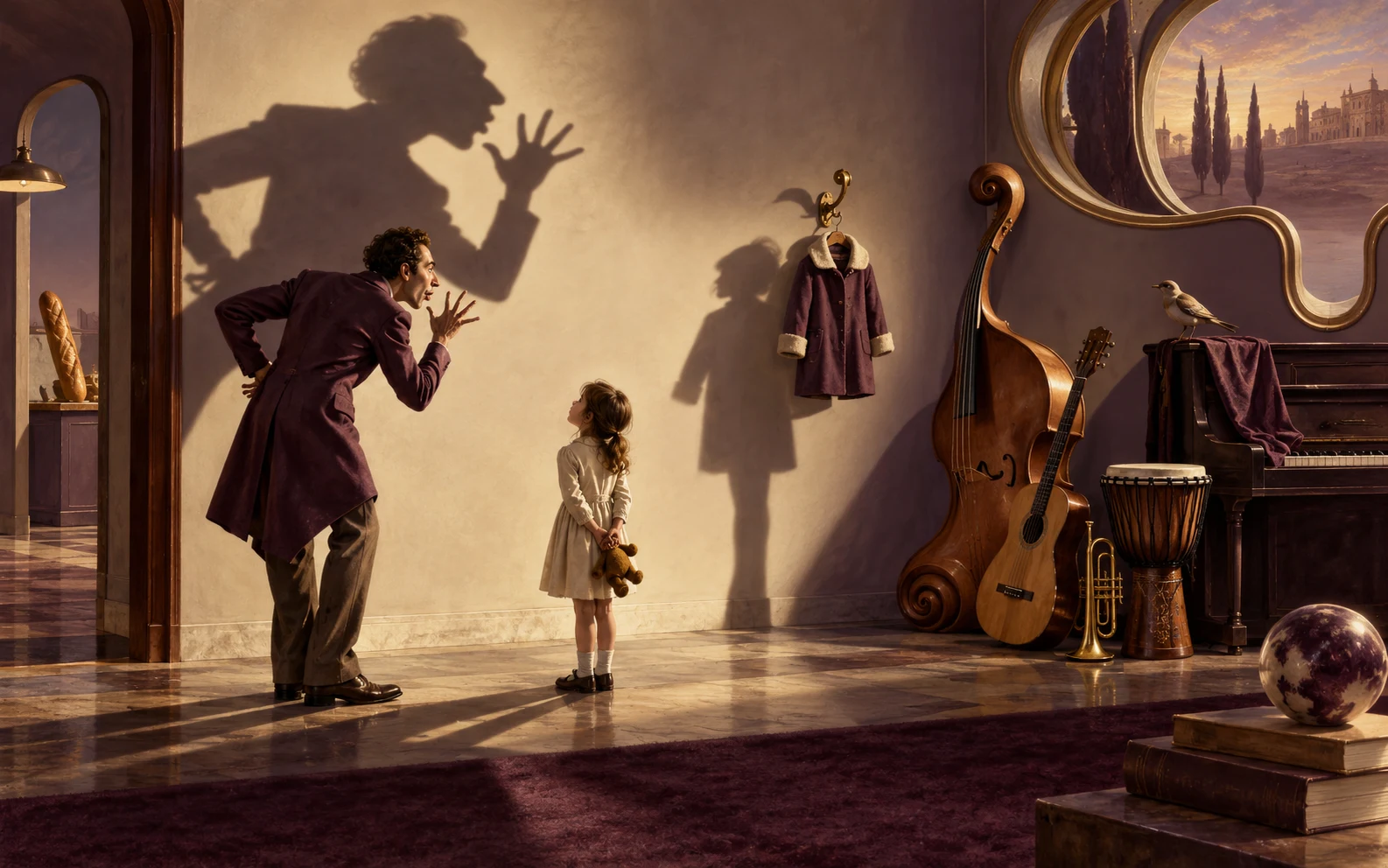
Imagine Sergey and his daughter Nika. They buy bread, leave the shop, and Dad puts on a little show, mimicking the shop assistant's unfamiliar accent. That morning he explained that everybody deserves respect.
Epigraph
We are the guides of these travellers…
Maria Montessori, The Montessori Method, chapter XV, page 237, translated by Anne E. George, 1912. A short sentence fragment with its continuation omitted from her own educational discussion of adults accompanying children's observation. This historical image does not establish a modern outcome for a particular child.
What this article is about
Imagine Sergey and his daughter Nika. They buy bread, leave the shop, and Dad puts on a little show, mimicking the shop assistant's unfamiliar accent. That morning he explained that everybody deserves respect. By evening he has released the practical supplement: somebody else's speech is fair game for a laugh, especially when its owner stays behind the counter instead of ruining the performance by being present. Nika watches. We don't know what she thinks. We do know what Dad did: a particular person's way of speaking became entertainment. Bread purchased; qualification as an expert on strangers' lives apparently included free.
This is about language, appearance, habits, money and beliefs: what we noticed, what judgment we attached and how we treated the person. One remark cannot reveal a child's future character, any more than one receipt can reconstruct the whole family accounts. There is no tested recipe for “fix prejudice before bedtime” here either. Montessori's historical teaching, modern experiments and the Convention address different questions. We will examine the adult's example without appointing the child head of the family's sainthood inspection board. Dad already has an action he can take responsibility for; his daughter needn't issue a certificate declaring him a wonderful person.
I. The child sees the show, even if the poster advertised kindness
Sergey may sincerely consider himself a decent person. The good intention need not be fake; it simply doesn't erase that particular scene outside the shop with a rubber labelled “I'm generally quite nice”. Nika heard the tone, saw Dad's smile and knew the assistant wasn't there. She might have found it funny, awkward or confusing; she might have been distracted altogether. We won't assign her a hidden reaction. The question is smaller: an adult did this with somebody else's speech. Not “his daughter will inevitably become such-and-such”, but one action without fortune-telling from a child's glance.
Dad never solemnly announced, “People with this accent are inferior.” He did choose that speech for his comedy routine. He could instead have calmly asked about a word he didn't understand: a different action, even if both versions come with the same lecture on respect. A child's smile doesn't prove learned hostility, any more than smiles in a family photograph prove there are no debts or grievances. We are looking at an example we can actually observe. A child is not an instrument that measures Dad's intentions and the remaining percentage of good parenting in his battery with one facial expression.
A useful question for the adult: if I remove my explanations, what remains visible? A joke, patient clarification, avoidance, an attempt to stop someone speaking? This is a way to examine an event, not a laboratory test for a defect hidden in the soul. Being hurried isn't automatically contempt; one awkward moment isn't a whole person. But a reason doesn't cancel an action. Sergey can acknowledge the mimicry without declaring himself a hopeless monster. And without asking Nika to say “it's all right, Daddy” immediately so he gets a consolation biscuit for successfully noticing his own behaviour.
II. An accent is not a certificate of human worth
The assistant spoke differently from what Sergey was used to hearing. That tells us nothing about whether the person is honest, educated, attentive or able to help a customer. In our scene the request for bread was understood and the purchase completed. Dad may have quietly supplied everything else through his internal fiction department. The accent's origin can remain unknown: a person needn't attach their migration history and family tree to a loaf to stop being used as a free sound effect. Unfamiliar speech describes our encounter with it; it doesn't award its owner a rank.
Respect doesn't require pretending every word is equally clear or every arrangement suits everybody. Didn't understand? Ask. An agreement unclear? Clarify it. Wrong change? Check the amount and seek correction of that particular error. Ten roubles don't warrant an investigation into an entire people's moral quality. What somebody can do in a particular situation and their human worth are different things. Calm conversation needn't solve every conceivable problem; checking an amount concerns the amount, not how familiarly the person pronounces their consonants.
“This way of speaking is unfamiliar to me” and “people like that can't be trusted” are claims of different sizes. One can describe your perception; the other claims knowledge about many people. Buying one loaf did not provide that knowledge, however large the bag. Nika might adopt Dad's connection or might not; the adult can at least avoid selling it as an obvious fact. There is no need for a lesson claiming everybody is perfect and only villains check their change. Particular caution, acknowledged uncertainty and a refusal to treat somebody's difference as proof of an inferior grade can coexist.
III. Two experiments are not an X-ray of the entire family
The publisher's abstract for Skinner, Meltzoff and Olson describes two experiments involving adults' biased nonverbal signals. In the first, children saw a short video showing different treatment of two people; researchers then assessed preference and prosocial behaviour towards those people. The second reports that the preference acquired spread to other people. This is a particular setting, not a surveillance camera covering an entire childhood. Our basis is the complete publisher's abstract, not the full paper, methods and data. Invented sample sizes, effects and details don't get bolted onto it: a scientific link doesn't include a sack of spare parts for whatever conclusion we fancy.
The research allows a limited question: an adult's treatment of someone can be studied as a visible signal, rather than only as a spoken commandment. It doesn't predict that Nika will mimic people or hold a particular belief until retirement. Nor does it prove Sergey's later conversation will fix everything. A short video and a living family differ in circumstances, participants and time; the magic phrase “children copy everything” doesn't remove those differences. Our fictional daughter wasn't enrolled in an experiment just because Dad bought bread today and the article acquired a link.
Our question is broader: speech, money, faith, habits and different encounters. We won't stretch one result over all these differences like a universal cover for a sofa, a motorcycle and a refrigerator. We can consider our mockery morally without that generalisation. Sergey already knows he ridiculed an absent person's speech. Deciding to stop needn't first require proof that he damaged his daughter or produced a lasting prejudice. A scientific question and personal responsibility can stand beside each other. Neither has to dress up as the other before an adult finally deals with his own action.
IV. A guide doesn't own every route in the child's head
In chapter XV of The Montessori Method, Montessori discusses observation, language, individual differences and different assistance for children. This is historical pedagogy in Anne E. George's translation from the 1912 edition, not a modern tolerance experiment. Old exercises don't become ready-made instructions for your family because a quotation looks lovely. A limited image is useful: the adult draws the child's attention to the world, and the child is a separate observer. A guide accompanies a traveller; they don't register ownership of the traveller's head along with the suitcase.
Nika might ask, “Why are some words hard to understand?” That needn't be hostility; she may be trying to work something out. If Dad responds to every question with a siren announcing “an incorrect view has entered the family”, curiosity gets hit before he discovers what it means. Don't demand an immediate recital of the approved formula. Clarify the question; distinguish curiosity, mockery and treatment of a person. Context matters. Dad has not received his daughter's understanding in a sealed envelope. Her answer may differ from the one he is already rehearsing on her behalf.
Dad needn't know everything about every language and custom either. “I don't know where that accent comes from; we didn't need to know to buy bread” is a perfectly ordinary answer, not resignation from parenthood. If they want to learn more, appropriate information and the voluntary participation of anyone they ask are needed. The assistant isn't a free embassy for all cultures, summoned to the counter for a family tour. Explaining what is known, acknowledging ignorance and taking responsibility for treatment are possible. Issuing a final worldview to your daughter or demanding a stranger's biography as teaching material is a different and rather presumptuous service.
V. Respect doesn't mean agreeing with absolutely everything
That evening Sergey hears a relative express an opinion he disagrees with. Setting a good example doesn't necessarily mean swallowing it with the tea and declaring differences untouchable. A factual claim, an unsuitable rule or a harmful action can be challenged. Name the subject and grounds: which statement is wrong, what information is needed, what limit applies in your home. The speaker's origin and language are not substitutes for an argument. Precision promises no peace at the table, but it avoids turning a disagreement over one issue into writing off an entire person as “the wrong breed”.
Nika may see Dad clarify, decline to continue an argument or identify unacceptable treatment—or simply deliver a humiliating nickname, after which the only subject left is Dad's talent for nicknames. The first approach doesn't make him infallible. An adult can feel irritated, pause and later correct his claim. A pause isn't necessarily contempt; confident volume isn't proof of being right. Examine the grounds and the action separately from the person's category. A family argument shouldn't be won by whoever has the strongest vocal cords and the fastest department of insulting labels.
Where there are threats, violence, pressure or danger in continuing contact, an ordinary discussion may be completely inappropriate. Don't tolerate that in the name of openness or present the child as a living advertisement for intercultural harmony. Protection and suitable assistance are needed for the particular circumstances; one conversation doesn't come with a universal emergency exit. Contact can end because of an action and a risk without declaring everybody similar dangerous. A necessary boundary remains a boundary. It needn't include humiliation of somebody's origin or require your daughter to attend a risky meeting for the sake of an especially beautiful family principle.
VI. You can love your borscht without a world championship in borscht greatness
Sergey has a language, family habits and favourite celebrations. Recognising other people's dignity doesn't mean urgently abolishing them and handing his daughter a universal cultural void. Article 29 of the Convention on the Rights of the Child places respect for one's own cultural identity alongside respect for other civilisations. That is a normative aim of the document, not an experiment on the effects of family conversation or a religious-education timetable for every country. The question is smaller: can we talk about what we love without somebody else's supposed wretchedness as the backdrop? Our family history needn't hire other histories as extras in its own magnificent production.
You can cook a familiar dish and not want to replace it. There is no need to declare that everybody who eats differently has ceased to be human. Say what you like and which conditions matter. If Nika wants to try something else, consider the food available, circumstances, necessary restrictions and particular risk—not her loyalty to Grandma's ladle. This isn't dietary advice saying everything can be tried indiscriminately. Checking food simply isn't an exam in belonging. Favourite borscht can remain favourite borscht without an official declaration that all other soups are errors in the universe.
Nor should a child be required to hide their language, clothes or belief for everybody else's convenience. Nika needn't become a featureless placeholder to respect other people. Not everybody needs to participate identically in every event; an available shared arrangement can leave genuine differences intact. The Convention's Articles 2 and 30 on non-discrimination and children's cultural life have their own addressees and conditions; they don't prove our suggestion works. The moral point of the adult's example is smaller: respect isn't a prize for resemblance, and a child's own history isn't an entry pass confiscated after the first new question.
VII. Somebody else's budget needn't attend a family interrogation
A guest at a celebration might need a quiet place, different timing or an explanation of a custom. Conditions can be discussed without ceremonially declaring the guest a problem for which the whole household is performing miracles of generosity. Good intentions don't make assistance suitable automatically: clarify the specific offer with its recipient, without a public confession of all their reasons. No answer? Don't present your guess as an established need. Your daughter may see adults alter an arrangement without passing judgment on the guest. “May” doesn't mean a guaranteed parenting bonus for Dad's new folding chair.
Someone declines an expensive trip, and you're already preparing to measure the depth of their friendship by the thickness of their wallet. We don't know their circumstances. They needn't send a bank statement to prove respect for the hosts. A different available arrangement can be offered without a ceremony entitled “We Have Descended to Your Level”. Cheaper may not suit them either. One invitation doesn't repair every difference between lives. A refusal can be accepted without mockery; labelling a whole group lazy or ungrateful because one guest is absent is the organiser's imagination pretending to be the result of an inspection.
The family doesn't acquire an unlimited obligation to pay for any arrangement that suits everyone either. It has its own resources; the other person can decline an offer. A limit can be stated honestly and incompatibility left open, without a legend about somebody being worth less. Nika needn't act as negotiator, obtain private explanations or persuade the guest to agree. She isn't a trainee at the family Ministry of Public Reconciliation. The example concerns her father's actions. Repairing society with his daughter's hands while disposing of his own awkwardness is highly questionable educational outsourcing.
VIII. Correct the action, not Dad's advertising brochure
Sergey can return to the scene: “I mimicked the way that person spoke.” Without announcing that he has understood everything forever, and without assigning Nika shame for her smile. His daughter wasn't hired to comfort Dad and restore his self-esteem either. If the adult wants to change his treatment, he needs a specific option for a similar occasion: ask about a word, don't copy an accent for laughs, challenge the actual issue. This doesn't guarantee a new belief in the child. It does identify a possible change in his own action instead of another monologue about “I'm so wonderful I even acknowledge my mistakes better than everybody else”.
There is no automatic requirement to return to the assistant with an apology, a private moral lecture and your daughter in the front row. The person may know nothing about the joke, want no conversation or simply be working rather than servicing your moral upgrade. The good meaning of an apology doesn't issue its recipient a ticket to a compulsory educational show. Consider separately which action is actually addressed to them and which contact is necessary and appropriate. There is no universal order to meet. Your mockery can stop without the stranger's participation. If contact happens, they retain their own answer, including the wish to bring the family “Dad's Best Confession” awards to a swift conclusion.
Nika may not have noticed the joke, may ask about something else, agree or object. Don't mark her reply with a red pen against the new family tolerance standard. Leave room for questions without demanding recognition that the family is now better. Her later behaviour isn't exhausted by this conversation: there are other encounters, information and her own understanding. The adult is responsible for his action; he doesn't own the entire result for another person. That isn't giving up care. Dad's confession isn't a button that obliges his daughter to reboot immediately as the correct kind of human.
IX. Three foundations are not a parenting warranty
Montessori considers historical educational guidance; contemporary authors test a particular question in two experiments; the Convention sets out normative aims and protection of dignity. They can be compared, but they cannot be poured into one proven method for every family like three leftover sauces into a suspicious universal gravy. Their proximity doesn't mean a child inevitably copies an adult, correct speech wipes out prejudice or every difference is harmless. A separate moral question remains: what treatment do I show, and what grounds do I attach to somebody's difference? Answering it doesn't require handing the mixed sources a joint diploma.
Nor is round-the-clock surveillance of a child needed to hunt down a hidden parenting defect. One of your remarks or decisions can be considered without sorting all parents into first, second and technically unfit classes. That sorting would repeat the same mistake: a particular feature becomes a person's rank. Responsibility for an action remains; it isn't a complete assessment of a person. Serious concern about a child's condition calls for separate appropriate attention and, where needed, professional help. Our question isn't a diagnosis of views, development or the cause of behaviour. A handsome report for your acquaintances doesn't replace the help needed either.
The word “difference” doesn't grant amnesty to everything. A harmless preference is one thing; an action violating somebody's limit or creating risk is another. A person's dignity can be respected and a particular action rejected. Unusual speech isn't proof of vice; nobody has prohibited checking the price, change and terms of a purchase. Respect concerns the participant; checking concerns the subject. Neither automatically awards the other a seal of quality. A more precise example is available for the child to see. What they make of it still isn't a box Dad can fill in on the report beforehand.
X. Bread can be bought without inaugurating a new moral era
A few days later in our fictional scene, father and daughter return to the shop. Sergey organises no public reconciliation and requires no especially friendly greeting from Nika. He simply deals with the purchase and calmly asks about a word he doesn't understand. We don't know whether his daughter changed or the assistant felt justice restored. One small change is known: speech stopped being material for a routine, and an unclear word became a subject for clarification. Bread purchased again. Not enough to proclaim a new family era; enough for Dad to have done something differently.
If Nika later makes an awkward joke herself or disagrees with her father, that is a new event to consider, not proof the previous conversation wasted the parenting budget. One example doesn't explain everything that follows. She may ask about a custom Dad doesn't know; he can find appropriate information or acknowledge ignorance. Parental certainty isn't the only permissible outcome of meeting the world. Learning, clarification and maintaining a boundary where there is a real risk remain possible. His daughter needn't constantly prove the family holds good views like a living banner nobody is allowed to switch off.
An intention, an observable example and somebody else's understanding are three different things. We don't always show precisely what we meant to explain; a child doesn't always adopt what they saw. This limits promises, rather than giving permission to do nothing. Take responsibility for the remark, its grounds and subsequent treatment. You can love your own culture without humiliating someone else's, challenge a claim without a sweeping label, and end dangerous contact without declaring an entire people a threat. The child's later outlook is developing experience, not a completed artwork on which an adult signs “all rights mine”. Harmony isn't guaranteed. Your real part in the actions remains.
What this means in practice
1. Examine one of your episodes; don't submit the child for inspection
If appropriate, choose an ordinary safe occasion when the child saw you treat someone. What did you say, choose, ask, or discuss in the person's absence? Separately, which difference did you notice and which judgment did you add? Don't determine the final parenting result from a child's smile: it isn't a character barcode. An accent, income and unfamiliar custom don't necessarily explain reliability. If something needs checking, name the subject and the information required. The unknown can remain unknown. This examines an action; it isn't a prejudice test or therapy with an “Ideal Family” prize.
2. One change without recruiting strangers as extras
You can ask rather than mimic, challenge the actual subject, offer an available arrangement or acknowledge an unsupported conclusion. Don't make the child your examiner or another person compulsory scenery in your educational film. The need for contact, its appropriateness and safety are separate questions. Where there is a threat, reflection doesn't require continuing the relationship or revealing plans to a dangerous participant for the sake of a beautiful ending. Protection and suitable assistance depend on place and circumstances; their actual availability needs finding out, not replacing with a generally kind phrase. An adult's practice shouldn't finish with “what a lesson in openness” pasted over a real risk.
3. Record an actual change; don't hand your daughter a finished head
After the event, name what actually changed and leave the rest unknown. A conversation can be omitted, stopped or revisited later. It promises neither the disappearance of prejudice, the child's agreement nor family closeness. A child's question can be clarified; the limits of your own knowledge acknowledged. What matters isn't a perfect tolerance protocol, but distinguishing your grounds, your action and another person's independent understanding. Your own history can be supported and another respected without identical beliefs. Sometimes the start is very small: a person stops being evidence of an inferior grade merely because you heard an unfamiliar sound, and Dad stops treating a purchased loaf as a licence to decide somebody else's worth.
Key quotation
very different kinds of help
Maria Montessori, The Montessori Method, XV, page 231, Anne E. George translation 1912; a contiguous phrase within her own sentence about individual differences requiring different help from a teacher. The phrase retains that educational context; it does not diagnose a child's need or prove the usefulness of any offered help.
Connections between traditions
| Basis | Connection with the question | Difference and limit |
|---|---|---|
| Montessori, XV | An adult accompanies a separate child's observation | A 1912 educational text in translation, not an experiment on the transmission of prejudice |
| Skinner, Meltzoff, Olson | Adult treatment is examined as an observable nonverbal signal | Two experiments' abstract was read, rather than a prediction of a particular child's destiny |
| Convention, Articles 2, 29, 30 | Normative grounds for nondiscrimination, one's own culture, and respect for others | The document does not test a family conversation's efficacy; local procedures remain separate |
| Editorial reflection | Distinguishes a feature, judgment, subject of examination, and one's own action | A voluntary reflection, rather than the sources' common doctrine or a diagnostic method |
Historical education, an experimental question, and a normative goal do not form a single tradition or guarantee an outcome. Their comparison retains distinct grounds.
Primary sources
- Maria Montessori. The Montessori Method, translated by Anne E. George, New York: Frederick A. Stokes Company, 1912. Project Gutenberg 39863. Actual reading: title/preface metadata and selected chapter XV context including pages 231–238; not the whole book or original Italian critical edition. Historical education, not current efficacy evidence. Rights UNKNOWN; no universal licence inferred. Actual text.
- Allison L. Skinner, Andrew N. Meltzoff, Kristina R. Olson. “Catching” Social Bias: Exposure to Biased Nonverbal Signals Creates Social Biases in Preschool Children. Psychological Science 28(2), 216–224, issue February 2017, first online 21 December 2016. DOI 10.1177/0956797616678930. Actual reading: complete publisher abstract and metadata/open-practices/rights notice; methods, data, and full paper unread. No direct quotation; rights UNKNOWN. Publisher record and abstract.
- United Nations. Convention on the Rights of the Child, adopted 20 November 1989, entered into force 2 September 1990; official text hosted by UNICEF. Actual reading: identification and selected Articles 2, 29, 30 with returned surrounding context. Normative document, rather than parenting-effect evidence; local application and services not checked. Direct quotation zero; rights UNKNOWN. Official text.
Tags
children, parents, adult example, differences, respect, accent, speech, belonging, culture, dignity, prejudice, observation, nonverbal signals, disagreement, grounds, action, family life, unknown, clarification, boundaries, safety, voluntary participation, responsibility, income, accessibility, Montessori, education, Skinner, Meltzoff, Olson, Convention, United Wisdom
About the authors
Andrey Zarinsh is the author and founder of United Wisdom. He explores inner transformation, the unity of traditions, intercultural dialogue, and contemporary spiritual discipline. Instagram: @andrey.zarinsh.
Maria Evilkut is a coauthor of United Wisdom. Alongside her research, she seeks to examine these ideas in practice and observe how principles of unity and mutual understanding work in real life between people and cultures. Instagram: @ilkutki.