
World and Consciousness
Kant: The Conditions of Experience and the Limits of Possible Knowledge
The human brain is hardly an all-seeing laboratory of cognition; it is a squishy lump of grey matter trapped for life inside the dark cage of a skull, sentenced to peer out at reality through the cramped slit of five…
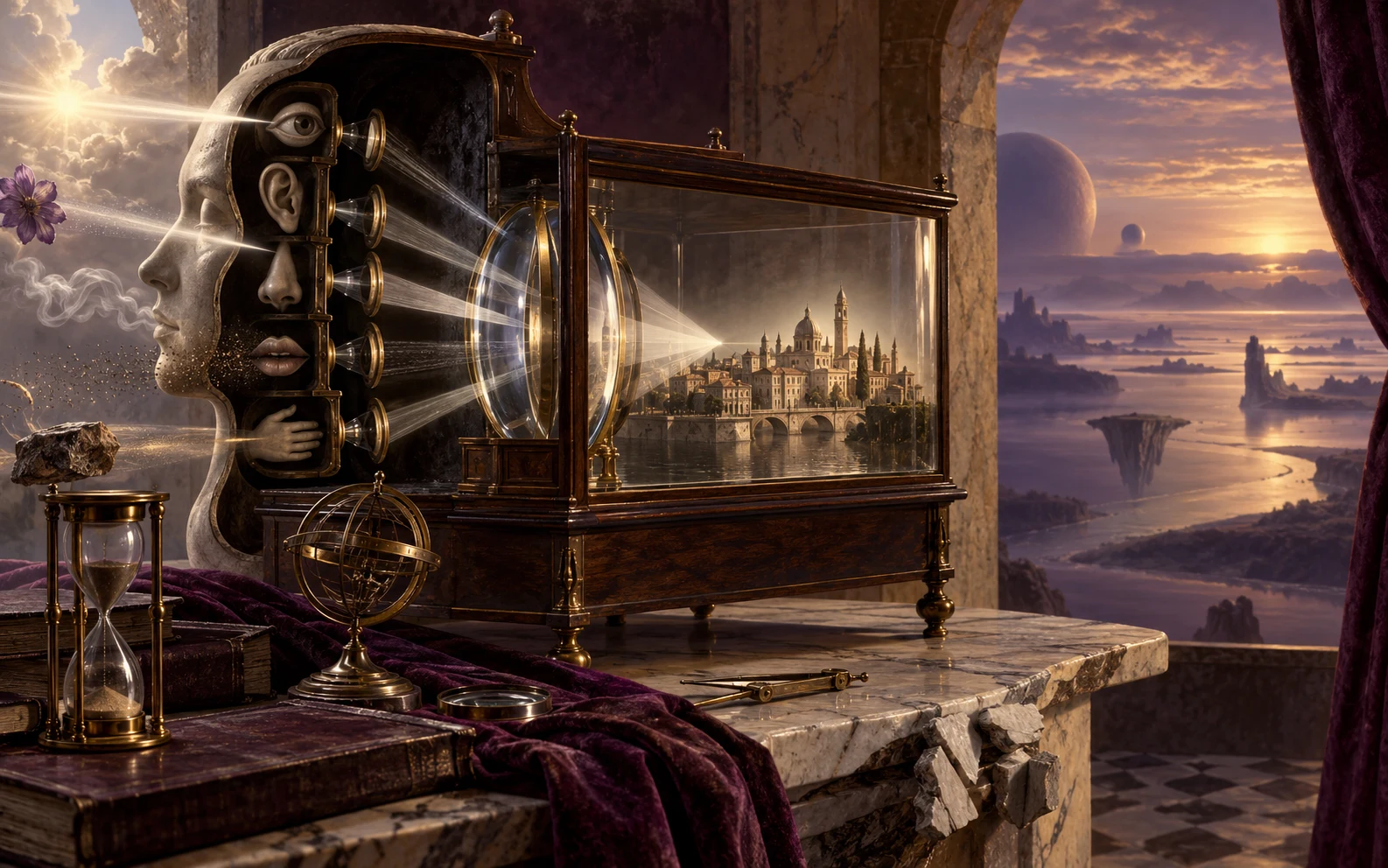
The human brain is hardly an all-seeing laboratory of cognition; it is a squishy lump of grey matter trapped for life inside the dark cage of a skull, sentenced to peer out at reality through the cramped slit of five measly senses. Immanuel Kant spent his existence politely breaking the news to humanity: nobody gets out of the structural conditions of our experience alive, and a glimpse of the world "as it truly is" won't be granted to us even on the autopsy table.
1. How Your Personal Perceptual Morgue Operates
The average person is convinced their eyeballs are high-def video cameras broadcasting raw, unfiltered truth. In the Prolegomena and the Critique of Pure Reason, Kant looks upon this optimism the way a medical examiner looks upon an upbeat corpse:
- Sensibility and Understanding: Your senses drag in raw biological debris—patches of light, air vibrations, the stench of decay. The understanding then straps a straightjacket of categories (causality, quantity, quality) onto these chaotic spasms. Did the morgue door slam because of a draft? You claim the draft shut it, even though your eyes merely recorded two consecutive frames in time. The causal thread stitched onto the cold body of reality was supplied entirely by your own understanding.
- Space and Time — Irremovable Prosthetics: Life coaches love chirping: "Take off your blinders and gaze upon the world without filters!" According to Kant, space and time are not physical features of the universe, but a priori forms of sensible intuition—the fundamental conditions of our experience itself. A crucial warning, though: metaphors of glasses, processors, or prison cells are just vivid pedagogical campfire tales for dummies, not neurobiological proof of Kantian philosophy. You cannot take these lenses off: beholding the world outside of space and time is impossible, simply because without them, no coherent experience can exist for us at all.
2. Phenomenon vs. Noumenon: Maximum Security Quarantine
Kant slices existence into two distinct zones:
- Phenomenon (Appearance): The shadow play organized by our forms of perception and understanding. The specific way the world presents itself through the terms and conditions of human cognition.
- Noumenon (The Thing-in-Itself, Ding an sich): Reality as it stands on its own, completely independent of our cognitive hardware.
And here is the kicker: we possess zero cognitive access to it. This isn't the "far side of the moon" where you can eventually wander over with a flashlight, nor is it "someone else's soul" to be pried open over a late-night drink. Whether you build a multi-billion-dollar particle collider or dissect your neighbor's brain, you remain strictly confined within the realm of appearances. The thing-in-itself remains fundamentally out of reach for theoretical knowledge while we continue dissecting mere phenomena.
3. "Everyone Has Their Own Truth" — A Manifesto for Lazy Cadavers
Since we are locked inside appearances, does that mean objective truth is dead and any lunatic's delusion holds the same weight as a physics textbook? Nice try, but no.
- Two coroners stand by a window watching a hearse pull up: one is counting the minutes until his shift ends, while the other is waiting for fresh cargo. Their internal misery is subjective, but the timestamp in the intake log and the physical arrival of the vehicle are entirely verifiable.
- We all share the exact same conditions of sensibility (space and time) and the same universal categories of understanding. Therefore, within the boundaries of experience, knowledge is genuinely objective and open to ruthless fact-checking. Being forty minutes late remains a stubborn fact, even if the latecomer whines that "time is just a construct and my spirit was trapped in the astral plane". Masking sheer laziness behind "well, everyone has their own reality" is just intellectual atrophy.
4. Don't Stretch Kitchen Logic Over the Abyss
Humans possess a bizarre urge to grab a wrench from the garage and try to dismantle the fabric of the cosmos with it:
- Someone masters debits and credits, and instantly begins calculating whether marriage or having kids "yields an acceptable ROI".
- Someone figures out why a kitchen kettle short-circuited, and immediately drops to their knees screaming: "What is the ultimate purpose and grand design behind my suffering?"
Kant reminds us: categories of the understanding (like causality) only function within the borders of possible experience. The second you snatch a concept like "cause" or "purpose" and chuck it past the limits of empirical verification, the gears just spin into a dead vacuum. Yet, hitting the perimeter of knowledge proves neither the existence of a higher purpose nor its absence: the cognitive engine simply ceases to yield testable answers out there, and parading the boundary of human reason as an ironclad debunking or validation of whatever lies on the other side is a rookie blunder.
5. Applied Cynicism: Surviving the Diagnosis
What are we supposed to do with this bleak setup in everyday life?
- Autopsy your hysterics: The grim conviction that "my life is ruined, this upcoming confrontation is doomed to fail" is not prophecy—it is an unsubstantiated generalization. Dissect the phrasing: what does "fail" actually denote? Will they refuse to wire the funds? Will they hit you with a chair? Or are you just throwing a tantrum because another human meat-sack declines to dance to your tune?
- Downsize your ambitions: You don't need to unravel a person's eternal metaphysical essence just to strike a deal with them. Checking the paper trail of their past track record and the immediate terms on the table is plenty, even if that still guarantees zero promises about the future.
- Respect the boundary: Our cognitive apparatus has hard, unyielding borders. But inside those borders, we are more than equipped to tell an audit trail apart from a fever dream—and avoid breeding useless illusions before we punch our final ticket to the void.