
Boundaries, choice and changing conditions
Rest, the body and daily needs on someone else’s timetable
Actual rest, water, food, toilet and hygiene conditions under another’s timetable are considered. A work scene and separate controlled-institution case extend beyond the shift boundary.
Epigraph
so he giveth his beloved sleep.
Psalm127:2, short clause from KJV. Complete selected psalm. A religious image of gift does not mean someone unable to sleep is unloved, and prescribes neither sleep arrangements nor judgement of early workers.
What this article is about
A timetable announces a break, but water requires a walk, meals a queue and leaving a post a replacement. Rest time has arrived while the means to meet a need have not. Someone may blame their inability to use a pause properly when time, access or an object is missing rather than relaxation technique.
This article concerns daily bodily needs under someone else’s timing. It extends beyond the working-day boundary: water, food, toilets, hygiene, suitable space and assistance can depend on shared arrangements. Fictional scenes distinguish announced possibility from actual access. No universal sleep, fluid, diet or exercise prescription, self-treatment or guaranteed protection route is supplied. Need requires no proof through dangerous deprivation or heroic endurance. A better break is not every necessary change, but retains its scope; incomplete rest diminishes no dignity and establishes no insufficient discipline.
I. A scheduled break must become usable
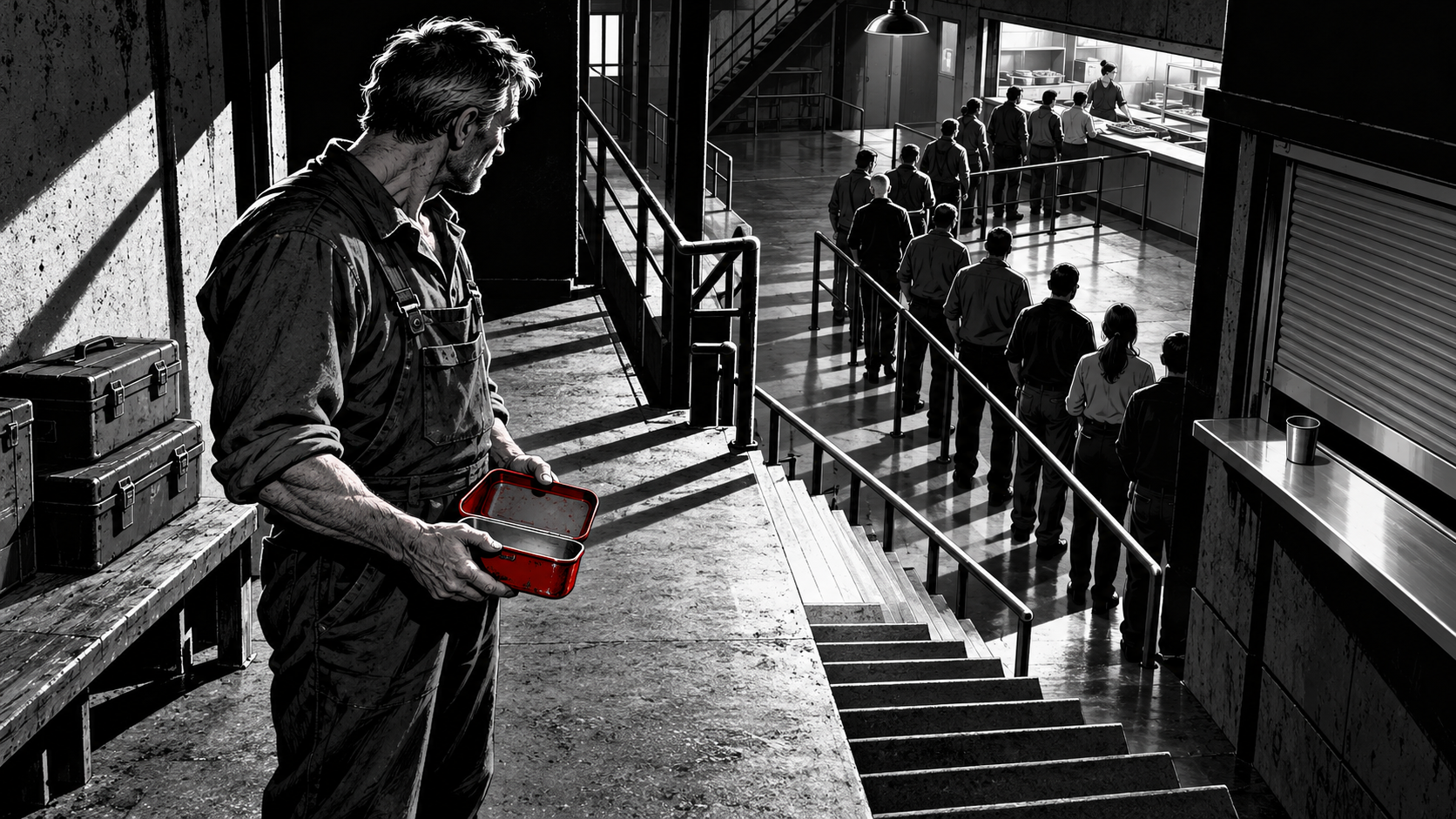
Imagine Viktor at a work site with a twenty-minute break. Walking to the dining area and back takes eight minutes; queuing takes seven, leaving five for eating. This is fictional arithmetic, not an acceptable standard or advice to eat in five minutes. Following a timetable may still leave an inadequate opportunity. Announced duration, travel and remaining usable time differ; the label “break” makes them neither equal nor sufficient.
A queue does not establish deliberate deprivation. Organisation, staffing, timing or coordination may be missing. The cause needs consideration, but unproved malice adds no minutes and supplies no meal. A gap between promised opportunity and available action can be discussed without declaring the whole site unsafe or proving someone intended deprivation first. Arrangement and intention need not coincide for an actual shortage to exist and deserve a concrete description.
A break may include required acts: returning tools, reaching an exit, obtaining permission or changing clothes. This determines no jurisdiction’s working-time rules. The practical question is what remains under someone’s control. Identical timetable numbers can produce different access where one person is nearby and another passes several mandatory stages. Equal minutes alone cannot replace those circumstances. Available time therefore needs description alongside the route and requirements attached to using it.
Ask which need, place, time and resource are involved, rather than immediately blaming poor resting skills. Viktor may use part of a break badly while organisation remains relevant; an external limit does not prove every personal act optimal either. Both levels can be considered without finding one culprit to explain everything. No actual site is inspected here. The point is that the result does not follow from a timetable entry alone.
II. Bodily need is not a character defect
Fatigue, hunger, thirst and needing a toilet are not one emotion met through one response. No particular sensation’s cause or medical severity is assessed here. Someone may name a need without a complete explanation. Asking for water need not become a public endurance test. An appropriate act may nevertheless depend on health, competent assistance and actual conditions rather than a general sentence. Naming the subject is not diagnosing or prescribing its solution.
Enduring inconvenience differs from no longer needing a resource. Viktor’s repeated queues establish no adequate access. One difficult day establishes neither overall health nor an entire arrangement’s quality. Retain a specific observation: what was accessible, what failed and what repetition is actually known. No endurance limit should be tested for persuasive evidence, and deterioration should not be awaited before considering need. A concrete shortage can be described without manufacturing a more dramatic demonstration.
Shame may obstruct ordinary requests where serious people are expected not to interrupt work for bodily matters. This is a possible social scene, not a clinical inference about everyone. Respectful treatment requires no public account of intimate detail. A bounded request to a suitable recipient may suffice where available. Their competence and confidentiality are not presumed. Dignity also concerns information handling when organising access genuinely requires some information about the person involved.
Needs matter beyond productivity: rest is not only a technique for quicker output. This is a value position, not a promised medical effect. Incomplete recovery establishes neither unwillingness nor failure. Naming and meeting a need differ. Consideration should not require proving the body’s usefulness to the project before noticing a missing resource. A person can need appropriate conditions without making a persuasive business case for the benefit others will later receive from them.
III. Access has several conditions
Water may be behind a locked door; meals available while a post cannot be left; a rest room occupied by a compulsory meeting. These fictional gaps differ. Resource presence, permission, reachability and usable timing do not coincide. One establishes none of the others. Specific wording can identify what is missing without promising change or making every restriction safe to test. A room’s existence does not say when or how someone can actually use it.
Physical reachability also varies. Distance, stairs, objects carried and individual limitations change practical possibility. No health or actual accommodation entitlement is determined. Identical instructions establish no identical access. The real route can matter alongside a door on a plan. Assistance is not arranged merely because someone could theoretically provide it or the space is formally for everyone. A possible helper and a person actually able and available to assist are different resources.
Suitability differs from presence. A rest area may not offer sitting, quiet or its intended function. No universal room standard is prescribed. Ask whether use matches the promise. Opening a room and making it usable during an available interval are separate results. The first need not be dismissed; neither should a sign and unlocked door be reported as fully meeting the need. The actual task still depends on the circumstances in which the room can be used.
Obstacles may sit between services: whoever permits a break does not manage water; whoever has a key does not know shift times. Kind replies may leave Viktor without access, without each speaker deceiving him. Coordination, an object or another decision may be needed. Identify what was confirmed. A forwarded question, named responsible person and functioning access remain distinct even where everyone wants to help and the conversation ends calmly. Goodwill does not itself supply the missing connection between them.
IV. Rest is not an obligation to sleep immediately
Suitable time and space permit rest without guaranteeing immediate sleep or recovery. No sleep disorder is assessed or treated here. A break should not become a test requiring correct restoration. Conditions and results differ. Continued fatigue proves neither every pause useless, personal fault nor adequate external provision. Viktor’s actual state cannot be certified from the schedule or from knowing a room was provided. An opportunity can be real while a question about the result remains open.
External timing may continue off shift through transport, roll calls, shared housing, light and noise. No legal workday boundary is determined; actual days are considered. Formally free time need not mean control of the environment. Permission to lie down does not control lighting or others’ acts. This makes no neighbour automatically at fault. It shows why sleep cannot be described solely as choosing to turn off a phone or taking advice seriously enough.
A personal habit may help where available and appropriate. No breathing, exertion, medicine or changed routine is prescribed as compulsory. Rest need not be earned through practice. Religious quotation and discipline replace no necessary assessment. Immediate health danger needs suitable urgent competent assistance; exercises should not delay it. No universal channel or always-available recipient is verified. General advice cannot establish whether a particular action is appropriate for the person’s actual condition and care arrangements.
Quiet time is not necessarily complete recovery. Some relief may coexist with inadequate overall rest; suitable surroundings may produce no noticed change now. Neither requires one character judgement. Name what happened rather than demanding expected positive feedback. Pause, access, resting and result relate without coinciding. No formula converts quiet minutes into guaranteed health or energy. These distinctions preserve an opportunity’s actual value without making a person responsible for reporting a result that has not yet occurred.
V. Hygiene and privacy also need arrangements
Toilets, washing and necessary clean items do not appear through “care for yourself.” An open door, time, water, accompaniment or permission to leave may matter. These examples are no universal institutional checklist. They show the material side of what is called personal responsibility. Where a resource is unavailable, demanding cleanliness does not explain feasibility. No actual sanitation or technical adequacy is certified through this general account; appropriate conditions still need actual provision and, where required, relevant competence.
A private need requires no announcement to everyone. Some information may be necessary for access, but recipients and scope matter. A toilet request grants no automatic permission to discuss health across a group. All legal exceptions and actual duties are not determined here. Request, needed clarification and wider disclosure differ. Kindness establishes no authority to hold data, prescribe actions or pass details to every interested person. Their role matters alongside the wish to be helpful.
Needs may intersect in shared space. Viktor gains no automatic right to others’ possessions or breaks. That does not remove the need for organised access. Institutional provision and a participant’s conduct towards others are separate responsibilities. Shortage authorises no use of another’s vulnerability. A two-person conflict also need not explain the whole deficit: both may queue for a resource unsuited to the actual circumstances. Their disagreement does not automatically supply or identify the wider arrangement required.
A one-off workaround should not become permanent duty. Someone’s help does not make time and energy inexhaustible shared stock. Both people may bear costs. Distinguish arranged access from chance participation, without reproaching a responsive helper. No complete reform is offered. A need should not be reported fully resolved because someone once compensated with personal resources. That episode can count as actual help while leaving unanswered how access will function when the helper is absent or cannot repeat the contribution.
VI. Separately: conditions someone cannot simply leave
Consider another fictional scene. Nikolai is in a controlled institution and cannot independently leave for water or an item. The category or lawfulness of detention is not determined. “Choose another dining area” or “go home” cannot describe this situation. Controlled movement gives needs an institutional dimension. Asking, permission, accompaniment and delivered resources differ. Explaining the proper request establishes no complete access. The person’s dependency should remain visible rather than being treated as solved once the institution has supplied the correct wording to use.
Rules can have different grounds, including safety or individual care. This article authorises no cancellation of medical restrictions or prescribed arrangements through general language about need. An explanation called care is not automatically sufficient either. Where practicable, the restriction’s purpose, decision maker’s competence and actual provision matter. No legal or medical assessment is performed here. An author’s confidence in a fictional example cannot replace the particulars needed for a real decision about a person’s conditions or treatment.
Nikolai need not prove missing access through deterioration, fasting, refusing water or another dangerous test. No control bypass or covert resource tactics are proposed. Immediate danger needs appropriate urgent assistance under actual conditions; availability is not presumed. Calm creates no object and transfers no institutional responsibility. Dependence may continue after a need is accurately named, without becoming a moral defect requiring greater endurance. No exercise should turn recognising a shortage into a reason to worsen it for more persuasive evidence.
Adapting once does not authorise every deprivation. A more bearable evening establishes no adequate overall arrangement; absent visible protest establishes no absent need. One experience does not decide the whole institutional history either. Resource, time, authority and result remain concrete questions rather than a completed investigation. Partial access can matter without replacing consideration of what remains unavailable and may need another decision or assistance. Neither improvement nor continued difficulty should be assigned more explanatory scope than the actual episode provides.
VII. Voluntary discipline and deprivation differ
People may choose early waking, dietary arrangements or religious discipline. Not every limit is coercion, but similar outward acts need not share conditions. Voluntary practice differs from missing necessities. Actual agreement, reconsideration and consequences of refusal matter. No particular religious practice is assessed or fasting prescribed. Another’s endurance establishes no suitable arrangement for someone else regardless of health and circumstances. A meaningful example can be respected without becoming a requirement for another person to repeat it or prove equivalent capacity.
Shared meaning replaces no particular need. Work, community or discipline can matter alongside appropriate meal and rest time. Questioning conditions need not erase earlier value; gratitude grants no acceptance of every deprivation. Need also gives no general permission to breach actual duties or endanger others. These levels avoid a forced choice between endorsing the entire routine and declaring all experience false before a current need can be considered. One relevant obligation does not settle every different question concerning the conditions under which it is performed.
Spiritual language should not test whether someone has outgrown the body. Meaning guarantees neither water, sleep nor safety. This concerns explanatory limits, rather than rejecting spiritual life. Religious support can matter without replacing material provision or competent care. Its effect is not measured and abandonment is not advised. Correct faith, gratitude or calm should not become preliminary achievements before need deserves a suitable response. A source of meaning and a necessary external resource can remain valuable in different ways without either being assigned the other’s work.
Illness, disability or limited energy do not diminish dignity when a shared regime does not fit. This is a value boundary, not medical assessment or a ruling on particular rights. Actual differences may need consideration even under identical demands. Someone else’s successful practice does not check an individual situation. Endurance comparison should not allocate necessities. Greater capacity gives no automatic authority over what another must withstand without help. A person’s limits require actual consideration rather than a verdict inferred from the most resilient participant’s experience.
VIII. A small request should not conceal a larger gap
Where conditions permit, ask about a concrete need: water, timing or room access. This is no universally safe complaint channel. Who hears, decides and provides may differ. “I will forward it” can be honest without being delivered water. A decision may still need a key, time and someone to act. Recognise actual steps without reporting resolution too soon or blaming every intermediary for lacking control over the whole arrangement. Their willingness and the resource’s availability need separate descriptions.
A request need not contain an entire health history where unnecessary. Actual medical or legal information requirements are not determined. Role and competence matter; willingness to advise is insufficient authority to prescribe. Necessary assistance should not become experimentation through a universal text. No doses, durations, fluid restrictions or exercise scheme are provided. Access clarification and individual health decisions differ, sometimes needing different people. One cannot be reported as completing the other merely because both concern the same bodily need or were discussed in a single conversation.
For organisers, announcing a rule differs from making it feasible. This is an author’s framework, not a legal finding for every country. A specific route and result can be considered without every difficulty proving a breach. Instructions do not automatically establish adequate provision; one complaint establishes no automatic correctness either. Relevant information and the particular need matter, preserving distinctions between promise, decision, resource and act. A procedure should not substitute for those facts when the question concerns whether someone could actually use the opportunity described.
Sometimes information is gained but access remains unchanged. Viktor knows where he asked, while meal times stay fixed; Nikolai names a need while the resource remains missing. Honest description should not blame insufficient politeness. A missing decision or object cannot be created through endless improvement of a request. Further contact, risk and suitable assistance remain separate questions, not verified possibilities for every reader. A person can have made a specific effort without either controlling the response or deserving the continued absence of the necessary resource.
IX. Dignity is not measured in recovered energy
Part of a need may be met while fatigue remains. This neither erases the opportunity nor establishes everything necessary provided. Water received, eating, usable space and actual recovery differ. They should not merge into “everything is fine now.” No health assessment is made. Missing expected benefit is not ingratitude, and one favourable result certifies no adequate conditions overall. What has improved can retain its scope alongside a need that remains, without requiring either triumph or denial of the specific resource actually delivered.
A resource may arrive once while regular access remains unknown. Today’s open room need not be fictitious help, but one opportunity and stable access differ. Viktor can value someone’s contribution while questioning arrangements. Neither gratitude nor questioning automatically settles every duty. Name what happened, how long a condition is known and what remains missing, without attaching a future promise to one successful episode. Acknowledging the actual help does not require reporting that its continuation has already been agreed or made practically reliable.
The body need not produce a result to validate care. Continued fatigue permits neither cancelled respect nor demands for better inner work. Provision is also not automatically sufficient or safe for health; suitable competent assessment may be needed. Help and limits can be named together. Good intention does not replace actual result, while incompleteness does not make someone responsible for every continuing shortage. Neither listener nor recipient needs to report an effect merely to preserve the meaning of a helpful act that genuinely occurred.
Dignity rewards neither health, endurance nor productivity. It remains when someone needs help, cannot recover quickly or cannot safely ask. This value does not promise water or suitable surroundings through respect alone: material needs remain material. Accurate naming matters without being sufficient. Spiritual support, caution and partial results may coexist with actual provision, without one resource replacing all absent others. A person’s worth should remain distinct from the practical question of what conditions and assistance have actually become accessible to them.
X. Sources do not demand victory over the body
Psalm127 connects labour with trust in God and sleep as gift. KJV. The full text includes building, guarding and children. This is religious poetry, not a medical regime or judgement on early shifts. Sleeplessness does not mean God withholds love, and need requires no correct-faith test. The bounded comparison questions reducing life to uninterrupted effort. It promises no sleep and supplies no instruction replacing actual conditions or competent assistance where these are needed by the person involved.
Dhammapada203–204 concerns hunger, body and health within Nirvana and spiritual life. Selected197–208, Müller. This is no medical classification or replacement of food through spiritual attitude. Valuing health diminishes no sick person’s dignity. The text should not require someone to cease needing or call deprivation useful. The comparison retains necessary conditions without promising clinical effects from reading, faith or inner agreement. It does not turn an ancient religious account of suffering and release into a treatment plan for a reader’s actual condition.
Mandela Rules separately consider sleep conditions, sanitation, hygiene, bedding, food, water and clinical responsibility. Selected Rules12–24 and27. This normative prisoner-treatment context is explicitly nonbinding in the resolution. It determines no local law or Nikolai’s category, inspects no institution and promises no enforcement. Numeric minima are not exported as individual prescriptions. Citation shows conditions should not wholly become personal discipline, but provides no verified remedy. The normative account and the reader’s actual means to obtain a resource remain separate.
The three grounds form no single instruction. Biblical gift, Buddhist spiritual context and institutional norms differ. This author’s comparison is no scientific health model or identity of traditions. No short passage checks a reader’s actual access. Material resource, ability to use it, individual condition and competent help remain distinct questions, not solved through a well-named need or quotation. Respect for the sources includes retaining their setting and limits, rather than presenting them as if they had already assessed or repaired the specific circumstances of the reader.
XI. Naming a need begins distinction, not resolution
Viktor may gain a better interval without the whole day changing. That is improvement, not complete recovery. Nikolai may receive one item while other conditions remain. Partial progress need be neither total victory nor zero. Its value need not be denied for honesty about the whole; equally, it should not close every unconsidered question. The actual result keeps its scope rather than being assigned responsibility for justifying the entire arrangement or proving that no additional condition, decision or assistance remains necessary.
Another’s timetable may resist quick change without making shortage deserved or need disappear. Someone may know what is missing yet lack a safe step. Complaint or refusal is no test of preserved selfhood. Available help needs an actual role; a recommendation cannot report it found. An absent resource deserves an accurate name instead of promises leaving someone alone with adverse consequences. Understanding the problem and possessing the means to address it should not be confused simply because the first can be expressed clearly in an article.
Caution may help once without making a participant sole organiser of rest under another’s control of time and surroundings. Actual duties remain; whole-system responsibility does not automatically transfer. Personal acts and external gaps can both be considered without one permanent explanation. Change is not guaranteed. This avoids assigning every shortage to personal failure or turning bodily respect into another standard someone must perform perfectly under every restriction. The point is a more accurate division of questions, not a certificate that either side is automatically correct about the whole situation.
Daily needs have an actual side: water must be received, time usable and a suitable resource supplied beyond its name. A person is also more than needs and measured recovery. Body, dignity, conditions and assistance limits can remain visible together. Philosophy is no substitute for provision, and partial access establishes no complete sufficiency. The relationship remains open to actual life rather than closing every material question through a helpful image or treating a single delivered resource as proof that nothing else of importance remains to be considered.
What this means in practice
If there is no immediate danger and reflection delays no needed help, choose one ordinary need with uncertain access. Do not test shortage through deprivation, await deterioration or deliberately break arrangements. Writing is optional and may be unavailable. This prescribes no regime and assesses no condition; skipping is allowed. The aim is one case’s circumstances, not proving correct self-care where resources are missing. The exercise should not turn a need into another opportunity to judge whether someone is sufficiently disciplined or able to manage everything alone.
Separate resource, time, place, permission and reachability where relevant. What exists, was promised or remains unknown? Unknown costs are not zero. Necessary medical or urgent help requires suitable provision, not created by a general text. Set no fluid, sleep, food or exertion amount through religious quotation, and cancel no individual care arrangement through a fictional person’s example. The distinctions concern access and uncertainty rather than authorising changes to what is appropriate for a person’s actual health, needs or treatment in their own circumstances.
Where a suitable safe step is available, a specific request may be considered without a duty to speak out. Distinguish listener, decision maker and provider; avoid unnecessary personal or third-party details. Reply, permission, object and met need differ. Improved feelings are no gratitude report required immediately. Missing conditions cannot be supplied through perfect wording or endless attitude work. A request may be one action without becoming control of everyone else’s decision, the means they possess or the result they are able and willing to deliver.
Finish with what became clearer or arrived. A route obstacle may differ from reluctance to rest; a new resource may leave a larger question open. This is neither diagnosis nor fully changed conditions. Stop where strain increases or necessary tasks are obstructed, returning to an accessible action, rest or suitable help. Need is no shame; absent results diminish no dignity, and partial ones require no declaration that the whole arrangement is sufficient. The exercise can retain a modest use without being made responsible for resolving the wider circumstances.
Key quotation
Health is the greatest of gifts
Dhammapada204, short clause from F.MaxMüller’s translation. Context197–208. Valuing health diminishes no sick person’s dignity and replaces no necessary assistance with spiritual practice.
Connections across traditions
| Comparison | Question about conditions | Limit |
|---|---|---|
| Psalm and sleep’s gift | Is life reduced to effort? | No divine-love test through sleeplessness |
| Dhammapada and health | How do body and spiritual aim differ? | No medical prescription |
| Institutional norms | What supplies access? | Norm does not establish implementation |
| Break and possibility | What was actually received? | Minutes guarantee no recovery |
| Dignity and need | On what grounds is someone respected? | No endurance reward |
Five bounded comparisons are not five independent traditions or a shared treatment procedure.
Primary texts and sources
- Complete Psalm127, KJV: five verses, not commentary or medical instruction.
- Dhammapada197–208, F.MaxMüller: complete selected chapter, not original language, diet or health assessment.
- UN, A/RES/70/175, Mandela Rules: selected Rules12–24/27, nonbinding qualification and earlier checked1–5context; not the whole document or institutional inspection.
Tags
rest, body, need, timetable, break, access, water, food, hygiene, toilet, sleep, place, time, resource, route, queue, permission, authority, institution, work, detention, dignity, health, assistance, discipline, voluntariness, responsibility, result, recovery, psalm, Dhammapada, conditions, practice
About the authors
Andrey Zarinsh is the author and founder of United Wisdom. He explores inner transformation, unity across traditions, intercultural dialogue and contemporary spiritual discipline. Instagram: @andrey.zarinsh.
Maria Evilkut is a coauthor of United Wisdom. Alongside research, she seeks to test these ideas in practice and observe how unity and mutual understanding work in real life between people and cultures. Instagram: @ilkutki.
catalog_id: SYS-127 · language: en · revision: 1 · publicUW Handbook 2026-10-03