
Boundaries, choice and changing conditions
Leaving with children or other people who depend on support
The article considers leaving with a child or adult needing assistance. It distinguishes voice, responsibility and representation, travel and care after arrival, confirmed resources and promises, assistance and renewed control.
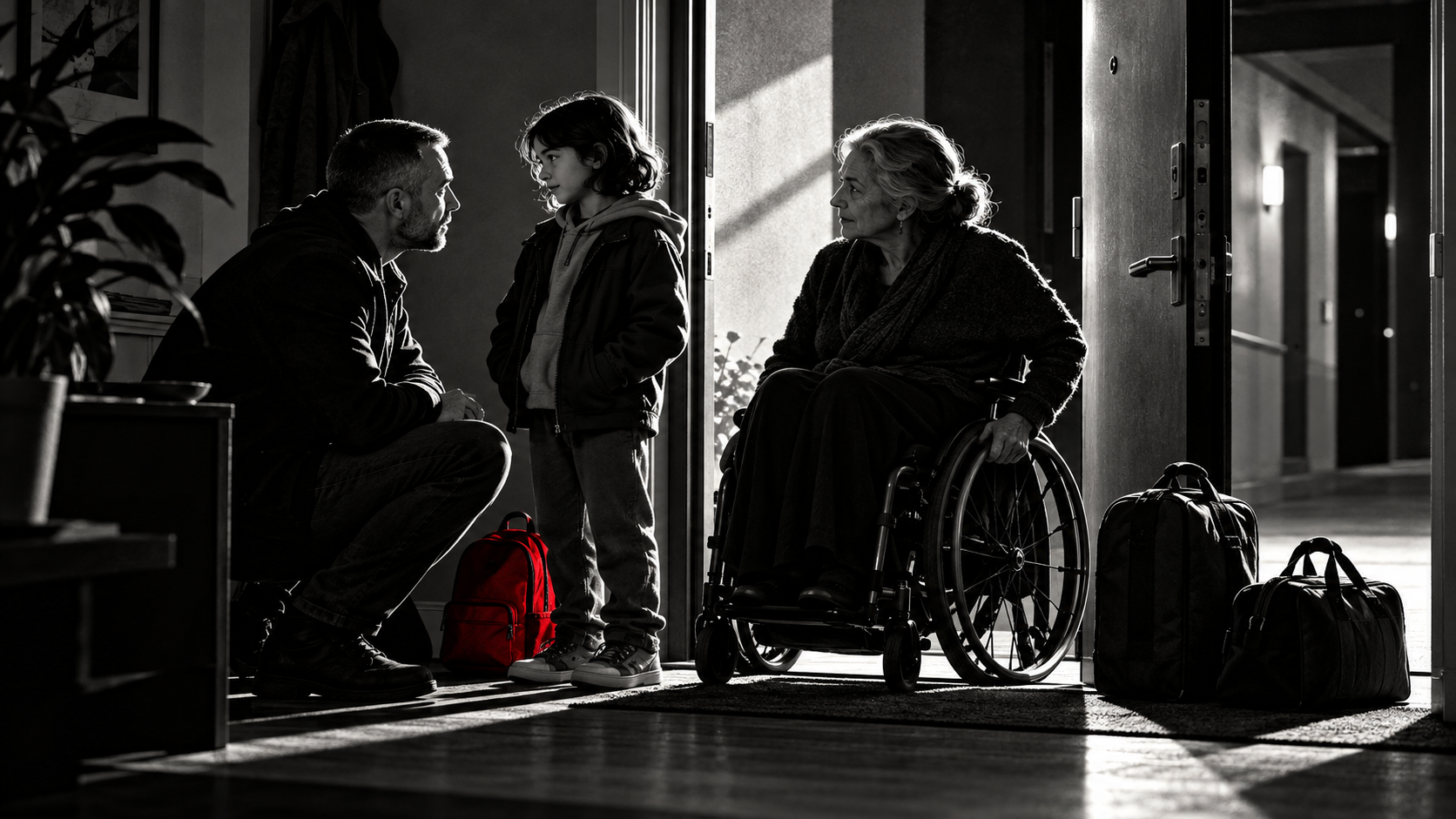
“Two are better than one”. Ecclesiastes 4:9, short fragment, King James Version. Selected verses 4:9–10.
What this article is about
Advice simply to leave assumes someone can gather their belongings and decide only for themselves. A child, older relative, adult needing care or several people with different capacities may be alongside them. The question changes. Crossing a threshold matters alongside who decides what, who has authority to act for another, how care will continue and where people can actually arrive. Love and responsibility matter without making another person part of one's luggage. A plan concerning several lives needs to recognise several individuals.
This article distinguishes those tasks without selecting staying or leaving for a reader. It establishes neither guardianship, legal capacity, authority to relocate, border procedures nor a safe departure plan. Immediate danger or a need for medical attention cannot await perfect preparation or the end of reading. Particular protection measures and powers need local assessment. Leaving, temporarily remaining and seeking assistance each guarantee no safety by themselves; even contacting an acquaintance can have consequences. What follows offers questions for understanding, rather than a compulsory action sequence.
I. Several individuals participate in one departure
Imagine a parent considering leaving a setting of pressure with a child, while another adult assists a relative needing daily care. Both cases involve care, but their relationships differ. A child and an adult have different positions; parenthood, kinship and assistance are not identical. Beginning with individuals and needs, rather than an undifferentiated we, makes several things visible: whose decision is known, whose voice has yet to be heard, and which authority is only being assumed. These are fictional cases, not reports about actual families.
An adult's decision to change their own life does not automatically answer every question concerning a child. Willingness to assist a relative creates no authority over their residence. Conversely, another person's need for care does not remove the caregiver's own safety from consideration. A mistake arises when one person becomes the sole actor while everyone else is either an obstacle or their extension. Accurate consideration retains everyone as a participant with dignity, capacities, connections and needs, despite substantial differences in responsibility and freedom to act.
Leaving can conceal several decisions: departing a room now, changing permanent residence, ending group membership, transferring some care or seeking protection. Their timing and grounds need not coincide. Temporary accommodation cannot settle permanent residence; transport cannot replace accessible assistance after arrival. Distinguishing tasks encourages no delay of urgent protection. It prevents presenting one completed step as completion of every other task, or promising a dependent person something that does not yet exist. Progress and unresolved needs can both be acknowledged.
Knowledge also differs from assumption. A friend's promise to help may mean listening, rather than accommodating an adult, child and person with limited mobility for a month. Always having provided care describes experience without establishing legal powers. Unknown conditions cannot become confirmed resources just to make a plan persuasive. They can be named while respecting what has already been done. Incomplete knowledge makes someone neither a bad parent nor a bad helper, and diminishes no seriousness of the pressure they face. Uncertainty deserves an accurate place in the account.
II. A child has a voice without carrying the adult decision
A child can love someone an adult fears, miss home and resist changing schools. These feelings establish no absence of danger, and are no mistake requiring immediate correction through the right explanation. Listening means considering the child's experience without demanding a side in an adult dispute. An adult's responsibility to seek appropriate protection cannot become a child's responsibility to approve the whole plan, understand every circumstance or comfort a parent struggling with a decision. Care needs room for feelings that do not fit an adult's preferred story.
Article 12 of the Convention on the Rights of the Child concerns expressing views and giving them weight according to age and maturity. This international standard establishes no particular case procedure here. It cannot be reduced either to ignoring children because adults decide, or treating a child's statement as permission for everything. The child's voice, adult responsibility and legal authority differ. The article determines no age of independent consent for any action and checks no local implementation of the standard. Listening and authorisation are separate questions.
A fictional conversation can ask what a child does not understand or needs now, rather than demanding a general choice of sides. Explanations should match their capacities and what is actually known. Promising everything will stay unchanged when that is unknown, or asking a child to become the adult for two people, is unhelpful. Children should not be assigned to collect evidence, carry hidden messages, reassure another adult or protect a secret as the condition of family welfare. Such roles can transfer others' responsibilities onto them.
Missing words establish neither missing feelings nor agreement. Infants, children communicating differently and teenagers unwilling to talk now need different attention. This gives adults no permission to invent convenient wishes. What was heard, observed and inferred can be distinguished honestly. An appropriate professional may be needed for a particular assessment; knowing a child does not make every helper that professional. A difficult conversation cannot make the child the author of an adult decision or the person now responsible for its consequences. Attention can respect both voice and responsibility.
III. An adult needing support does not become a child
An adult may need assistance with mobility, communication, everyday tasks or particular decisions. This automatically establishes neither an absent will nor an absent legal voice. Physical assistance can coexist with clear wishes; someone may understand part of a question and need another part explained accessibly. Dependency supplies no diagnosis or complete description of abilities. A small child's decision arrangements therefore cannot simply be transferred to an adult. Kinship cannot be treated as self-evident permission to decide everything for them. Particular needs require particular understanding.
The UN in Ukraine introduction to General comment No.1 describes moving from substitute to supported decision-making for persons with disabilities. Only this short introduction is used here, rather than the full document or local law. All adults needing care are not thereby classified as disabled. The bounded perspective asks what helps a particular person understand an option and express their will. It establishes no relative's powers, representative's existence or validity of particular consent. A principle and an individual legal finding remain distinct.
In a fictional example, a relative struggles with a long text but can discuss two accessible options and ask questions. Explaining differs from supplying the answer. Another person may need an independent means of communication instead of an account supplied only by their usual spokesperson. These examples are no universal capacity-assessment protocol. They question the use of a helper's convenience as the measure of another person's will. Understanding may require time, interpretation or suitable support; its format must consider actual access and circumstances rather than an imagined ideal setting.
An adult's wish not to relocate cannot automatically be attributed to ingratitude or illness. Their words also settle no question about coercion, urgent danger or a representative's actual duties. These require appropriate local professional consideration. The article authorises no forced removal and commands no helper to remain through any threat. Different wishes create a difficult task, rather than justification for renewed control. Beyond actual authority, good intentions are insufficient to declare another person's decision invalid. The limits of helping remain relevant when decisions diverge.
IV. Care, representation and authority to act
A parent, legal representative, relative, institution employee and volunteer may share a story while retaining different roles. Who provides care, makes a particular decision, supplies transport or merely knows about the situation? One person can hold several roles without making them identical. Paying for medicines establishes no authority to change a prescription; possessing a home key settles no authority to determine another residence. These examples identify questions without supplying legal findings for a particular reader. Experience and practical access do not themselves define every power.
For children, Articles 3,9 and19 of the Convention require attention to interests, protection and legal conditions of family separation together. They supply neither universal permission to take a child away nor an unconditional prohibition on seeking protection to preserve a family. Parental contact also has a qualification concerning the child's interests. Particular authorities' decisions, restrictions and local procedures remain unchecked here. A moral conviction that help is needed differs from established authority to perform a specific action in another person's name.
Crossing a border adds questions of powers, documents and applicable rules. Article 11 of the same treaty addresses illicit transfer and non-return of children abroad. It determines no particular move's lawfulness. This article establishes neither consent requirements, judicial exceptions nor an international return procedure. Advice to take someone farther away cannot therefore be presented as a neutral improvement to a plan. Where possible, competent clarification concerns actual countries and circumstances. Urgent danger still requires available emergency protection without waiting for an ideal research process to be completed.
Where a helper's role is unclear, ask precisely which action they may perform now and on what basis. Recognising a need requires no advance mastery of every legal arrangement in a life. Unknown authority nevertheless cannot be created by insistence or closeness. Another person's assertion that something is forbidden also cannot replace verification. Between claiming power and submitting unconditionally to every prohibition lies the task of obtaining suitable, concrete clarification. Unnecessary disclosure of others' data and promises about an outcome are no required part of that task.
V. Continuity of care matters beyond a convincing route
A fictional plan includes a car and address but no answer about assistance with standing, eating, communication or continuing prescribed care after arrival. Movement has been described; care has not. An infant, schoolchild, adult with limited mobility and person with a sensory need cannot be treated as one passenger category. A belongings list reveals no complete picture. Necessary actions and actual people able to perform them deserve attention, alongside the recipient's preferences and dignity. Reaching a destination is one outcome within this larger task.
Medicines, medical devices and treatment need appropriate professional attention where continuity is affected. The article suggests no changed dose, interrupted prescription or improvised medical substitute. Familiar helpers may lack both training and capacity to continue care. Everyday assistance differs from a task needing a professional. Medical needs impose no obligation to remain in danger; they mean protection and care should be considered together. Urgent medical attention must not await complete resolution of housing. One unresolved practical question cannot make every other need disappear from consideration.
Care includes sleep, food, toilet access, understandable communication and personal space. Such needs can look small beside a major decision, but they constitute the next day. A fictional offer of a sofa might suit one person and be inaccessible to another because of stairs or missing assistance. This concerns fit with reality, rather than ingratitude. Hosts need not possess every resource. An honest description of limits nevertheless helps more than a vague promise to manage somehow that leaves a particular vulnerability invisible and an essential action unassigned.
In Luke 10:33–35, compassion exceeds intention: care continues in a particular place and arrangement. The contemporary editorial comparison concerns the difference between sympathy and organised assistance. The ancient episode supplies neither medical treatment, representation rules nor an obligation to finance everything indefinitely. It can question the content of a promise: what will actually happen, and who will do it? Ancient treatment should not be reproduced. Nor should handing care to someone else be considered sufficient merely because a moral account describes such a handover.
VI. Destinations and assistance have particular limits
An address establishes no capacity to receive everyone. A fictional acquaintance agrees to one night for an adult, without discussion of a child or continuous care. This is no confirmed destination for a joint departure. Promised capacity, duration, accessibility and undiscussed conditions differ. Clarification obliges nobody to tell everyone a complete plan or history. It asks that neither consent nor resources be counted as obtained when they are absent. The possible consequences of making the clarifying contact itself also need attention; more information is not automatically costless.
A service has a scope: eligible people, whom it accommodates, available support and required disclosure. No particular service is checked here, and no place is guaranteed. Help for one adult may exclude a child or particular care need. One inaccessible option demonstrates neither an illegitimate need nor an absence of all assistance. It identifies that option's limit. A useful account distinguishes finding a name, receiving a response and confirming actual availability. These are separate results, and moving between them requires evidence rather than hope.
Hosts retain boundaries of their own. Agreement to transport differs from providing care, housing and legal assistance. Conversely, financial support acquires no entitlement to govern every decision. People can agree to a task without creating unconditional obedience. Demanding compliance because someone has been rescued reproduces dependency instead of expanding options. Where circumstances allow, actual responsibilities and limits can be discussed without treating respectful assistance itself as a debt. The helper's limitations and the recipient's dignity need not be set against one another as competing claims.
A child or adult needing support benefits from understanding an accessible part of events: who is nearby, where immediate assistance is and what is known about the next period. Everything need not be disclosed or a final solution promised. Honestly stating that only a certain part is known differs from leaving someone wholly uninformed. Explanations should consider age, communication and actual circumstances. Nobody should become the keeper of a dangerous secret or the person responsible for reconciling promises between adult helpers. Information can support participation without transferring responsibility.
VII. When wishes and possibilities differ
A joint departure need not express every participant's decision in the same form. Parents hold responsibilities; children express experience; independent adults decide for themselves; representatives act within actual powers. Emotional intensity removes none of these distinctions. Nor is there a universal rule that every step must await everyone's complete agreement. Urgent danger, child protection and medical needs require concrete, competent consideration. This article establishes no exception and authorises no reader to declare one applicable unilaterally. The question concerns real responsibilities rather than the strength of an observer's conviction.
Someone receiving help may wish to retain a connection with part of the previous setting. It may matter or involve risk; a helper's preference to sever everything cannot settle it. Children's contacts also involve particular rights, conditions and possible authoritative decisions. For adults, assistance should not automatically remove an entire previous life. The task is to distinguish relationships and circumstances, rather than replace every former connection with one new controlling centre, even one describing itself as safe. Concern and complete authority over contact remain different things.
Inability to provide everything simultaneously does not make someone the cause of that impossibility. Name actual constraints: unconfirmed care, unclear authority, inaccessible accommodation or an unclarified procedure. This differs from judging a person too complicated. Naming a difficulty does not resolve it; another competence or support may be needed, and cannot be promised without a basis. Helpers can acknowledge their own limits without declaring the dependent person an unnecessary participant best removed from the story. Their needs remain real even where resources are limited.
A pause may belong to constrained circumstances without proving safety. Movement also cannot become success merely because it was difficult and courageous. A concrete aim asks which danger is reduced, which need remains and what is confirmed. In urgent circumstances these questions must not become an examination before help is permitted. They retain reality without condemning imperfect choices or mistaking an attractive name for actual care of everyone affected. Acknowledging unresolved needs is compatible with recognising a step that has already mattered.
VIII. Helping within one's role
An outsider can offer a particular action: listening, checking a resource or completing an agreed practical task. This makes them neither the family's representative nor director of the situation. Requests, consent, powers and actual duties differ; the article establishes none for its reader. A good purpose creates no automatic entitlement to change medical decisions, remove someone, publish a location or speak to every participant on their behalf. Assistance can remain modest and useful without acquiring control over the entire process. The scope of the offer matters.
Confidentiality matters, but absolute secrecy cannot be promised without understanding one's role. Professionals and acquaintances may have different duties, especially regarding children or people needing protection. Their content needs local clarification. This does not authorise sharing information just in case. Who receives it, for what purpose and on what basis? A child's account, an adult's medical information and a prospective address are not helpers' collective property. Uncertainty remains uncertainty, rather than a concealed guarantee of secrecy. Protection and disclosure need concrete consideration together.
Consent concerns an action. Someone may request opening hours without authorising disclosure of their whole history, or agree to transport without agreeing to permanent residence. Silence confirms no entire sequence. This cancels no established protective duty, but permits nobody to invent duties for convenience. Maintain the scope of a request where circumstances permit clarification. Immediate danger calls for appropriate emergency mechanisms, rather than amateur certainty that any well-intentioned act must be right and lawful. A moral motive and an actual permission require distinct attention.
Nobody should be required to demonstrate seriousness through a risky performance: arguing with a leader, threatening departure or disclosing a plan to the whole family. Such experiments are no necessary part of understanding. Assistance also cannot rely on invented consent or unlimited rescue promises. Clarifying capacities, roles and known circumstances may be more accurate than loudly demanding action. The purpose is to improve actual access to support without assigning dependent people and caregivers a heroic price they never chose. Their readiness cannot be measured by that performance.
IX. Responsibility does not mean rescuing everyone alone
An inability to leave others can express love, duty, fear and missing alternative care together. Easy advice should not dismiss it. It also cannot require one adult indefinitely to endure every threat to health and life. Others' needs deserve serious attention without creating endless personal resources. The question concerns distributing actual responsibility, rather than competing over sacrifice. Asking for support is not itself abandonment. Caregivers remain among the people whose needs matter, including where their previous work has become so familiar that others scarcely notice it.
Ecclesiastes 4:9–10 connects companionship with helping someone who falls. Here it offers a limited ethical perspective on shared support. It proves no requirement that everyone leave simultaneously and obliges no dependent person to rescue a helper. The ancient image replaces neither institutions, powers nor resources. Its practical question concerns help that actually shares a burden. It becomes distorted when used only to require one person to support everyone while never needing support themselves. A meaningful image cannot supply absent capacity simply by being repeated.
Guilt establishes no legal duty and cancels none that exists. It can point to an important bond without precisely identifying who may and can perform a necessary action. Distinguishing one's promise from someone else's unlimited demand can be difficult. This excuses no indifference; it clarifies accepted commitments, unresolved questions and what exceeds one person's capacity. Helpers should not turn shame into an instrument for speeding another person's decision, especially when others will carry the consequences. Emotional force cannot substitute for actual knowledge of the available possibilities.
Where care is handed over, agreement and actual capacity to fulfil it both matter. The article nevertheless requires no perfect replacement before urgent protection. Imperfect circumstances may call for protection and the search for further support together. People cannot fairly be judged retrospectively as though every missing resource had been available. Difficulty also cannot establish that considering departure is forbidden. Accuracy retains everyone's needs, including those of the person who has provided previously invisible care. An incomplete arrangement is not automatically either adequate or blameworthy; its limits need attention.
X. Care continues after movement
Changed address, ended membership and changed dependency are separate outcomes. The first day may retain questions of rest, food, education, treatment, income, contact and legal decisions. This makes a first step no less meaningful, but it should promise no completed history. A fictional child has reached another place without losing fear about their familiar life on an adult's timetable. Another adult can receive physical assistance while still needing a way to participate personally in decisions. Relocation and participation cannot be treated as the same achievement.
New arrangements also need limits. Temporary helpers can define time and scope without threatening dignity for disagreement. Recipients can be grateful and retain other views. Actual legal duties and concrete needs require separate attention; neither makes assistance a purchase of obedience. Leaving one setting need not reproduce its arrangement in another. No guarantee follows that events will unfold this way. This is a direction for considering relationships, rather than a description of conditions already secured. A helpful intention still needs reality to support its claims.
A child need not look happy immediately, nor an assisted adult instantly approve every decision. Mixed feelings establish neither automatic failure nor ingratitude. The article diagnoses no experience and predicts no recovery. Where specialist assistance is needed, an actual available option differs from a name alone. Ordinary needs can remain significant: a personal conversation, rest, understandable information and participation. Human life exceeds an account of a correctly executed departure. This applies to everyone involved, including caregivers and those whose needs made the transition more complicated.
Returning to togetherness, it can mean care for several individuals instead of permission for one to decide for all. Age, choice, support needs and authority differ. A departing caregiver need not become all-powerful; someone needing help need not disappear as a person for a convenient plan. A good intention is not confirmed assistance, and confirmed movement is not safety. These distinctions can frame the next question more accurately and allow actual support to be accepted without giving it control over every subsequent part of life.
Practice: people, roles, care and uncertainty
If reflection is possible now, consider each person affected. Distinguish a known need, an expressed wish and an assumption for each. Recording is optional: storage and discovery can have consequences. Assign no child to collect adults' answers. The purpose is to recognise participants, rather than create a perfect diagram or prove entitlement to help. Immediate danger and medical needs should not wait for an exercise before accessible emergency protection or treatment. Reflection is a possible aid to understanding, not a prerequisite for assistance.
Next distinguish roles: personal decision, parenthood, established representation and help with a task. Which powers are known, and which need competent local clarification? Closeness or duty alone establishes no authority to relocate. An international text supplies no permission for a particular move; another person's prohibition does not necessarily settle the issue either. Keep uncertainty as a question rather than fill it with guesses, particularly concerning children, borders, medical decisions and acting for another person. What is morally important and what is legally authorised need separate consideration.
Consider continuity of care separately. What assistance does a particular person need? What is known about travel and arrival? Who has actually agreed to a task and can perform it? Change no treatment based on this article, and treat goodwill as no medical substitute. Available resources differ from hopes. A single evening or service can be named honestly as a limited resource. It need not be useless, but it confirms nothing beyond its actual scope. An acknowledged limit is more useful than a larger promise without evidence.
Finally, identify one question needing a suitable next answer: authority, care, accessible accommodation, someone's voice or urgent protection. Immediate contact is not compulsory; its conditions and risks matter too. The article sets no universal order and promises no safe outcome. A helper can define participation without appropriating decisions. Care becomes more concrete when intention, agreement and an actually available action are distinguishable. Each person retains dignity and a voice, even while parts of the situation remain difficult and unresolved.
Key quotation
“took care of him”. Luke 10:34, short fragment, King James Version. Selected passage 10:33–35.
Compassion becomes concrete care in the passage. The comparison questions a promise's content without turning an ancient episode into a medical protocol, representative authority or command that one person rescue everyone without limit.
Cross-map: assistance and limits of comparison
| Source | What it helps examine | Limit |
|---|---|---|
| Ecclesiastes 4:9–10, KJV | Support can share a burden | No compulsory joint departure or endless rescue |
| Luke 10:33–35, KJV | Care includes actual action and continuation | No modern treatment or legal representation |
| Convention on the Rights of the Child, selected articles | Interests, voice, protection and legal conditions belong together | No permission for a reader's particular relocation |
| UN in Ukraine, General comment No.1 introduction | Supporting a decision differs from replacing it | Introduction read, not full document; local powers unestablished |
Four rows reflect relevant contributions without adding traditions for a quota. Two biblical passages are not declared two independent world traditions; moral images and modern standards do not establish each other as legal evidence.
Ecclesiastes 4:9–10 ↔ Luke 10:33–35. Ecclesiastes shows another person’s value through helping someone who falls; Luke gives care continuation through concrete action and arrangements for further attention. The resemblance is that one person’s effort need not remove every need: help can be material and sustained. Yet mutual support between two and assistance to an injured person distribute roles differently. Togetherness requires no simultaneous departure from one environment, while continuing care means neither limitless funding nor legal representation. Two passages from one biblical tradition are not independent confirmations of a modern plan’s effectiveness.
Selected Convention on the Rights of the Child articles ↔ the read introduction to General comment No.1. The Convention holds children’s interests, voice and protection together; the article 12 introduction concerning persons with disabilities distinguishes supported from substitute decisions. The resemblance is that needing someone else’s participation does not itself make the recipient’s voice irrelevant. The boundary is substantial: children’s interests, age-related conditions and parental relationships are no single model for dependent adults. The read introduction also replaces neither the full comment nor local legal grounds. Helping move a child and supporting an adult’s decision therefore require different authority questions; neither source grants permission for a particular action.
Primary sources
- Ecclesiastes 4:9–10, King James Version. Selected verses read completely, not the whole chapter.
- Luke 10:33–35, King James Version. Selected passage read completely, not the entire parable.
- Convention on the Rights of the Child, UNICEF treaty text. Selected Articles 3,9,11,12,19 read completely; not the whole treaty or local procedures.
- UN in Ukraine, General comment No.1 (Article 12: Equal recognition before the law),24June2021. Complete short official introduction read; PDF and full comment unread.
Tags
leaving a system, child, dependent adult, care, caregiving, parenthood, representation, authority, child voice, supported decisions, consent, safety, continuity of care, residence, assistance access, local rules, relocation, border, confidentiality, medical need, responsibility, guilt, support limits, dignity, Ecclesiastes, Good Samaritan
About the authors
Andrey Zarinsh is the author and founder of United Wisdom. He explores inner transformation, the unity of traditions, intercultural dialogue and contemporary spiritual discipline. Instagram: @andrey.zarinsh.
Maria Evilkut is a coauthor of United Wisdom. Alongside her research, she seeks to test these ideas in practice and observe how principles of unity and mutual understanding work in real life between people and cultures. Instagram: @ilkutki.