
Work and professional dependency
Competition within cooperation
Rivalry over shared work and labor assessment: comparison terms, recognition, common duties, shared results, personal indicators, relative rank, and separate sanctions.
Epigraph
Emulation makes us take steps to secure the good things in question,
Aristotle, Rhetoric, II.11, first clause of a sentence translated by W. Rhys Roberts, Internet Classics Archive. The continuation contrasts this with seeking to deprive another person of their good; the historical moral classification of people is not adopted as contemporary diagnosis.
What this article is about
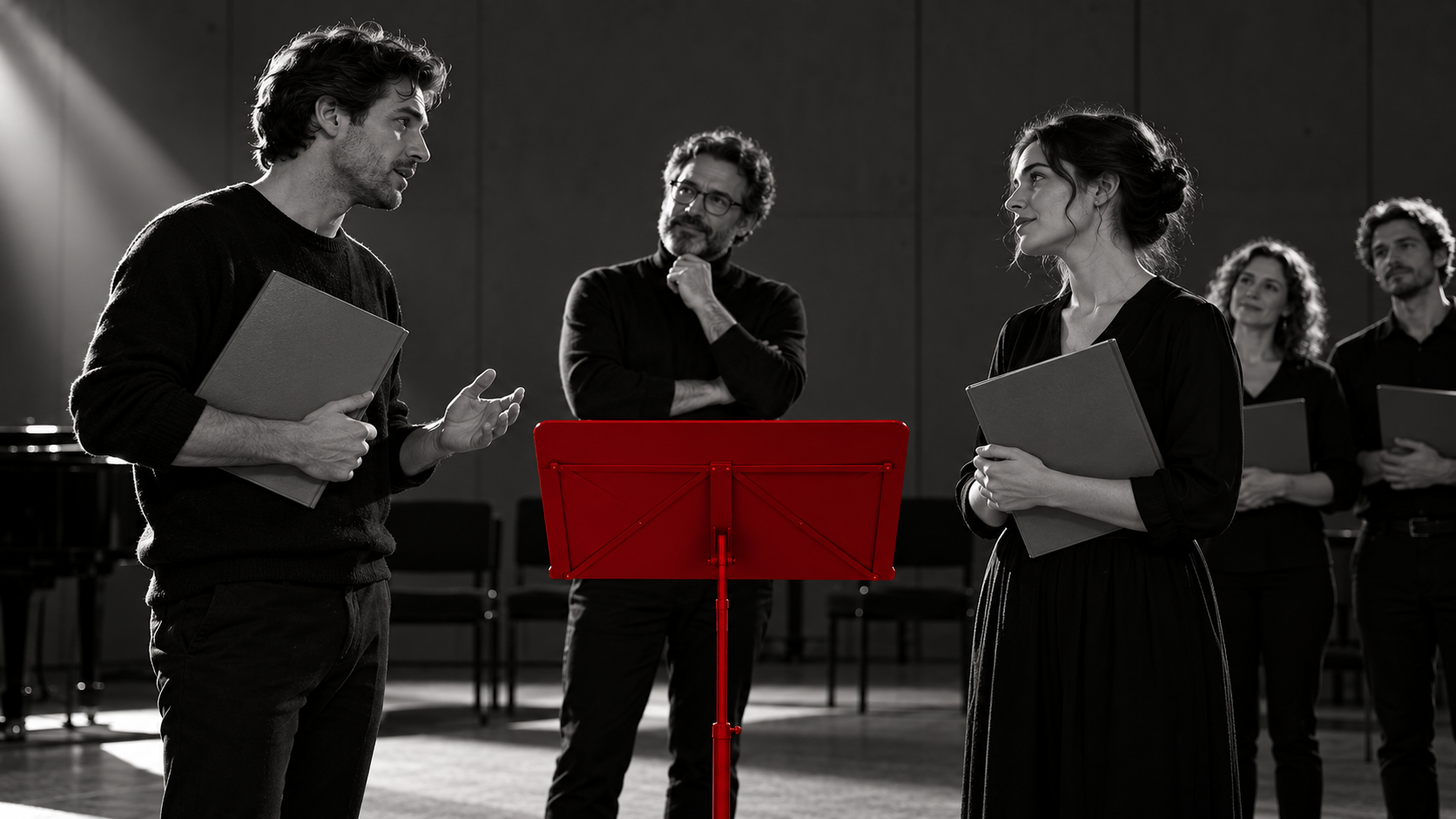
People can prepare one undertaking while seeking different places within it. In a hypothetical amateur choir, two participants propose arrangements for the concert's single opening. Both want their version performed, and both are needed to prepare the shared programme. Competition does not disappear with the word cooperation, but neither does it require treating the other person entirely as an obstacle. The article considers the object of comparison, grounds for selection, access to information, recognition of contributions, and conduct after a decision. Aristotle's distinction between emulation and envy is compared with a Christian question about wisdom, strife, and peace; these texts are not combined into a psychological theory of teams. The practical aim is to make limited rivalry intelligible, without presenting one version's victory as an assessment of a whole person or making the unsuccessful participant silently carry new duties to prove maturity.
Both examples are wholly fictional, not effectiveness research. A separate workplace example distinguishes shared results, indicators, rankings, and sanctions. No national pay or disciplinary rules are determined; safe objections and independent review are not guaranteed.
I. Rivalry needs naming within its actual scope
The choir has one opening and two prepared versions. Selecting one inevitably leaves the other outside this programme. If the director says everyone is simply doing something good together, a real difference of interests may be concealed. Participants want to help the concert and present their own work. This desire does not cancel cooperation. It does, however, require an intelligible object of choice: which arrangement fits this ensemble, time, and intention. Discussing a particular option helps prevent one evening from becoming a contest for the right to count as the chief author of the choir's life. A limited programme slot is not a limited place for a person in the community, unless the community actually operates that way.
Rivalry can be named without accusation. Mark and Olga both submit an opening, and the decision concerns one number. Each retains the right to prefer and explain their own intention. Meanwhile, the shared task includes rehearsals, other songs, and agreements with participants that do not depend on this selection. The boundary between the competing part and the rest of the work needs seeing. Without it, every action by the other person starts to look like a move against oneself: a comment about timing, a request for a score, or a suggested tempo change. This interpretation does not become a fact merely because genuine rivalry exists over one decision.
The scope may be wider than announced. Suppose the chosen version also gives its author the right to lead rehearsals or receive separate payment. The matter then concerns more than a musical option, and these consequences should be named beforehand. A concealed addition after selection changes the meaning of participation. The article does not establish a single fair system for a choir. It proposes precision about the object: what people compete for, which action follows from the decision, and what does not follow. Without this, an appeal to respect the result too easily demands acceptance of conditions participants did not know when they agreed to prepare versions.
II. Comparison can direct work or the exclusion of another
In Rhetoric, II.10–11, Aristotle distinguishes seeking to acquire a valued good from seeking to prevent another person from possessing it. This account belongs to a discussion of emotions and an orator's influence on judgement; it is not a contemporary study of working groups. A limited editorial connection concerns the direction of action. Mark may hear Olga's clearer opening and rework his own. Or he may try to conceal her file so that her version is never considered. In both cases he wants the selected place, but the actions differ in what happens to the shared task and the other person's access to selection.
This distinction cannot infallibly divide people into good and bad types. The ancient text contains moral assessments, inherited honour, and contempt; the article does not transfer that social scheme to choir members. One person can improve work honestly and act impermissibly at another moment. Discussing a particular act is therefore more useful than declaring a competitor's concealed essence. If Mark delayed a file, its actual transmission and the grounds for delay can be examined. If he disputes an arrangement, that alone does not prove a wish to humiliate Olga. Criticism of an option requires considering its content, while an assumption about motive needs grounds of its own.
Conversely, wanting to improve does not make every method permissible. A person may work very seriously on a number while using somebody else's notes without consent or circulating false information about a rival's readiness. Personal development and the conditions of another's participation should be distinguished. The former does not justify violating the latter. In the hypothetical choir, fair competition presupposes an opportunity to present a version and receive a decision on intelligible grounds. This is an editorial proposal, not a promise that rivalry will become enjoyable or always produce better music. It preserves the question about an act where a slogan about healthy competition might otherwise close it.
III. A criterion concerns the task, not a person's entire worth
The director may choose a short arrangement because the concert already exceeds the time available. That does not mean the longer version is worse as a work in general. With another ensemble or evening it might fit better. When grounds are unnamed, selection easily turns into a general ranking of talents. A criterion should therefore be connected with the particular task: duration, participants' capacities, the opening's intention, and preparation required. Such a criterion does not make artistic judgement entirely measurable. It lets people see what was actually decided without assigning universality to a choice for one programme.
Part of the basis may remain the director's judgement. It need not be disguised by a number that appears more objective than it is. For example, fitting the concert's overall tone cannot be derived entirely from the number of bars. The intended transition between numbers and why the chosen version supports it can be explained. Where several different grounds enter the decision, they should be distinguished. Feasibility of performance and artistic preference are different. Rejection for the first reason does not prove the second. A person may disagree with the assessment yet understand which action was adopted and which promised selection conditions were followed.
Nor should a criterion suddenly change to favour a desired winner. If versions were initially requested for the current ensemble but, after submission, suitability for a future recording by another choir becomes the standard, the object of selection has changed. The task can be reconsidered, but this must be named as a new basis and its consequences for completed work discussed. Change need not imply bad intent: circumstances genuinely can differ. However, absence of intent does not remove the actual alteration of conditions. Precision helps keep the question from becoming merely suspicion of partiality, without demanding that participants accept every new measure as part of the old contest.
IV. Access to shared information should not become a concealed advantage
Olga received an accurate list of voices, whereas Mark knows only last year's ensemble. His version may prove less suitable for a reason unrelated to the musical choice. If task information reaches one person through a private conversation, comparing options already involves differing preparation conditions. This does not mean all people's possibilities must become identical. Experience and time differ. But shared starting conditions that the group promised to provide should be accessible within the agreed scope. Otherwise the decision compares more than proposed work: it also compares responses to a change in the task unknown to one participant.
When a difference is discovered, current information can be passed on and the need for time to revise established. The situation need not require starting everything again if the change is small and an available way to accommodate it is clear. Yet conditions cannot be declared equal merely because a message was sent one minute before selection. Its significance for the version needs examining. Sometimes postponement is better, sometimes a limited decision is possible, and sometimes the comparison must be described as still unestablished. The article promises no single fairness algorithm. It shows the need to distinguish transmitting information from an actual opportunity to use it in the promised action.
Shared materials may also have limits on use. A draft Olga supplied for rehearsal discussion does not become a freely available basis for Mark's proposal without clarifying conditions. Permission can be requested, a borrowed part identified, or an independent route chosen. This does not resolve a legal copyright dispute. It concerns intelligible participation and the work's origin. If people already agreed to exchange solutions, that agreement should be recognised rather than permission demanded anew for every permitted action. But consent to defined assistance does not mean consent to every transfer, altered attribution, or expanded use of material for the sake of winning.
V. Rivalry does not cancel accepted shared work
While versions are considered, the choir keeps rehearsing other numbers. Mark need not help finish Olga's competing arrangement if he promised no such help. But if he accepted the task of preparing the shared rehearsal list, he cannot conceal it until selection to weaken her position. Refusing new participation and abandoning an accepted action must be distinguished. Competition provides no grounds for declaring every earlier obligation temporarily invalid. Equally, cooperation does not entitle the group to add any workload when someone fails to obtain the desired place. Both boundaries concern what was actually accepted, rather than a general image of selflessness.
If shared work interferes with preparing one's version, the constraint should be named before a failure. Timing can be reconsidered, assistance sought, or submission withdrawn while defined duties remain. The decision depends on the actual arrangement, but a concealed struggle for hours does not make it clearer. For example, Olga leads a rehearsal required for everyone and cannot revise her number by the same date as Mark. This difference may ground discussion of timing without guaranteeing a special decision for her. Participants clarify conditions without using busyness as a universal argument for one person's greater merit or another's lesser responsibility.
It is especially important not to turn assistance into a trap. If the unsuccessful participant must now finish the chosen version without payment to prove an absence of envy, this is a new task imposed through moral pressure instead of consent. That person can volunteer or continue an already accepted part. Refusing additional work does not itself prove malicious pleasure in others' difficulties. One can regret a result and still act correctly. The shared programme needs concrete commitments and available conditions; it should not be maintained by demanding that every disappointment first be overcome into a form of conduct convenient for everybody else.
VI. Peace does not mean the absence of differences and objections
In James 3:13–18, wisdom is connected with conduct, meekness, and peace, while bitter envy and strife are contrasted with wisdom from above. This is a Christian argument with a religious foundation. It is not a ranking of working teams and does not establish that every comparison of options is impermissible. A limited connection concerns the character of participation: one's judgement can be presented without basing shared work on humiliation and concealed hostility. Peace is not converted here into a demand to overlook differences. The article retains the possibility of challenging a decision's grounds without making another person's defeat a condition of one's own worth.
If Mark notices a violation of promised conditions, asking him to be silent for a pleasant atmosphere does not resolve the matter. What happened and whether it affects selection must be considered. An objection can be uncomfortable and substantive. Its form matters too: the unavailable list can be identified instead of accusing everyone of conspiracy. Yet a polite statement does not become true through politeness, just as a sharp tone does not establish that its subject is false. Content, conduct, and the next step can be clarified separately. Discussion then does not reduce to whose voice sounds more peaceful while the actual condition remains unexamined.
Nor should religious language deprive someone of the right to propose a version. A group may prefer a particular spiritual tradition, but our editorial connection establishes no criterion of choir members' true faith. A person need not adopt that faith to understand the proposed distinction between actions. The source retains its foundation, and the practical proposal remains limited. This boundary helps prevent comparison from being presented as proof that an ancient author and a Christian epistle recommend one organisational procedure. They ask different questions; the article considers the direction of rivalry alongside the moral quality of participation without erasing that difference.
VII. Recognition of work differs from a selected place
Olga's version entered the programme, but Mark genuinely prepared an independent alternative. That work can be recognised without promising future performance. If thanks sound like an indefinite promise of the next concert, they create a new expectation the group may not have accepted. Naming what was done is more precise: a transition was explored, another texture proposed, parts prepared. Recognition need not make two results equally suitable for this decision. It preserves participation's history so that selecting one version does not become a story in which the other person did nothing useful or merely obstructed the shared intention.
If the selected version uses part of shared discussion, that part's origin can be identified too. Olga might have reworked the opening after Mark's observation while remaining the author of her version. There is no need to choose between complete exclusivity and dissolving every name into the word collective. Accurate attribution depends on actual work and agreements. The article establishes no legal authorship regime. It proposes keeping history from being rewritten for an attractive legend about the winner. Recognising an observation does not automatically transfer the whole result to its maker; accepting help does not require denying independent preparation when that help actually concerned only a part of it.
Sometimes a participant values the opportunity to present a version more than public thanks. It should not be decided for that person that recognition fully compensates for rejection. This difference can be heard while the chosen programme remains. Rivalry is a limited decision that need not satisfy every wish. Emotional balance should not be promised as a result of correct documentation. Someone may need time, choose another project, or propose the number later without guaranteed acceptance. These possibilities do not cancel the current decision or turn it into an endless debt owed by the group if no corresponding promise was actually accepted.
VIII. After selection, what remains shared needs clarifying
Selection is complete and the group moves to preparing the chosen opening. Each person's further participation needs naming. Mark retains his parts in other numbers but need not become Olga's assistant for every revision. Olga does not acquire an unlimited right to change the whole concert because her version was accepted. The director maintains the boundary of the selected action. Victory then does not silently expand, and losing does not become a general loss of role. If a new version needs extra rehearsals, that is a new dependency requiring agreement. A decision about a number and a decision about somebody else's time remain different, even when closely connected in practice.
Agreeing to perform the selected version need not mean recognising it as the best in general. A participant can continue preferring another while accepting joint action within a defined scope. This distinction avoids demanding an identical inner assessment from everyone. But private disagreement cannot justify secretly performing one's own version instead of the accepted one. If someone can no longer participate under the agreed conditions, this must be communicated and a transition discussed. The article does not promise a painless exit. It preserves an intelligible decision for the others, who need to know the actual ensemble and available preparation arrangement.
Reconsideration is possible when substantial circumstances emerge: the ensemble changes, a number cannot be prepared, or an unexamined condition is discovered. This need not cancel the winner's achievement. The scope can be reduced, another option chosen, or the number postponed. The basis for reconsideration should be named separately from dissatisfaction with the result. Otherwise every difficulty revives a contest that nobody announced anew. Conversely, formal completion of selection should not block an actual error. Participants distinguish maintaining a decision through inertia, substantive correction, and renewed assessment of options. These actions have different histories and different consequences for work already completed.
IX. A violation of conditions should be examined through the act
Suppose one version was not shown to the choir because of an error in transmitting the file. This is an actual problem even if nobody intended to exclude its author. What arrived, what was available to the decision-maker, and the basis for selection need checking. Correction may require renewed consideration, but need not predetermine a different winner. Establishing a violation and determining its consequence are different actions. If the fact is unconfirmed, it cannot be declared established merely to restore a feeling of fairness. The question can remain open and available verification performed without turning suspicion into a new history of the entire concert.
If deliberate obstruction occurred, it too should be described precisely. Concealing a file, falsely reporting readiness, and sharply disagreeing with the music are different acts. Each has its own subject and possible correction. Discussion need not demand a psychological diagnosis before calling a particular act impermissible. Nor should it be justified by saying competition always makes people defend themselves. Rivalry explains the context without establishing the permissibility of every means. The practical question concerns restoring available participation, examining the decision, and clarifying future conditions, rather than merely deciding who should now feel more ashamed.
During examination, versions and necessary information should be preserved without collecting participants' personal histories without grounds. If the cause is unestablished, that limitation should be named. A corrected message does not prove that an opportunity for consideration has itself been restored; repeated selection does not prove restored trust. The article distinguishes these results without promising complete reconciliation. Sometimes a procedure needs changing, sometimes this contest should be abandoned, and sometimes continuation after limited correction is possible. The decision depends on the actual violation and accepted work scope. This does not create an ideal group, but helps keep a concrete question from being closed through general praise of cooperation or condemnation of competition.
X. Cooperation maintains the boundary of rivalry
The choir can retain two different wishes and one concert. This does not require declaring competition the chief engine of growth or eliminating comparison altogether. Its useful place in selecting a particular option needs distinguishing from the point at which it starts controlling all participation. The limit concerns action: accessible materials, announced conditions, an intelligible decision, and subsequent duties. It does not require identical feelings about the result. Mark may be disappointed, Olga pleased, and others indifferent to authorship while interested in performance. Shared work remains possible within a defined scope if these differences do not conceal incompatible promises or actually unavailable conditions.
Sometimes a group discovers that no contest is needed. Versions can be combined with their authors' consent, a number selected by rotation, or the opening's intention changed. These decisions are not automatically better: combining may worsen the music, rotation may ignore the current ensemble, and change may demand new effort. They should be considered as options rather than proof of the community's moral superiority. Competing proposals may also remain the best available selection method for this programme. The article proposes no universal prohibition. It requires that the chosen arrangement not conceal absent consent, unrecognised work, or a winner's silently expanded role behind words about harmony.
In the hypothetical story, completion does not consist in rivalry disappearing from memory. People know what was selected, why one version was accepted, and what they now do together. The other version's work is preserved in history, promises are not invented, and further assistance has an intelligible scope. Aristotle and James remain different references: the direction of desire and action is considered alongside a moral and religious question about peace and wisdom. The practical connection belongs to the editors rather than a shared ancient instruction. Cooperation can accommodate competition where its boundary remains discussable and a decision about a part does not silently authorise control over another person's entire worth.
XI. Shared results, indicators, rankings, and sanctions differ
Work assessment can concern a key performance indicator, or KPI: a specified measure of one aspect, not a whole employee. Shared results, meeting personal indicators, and relative group positions differ. Numbers alone explain neither what was counted nor its connection with the task. Measurement does not automatically prescribe consequences: ranking, rewards, and sanctions need their own grounds and actual decisions.
In another wholly fictional workplace example, Mark and Olga prepare a shared report. A table counts closed requests; Olga also checks shared data, while Mark receives differently complex tasks. Completed common work can coexist with incomplete contribution counts. This proves neither malice nor useless measurement. Counted subjects, performance conditions, and assistance differ. Cooperation may become uncounted load for someone enabling the team’s result.
Suppose both meet an announced personal indicator while one ranks lower. Relative position does not itself establish nonperformance; comparison membership matters too. Conversely, first place establishes no quality of the shared result. Activity counts, outcomes, and comparison rules differ. Linking lower rank to reduced pay or discipline needs separate actual terms and powers rather than arithmetic inference or a moral verdict.
Understand data, periods, comparable conditions, and review functions. Correcting records does not guarantee restored trust; finding an error does not automatically select a different winner. Facts and suitable decisions matter. No national pay, disciplinary, or refusal instruction is supplied; independent review and safe reporting are not promised. Aristotle and James authored no modern KPI system. This bounded editorial comparison keeps shared results visible and sanctions distinct from measurement.
What this means in practice
Name the competing part of a shared task. What is selected, which consequences follow for role, time, or payment, and which do not? Distinguish this part from shared actions already accepted. Clarify current information and selection grounds, preserving judgement's limits where it cannot become a number. If conditions changed, name the change and its effect on work already prepared. A short agreement helps reveal the object; it proves neither identical possibilities for people nor guaranteed fairness of every decision. In the choir, this means selecting one opening for a particular ensemble rather than fully ranking the musicians.
Consider your own next action: does it improve a version, clarify conditions, or deprive another person of available participation? Do not infer a competitor's motive merely from rivalry's existence. Check an objection's content separately from its tone, and a reported violation separately from the desired consequence. Do not use help, gratitude, or spiritual maturity to assign new duties without intelligible consent. After selection, name subsequent roles, the accepted work's origin, and the boundaries of promises. Recognition of effort need not mean future performance; the chosen slot does not establish that all the winner's contribution was exclusive.
If an error emerges, preserve relevant history and distinguish correcting information, renewed consideration, and subsequent joint action. Do not promise restored trust on the strength of one technical step. If cooperation in its current scope is unavailable, discuss limitation or transition instead of secretly ending participation. This practice does not guarantee enjoyable rivalry. It helps keep a decision at its actual scale: comparing work without turning a person into an entirely defeated figure, and preserving a shared task without making words about unity permission to bypass the participation conditions that gave it intelligible substance.
For work assessment, distinguish shared results, personal indicators, relative position, and proposed consequences. Examine data and comparison conditions. Errors need suitable consideration without automatically choosing a winner or sanction; measurement is not every contribution.
Key quotation
And the fruit of righteousness is sown in peace of them that make peace.
James 3:18, complete verse in KJV Standard, King James Bible Online. The context of 3:13–18 preserves the Christian distinction between wisdom from above and bitter envy; the quotation is not converted into an empirical promise of team effectiveness.
Connections between traditions
| Question | Historical reference | Editorial connection | Boundary |
|---|---|---|---|
| Where rivalry is directed | Aristotle, II.10–11 | Developing one's version or obstructing another's participation | Not diagnosis of a human type |
| What the source considers | Aristotle, II.11 | Desire is connected with action | Rhetorical context is not team research |
| How wisdom manifests | James 3:13–18 | Participation is considered through conduct | The Christian foundation is preserved |
| What peace means | James 3:17–18 | An objection need not be built on humiliation | Peace does not cancel examining conditions |
| Where comparison ends | Two different questions | Selecting a part does not assess a whole person | No single theory of competition |
The comparison preserves the difference between a rhetorical and philosophical text and a Christian one. Contemporary conditions of selection and participation are editorial proposals, without attributing one management procedure to the sources.
The work-assessment addition is editorial analysis. Historical sources prescribe no KPI, pay, or disciplinary system; shared results, records, relative places, and consequences retain distinct grounds.
Primary sources
- Aristotle. Rhetoric, II.10–11. Translated by W. Rhys Roberts, Internet Classics Archive. Both complete selected sections on envy and emulation were read, including their concluding connection with persuasion; translator metadata were checked. The exact print edition and rights of the electronic version outside relevant jurisdictions were not independently established. Moral typologies, inherited honour, and contempt are not transferred to a contemporary community.
- James 3:13–18, KJV Standard. The complete continuous selected passage was read, and displayed book and edition checked. The site's later commentary is not used as biblical text. The exact modern print edition and worldwide rights of the site were not established; KJV status depends on jurisdiction. Philosophical and religious references are not empirical evidence of the proposed practice's effectiveness.
Tags
competition, cooperation, rivalry, shared task, comparison, selection, participation conditions, criterion, option, recognition, contribution, envy, emulation, respect, information, access, authority, promise, boundaries, decision, disappointment, objection, error, reconsideration, assistance, Aristotle, Rhetoric, James, peace, choir community, KPI, work assessment, indicator, shared result, ranking, sanction, counted contribution
About the authors
Andrey Zarinsh is the author and founder of United Wisdom. He explores inner transformation, the unity of traditions, intercultural dialogue, and contemporary spiritual discipline. Instagram: @andrey.zarinsh.
Maria Evilkut is a co-author of United Wisdom. Alongside her research, she seeks to test these ideas in practice and observe how principles of unity and mutual understanding work in real life between people and cultures. Instagram: @ilkutki.