
Family, community and living together
Family tradition and personal choice
A full R32 revision for an adult whose partner, career or faith choice is called rejection of family and circle. Alongside fictional Lida’s gathering are separate serious-sanction variants: housing/income loss, isolation and stated threats. They are not added to her biography or presented as every family or religion.
Epigraph
“two temperaments, two consciences”
Edmund Gosse, Father and Son: A Study of Two Temperaments, chapter I, fragment of the first sentence. Different people within one history; the sentence's continuation is omitted.
What this article is about
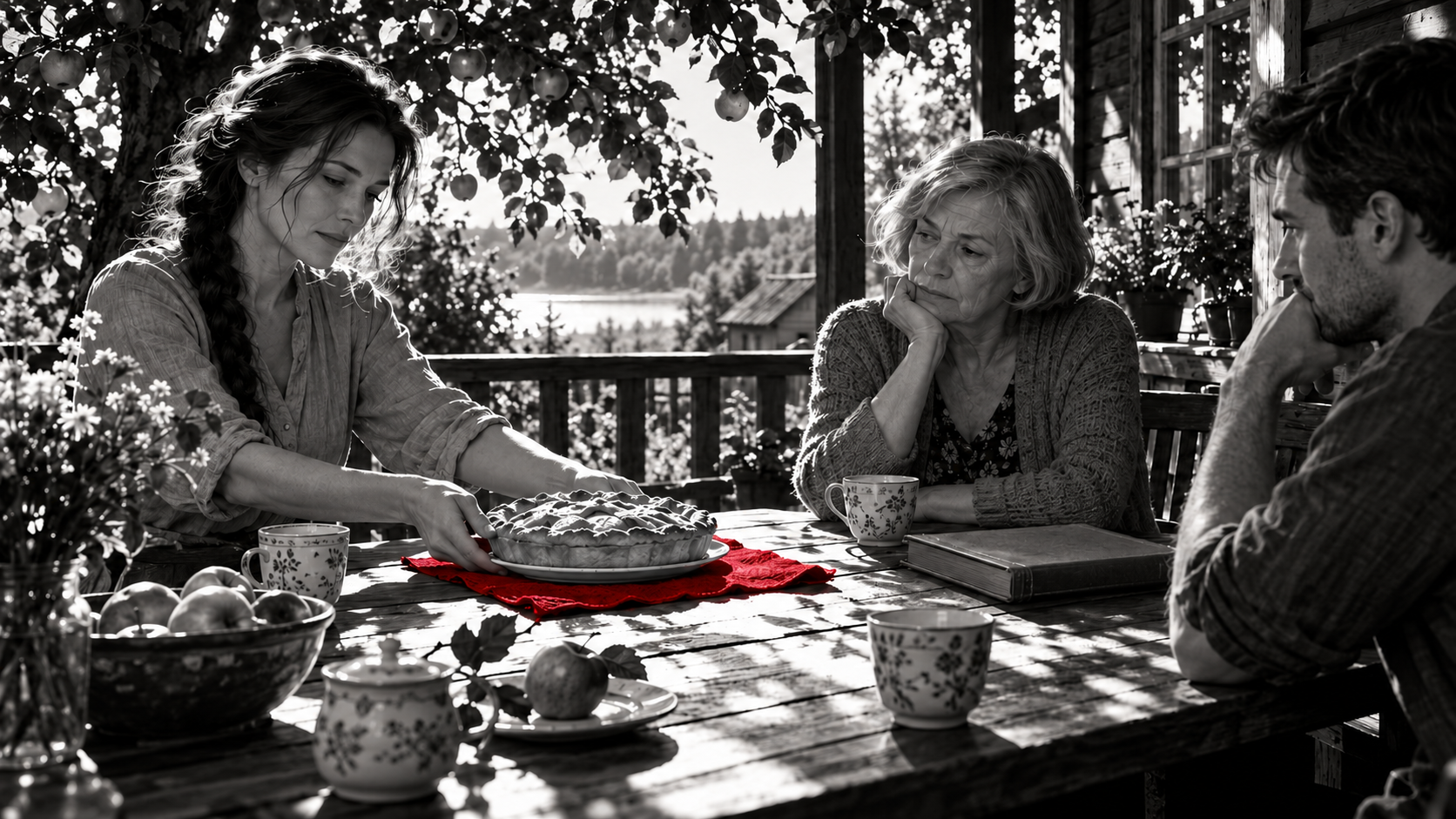
Every first Saturday in June, Lida's family gathers at their country house. Her grandparents did the same: food together, a photograph by the apple tree, and stories about earlier meetings. Now Lida proposes coming another day and skipping the obligatory round of speeches. Her aunt Tamara hears rejection of the family. Her brother Nikolai thinks retaining any element means submitting to the old order. Lida wants neither to repeat the whole day according to its former script nor to declare her history empty. This is a hypothetical scene written for the article, not an observed case.
The article explores how an adult can continue, change, or leave particular elements of a family tradition. Memory, participation, and accepting a rule have different content. A changed form need not retain its meaning; preserving a form does not prove personal agreement. The nearest article, R-11-N01, concerns gratitude to parents and an indefinite debt; here we consider the repeated family arrangement itself. There is no guarantee of approval, reconciliation, or closeness, no mandatory practice for dangerous relationships, and no legal determination of family obligations.
Partner, career and faith choices under serious sanctions, and retaining language, culture and particular ties while declining coercion, are also considered. These variants are not added to Lida’s biography; a family lunch supplies no model of safe action in dangerous conditions.
I. First establish what is being called tradition
Tamara says the family has always gathered together. But one word covers a date, place, dish, photograph, and each person's obligation to make a speech. Lida is willing to share food and view old photographs but not to speak. If the entire set is declared indivisible, her answer becomes total rejection before she can state its scope. Elements can be distinguished without promising to retain them all. This describes the object of choice; it is not a covert way to dismantle someone's favourite gathering gradually and call destruction care for it.
Not every element was repeated identically. Grandmother changed dishes, grandfather sometimes arrived late, and speeches appeared after his death. Such details may be known from photographs, accounts, or personal memory. An unknown origin is permissible too: the family may not know who first suggested an action. The word always does not confirm a continuous history. Yet finding that something is new does not make it meaningless. A later addition may have acquired real significance even when mistakenly portrayed as an unchanging part of several generations' lives.
Nikolai calls any demand to repeat the past a tradition. For Tamara the word chiefly means a gathering of people. Their definitions may differ, and the article does not appoint a correct family vocabulary. Understanding which action is being discussed now matters. Lida might speak about speeches, Tamara about the day, and Nikolai about the right to decline. Until their subjects are distinguished, each answer looks like an objection to everything else. Clarification does not guarantee agreement; it reveals precisely what is being retained or changed and which conclusions remain too broad.
Several names can remain instead of one: the usual gathering day, a favourite dish, a way of remembering grandfather, and an expected speech. Their connections remain, but choice becomes more specific. Sometimes participants really want an indivisible observance. That must be heard too, without promising that they will accept a partial version. Lida need not call the whole convenient merely because others do not want it divided. Description supplies a basis for discussion; it does not make anyone's option an already shared arrangement for everyone present.
II. History explains significance without deciding for the inheritor
Tamara remembers the first summer day after a difficult family period. Sharing a table meant that people could be together again. Lida did not see that day but can hear the account. The past's meaning need not be invented merely because someone today does not share its former form. Understanding the account, however, is not equivalent to accepting every present rule. Historical grounds and obligatory participation leave a separate question, unsettled by the strength of feeling of someone describing what matters to them.
In chapter III of On Liberty, Mill considers custom evidence of experience that an adult must interpret within personal circumstances. He does not advocate living without accumulated knowledge. His philosophical basis is developing individuality, not research into family gatherings or proof that every departure is correct.
Lida can ask which significance of the past relates to her present involvement. She might value seeing relatives without regarding public speaking as a suitable form. Another inheritor might accept the whole day after considering it personally. Personal choice does not require difference for its own sake. Nor does it guarantee a good decision: Lida might misjudge consequences or overlook a known promise. A reference to past experience should be grounds for thought rather than a way to exclude her own consideration from family life beforehand.
Tamara can regard a change as loss. She need not immediately call it a splendid new expression of the former meaning. Lida can understand that loss without making it the sole condition of a decision. Another person's disappointment retains human weight but does not automatically establish that every element should be repeated. History thereby remains significant without becoming authority to choose for someone else. Tradition can be a known inheritance that people consider differently, rather than a shared answer to every subsequent question about the family's life.
III. Continuing can have a personally chosen basis
Lida decides to make grandmother's pie. Nikolai asks why she is submitting to expectations again. Identical actions, however, do not always have identical grounds. She likes its taste, remembers preparing it together, and wants to share food. This can be her own choice despite an inherited recipe. Freedom cannot be determined solely by the number of elements abandoned. Meanwhile, her account of wanting to participate does not establish others' motives. Someone cooks from habit, another from obligation, while another declines to explain participation before the whole family.
In The Analects, IX.3, Confucius accepts an economical change in a ceremonial cap's material but retains the earlier manner of bowing against a widespread change. Different elements receive different judgments within ritual order. This is not a modern theory of individual family choice: proper observance and its hierarchical grounds retain their independent importance.
The comparison allows alternatives to unconditional repetition of everything or rejection of everything. But Lida's decision is not derived from the ancient example. She considers the dish, speeches, date, and participation herself. If making a pie involves someone else's kitchen, costs, or agreement, conditions matter alongside an inner wish. Personal meaning creates no unrestricted right to arrange a shared day one's own way. Accepting an element personally remains personal; shared action needs others' participation in the parts that actually concern them.
Sometimes Lida can simply arrive without explaining the pie as a philosophical position. Not every voluntary choice requires a public defence. Yet if speeches are expected and her whole visit is taken as consent to them, the subject is better clarified when possible and safe. Otherwise, a small continuation becomes grounds for an expanded assignment. Personal choice retains a specific scope: a prepared dish does not confirm acceptance of every norm of the gathering, just as declining a speech does not mean denying every connection with the people around the table.
IV. A changed form does not guarantee retained meaning
Lida proposes moving the gathering to Sunday. For her, seeing people remains possible. For Tamara, Saturday connects with the day the family first returned to the country house together. Nobody can declare that meaning is definitely identical because other elements remain. A change might preserve one part and lose another. That does not make it automatically wrong but calls for an accurate description. Lida offers a different option, rather than proof that nobody will lose anything if they agree to it now.
Tamara might accept the move for practical reasons while grieving the earlier day. Such agreement does not confirm complete inner approval. Lida might also come on Saturday this year without accepting an obligation for every year following. Participation, preference, and a further promise differ. Sometimes the family finds leaving those states unexamined more convenient because a shared photograph looks smoother. But pictured unity establishes no acceptance of the same meaning and duration of participation by everyone in a repeated arrangement.
Some changes cannot be portrayed as a small adjustment. Lida might want to omit the remembrance entirely rather than tell a story about grandfather. If that is central for others, the new proposal might be a different gathering. It can be considered without insisting that it remains the same custom. Honest naming sometimes preserves more respect than assurances of unchanging faithfulness. People should not be made to accept something new under an old name simply to avoid explicitly acknowledging an actual difference.
Nobody is obliged to ensure painless continuity. A changed form may succeed, remain disputed, or be rejected altogether. The article proposes no technology for renewing family arrangements. It proposes seeing precisely what carries over, what changes, and whose agreement remains absent. A similar dish or place does not prove identity. The possibility of loss does not prove a ban on any choice either. A real decision remains between these positions; outward similarity cannot predeclare it either restored tradition or destruction of the family.
V. Another person's memory need not be corrected to make your choice
Lida remembers being made to describe school failures amusingly at gatherings. Tamara remembers good-natured laughter. These memories concern a shared event but need not have the same judgment. Lida need not prove that Tamara always felt concealed cruelty to name her own dislike of speaking. Tamara need not deny what she hears for her pleasant memory to remain possible. Recognising different experiences establishes no complete fact about disputed details, but prevents appropriating another person's answer for a convenient family account.
A known action, one's assessment, and another person's explanation can be distinguished. Lida knows that a story was expected; she does not know every listener's thoughts. Tamara considers the intention good; that does not require Lida to have experienced it pleasantly. The article neither diagnoses participants nor demands a general verdict on the entire past. Naming a particular element someone no longer wants to repeat is sometimes enough. Personal choice should not depend on every witness acknowledging that they experienced the event identically and fully endorse its assessment.
An unpleasant memory, however, does not make every subsequent conjecture reliable. If Lida decides that the entire gathering was always created for humiliation, that new assertion needs grounds. She can decline an action without assigning a secret purpose to everyone. She can also name actual harm without softening it through obligatory gratitude for good pie. Particular facts do not cancel each other. Such precision promises no relief but leaves the past complex instead of supplying two completed images: an impeccable family or meaningless history without a single good event.
The family album need not become a court either. Old photographs can remain even if Lida no longer participates in the former format. They need not be published where consent or personal information is at issue. Nor should someone be cut out of shared history merely because their present choice is inconvenient. This article establishes no legal rights to photographs or documents. It distinguishes remembering what occurred from assigning future action: an image of the past does not oblige repetition, while declining repetition provides no ground to declare that the past never existed.
VI. When disagreement involves serious sanctions
At the start of Father and Son, Gosse describes two people's divergence with continuing respect. In the selected concluding context, his father's demand leaves no compromise and the son asserts independence of inner life. This is his retrospective account, not a neutral assessment of all religious families or a guarantee of preserved relationships following a choice.
Tamara may continue the former Saturday without Lida. Lida might see several relatives separately. Different forms of participation emerge rather than a new arrangement accepted by everyone. They need not be presented as a temporary stage preceding complete future unity. Separate meetings might remain, or some contact diminish. Their actual state matters more than an attractive name such as reconciliation. Nobody should declare another person already in agreement merely because they prefer a completed shared story and want the familiar family photograph back in its place.
Nikolai can likewise retain a broader refusal. He need not adopt Lida's partial option as proof of maturity. Yet his answer cannot assign her involvement the concealed meaning of submission. Each chooses within personal circumstances; shared actions require corresponding agreement. If Nikolai promised to transport things, that is a separate subject not automatically removed by rejecting the custom. Choosing a tradition remains significant without becoming a universal answer to every particular relationship, promise, and consequence that has arisen among its participants.
In a separate fictional example, an adult is required to marry the circle’s chosen partner and told refusal will cost their housing. That differs from disappointment about a gathering’s date. Introducing someone is not identical to forcing marriage; relatives’ agreement supplies neither the adult’s nor the partner’s consent. The stated sanction is given, rather than its enforcement, threatening capability or legal classification. Safe refusal, meeting and travel are unselected; public proof of independence is not required.
In a career variant, the circle demands continuation of a family business and links another choice to lost income or housing. Practical dependency does not disappear through inner clarity. Not every withdrawal of support is automatically criminal: relationships, agreements and acts matter. Learning, current employment and livelihood are not settled by a romantic demand immediately to leave everything. No new income, housing, payment or programme is verified; professional disagreement does not make someone the cause of another’s violence.
In a faith variant, someone is required to profess a belief or perform a rite, with refusal linked to isolation, housing loss or a stated threat of violence. These are separate conditional possibilities, not every believer or Lida’s family. Doubt, changing faith, declining a practice and rejecting all culture differ. Neither unbelief nor returning to faith proves maturity. Others retain conscience without thereby receiving authority to decide for someone or demand complete public confession.
Such sanctions exceed ordinary disagreement. Stated threats, actual restrictions and real capabilities need separate grounds. Joint discussion, mediation, disclosure and approaching services are not declared safe; understanding requires no risky announcement. Country, applicable law, services, access, confidentiality, protection and legal outcomes remain unestablished. Contact, an accepted message and help differ. Gosse’s retained respect guarantees no present outcome or duty to endure danger. This promises neither that choices affect nothing nor that their consequences are already known.
VII. Declining an element does not require contempt for its participants
Lida does not want to make a speech. She need not declare those who like speaking people without dignity of their own. Refusal concerns her action; judging others' participation is separate. Tamara can continue the remembrance circle for her own reasons. But recognising this distinction does not prohibit criticism of a particular demand. If speech is imposed as a condition of belonging, Lida can name that dependency specifically. Respect for people means neither declaring every arrangement they accept good nor losing the ability to give grounds for disagreement.
Nikolai proposes publicly mocking the gathering to prove freedom from it. That changes the subject: defining one's participation becomes judging relatives before outsiders. It can have consequences for personal information and later communication needing separate consideration. The article neither forbids speaking about personal history nor assigns an obligation to protect family reputation at any price. It simply does not make public disparagement a necessary part of independent choice. An action can change without an obligatory portrayal of everyone who remains as unreasonable or unworthy.
Tamara can likewise avoid passing judgment on Lida. She can say the new form does not fit her understanding of tradition. That is a specific disagreement. Asserting that Lida no longer belongs has a different scale and does not follow from one absent speech. Sometimes family belonging really is understood through obligatory arrangements; that difference then matters and should be acknowledged rather than concealed. But the article does not adopt such a definition as a universal norm. A person should not receive an additional demand from us to perform an action to prove their human worth.
Disagreement may remain sharp. Precision does not guarantee politeness or promise a considerate response from relatives. Lida may choose limited contact, a personal note, or no discussion of reasons for now. She need not construct a perfect explanation for a limit to exist. At the same time, describing her decision does not establish what someone else actually meant to say. When conversation is available and desired, the particular subject can be clarified; otherwise, the article does not make continued conversation a mandatory condition for a personal answer's legitimacy.
Language, songs, food, remembrance and faith are no indivisible signature beneath every demand. Someone can retain language while declining a prescribed marriage, value a craft while choosing another career, or retain cultural memory without a rite. Access to every place or relationship is not promised; inherited elements can have different present conditions.
A particular tie needs another participant. A relative may want contact without being able to protect it; shared language proves no confidentiality. Community acceptance, everybody’s hidden support or a new shared version cannot be guaranteed. Culture can remain meaningful without immediate return, forgiveness or proof of loyalty. Rejecting one coercion makes neither every old tie safe nor every memory disposable.
VIII. A new tradition must also remain a proposal
A year later Lida arranges a small autumn lunch. She wants everyone to come without speeches and choose when to leave. But a form convenient for her does not automatically become a shared good. Nikolai dislikes collective lunches, Tamara wants another date, and someone is unready to host. If the new order is declared the only free and mature one, it starts assigning participation just as the old did. Rejecting former obligation matters only to the extent that the new proposal actually leaves room to decline.
Lida can keep her gathering without requiring the collective name family tradition. It might become customary for several people or remain a single event. Repetition arises from actual involvement rather than a festive announcement. Helping with food does not promise to cook every autumn. Attending once does not mean agreeing to every future date. Scope must also be retained within an enjoyable new option; otherwise voluntary participation becomes merely a feature of the invitation, lost immediately after the first reply.
The new may also be less convenient than the old: more expense, fewer available dates, loss of a favourite place. An independent proposal is not exempt from assessment. Lida may learn something that changes her plan without destroying her choice. She can retain the old dish, agree to Saturday, or hold a separate gathering. A change following consideration is not automatically a return to submission. Freedom is not measured by maintaining distance from every inherited element; it includes recognising grounds and accepting another answer in present conditions.
IX. A shared form should not conceal another person's work
Preparing food, cleaning, invitations, and travel may support the familiar day. Tamara loves the gathering but is tired of doing everything alone. Discussing only her speech, Lida might miss this part. That does not oblige her to accept all the work but helps distinguish an attractive image of the custom from the actions sustaining it. Preserving tradition sometimes means wanting a result without an agreed person to provide it. The unchanging photograph then conceals a changed cost for someone whose current possibilities nobody has asked about.
Tamara can decline to cook while continuing to value the gathering. Her choice too should not automatically become rejection of the family. Lida can offer another dish or one part of help without promising the whole day. Nikolai can decline attendance and any task. If their answers leave the former option unworkable, the actual gap must be acknowledged. An assertion that someone will surely continue cannot close it. A custom exists through actual actions, not only through wishing for a familiar result and considering it already secured.
Discussing work provides no completed exchange rate for love. Two hours cleaning, expenses, and presence cannot automatically be combined into a ranking of family faithfulness. A particular promise, result, and available offer can be checked. A new option can also be declined. This is separate consideration of the gathering's conditions, not a moral examination of belonging. R39 on unnoticed parts of family involvement is useful for that subject; here the limit is narrower: a beloved repeated custom should not portray another person's labour as a natural property of the house, available regardless of their answer.
X. Returning need not promise to repeat everything
The following June Lida does come to the country house. Tamara thinks the disagreement is over. Yet attending may concern this day rather than cancel the previous limit on speaking. That can be clarified separately under suitable conditions. Returning to a familiar place is not admitting that refusal was a mistake. Nor does an absent speech prove that Lida came merely as a formality. The article establishes no concealed motives. It retains the scope of involvement someone actually accepts now.
Memory of the past and present choice can remain connected without final family agreement. Lida might bake a pie, hear a story, decline a photograph, or leave early. Others might be dissatisfied. The result need not be called restored harmony. A more limited outcome is understanding what she continues, changes, and declines; the family may have heard that answer, or not. A prepared explanation, retained album, and actual visit are different facts, none confirming the whole content of someone else's agreement.
Returning to the first Saturday, tradition can be seen without an appointed winner. History did not disappear through Lida's choice; choice did not disappear through history's real significance for Tamara. Their compatibility is not guaranteed. Yet someone can retain an accurate name for an inheritance without presenting it as an obligatory script for their entire future life. They can continue for personally chosen reasons, change while acknowledging loss, and leave without demanding total forgetting. None of those paths need become a shared decision of every relative.
If serious pressure later weakens in another situation, that is a separate conditional stage, not an end to every dependency. Rapid restoration of trust, work, reputation and intimacy is not promised. Earlier help makes neither every old tie safe nor immediate contact obligatory. Partners and others retain consent without duties to trust, forgive or join recovery. This gives Lida no new dangerous biography and makes her gathering no universal model.
What this means in practice
If the subject suits you, choose one customary element for personal consideration: a date, dish, story, role, or manner of participation. State what is known about its history, what came from another person's account, and what remains unknown. No full family verdict is needed. Then distinguish its significance for you, the actual action, and a supposed future obligation. You can continue, change, or leave the element without assigning the same answer to others.
When proposing change, describe what remains and what may be lost. Do not guarantee former meaning or approval. Separately check a specific accepted promise, others' resources, access to personal information, and necessary agreement for shared action. Do not turn one visit into a perpetual obligation or declining a part into denial of the entire history.
Discussion is optional. Serious sanctions for partner, career or faith choices may make ordinary family conversation inapplicable. No risky announcement, move, job change, meeting or disclosure is required. Support, protection, access and confidentiality remain unverified; contact is not help. Clarity guarantees neither community acceptance, a correct decision, closeness nor safety. Language, memory and particular values can remain without repeating coercion or immediately renewing contact.
Key quotation
“the right to think for myself”
Edmund Gosse, Father and Son, concluding context, account of the son's demand, primary web line1360. A fragment of the author's account of his own objection, not a sentence from the father's embedded letter.
Connections between traditions
| Concrete sides | Explained similarity | Different grounds | Particular boundary |
|---|---|---|---|
| Gosse, opening and ending of Father and Son: shared history and diverging consciences ↔ Mill III: inherited experience and its applicability to an adult | In both examined passages, what comes from predecessors does not exhaust someone's present judgment. Gosse's close father–son history does not remove their final divergence; Mill treats experience and custom as material whose applicability adults must interpret themselves. Connection with the past can thus be distinguished from repeating a prescribed answer. | Gosse retrospectively narrates a religious family conflict, including the father's demand; Mill philosophically defends individuality and personal use of experience. The memoir's outcome does not prove the philosophical rule. | No generalisation about every religious family, proof of every choice's correctness or promise of retained respect, contact or safety. |
| Mill III: personal interpretation of custom ↔ Analects IX.3: accepting the silk cap while retaining the bow below | Both distinguish elements rather than accept a prevalent package simply because others follow it. Mill requires judgment about inherited experience's applicability; IX.3 accepts changed cap material for economy but rejects the changed place of bowing. The similarity is differentiated assessment, not an identical criterion. | Mill defends adult individuality; the Confucian decision retains proper ritual and hierarchy. It does not make personal preference the supreme ground of every alteration. | Neither ancient endorsement of modern voluntariness nor transferred hierarchy, and no inference that relatives will accept every partial version of a rite. |
| Gosse's ending: thinking independently against the father's demand ↔ Analects IX.3: refusing to move the bow with common practice | Both selected episodes show a limit to accommodation: another's approval or a practice's prevalence does not remove what the speaker considers essential. Gosse's subject is personal judgment; IX.3 concerns the proper place of bowing. The concrete similarity is a boundary being retained. | The memoir narrator's independent conscience and fidelity to ritual norms may lead to different decisions. They are not one doctrine of freedom and do not determine Lida's choice. | No duty to dispute with a dangerous relative, maintain contact, endure sanctions or treat every uncompromising stance as right. |
| Author analytic row: Lida remembers baking her grandmother's pie ↔ Lida declines compulsory speaking | Both concern one family history but answer different present questions: a recipe can continue through personal desire, while giving a speech needs its own answer. Retained memory does not prove consent to the whole script; declining a speech does not itself erase memory or chosen food. | This distinguishes elements in the article's hypothetical scene, not a fourth historical tradition or evidence of everyone's motives. Another person may prepare the same dish for different reasons. | No guaranteed acceptance of partial attendance, access to another's kitchen or labour, legal document rights or relatives' obligations. |
Sources
- Edmund Gosse, Father and Son: A Study of Two Temperaments, Project Gutenberg No.2540, English original. This revision reads author/version details, chapter I opening40–43 and selected ending1278–1313/1349–1378, including the complete final letter/response; not every intervening passage or the whole book. The whole book was not read; exact underlying printed edition not established. Both short quotations come only from Gosse's own narration, with Russian translations prepared for this article. Gutenberg's US availability is not declared universal permission.
- John Stuart Mill, On Liberty, chapter III, Project Gutenberg No.34901, English original. This revision actually reads selected context528–553, particularly540–545 on experience/custom; earlier597–609 were not freshly opened or used as new examined support. The first distinction is used; no modern clinical, legal, or empirical recommendation is derived. Exact printed issue not established.
- The Analects of Confucius, IX.3, James Legge's English translation from Chinese Classics, PG No.3330. This revision reads primary introductory information0–43 and selected contextIX.1–9 at225–232; not the whole corpus. Ritual grounds and hierarchical limits are retained; no direct quotations. No full-corpus or exact printed-edition claim.
Tags
family, tradition, choice, custom, generations, history, memory, inheritance, form, meaning, consent, participation, voluntary involvement, change, continuation, refusal, celebration, gathering, ritual, respect, difference, promise, limit, closeness, Gosse, Mill, Confucius, independence, belonging, responsibility
About the authors
Andrey Zarinsh is the author and founder of United Wisdom. He explores inner transformation, unity across traditions, intercultural dialogue and contemporary spiritual discipline. Instagram: @andrey.zarinsh.
Maria Evilkut is a co-author of United Wisdom. Alongside research, she seeks to test these ideas in practice and observe how unity and mutual understanding work in real life between people and cultures. Instagram: @ilkutki.