
Understanding the effects of war
Why distress may become more noticeable after reaching safety
A move is complete, immediate danger has diminished, and there is somewhere to close a door and sleep. Things should apparently become easier. Yet this may be when someone notices anxiety, exhaustion, sleep difficulties, or feelings previously difficult to name. Why does life feel harder when the surroundings are calmer? Fear can follow: perhaps safety damaged something, or deterioration is now inevitable.
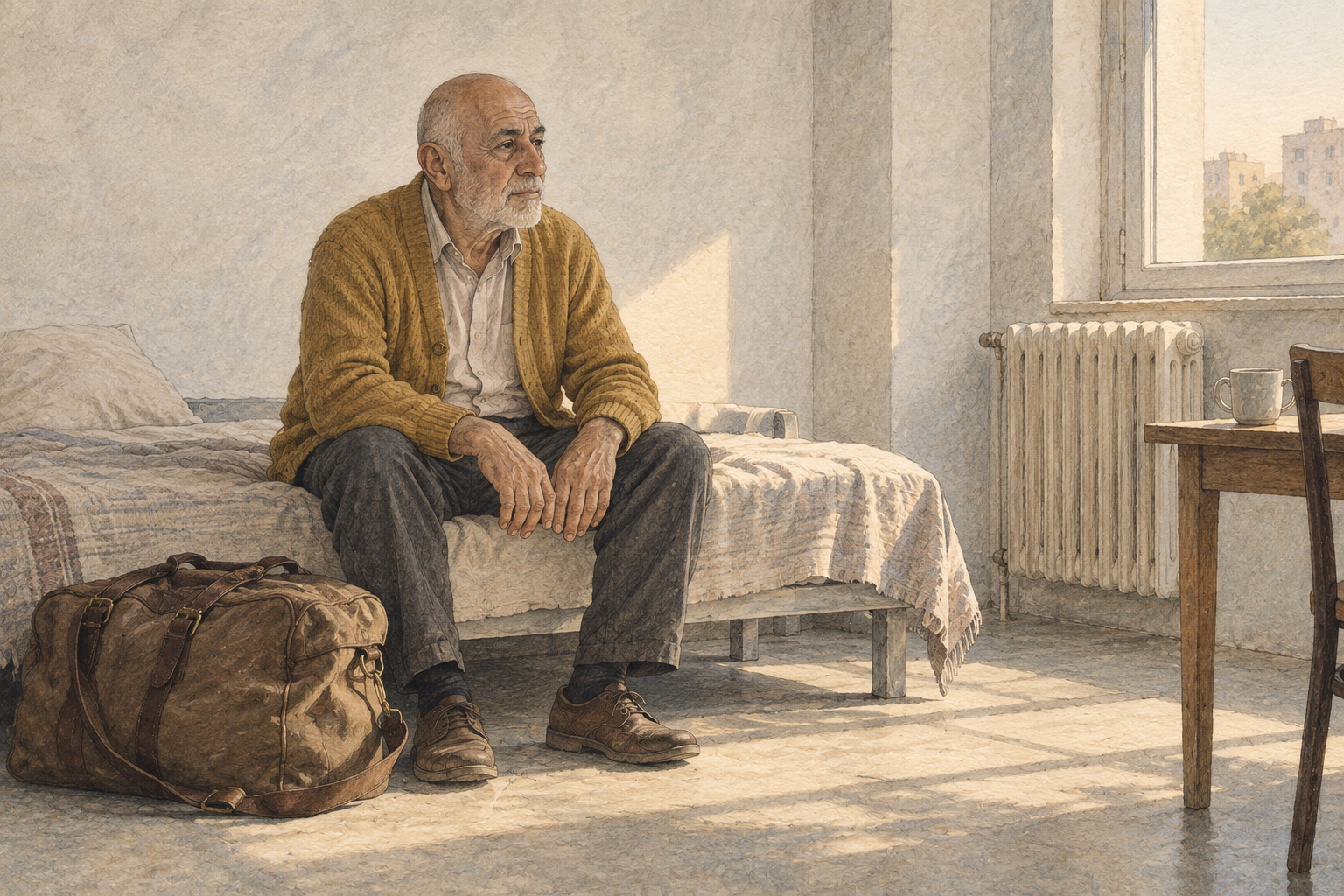
Epigraph
“a time to keep silence”.
Ecclesiastes 3:7, a short KJV fragment. In the selected passage, 3:1–8, a time to speak stands alongside it. This is wisdom poetry, not a symptom timetable or instruction to remain silent about violence. The Russian fragment is the authors' translation. [S4]
What this article is about
A move is complete, immediate danger has diminished, and there is somewhere to close a door and sleep. Things should apparently become easier. Yet this may be when someone notices anxiety, exhaustion, sleep difficulties, or feelings previously difficult to name. Why does life feel harder when the surroundings are calmer? Fear can follow: perhaps safety damaged something, or deterioration is now inevitable.
There is no single explanation for everyone. New symptoms, greater awareness of an existing difficulty, and changed circumstances are different questions. Professional information allows later symptom onset without making relocation its universal cause. This article preserves those distinctions without self-diagnosis or expecting a compulsory breakdown. Read selected sections without revisiting details. Present safety, medical concerns, and access to care require attention to actual conditions, independently of anyone's ability to explain the whole sequence persuasively.
I. Safety does not always mean every task is complete
Safety often names one important change: no longer being under the previous immediate threat. That can be a real achievement. Housing, income, contact with relatives, and treatment access may nevertheless remain uncertain. Recognising unfinished questions need not diminish reaching a more protected place. A reduction in one danger differs from resolving every condition of life. Both facts can remain true without making gratitude incompatible with asking for something still needed.
WHO separately describes emergency-related social problems and disrupted access to services. [S1] This framework keeps life after relocation from becoming only an internal state. Uncertainty about next month's accommodation has an external subject. It does not automatically become misperception because the journey ended. This article assesses no individual's safety and does not declare a new place completely protected on the reader's behalf or assign the same circumstances to all displaced people.
Consider fictional Irina. She left dangerous surroundings but does not know how to continue routine medical follow-up or when contact with a relative will be possible. Others call her new situation a peaceful life. She sees several unfinished tasks. The illustration establishes no diagnosis. It shows how “You are safe now” can contain an important truth without describing an entire day, its remaining uncertainties, or the practical assistance that could matter.
Clarify which threat diminished, which questions are settled, and what remains unknown. A complete list is unnecessary; one unfinished task may suffice. Precision creates something actionable without assigning every feeling to the past. Psychological discussion and practical help can proceed alongside one another with distinct purposes. Neither appreciation for a protected place nor acknowledging difficulty needs to cancel the other, and neither requires a complete account before a small request is considered.
II. New, stronger, or newly noticed
“This wasn't there before” can mean different things. An experience may be new, an existing difficulty stronger, the circumstances for noticing different, or an opportunity to speak newly available. The article selects none on the person's behalf. Distinguishing questions does not challenge their words. It prevents an initial description of sequence from becoming a complete theory of cause and future, especially when the person has not yet had a suitable opportunity for assessment.
NIMH says PTSD symptoms can emerge later, although they usually start earlier; courses vary. [S2] Possibility is no diagnosis of every difficulty after relocation. A late date alone does not establish PTSD. Nor does the source say that protected surroundings must cause deterioration or that worsening is necessary for recovery. Timing needs consideration alongside the nature and effects of a difficulty within a competent professional process rather than a universal narrative.
Irina may notice difficulty falling asleep when former urgent tasks are absent. That does not establish their absence as the cause. Observable details can be described: when she noticed, what evenings involve, and what is affected. Explanation remains open. Popular language about a nervous system finally deciding to break down should not replace it. This article has established no such mechanism and offers no reason to expect it in everyone reaching safety.
An accurate uncertain phrase may begin the conversation: “I noticed it after moving and don't yet know when it started.” Reconstructing a detailed chronology or repeatedly revisiting events is unnecessary here. Unknowns can be reported to a professional. They do not invalidate the request or require a choice between calling everything a new disorder and denying a present difficulty because it was not previously described. A question can remain legitimate while its explanation remains incomplete.
III. A new day brings different demands
Relocation changes more than threat levels. Housing searches, schedules, unfamiliar transport, work arrangements, and another language may become tasks. Not everyone experiences them. Where present, however, “peace” cannot remove them from the day. Former urgent demands may have been replaced by tasks with less dramatic names but real time, costs, and consequences. An observer can notice the changed setting while overlooking how much activity remains necessary within it.
Irina must arrange care she previously did not need to locate independently. A website gives an address but not whether new visitors are accepted. This is a separate uncertainty. Assistance verifying information may help with that question without explaining all distress or becoming treatment. A task can be missed if relocation is assumed to leave nothing except adjusting one's attitude towards an internal state. Practical information can matter even where the larger explanation is unknown.
New demands can also reveal a difference between completing one essential task and managing an ordinary full schedule. This need not establish loss of all ability. Consider one part of the day: missing information, a step requiring accompaniment, or something that can wait. This is an authorial participation proposal, not an established cause of delayed symptoms. Practical clarity has value without a complete account of health or a claim that reducing one demand resolves everything.
Helpers can check accessibility. “Everything is available here” does not answer whether a particular service can be used now. Information, confirmed booking, and completed consultation differ. An uncompleted step should not automatically become resistance to well-being. Clarify an obstacle where possible and appropriate. The next action may concern service organisation, language, or cost rather than another internal exercise, and failure to obtain access need not become a judgement about willingness to recover.
IV. New health questions are not absorbed by the past
Sleep problems, pain, pronounced fatigue, and other changes may prompt a psychological explanation. Timing does not exclude other causes. NIMH places PTSD assessment within professional work and describes accompanying conditions. [S2] This article performs no examination and does not allocate sensations among diagnoses. A medical question remains open even when a war history seems sufficient to explain everything to observers, or an earlier psychological explanation was useful for a different concern.
Irina may have existing treatment whose accessibility changed after moving. The practical arrangements for continuing care need clarification; prescriptions should not be changed through an article. Interrupted follow-up cannot simply be renamed adaptation. No universal pathway across countries is supplied. A suitable service can be asked what is needed for competent consultation about current needs, rather than leaving the person to decide medication or treatment questions independently through general information.
An acute medical change has urgency according to the change and circumstances. One specific NHS example is sudden confusion, which requires immediate medical help. [S3] This is neither a home test nor a complete danger-sign list. Foreign contacts are not transferred. The boundary is to avoid postponing a new acute problem while first trying to prove a psychological link with the past or completing an analysis of the sequence in which feelings appeared.
For nonacute questions too, facts are preferable to declaring the body permanently damaged. When was the difficulty noticed, what does it affect, and what care occurred? Approximate information can be given; unknowns can be stated. Someone can describe pain, anxiety, demands, and uncertainty together without choosing between medical and human language. Establishing causes belongs to an appropriate professional process, while the present concern need not wait for a perfectly organised account before contact is made.
V. The journey can end while connections continue
Moving does not necessarily finish all significant events. Relatives may remain elsewhere, information arrive irregularly, and losses remain unresolved. These are possibilities, not a compulsory portrait of relocation. Earlier immediate danger may have diminished while new messages still require decisions. Life after travel is not always an interval free of the continuing situation and its practical consequences. Calling the journey complete should not quietly declare every other part of the history complete too.
Irina may worry before an expected call. Before reducing this entirely to previous trauma, clarify what she awaits now. Real uncertainty about a relative can be acknowledged. Equally, the article does not establish that every feeling accurately reflects external danger. Facts and health require their own consideration; neither proves the other without available evidence and suitable competence. Both can be discussed without requiring the listener to settle all uncertainty in one conversation.
Information habits can be considered specifically. Neither continuous news monitoring nor complete disconnection should be imposed. People may agree who will communicate verified necessary information and how. This is a voluntary everyday arrangement, not a clinical protocol or safety guarantee. It must reflect actual responsibilities and preferences rather than assuming that following news has the same purpose for everyone or that a helper can decide which contact is essential without asking.
Observers may struggle with unfinished situations and offer “It's all behind you” as comfort. More precise participation can be smaller: one part ended while other questions remain. No fixed phrase or relief is promised. This need not declare the new home unsuccessful. It allows protection achieved and an unfinished part of life to coexist, without making appreciation require silence or requiring every continuing concern to be interpreted as a rejection of the move.
VI. Time should not become an accusation
Someone may expect to feel differently after a certain number of days or months. Families can supply the deadline: how long is needed when housing is already available? Yet a calendar measures neither all conditions nor all demands. Educational descriptions of timing are no personal contract. This article gives no date for ending feelings and promises no obligatory worsening phase that supposedly certifies correct recovery. A new question does not have to fit either expectation.
NIMH distinguishes possible onset and course of PTSD. [S2] That clinical information is not transferred to every reader or used to require a waiting period before care. A present concern can be raised now. Timing supplies information for assessment, not an examination of deservingness in which someone must first endure long enough or, conversely, have requested assistance quickly enough to make the current difficulty count as real.
A particular interval can be clarified: what changed after the latest move, new obligation, or medical event? Continuous tracking is unnecessary. One difficult day does not determine a whole trajectory. A quiet period does not invalidate a subsequent question. Reporting change need not mean that an earlier self-description was false or earlier assistance worthless. Different observations can remain accurate descriptions of different periods, even before their relationship is fully understood.
Helpers can also revise expectations. Support lasting longer than anticipated calls for discussion of real limits and alternatives, rather than declaring someone too slow to become normal. An honest revision preserves useful information: what is possible, what needs another source, and which task remains open. Uncertain futures require neither endless availability nor shame about pace. A limited offer can remain meaningful without becoming a deadline for the recipient to finish needing it or a promise that the whole process will end soon.
VII. An opportunity to speak is no duty to disclose
A suitable listener or time may become available after relocation. The opportunity does not require immediate use. Someone may want conversation, prefer professional consultation, or discuss only practical matters for now. This article does not establish that silence obstructs everyone's recovery. Detail cannot certify trust, gratitude, or seriousness. A person can choose the amount shared without having that choice converted into evidence for or against a condition or readiness to recover.
“I am struggling, but I don't want to tell the history” is a complete boundary Irina could express. A helper can clarify whether discussion of today or a particular task would suit. Returning to events is not required to make participation real. Where professional care is needed, necessary information belongs within that process, rather than being set by someone who decides the moment has arrived to experience everything in the correct way.
Agreement to conversation has scope. It does not automatically permit family retelling, publication, or a third person's presence. Communication methods and record visibility also matter. No digital security protocol is provided, but no diary, message, or personal note is required. An unwanted record need not be created. Contact options should reflect real conditions rather than the convenience of an exercise suggested in a general text or another person's wish to document progress.
Decisions can change. Someone who begins may stop or postpone part; a relative may identify a time limit. This need not be mutual rejection. Clear capacity distinguishes a pause from unlimited presence promised but unavailable. Meaningful participation depends less on disclosure depth than on understandable choices and agreed actions affecting the person's life. Privacy and practical help can coexist without demanding complete access to everything experienced, remembered, or left unsaid.
VIII. Small arrangements without a self-testing programme
When urgent movement gives way to another routine, filling the day can become a question. The article demands neither constant activity to avoid feelings nor compulsory silence to produce them. Neither prescription follows from the sources read. One manageable everyday task and its conditions can be considered without making it treatment or a readiness test for peaceful life. Its usefulness need not establish a mechanism explaining why distress was noticed at this time.
Irina may want appointment information or a short walk with someone close. An ideal new routine is unnecessary. A task has a beginning, a suitable amount, and room for revision. If excessive, that informs this decision rather than proving complete incapacity. If completed, demands need not immediately increase to certify success. Another step remains a separate question for later discussion, and a useful result need not promise that every following day will be easier.
No detailed recollection, deliberate confrontation with reminders, or strong emotional reaction is required. The article offers no self-directed exposure. It prescribes neither breathing, meditation, nor bodily practice to everyone noticing difficulty after a move. Preferences and medical circumstances differ. Assistance with an ordinary task needs no clinical name to matter and cannot replace competent care when needed. Its scale and purpose should remain clear to both the person requesting and the person offering it.
Structure also differs from control. An agreed meeting time helps a shared task; unrequested hourly reporting becomes surveillance. Clarify which part of organising a schedule has been entrusted to a helper. Safety should not be declared dependent on perfect list completion. Life after war remains unpredictable. A small plan is a proposal whose actual usefulness can be checked, not an emotional guarantee or another basis for blame if circumstances change, preferences differ, or the planned action proves unsuitable.
IX. Contact begins with a present question
A possible first phrase is, “After my circumstances changed, I noticed this difficulty and want to understand suitable help.” This is authorial wording, not a medical conclusion. A mechanism or diagnosis need not be chosen in advance. For assessment, provider experience, process, language, and use of results can be clarified. Local rules belong to the particular service, not this article, and asking about them need not imply unwillingness to receive assistance.
Continuing treatment, interrupted access, and new physical changes should be identified as those questions. Not every contact needs to confirm one PTSD explanation. Another kind of care may suit; that requires professional consideration. No pathway or self-directed prescription change is supplied. Current information and needs matter more than convincing a professional that safety caused deterioration through a mechanism already selected online, and uncertainty about the cause can remain part of the account.
A contact, confirmed appointment, and care begun differ. An address leaves availability to be checked. After consultation, understand what is established and what needs further investigation. An unclear explanation can be requested differently. This guarantees no easy route. It identifies obstacles without making every delay a failure to use a safe life or a final refusal by an entire system. Accurate stage descriptions can preserve the next practical question rather than replacing it with a judgement.
A relative may assist within agreed limits: travel, checking times, or formulating one question. That grants no automatic presence in consultation or access to results. Different parts require separate agreement. The helper does not become a clinician; difficulty does not remove the person's voice. Even a small retained choice matters to understandable participation, independently of how completely the history can be explained or which name might eventually be established through assessment.
X. Silence and speech in two traditions
Ecclesiastes 3:1–8 lists different times, including silence and speech. [S4] Here it invites reflection on life exceeding one permanent state. Poetry cannot predict symptom sequence. Relocation establishes no compulsory time to disclose, cry, or express gratitude. Nor does the passage's reference to war become a justification of violence in this article. The comparison remains within voluntary meaning rather than claiming authority over clinical care, protection, or the reader's next decision.
In chapter 15 of Legge's Tao Teh King, muddy water is associated with stillness and gradual clearing. [S5] This is philosophy, not nervous-system anatomy. Its limited application concerns avoiding pressure to resolve every uncertainty immediately. It proves neither that silence suits everyone nor that symptoms disappear unaided. Medical and practical assistance should not be postponed for contemplation or waiting. A person can decline the image without refusing help or failing to understand the text.
The sources differ in form and foundation. Biblical wisdom lists times of human action; the Daoist passage presents an image and cautious quality. The authors compare them only to resist imposing one pace. This selected bridge establishes no shared treatment. Readers can skip both while retaining professional and practical questions. Assistance depends on neither a religious worldview nor the wish to find philosophical significance in experience, and no common doctrine has been inferred from the resemblance.
Stillness must not become another duty. Conversation, shared activity, and temporary distance may suit different people. None certifies a correct inner process. Safety need not be performed as grateful calm. Distress should not be demanded as proof that a history finally emerged either. Both traditions remain reflective possibilities with room for choice, rather than explanations of what inevitably happens to everyone after war or authoritative commands about what readers should feel next.
XI. The first period after change does not determine the future
Noticing difficulty after relocation can provoke fear about an entire future. If surroundings are calmer while life feels harder, does only worsening lie ahead? This article makes no such inference. Present experience deserves attention without supplying a whole trajectory. Earlier relief guaranteed no absence of future questions either. The present can be considered without a contract requiring it to predict everything that follows or demonstrate whether moving was the right decision.
Irina may value her new place while needing help with sleep or daily arrangements. Gratitude and a report of difficulty need not compete. She may also decline interpreting this as beneficial growth. Protection's significance does not disappear through distress, and distress is no moral ingratitude. Different aspects can coexist without being assembled into an attractive story explaining why everything happened. Meaning may remain open while practical and medical questions receive concrete attention.
A relative may abandon either confident claim: now you must be calm, or now a breakdown must occur. A specific question about today and accessible assistance remains instead. A reader can report an observation with unknown cause; a service receives a request still requiring consideration. These modest results require neither total disclosure, premature diagnosis, nor promised immediate relief. They can make further discussion more precise without claiming that the difficulty has already been understood.
Distress may become more noticeable after circumstances change, but “after” does not automatically explain why. Medical assessment, an external task, or several kinds of help may matter. Their distinction creates no contradiction. Protection can be retained while explanations are sought and chronology remains incomplete. The next step follows actual conditions and the person's choice, rather than a single approved script for experiencing safety. There is room for uncertainty without converting it into either inevitable deterioration or proof that nothing deserves attention.
What this means in practice
Choose one question if useful. This is no recollection exercise or test of reacting correctly to safety. Completing every point, recording answers, and choosing a diagnosis are unnecessary.
Clarify what changed: threat, housing, demands, access, or contact with relatives. One task can suffice. Reduced danger matters without requiring every other question to be settled.
Separate observation and explanation: “I noticed this in the new place; the cause is unclear.” Detailed recall or proof that nothing existed earlier is not required. An uncertain onset can be reported professionally.
If asking someone close, define a small task: appointment information, shared travel, or listening without questions. They can state limits. Check what was actually done; emotional relief is no compulsory evidence of gratitude or success.
For care, clarify accessibility and appointment purpose. Continuing treatment and new medical changes should not automatically be assigned to earlier trauma. Sudden confusion is one example requiring immediate medical help independently of psychological explanations. Current external danger also requires available protective action appropriate to circumstances.
One distinction can remain today: incomplete explanation does not cancel a present question. Pausing is allowed; approaching assistance need not await finishing the article. Further discussion follows circumstances, without an inevitable-worsening script or compulsory immediate relief. You can retain a useful observation, leave other questions unresolved, and decide later which part to discuss and with whom.
Key quotation
“Let it be still”.
Laozi, traditional attribution, Tao Teh King chapter 15, James Legge's translation. The phrase concerns water in a philosophical image. It is no instruction to endure danger, delay care, or remain silent against one's preference. The Russian wording is the authors' translation. [S5]
Connections between traditions
| Area | Distinction | Limit |
|---|---|---|
| NIMH and WHO | Possible later onset and present circumstances | No proof that safety causes deterioration |
| Ecclesiastes 3:1–8 | Silence and speech among different times | No clinical schedule or compulsory disclosure |
| Laozi chapter 15 through Legge | Pressure and room for clarification in an image | No nervous-system mechanism, cure promise, or delayed care |
Three rows address specific questions. Other traditions were not added for quantity; the distinctions have not become one medical method.
Sources
- S1. WHO. Mental health in emergencies, May 6, 2025. Main material read fully earlier in this queue. Role: social conditions, resources, and services, not an individual's cause.
- S2. NIMH. Post-Traumatic Stress Disorder, NIH 23-MH-8124, revised 2023. Role: possible later onset, variation, professional assessment, and accompanying concerns. Main written text and reuse terms read; no personal prognosis.
- S3. NHS. Sudden confusion (delirium), reviewed May 28, 2024; next review May 28, 2027. Complete short article read. Role: one urgent medical boundary, with no foreign contact or home test transferred.
- S4. Ecclesiastes 3:1–8, KJV. Selected passage read fully. Primary wisdom text, short authorial translation, no clinical application. Page marks KJV Public Domain; worldwide status not asserted.
- S5. Laozi / James Legge. Tao Teh King, Project Gutenberg 216, chapter 15, edition updated May 11, 2015. Chapter and opening terms read earlier in this task. Primary philosophical image, not a medical mechanism; short quotation and own Russian translation, no book republication.
Tags
after relocation, distress in safety, effects of war, later onset, noticing distress, uncertain cause, present conditions, unfinished tasks, contact with relatives, care access, medical assessment, new symptoms, continuing treatment, sleep, daily demands, pace of change, choosing speech, choosing silence, voluntary participation, privacy, help without questioning, consent, dignity, philosophical imagery, Ecclesiastes, Laozi, Daoism, comparison limits, intercultural dialogue, United Wisdom
About the authors
Andrey Zarinsh is the author and founder of United Wisdom. He explores inner transformation, unity between traditions, intercultural dialogue, and contemporary spiritual discipline. Instagram: @andrey.zarinsh.
Maria Evilkut is a co-author of United Wisdom. Alongside her research, she seeks to test these ideas in practice and observe how principles of unity and mutual understanding work in real life between people and cultures. Instagram: @ilkutki.