
Sleep, energy and self-care
Why falling asleep can become difficult after war
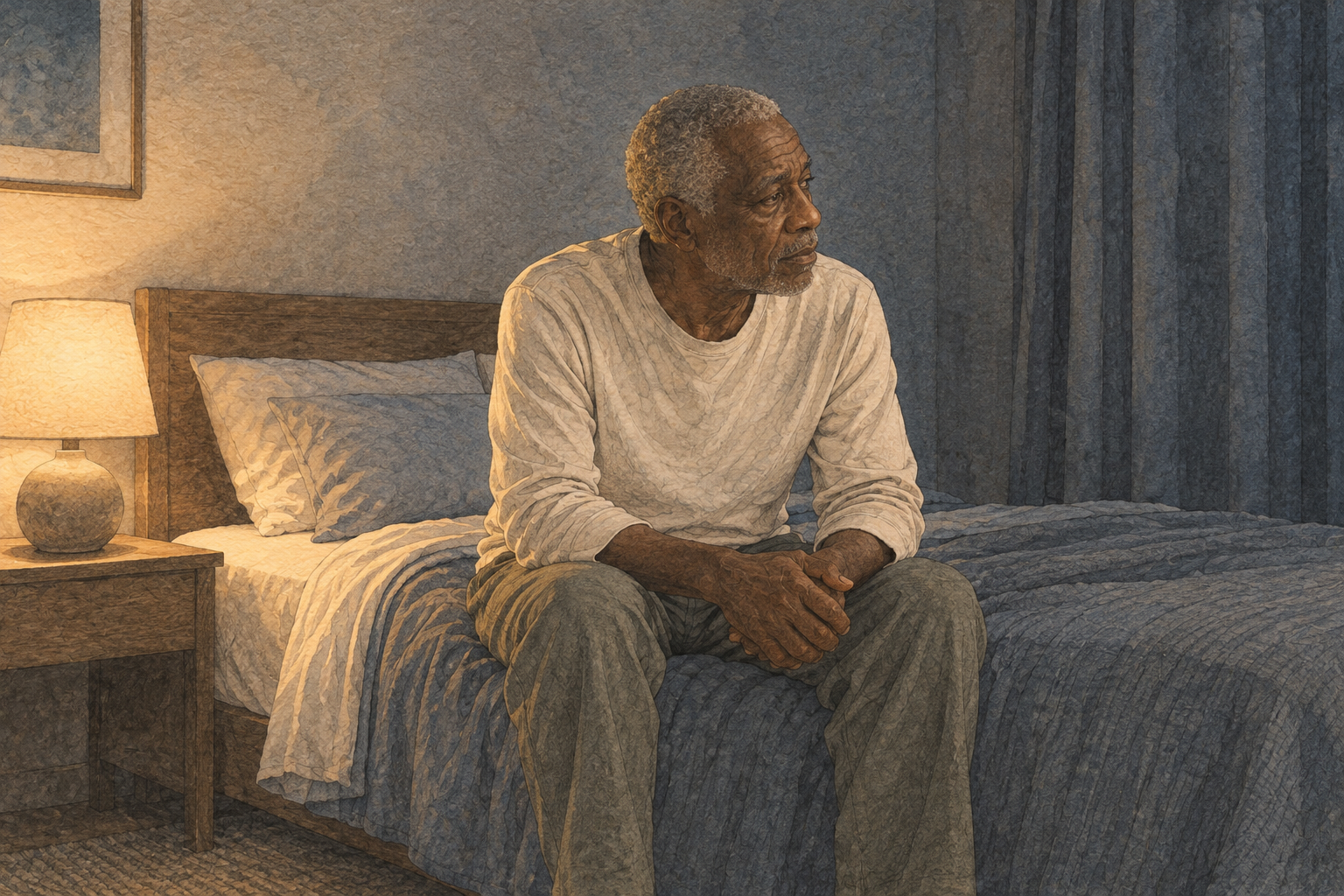
A person can be exhausted, have somewhere to lie down, and still remain awake. After war, present safety, crowded accommodation, and other circumstances may also matter. No single psychological explanation should be selected in advance. NHS discusses different circumstances and conditions associated with insomnia; NIMH includes difficulty falling asleep within PTSD's clinical context. [S1; S2] One difficult night…
Epigraph
“I will both lay me down in peace”
Psalm4:8, short King James Version fragment. This is a religious image of rest rather than confirmation of present safety or sleep promised as faith's reward. The Russian text is the authors' translation. [S4]
What this article is about
A person can be exhausted, have somewhere to lie down, and still remain awake. After war, present safety, crowded accommodation, and other circumstances may also matter. No single psychological explanation should be selected in advance. NHS discusses different circumstances and conditions associated with insomnia; NIMH includes difficulty falling asleep within PTSD's clinical context. [S1; S2] One difficult night establishes no diagnosis.
Distinguish the opportunity to sleep, falling asleep itself, available conditions, and suitable assessment. An ideal bedroom, calm thoughts, and a perfectly completed ritual are not required. Practical examples concern assistance arrangements rather than treatment. Sleeping medication, sleep restriction, breathing exercises, and changes to necessary protection are not prescribed.
Choose a section or stop. No proposed arrangement should delay current help or require ignoring actual danger. A difficult night proves neither weakness nor inadequate belief and will to live. Asking about health need not wait for a report of successfully completing every sleep suggestion or a promise to return to former productivity tomorrow. An unfinished explanation can remain beside a practical need.
I. Opportunity and ability to fall asleep differ
First distinguish lacking suitable time and space from having an opportunity but remaining awake. Both can coexist. This separates tasks rather than supplies a medical test. Continuing danger and necessary action give external conditions their own significance. They cannot be relabelled internal vigilance and ignored. An article knows neither surrounding events nor who provides protection and which requirements apply. It selects no moment to disregard an alert, abandon a necessary role, or declare a space adequately protected for sleep. A reader's circumstances cannot be verified through the wish that rest should now be possible.
WHO considers basic needs and assistance arrangements in emergencies. [S3] This institutional context promises no particular place or resource locally. Noise and crowding should not automatically become a failure of discipline. An external need and possible actual participation can be identified where available. Conversation creates neither a bed nor warmth and protection. Information received differs from a place provided. Accuracy prevents advice about surroundings from being presented as an already arranged opportunity to rest, with responsibility for missing resources then transferred to the person who still cannot make use of them.
Imagine Elena, a fictional example given somewhere to lie down who has not yet slept. She represents neither a typical history nor a diagnosis. The place answers one question; her condition remains another. Assistance need not be called worthless because sleep has not followed, or complete because a bed was supplied. A material result may be valuable and partial. Absent immediate effect authorises no greater pressure, demanded narrative, or explanation she must endorse in gratitude. Appreciation for a resource does not require pretending that every relevant health and practical concern is now resolved.
If an appropriate opportunity remains unavailable, the health question still matters. Both needs can stand without competing to be the real one. Acute needs and danger require action according to circumstances rather than a pleasing evening sequence. Elena need not perfect her surroundings before discussing sleep, or obtain a diagnosis before asking for an external resource. Distinctions clarify assistance without promising every part will be available and lead to sleep tonight. A useful arrangement can remain incomplete without becoming either a total solution or another failure attributed to her attitude.
II. Sequence is not a complete explanation
“This began after war” supplies an important temporal connection without establishing every mechanism or excluding other circumstances. NIMH includes sleep difficulty among possible PTSD manifestations, with diagnosis requiring suitable assessment. [S2] Each sleepless night is not declared a traumatic disorder. Experience need not be proved sufficiently severe before asking. Present difficulty deserves its own consideration. Assistance should not depend on comparing biographies, providing the correct event narrative, or identifying a change's beginning to an exact day. A meaningful temporal observation can be retained without claiming it already answers the individual medical question.
NHS discusses varied circumstances, including sleeping conditions, stress, pain, illnesses, and medicines. [S1] Here these prompt no independent elimination process or treatment selection. Readers need not check themselves for every listed condition. The point is to leave a medical question open rather than close it through one explanation. Prescriptions are discussed competently instead of stopped through coincidence with a difficult night. No doses, combinations, or independent additions are given. A proposed cause does not become established because it sounds persuasive and fits a general description. Accurate uncertainty can be more useful than a confident account exceeding the available facts.
Elena might notice sleep changes alongside pain, relocation, and new treatment. These are observations for discussion rather than a completed expert conclusion. One exclusive connection and an invented continuous chronology are unnecessary. State what is known and where uncertain. Professional consideration may need further details; one sentence is not promised to finish it. Present effects can nevertheless begin inquiry. Asking should not require a complete independent investigation and confident separation of every medical, practical, and emotional part of the situation. An incomplete account need not be made falsely precise to appear worthy of attention.
The earlier insomnia article remains separate rather than rewritten into a universal war diagnosis. Its substance-related context should not be assumed in every reader's life. Relevant circumstances require clarification without stereotype or moral examination. Considering possibilities limits the authors' certainty instead of assigning responsibility to understand everything alone. “Sleep has changed and interferes with life; I do not know why” can be an accurate opening. It makes need neither less important nor dependent on accepting one explanation first. Appropriate inquiry can retain more than one question without deciding that each must be resolved before help begins.
III. Exhaustion promises no immediate sleep
Elena may think, “Being this tired should make me fall asleep immediately.” This article establishes neither a required speed nor her individual physiology. Exhaustion gives us no knowledge of when sleep will arrive. An absent expected result should not become a character judgement or proof of inadequate effort. Correct relaxation is not a condition of understanding. Wanting sleep and remaining awake can both be stated without determining a cause, excluding medical concern, or establishing that medication is immediately needed. The fictional example illustrates a limit on inference rather than a mechanism explaining everyone's night.
Thoughts about tomorrow may be present without explaining the whole difficulty. Emptying the mind, suppressing memories, and finishing every inner argument are not prerequisites. This describes no required mental change or therapeutic effect of acceptance. It rejects a moral demand for perfect internal order before assistance. Every thought need not be disclosed for an observer to verify effort. Private experience retains boundaries at night, including when a helper believes confession is the only evidence of seriousness or usefulness. A practical request may be made without putting the person's entire inner life into public circulation.
Competition with an expected minute of sleep can be declined, without promising that relinquishing control will then produce sleep. One compulsory technique is not replaced with another. No timer, breathing count, or body-checking exercise is supplied. Someone noting the time is not thereby responsible for the difficulty; a general statement establishes no behavioural cause. A modest boundary might concern conversation: no continual demand to answer whether sleep has begun. That requests a communication arrangement rather than lays down a universal medical rule. Other circumstances may require different actual attention, which this example does not determine.
“I am very tired and not sleeping yet” can describe now, although assessment may require more information. It does not mean tolerating every condition without help or cancelling another need's urgency. Wakefulness need not yield a useful lesson, make war beneficial, or demonstrate spiritual strength. Sleep is not an attitude reward. Dignity and appropriate attention remain before an outcome that cannot be obtained through a reader's, relative's, or author's command. An honest statement of the difficulty can stand without reassurance beyond what is known or a promise that a different wording will change tonight.
IV. Conditions should not become an ideal-bedroom examination
Ordinary advice may mention quiet, darkness, and comfortable bedding. NHS includes sleeping conditions among possible circumstances. [S1] Actual accommodation may not permit general advice. No ideal room or complete environmental control is required here. WHO's emergency context includes basic needs and resources. [S3] Missing conditions should not automatically be blamed on poor life organisation. Practical discussion needs actual availability rather than only a helper's image of a correct evening and exemplary resting place. A suggested arrangement and an arrangement someone can actually obtain are different kinds of information with different practical consequences.
People sharing a room may have different needs: work, caregiving, information, and accessible communication. No shared schedule or disabling necessary alerts is proposed for quiet and darkness. Protection must not depend on performing bedroom advice. One nonurgent action that could move, and the available scope of participation, may be discussed. This is an organisational inquiry rather than therapy. Agreement is not guaranteed. Its absence does not make sleeplessness a personal failure or proof of unwillingness to recover. Limited choice deserves recognition rather than being concealed behind instructions the recipient cannot actually carry out.
Elena might request no detailed nonurgent conversation now. Acceptance is not promised, and actual urgency may differ. The request needs neither a full history nor diagnosis proof. Helpers can state their limits without promising more than available. Distinguish a postponed subject, partly altered surroundings, and sleep still absent. These results mean different things. Reducing one demand need not certify complete resolution. Remaining awake neither erases the contribution nor permits observers to demand immediate gratitude for every concession. A useful change may deserve acknowledgement without its recipient producing the outcome everyone hoped would follow.
A material need can be stated without promising a short request will supply it. Offering to inquire about accommodation differs from a verified option to move there. Actual participation needs clarification; no route or safe venue is selected here. When resources remain unavailable, a new internal assignment to release tension should not conceal the lack. External constraints deserve attention beside a possible medical question. Recognising both requires no proof that one factor explains the entire night and makes every other concern secondary. Different roles may matter even when none can presently supply a complete answer.
V. A small evening arrangement is not a treatment ritual
Where no urgent task takes priority, one available condition might be clarified: ending a nonurgent discussion, sharing a safe domestic activity, or obtaining understandable information about tomorrow's arrangement. These are assistance options rather than a required collection or proven sleep induction. They can be declined. Finished preparation promises neither eliminated uncertainty nor sleep. Questions may remain open. A bounded contribution can matter if it addresses a need, without becoming a new checklist to complete before exhaustion and the wish for help may be acknowledged. Its role is practical and limited rather than clinical.
Elena may want only the time of an important contact rather than a long exchange. Obtaining the answer and remaining awake are compatible. Information solves an information question, certifying neither health nor readiness for tomorrow's activities. If an answer remains unavailable, uncertainty should not be replaced by invented reassurance. Stopping all news and calls is not proposed; some information may be necessary. A nonurgent topic differs from current protection. Arranging a supposedly useful evening gives a helper no general authority over the person's telephone, documents, and relationships. Consent remains relevant to the proposed contribution.
Time-in-bed restriction, deliberate sleep loss, a universal nap ban, and commands to get up whenever awake are not prescribed. A war article knows neither individual sleep needs nor physical conditions. Alcohol and independent medication changes or combinations are not proposed for rapid results. Existing professional recommendations can be discussed through appropriate channels rather than cancelled here. An absent guaranteed technique does not mean no assistance exists. Practical roles, health assessment, and necessary resources have different purposes. They need not replace one another completely or form a compulsory sequence exhausted before the next question deserves consideration.
An evening can end without a report of successful relaxation. Neither declaring everything fine nor promising sleep at a set time is necessary. Concerning difficulties affecting life can be discussed professionally without first completing every domestic suggestion. Acute assistance should not wait for a ritual. This article performs no medical urgency sorting or universal action selection. Its organisational examples remain bounded: clearer task-sharing may result without becoming treatment or an examination of readiness to accept help. A partial contribution need not be inflated into a method whose failure would then be assigned to the recipient.
VI. Assessment can begin with present effects
NHS considers professional consultation when sleep difficulty disrupts everyday life and investigation of causes as part of assistance. [S1] No waiting period or exhaustion of home adjustments is imposed here. What happens and what it affects can begin inquiry. A particular service, appointment, and finished answer in one encounter are not promised. A prepared diagnosis is not an entry requirement. Sleep concerns can matter with a difficult account, uncertain dates, and no confident separation between earlier experience and present circumstances. The person need not solve the professional question independently before being allowed to ask it.
Relevant sleep changes, pain, existing treatment, and other known circumstances can be described without a causal verdict. This is neither an exhaustive list nor a replacement interview. Missing ideal records should not prompt invented precision. A diary may have a role in particular care, but every reader is not required to keep one as evidence of effort. Professional information-gathering has a purpose and format to clarify separately. A private note does not become public property; helping prepare it does not authorise forwarding its contents to every interested relative and acquaintance. Assistance with information retains its own limited scope.
Difficulty falling asleep can coexist with different health concerns. NIMH does not diagnose PTSD through one night, and NHS supplies no independent prescription choice through its cause list. [S1; S2] No dose, cancellation, or verdict on current treatment is offered. New questions can be brought to suitable competence. An existing medicine's relationship with the difficulty is not determined here, and a difficult night warrants no article-directed change. Appropriate attention differs from a confident domestic explanation that leaves pain, another condition, and actual circumstances unconsidered. A plausible story need not close questions the available evidence cannot answer.
Acute medical needs take priority over finishing an account and evening plan. No complete emergency list, foreign telephone number, or transport procedure is supplied. Restricted access remains a practical problem rather than proof that self-help is sufficient. Actual options may be clarified without guarantees or false precision. Elena need not sleep well first to validate asking. One better night likewise need not automatically close the concern. Assessment serves present health and suitable assistance rather than a moral judgement of how correctly someone has responded to war. The outcome need not be known in advance for the question to matter.
VII. Being present does not require guaranteeing sleep
A relative can offer a limited role: an ordinary task, clarifying a request, or an available contact. Guaranteeing sleep and becoming the sole resource are unnecessary. The recipient need not sleep to prove the contribution good. This separates responsibility and outcome. Elena might value accommodation and still need another kind of consideration. Absent effect is not automatically an accusation against a helper, while good intention does not remove the need to ask what participation is wanted. Gratitude is measured neither through speed of sleep nor through the absence of further concerns and requests afterward.
A brief conversation or ending the subject can be offered without forcing narrative, touch, breathing, or closed eyes. A wish to calm someone establishes no suitability. Silence and presence are not universally useful either; preferences can be clarified where possible. A helper should not certify danger ended without knowledge. False reassurance can obscure a factual question. Support should not depend on promising control of everything outside or excluding every reason someone might remain awake. A limited honest contribution need not become an undertaking to eliminate all uncertainty and deliver the internal state everyone would prefer.
Sharing an actual responsibility requires concrete, available agreement. Guards, shifts, and protective measures are not selected here. “I am watching everything” replaces no verified capability or permission to ignore necessary information. An everyday role must not silently become responsibility for another's safety without discussion and provision. Name what is actually taken on, for how long, and what remains unresolved where possible. Accuracy needs neither a medical explanation of every reaction nor abandonment of professional and external resources. A promise's limits should remain visible instead of being converted into reassurance beyond what the helper can substantiate.
Monitoring sleep and demanding reports do not follow automatically from care. A private night-time conversation retains boundaries; presumed usefulness alone authorises no forwarding. Professional assistance has conditions clarified separately. Helpers can name exhaustion and limits without promising constant presence. Inability to provide everything does not make a bounded role meaningless; it should simply not be called complete resolution. A person remains a participant in life asleep and awake. Assistance should not turn the night into a collective examination whose outcome the recipient must deliver to everyone nearby as evidence of sufficient effort and appreciation.
VIII. Images of rest are not a sleep technology
Psalm4 ends with peaceful lying down and sleep in religious trust. [S4] It measures no reader's safety, promises no protection, and judges no awake person insufficiently faithful. Piety requirements are not transferred into care conditions. Laozi15's muddy-water image belongs to philosophy. [S5] It is neither a nervous-system description nor evidence that stillness treats insomnia. Waiting cannot replace help and actual protection. Poetry may raise a question about pressure without determining health, circumstances, or tonight's outcome. Neither image authorises an observer to demand calm as proof that the reader has correctly understood the text.
| Source | Separate subject | Transfer limit |
|---|---|---|
| NHS [S1] | Different sleep circumstances and suitable assessment | No self-diagnosis or universal schedule |
| NIMH [S2] | Sleep within PTSD's clinical context | No explanation of every night or waiting rule |
| WHO [S3] | Basic needs and resource arrangements | No promised place or local access |
| Psalm4 [S4] | A religious image of rest | No safety guarantee or faith examination |
| Laozi15 [S5] | Water allowed to settle | No physiology or treatment through stillness |
The comparison retains different roles. Modern information concerns health and assistance arrangements; primary passages supply selected images and an ethical question. No shared method follows. A philosophical explanation can be declined while care remains needed. Spiritual agreement, reconciliation, and growth are not prerequisites. Rest should not become another demand whose absence earns shame. Someone may be wished sleep without being promised it, and helped with an available need without that role being called a guaranteed way to alter their state by an appointed hour. Meaningful images need not carry claims their sources cannot establish.
Elena may find an image close or want none of it; neither response determines prognosis. A medical or external question survives an appealing metaphor. Absent relief does not require stronger repetition or accusations of resistance. The authorial link is bounded: desired rest should not become compulsory effort's outcome and a moral score. Limited control does not mean no actual action, resources, or appropriate help. Ancient text replaces no professional; professional inquiry need not require abandoning personal meanings and chosen trust. The two can remain distinct without making either a condition for receiving attention to present difficulty.
IX. Tomorrow need not prove the night was overcome
After a difficult night, next-day activities remain a question. One description of tiredness assesses no readiness to drive, use machinery, or perform dangerous work. A good conversation and brief sleep certify no ability for every task. Actual risks and requirements need appropriate consideration. Inability to meet former output is no moral deficiency either. Necessary activity, available resources, and material limits can be discussed without promising to compensate for everything through willpower. The next day need not demonstrate that the night was handled correctly and the person deserved the assistance they were given.
Elena might request a nonurgent task's reconsideration and receive a refusal under actual conditions. Complete flexibility in every workplace, organisation, and family is not promised. Her need does not become invented. Scope and possible participation may be clarified without hiding significant risk where errors can harm. A small plan change is neither treatment nor cause verification. An unchanged plan does not automatically make earlier demands safe. Scheduling help and professional assessment address different subjects; neither should erase the other's question without suitable grounds. A useful distinction should clarify actual responsibilities rather than pretend consequences disappear.
A better night can be welcome without declaring complete recovery. Another difficult night proves no universal worthlessness of earlier help. Public daily reporting and comparisons with others are unnecessary. A history can be discussed in a needed scope without making every night a shared project. Existing professional observation has its own questions clarified separately. Treatment success criteria are not established here. Continuing need and limited results can both be named without exaggeration or erasing a resource genuinely provided because sleep remained absent. An outcome has its particular meaning rather than deciding the value of every contribution.
Continuing life requires no victory over wakefulness through one correct evening. Rest opportunities, health inquiry, and limited assistance can be pursued with actual protection retained. Answers may arrive separately or remain incomplete. Accuracy means not calling an external need laziness, a suggestion a guarantee, or wakefulness a moral defeat. Dignity survives difficulty that cannot change by command. Present concerns matter before diagnosis, ideal surroundings, and a pleasing recovery narrative. Assistance should not demand preliminary demonstration of the result for which it is being requested and which has not yet actually been obtained. An unfinished night can retain an honest open question.
What this means in practice
If no urgent task takes priority, separate three questions: is there an actual opportunity to sleep, what is known about the difficulty, and what assistance is available? Answering everything and designing treatment are unnecessary. One relevant question can begin.
A request might be, “I am exhausted but not falling asleep. Help with this particular task now; I am not ready for a detailed account.” Or, “I need information about resting opportunities rather than an examination of whether I relax correctly.” Wording guarantees neither understanding nor resources and a professional format.
One nonurgent task and participation limit may be clarified. This arranges help rather than produces sleep. Do not change medicines, sleep duration, or necessary protection through the article, or introduce independent restrictions and trials. Concerning difficulty affecting life can prompt suitable assessment without a finished diagnosis. Acute help should not wait for a ritual.
A modest result is a clearer need and a resource part actually provided. Sleep need not follow to validate participation. Stop without reporting or promising former output tomorrow. Rest is not bought through ideal conduct; an unfinished night cancels neither dignity nor a claim to further attention. A remaining question need not be concealed to reassure the person who offered help.
Key quotation
“Let it be still”
Laozi, Tao Teh King, chapter15, James Legge's translation; a short phrase concerning water. No instruction for immobility, treatment, or promised sleep. The Russian text is the authors' translation. [S5]
Connections between traditions
The five substantive rows are in section VIII. Assessment, external resources, and two images of rest keep different roles, without shared treatment, compulsory faith, or guaranteed sleep.
Sources
- S1. NHS. Insomnia, reviewed March19,2024; next review March19,2027. Complete main13–130 and dates132–133 read October18,2026. Varied circumstances and professional assessment, not hours, thresholds, home schedules, or remedies.
- S2. NIMH. Post-Traumatic Stress Disorder, NIH23-MH-8124, revised2023. Complete main21–154 read earlier; sleep60 checked within this task. No diagnosis or exclusive cause.
- S3. WHO. Mental health in emergencies, May6,2025. Complete main81–151 read earlier; basic needs and resources without statistics or local-access promises.
- S4. Psalm4 KJV. Complete selected psalm,49–62/versionPD65–67 read October18,2026. Short4:8fragment and own Russian translation; no entire Psalter, present safety, or worldwide rights conclusion.
- S5. Laozi / James Legge. Tao Teh King, complete chapter15 read earlier; opening terms and local-law qualification considered. Four English words and own Russian translation; no physiology, stillness treatment, or globally established licence.
Tags
falling asleep, sleep, difficult night, effects of war, rest opportunity, continuing threat, external conditions, insomnia, exhaustion, different causes, pain, prescriptions, no self-treatment, no sleep restriction, no ideal-bedroom demand, concrete help, consent, bounded role, professional assessment, no self-diagnosis, dignity, next day, resources, Psalm4, Laozi, images of rest, NHS, NIMH, WHO, United Wisdom
About the authors
Andrey Zarinsh is the author and founder of United Wisdom. He explores inner transformation, unity between traditions, intercultural dialogue, and contemporary spiritual discipline. Instagram: @andrey.zarinsh.
Maria Evilkut is a co-author of United Wisdom. Alongside her research, she seeks to test these ideas in practice and observe how principles of unity and mutual understanding work in real life between people and cultures. Instagram: @ilkutki.