
Injuries, treatment and rehabilitation
Prosthetic care: from expectations to a device someone can live with
A video shows someone walking confidently or grasping an object precisely with a new prosthetic hand. Between that image and another person's everyday life lie questions: is the device suitable, who explains its use, where can discomfort be discussed, and how will servicing continue after displacement? Receiving a prosthesis can be significant without answering all these questions. Discussing an injury among…
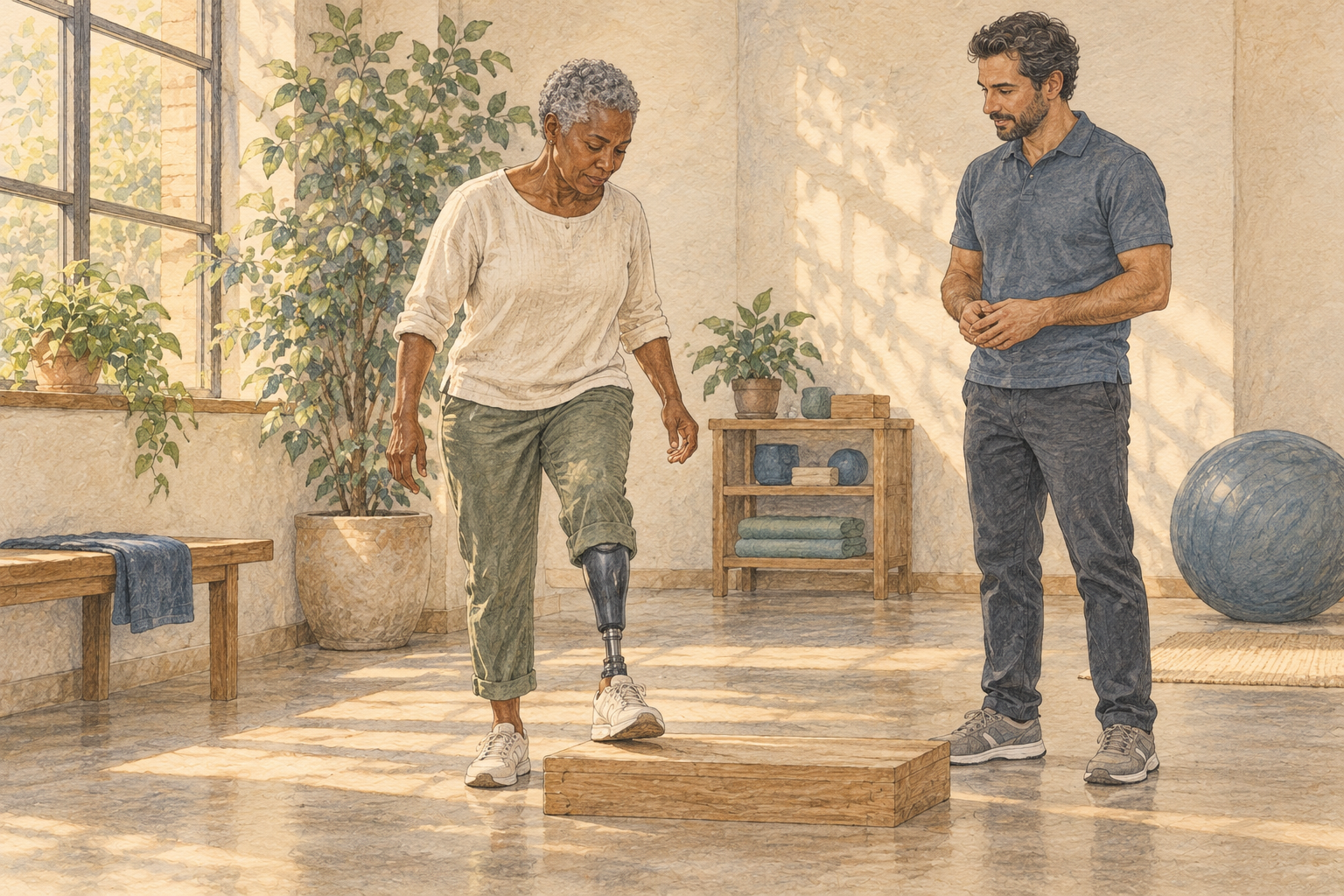
Epigraph
“For the things we have to learn before we can do them, we learn by doing them”
Aristotle, Nicomachean Ethics, II.1, a short excerpt from W. D. Ross's translation. Text and context. The argument concerns acquiring virtues through an analogy with craft. It does not authorize unsupervised prosthetic exercises or make rehabilitation outcomes a judgment of character.
What this article is about
A video shows someone walking confidently or grasping an object precisely with a new prosthetic hand. Between that image and another person's everyday life lie questions: is the device suitable, who explains its use, where can discomfort be discussed, and how will servicing continue after displacement? Receiving a prosthesis can be significant without answering all these questions. Discussing an injury among journeys, waiting lists, and other people's promises makes the situation harder.
This article distinguishes device selection, instruction, clinical assessment, and ongoing assistance. It offers no model comparison, adjustment instructions, activity schedule, or guarantee of former abilities. Instead, it sets out questions for conversations with professionals and relatives while preserving the person's own goals. Fictional scenes do not describe real patients. A prosthesis is one possible tool for participation in life. Dignity, assistance, and an interest in the future do not depend on using that tool.
I. A promise of a device is different from a promise of a result
In a fictional scene, a family hears that “the most advanced prosthesis” has been found. A plan quickly follows: by a holiday, the person will walk as before, return to work, and stop needing assistance. Yet the original news concerned only a device, sometimes merely the possibility of obtaining it. Expectations supplied everything else. Returning to the facts helps: what is offered, who assessed suitability, what instruction is proposed, and which results remain unknown? Technical novelty does not establish the entire future plan.
A video or another person's account may help someone articulate a wish. But the full conditions are usually out of view: the body involved, training, assistance, accessible surroundings, and events outside the frame. A recording cannot establish suitability for somebody else. Interest in technology need not be abandoned; it needs to remain distinct from a clinical judgment. Advertising should be discussed as a promise rather than an established ability for which the person must now account.
Several states can be distinguished. A device exists; it is offered; it is assessed for the person; it is supplied; its use is explained; a particular activity actually becomes more accessible. One state does not prove the next. Precision matters in messages between helpers: an address sent is not an appointment, and an appointment is not an encounter that occurred. Hope can coexist with leaving the unknown unknown. This reduces the pressure to display a result that nobody has verified yet.
If a promise was overstated, it can be corrected without blaming the person for insufficient effort. “We spoke of that date as established, but it was not confirmed” is more honest than “You disappointed us.” Sometimes a family plan needs revision, sometimes service arrangements, and sometimes a medical question. Considering these separately prevents disappointment in one's own assumptions from being directed at someone who sustained an injury and never gave the guarantee in question.
II. Selection starts with a person's life, not a catalogue
A goal may sound ordinary: reaching a familiar place, handling a particular object, participating in work, or choosing an appearance. Priorities differ. One person wants to discuss a specific activity, another servicing where they live, and another is not ready to choose. None of these positions needs an immediate final decision. Professional assessment connects the person, the activity, and possible options, rather than selecting the most impressive product in the abstract.
NHS guidance notes that a prosthesis is not suitable for everyone and that selection relates to health and intended activities. Professionals provide instruction in its use. This is a limited description, not an individual recommendation. NHS, Amputation. It does not mean someone should establish suitability from an internet checklist. A question for the team is which options are actually being considered in this case and what requires further assessment.
Sometimes only one option is available. It is then important not to stage a freedom of choice that does not exist. Its possibilities, limitations, and conditions can still be clarified; the absence of alternatives remains a fact about provision. Price or prestige does not measure the person's worth. Money, funding, or eligibility for a programme is a separate organizational question. This article establishes neither benefits nor a supplier's terms. Those need checking with a competent participant in the relevant location.
The person may propose a goal that does not appeal to spectators: convenience at home rather than a public athletic achievement, or an appearance different from an advertisement. Discussing limitations need not mean ridiculing a preference. The conversation can explore expectations, what is possible, and which compromises need explaining. Agreeing to hear about options is not consent to every option. A decision involving a body does not become a family vote because several people sincerely want to help.
III. A clear explanation is part of making assistance usable
In a fictional appointment, new terms are listed quickly, a sheet is handed over, and someone asks, “All clear?” The person nods because they are tired, do not want to delay the queue, or do not know what to ask. This does not establish clarity. They can request an ordinary-language explanation of one task, repetition of an important point, or a suitable recording format. A question does not make an adult a poor learner. Difficulty with one explanation does not establish an inability to participate in decisions generally.
Information about a device differs from permission to perform a particular action. Someone may know a component's name without understanding what they are advised to do at home. They can ask which instructions apply to them, who provided them, and when the next discussion occurs. This article does not replace those instructions with a universal list. If two participants give conflicting answers, the discrepancy can be brought to the responsible professional rather than resolved by choosing whichever speaker sounds more confident.
Language matters too. An interpreter or relative may assist, but medical details need not be discussed through any acquaintance who happens to be available. The translation arrangement, the person's participation, and privacy deserve attention. An electronic file is of little use to someone unable to open it; an oral explanation may be hard to retain after a demanding visit. The suitable format depends on the situation. This concerns accessible communication, not a requirement that every institution use one identical form.
At the end of contact, the agreement can be checked without turning memory into an examination: “I understood that this is the next step; is that right?” If something remains unclear, identify it. A signature or sheet does not prove that someone can perform an action safely. Equally, requesting clarification does not erase acquired knowledge. Explanation serves future life with the device, rather than an attractive ending to an appointment and a report that information was formally delivered.
IV. Learning is not a race against someone else's body
Another person's rapid result can become a deadline for oneself: “They can already do it, so I am behind.” Comparison does not establish whether the activity, condition, device, and circumstances are the same. An individual learning plan needs discussion with the relevant professionals. This article sets no session length, sequence of movements, or permissible physical load. A general text cannot safely supply such a programme, however confident its tone or clear its examples appear.
A person can identify what they want to understand at an appointment: which action is being learned, how the professional assesses its performance, and what to do when a difficulty arises. These are questions about instruction, not exercises. They need not be demonstrated before an explanation is provided. If the task is unclear, discussion can return to the explanation. Doubting whether an action is safe should not automatically be translated into inadequate motivation or unwillingness to mature after injury.
In a fictional scene, a helper suggests copying an online demonstration: “It looks clear; we need not wait.” Similar-looking devices do not establish identical instructions. An amateur recording may show one person's experience, an advertisement, or an incomplete account. Retaining a question for a trained participant is more useful than treating imitation as proof of determination. For someone waiting for assistance, this is not always an easy situation: waiting is difficult too. A delay should be acknowledged rather than presenting a risky workaround as an adequate replacement.
Learning may involve a helper's presence when agreed and appropriate. The helper learns a particular task; they do not gain authority over the whole of daily life. Their actual role and questions reserved for professionals should be clear. A child does not become a trainer responsible for the correctness of an adult's medical actions. If instruction has not occurred, it remains a missing part of assistance rather than grounds for writing into a family plan that everything necessary has been arranged.
V. Discomfort and a device problem deserve an appropriate recipient
When a troubling sensation or device difficulty occurs, someone need not decide alone whether it concerns the body, fit, a component, or conditions of use. Describing the problem to an appropriate professional and clarifying what happens next is enough. This article offers no home diagnosis. A new or worsening medical concern should not automatically be labelled inevitable adjustment; an immediate threat to life requires local emergency assistance.
In a fictional scene, someone stops a particular activity because the device causes concern. The family concludes that expensive assistance is “going to waste.” This argument may conceal the important question: who can assess the problem, and how can they be reached? The person can describe what happens, what changed, and instructions already received. They need not first demonstrate that the question deserves the money spent. Reporting discomfort does not become ingratitude because a device was costly.
Information already available may help the conversation: the device name, the provider's contact, a description of the difficulty, and previous instructions. There is no need to obtain it through a risky trial, disassembly, or an intimate photograph. When information is requested, its purpose and a suitable channel can be clarified. A family group chat is not necessarily the place for a medical image. The amount and method of disclosure should relate to the actual task, not a wish to prove to everyone that a problem exists.
The article does not advise filing, modifying, or changing use arrangements on an acquaintance's suggestion. Instead, clarify whom to contact and which instructions apply until that contact. If the responsible provider is unavailable, acknowledge the gap and look for competent assistance locally. “We will message the technician” does not mean an answer has arrived. Establishing the actual next contact matters more than demanding continued use to reassure relatives and confirm that the purchase was successful.
VI. Servicing continues beyond a ceremonial handover
Receiving a device is easy to photograph: there is an object, participants, gratitude, and a clear date. Servicing is less visible. It requires continuing contact, information, and access to the appropriate place. WHO considers assistive technology together with related systems and services rather than objects alone. Assistive technology, 2024. This is a general framework, not confirmation of a contract, warranty, or available workshop for an individual reader.
Before accepting commitments, someone can ask who handles further questions, what provision includes, how servicing needs are established, and what costs may arise. Knowing every technical term is unnecessary. The actual route matters: who receives a request and how an answer returns. Unexplained terms are a question for the provider. A charitable handover does not make a request for clarity ungrateful, and a purchase does not automatically include unlimited servicing.
Financial discussion can remain separate from medical assessment. Suitability is not established by the sum already raised through donations. New payment conditions deserve clarification before a decision, in an accessible record where possible. This article recommends no seller and establishes no consumer rights. Disputed obligations require current competent local advice. The distinction prevents a practical question from being answered only by an appeal to trust the people who tried to help.
Device documents and individual instructions can be kept in a convenient, safe form. But having a folder is not the same as having access to a service. If a contact changes, a workshop closes, or travel becomes impossible, an unresolved condition of use remains. The person need not conceal it for a report of a completed project. Assistance should be described through what has actually been received and continues, leaving missing elements visible. A device need not carry the promise of an entire system.
VII. Temporary accommodation and journeys belong to the actual task
A plan may look workable in a professional's room and encounter an obstacle at home. A narrow passage, unsuitable transport, unreliable communication, or displacement changes the conditions of participation. It does not establish poor learning. A particular place and difficulty can be described to those helping plan further assistance. The article proposes no independent testing of an unfamiliar surface or alteration of equipment; an environmental question needs an appropriate response rather than a test of courage.
If circumstances allow, continuity can be explored before a previous contact becomes unavailable. Who can receive the next request, what information is needed, and has agreement actually occurred? Sending a document does not establish continuity. Someone may have to leave urgently with no opportunity to prepare. This is not a mistake to correct through shame. The immediate task is then to establish an actual point of assistance now while leaving other conditions honestly uncertain.
Rules on transporting a device, borders, funding, and local programmes may differ. A universal article cannot establish them. The particular situation needs clarification with a competent recipient rather than turning somebody else's successful experience into an obligatory procedure. A relative can help with a question and communication when agreed, without taking complete control of an adult's documents. Personal data need not become open proof of need for everybody offering assistance through acquaintances.
WHO identifies access barriers including cost, physical access, and shortages of trained workers. Unmet global need. Global figures are not transferred to a particular country or person here. The limited implication is that unavailable assistance cannot be explained only through an individual's attitude. An obstacle should be named and discussed as an obstacle. Wanting to use a prosthesis does not create transport, instruction, and servicing from nothing.
VIII. Relatives can support a goal without becoming an assessment panel
In a fictional scene, every session is followed by “How much did you manage today?” The person starts preparing an answer before arriving home. The question may express care, yet feel like continuous evaluation. Relatives can ask what conversation would help: discussion of an activity, assistance with travel, quiet, or an ordinary family subject. Every encounter need not become a prosthetic progress report. An adult's life need not be entirely organized around observing a device.
When discussing a goal, relatives can state their actual possibilities and limits. Someone can accompany but lack the skill for a particular action; another can help with messages without answering a medical question. These boundaries matter to both people. A promise always to be there does not replace an arrangement for a particular date. When assistance is unavailable, identifying a missing resource is more useful than explaining everything through insufficient love or effort. Respect can coexist with acknowledgment of what is currently unavailable.
Participation need not be payment for assistance. A public account, a grateful photograph, returning to work, and an athletic goal require separate decisions. Receiving a device is not consent to all of them. If an organization requests a story for reporting, terms and boundaries deserve direct discussion without promising an unverified legal outcome. The ethical position here is simple: assistance does not purchase another person's biography, and an honest account need not end with a victorious picture.
An interest in learning can be supported without compulsory optimism. Being tired of prosthetic conversations does not disclose a rejection of life. Irritation at one question does not erase gratitude for another action. Relatives may need their own adult support in tolerating uncertainty, while respecting the person's privacy. Someone injured need not confirm daily that family expenditure was justified. The shared task is accessible assistance, not a persuasive demonstration of returning successfully to a former condition.
IX. Ancient words about learning do not become a rehabilitation protocol
At the beginning of the second book of the Nicomachean Ethics, Aristotle uses craft as an analogy for acquiring virtues. II.1, Ross translation. Only a limited question about the difference between hearing an explanation and learning an action is retained here. It does not follow that every repetition helps, pain reveals weakness, or skill with a device measures moral character. Ancient ethical theory did not investigate contemporary prosthetic care or prescribe the amount of practice.
In letter 6, Seneca discusses sharing knowledge and the value of living conversation. Letter to Lucilius. This can prompt a question about leaving someone alone with incomprehensible instructions. But a friend does not replace a clinical professional, and conversation promises no therapeutic effect. Roles remain distinct: professional instruction answers one question and friendship another. Warm relationships do not remove the need for trained assistance.
A reader need not agree with the philosophers or find a lesson in an injury. A classical text can be a conversation partner, be set aside, or be critically limited. When a quotation becomes an order to try harder, its function has changed: it is now an assessment rather than help with discussion. There is no promise that appropriate wisdom cancels physical limitations. Learning a particular tool is not a condition for a full inner life or authority for an observer to declare someone spiritually successful or unsuccessful.
Learning remains connected to the chosen task and actual conditions. A result may be a new skill, an identified obstacle, a question about another option, or a need for further assessment. These outcomes cannot be reduced in advance to victory and defeat. It is reasonable to notice what became known without attributing clinical certainty absent from the ancient text. Tradition can broaden the language of discussion while leaving the modern person entitled to assistance without a philosophical examination.
X. A useful result concerns a particular life
“Prosthetic care was successful” can conceal different results. A device was supplied, instruction occurred, an activity became more accessible, and a servicing question was resolved: each deserves a separate description. Outcomes may be mixed. One task works, another needs discussion, and access remains difficult. Precision makes change visible without requiring it to spread immediately across the whole of life. One easier day does not confirm every ability, and one difficult day does not erase everything learned.
The person's own words can enter discussion. What is more convenient now? Which task remains troubling? What would they prefer to leave for later? This is neither a compulsory questionnaire nor a replacement for professional assessment. Medical safety and device use also require actual professional information. A family vote does not establish permissible physical load. A person need not know every risk independently to be allowed to ask questions and be heard in a decision.
A plan may change. Housing becomes more pressing than work; new information prompts reconsideration of a way to participate. Not every revision means abandoning effort. Instead of promising a former life by a date, the next available contact and task can be clarified. Some unknowns will remain. Naming them is more useful than filling the space with an attractive forecast. Hope can coexist with uncertainty without becoming an obligation for the body to deliver an ending selected by others.
Finally, a device is part of life rather than its entire content. A conversation about a book, meeting a friend, or choosing not to discuss care has its own value without a report on its rehabilitative benefit. Someone may want many things and use different forms of assistance. Respect requires no technically flawless image. A sufficient immediate result is a question actually clarified or an accessible action that matters to the person, with honesty about the support still needed.
What this means in practice
Start with one expectation. Name the activity behind the prosthetic discussion and distinguish it from a promised date or advertisement. What is actually known: an offer, completed assessment, supplied device, or an action already learned? The rest can remain a question. Do not test a possibility through painful movement or copy someone else's technique for this exercise. It can remain an oral conversation with agreed assistance if writing is inconvenient.
At the next professional contact, clarify three connected matters: suitable options in your case, planned instruction, and whom to contact afterward. Ask for an understandable explanation of instructions applying to you. Report a troubling change; an immediate threat to life needs local emergency assistance. Do not alter settings, treatment, activity, or use arrangements on this article's advice. Unclear information remains a question that can be returned to the professional.
Check continuing conditions: an actual recipient, accessible communication, travel, servicing, and possible costs. Separate a medical answer from financial and organizational ones. Referral is not an appointment attended; a message sent is not assistance received. If moving, clarify actual transfer of necessary information to an appropriate recipient. Preserve privacy: bodies and documents need not be published to every potential helper. Missing provision should be named rather than treated as resolved for reassurance.
Agree one specific form of assistance and its boundaries with relatives: accompaniment, help with questions, or an ordinary evening without progress discussion. Check the helper's agreement and capacity; a child is not responsible for an adult's training. After an action, check that result without assessing the entire person. Discussion can continue later and a goal can change with new information. A device belongs in the context of your life; life need not become a report on the device's success.
Key quotation
“No good thing is pleasant to possess, without friends to share it.”
Seneca, Moral Letters to Lucilius, 6.4, translated by Richard M. Gummere. Complete letter. The context concerns knowledge and friendship. It creates no duty to share medical information or be sociable as a condition of assistance.
Connections between traditions
| Comparison | Limited question | What is not transferred |
|---|---|---|
| Aristotle II.1 and professional instruction | Hearing about an action differs from learning it | Moral judgment through physical outcomes or an ancient analogy as a treatment schedule |
| Seneca 6 and a present conversation partner | Knowledge can be discussed instead of leaving someone with an unclear sheet | Friendship replacing expertise, compulsory disclosure, or a therapeutic promise |
| WHO's contemporary framework and a personal task | A product is considered together with services and conditions | An inference of established entitlement, local servicing, or device suitability |
These three comparisons concern learning and continuing assistance. They compare distinct approaches rather than proving one doctrine; further traditions have not been added for a numerical requirement.
Sources
- NHS, Amputation, text page previously read in full in this task. Rehabilitation and Prosthetic limbs are used, without exercises or timelines. Reviewed February 17, 2023; the planned February 17, 2026 review date has passed. Suitability and instruction require individual discussion.
- WHO, Assistive technology, January 2, 2024. Main fact sheet read, particularly Overview, Unmet global need, and WHO response. Used for the relationship between products, services, and barriers; global statistics and projections are not transferred.
- Aristotle, Nicomachean Ethics, Book II, translated by W. D. Ross. Version information, II.1, and the opening of II.2 read. A brief excerpt is quoted within an ethical analogy, not as medical advice; the Russian translation is original to this article.
- Seneca, Moral letters to Lucilius, Letter 6. Complete letter read; Richard M. Gummere's translation details checked against the collection's title page: first printed 1918, reprinted 1925. Historical text; the Russian quotation is newly translated. Wikisource states CC BY-SA with additional terms.
Checked October 18, 2026. This article confirms no local programme, price, legal entitlement, device compatibility, or individual clinical suitability. Scenes and the sequence of questions are editorial synthesis. Rights in contemporary NHS, WHO, and Internet Classics Archive pages remain UNKNOWN; complete texts are not imported. Independent reading and clinical expert review have not occurred.
Tags
war, injury, amputation, prosthetic care, prosthesis, expectations, instruction, clinical team, professional assessment, everyday tasks, accessibility, device, servicing, repair, continuing care, displacement, temporary accommodation, information, language, consent, autonomy, privacy, family assistance, costs, funding, promises, actual results, Aristotle, Seneca, dignity
About the authors
Andrey Zarinsh is the author and founder of United Wisdom. He explores inner transformation, the unity of traditions, intercultural dialogue, and contemporary spiritual discipline. Instagram: @andrey.zarinsh.
Maria Evilkut is a co-author of United Wisdom. Alongside research, she seeks to test these ideas in practice and observe how principles of unity and mutual understanding work in real life between people and cultures. Instagram: @ilkutki.