
Home, community and ageing in place
Adapting a Home to Its Resident: Ease, Safety and Consent
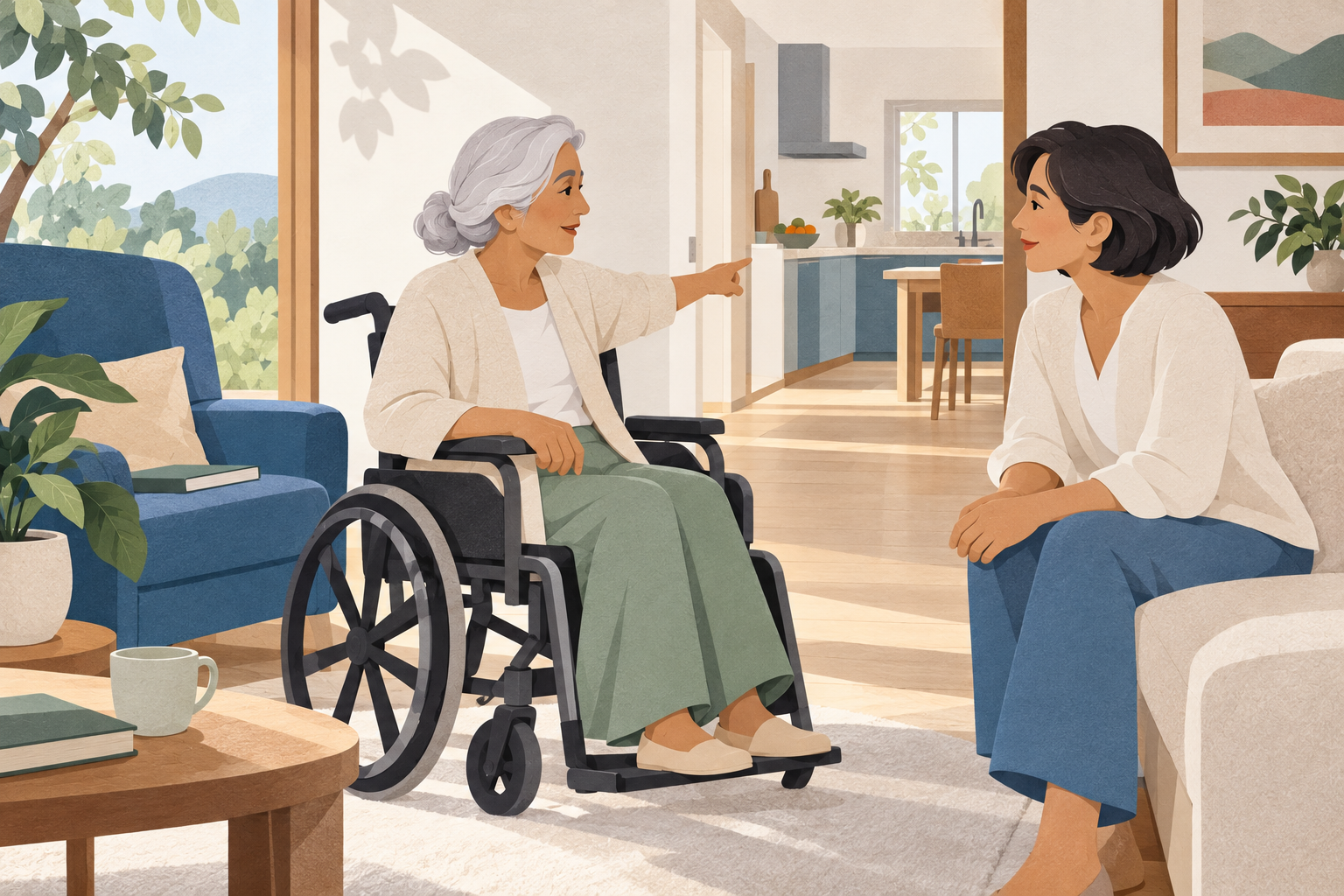
In a fictional story, Galina asks for an easier route from bedroom to kitchen. Her son proposes major work and removing an old chair by the window. She refuses, and the conversation changes: instead of the passage, they discuss why she resists care. Galina wants both easier movement and reading in her favorite place. Those wishes have not yet been examined together.
Epigraph
“but it is on the empty space (within), that its use depends.”
Laozi, Tao Teh King, chapter 11, James Legge translation, Gutenberg 216. The chapter compares a wheel, vessel, and room. This philosophical image of usefulness is neither a building instruction nor a demand to discard a resident's possessions.
What this article is about
In a fictional story, Galina asks for an easier route from bedroom to kitchen. Her son proposes major work and removing an old chair by the window. She refuses, and the conversation changes: instead of the passage, they discuss why she resists care. Galina wants both easier movement and reading in her favorite place. Those wishes have not yet been examined together.
This article considers housing changes through particular activities. Entrances, stairs, kitchens, bathrooms, lighting, storage, and communication may need attention. A list is not an individual design. Hear the resident's difficulty, desired result, and questions needing professional assessment. Age supplies neither one correct interior nor automatic authority for children. We separate convenience, actual safety conditions, consent, cost, and living during the work. Philosophical texts illuminate meaning without establishing construction, health, or applicable housing rights.
I. Begin with an activity the person wants to preserve
Make the home safe is too broad for a ready solution. One person wants to make breakfast, another reach the entrance, another use a bathroom with suitable assistance. These need different conditions. Before selecting equipment or moving furniture, hear the resident's task. What became difficult, at which point, and how does it happen now? No medical account is required to formulate the question. It prevents a helper's apparently obvious project from quietly replacing the activity the person wanted to continue. The initial description identifies a subject for inquiry rather than settling the answer.
Galina named a kitchen route; her son heard a need to remake the apartment. Extensive work might be needed, but that remains an assumption. Assessment lies between a reported difficulty and a proposed project. Skipping it offers a choice between everything proposed and refusing care altogether. A specific conversation leaves more options: identify the obstruction, what matters, and what cannot be settled at home through discussion alone. Agreement to a renovation need not become the price of explaining one's task or obtaining help with a more limited question.
UN Principles for Older Persons, principle 5, bring safety, personal preferences, and changing capacities together. This normative direction supplies neither an apartment design nor a service guarantee. Its relevance is their coexistence. Preference does not disappear when safety is discussed; saying safety does not make every technical idea suitable either. Attend to the person, action, and actual setting rather than choosing one principle and assuming the others have been provided for. A principle can direct attention while leaving the practical decision open to the relevant facts.
Activities can also be enjoyable. Reading by a window, receiving a visitor, or tending plants belongs to a life at home. Recognizing that does not preserve every object at any cost. It broadens the intended result beyond eliminating a difficulty noticed by a helper. A home is changed for a life, rather than only an observer's ease of moving through it. Naming the activity's meaning helps assess whether an adjustment serves it or removes that very possibility together with an obstacle. A useful change needs an account of what the resident can actually do afterward.
II. Areas for attention do not replace an assessment
Consider entry and exit, movement between necessary places, stairs and transitions, food preparation, bathing and toilet use, rest, storage, lighting, and calling for assistance. These are subjects for questions rather than compulsory works. Rooms are used differently. A staircase determines no ready solution; clear floor space establishes no complete route. What action is performed, what is available, and what actually obstructs it in this home? Naming an area can make inquiry more precise without proving that a particular item of equipment is required or that changing it will answer the task.
NHS Home adaptations gives examples involving stairs, bathrooms, doorways, kitchen surfaces, and outdoor access, and describes working out needs together during assessment. We do not turn its examples into instructions to install everything. The page belongs to a local assistance system; costs, availability, and entitlement do not transfer to every country. Here it identifies areas and an assessment function rather than supplies the reader with an engineering solution. The distinction matters when a general list sounds reassuring but nobody has examined the actual home or action.
Connect each area with a question. Can a needed object be reached without unsuitable effort? Are controls understood? What happens along the route? How does the person know an action worked, such as a connection actually being established? No hazardous demonstration is needed to make the question convincing. Reported difficulty and available information can justify seeking an appropriate assessment. This article proposes no testing of strength limits, repeated fall, or unsupported trial of equipment to complete an exercise. A concern can be described without requiring somebody to reproduce the danger for an audience.
Different questions call for different participants. The resident knows familiar life; a professional may assess a function or construction; an owner and other residents have relevant conditions too. Nobody automatically knows everything. Being good at buying technology does not make a relative an expert on every adaptation. Professional expertise also need not guess why Galina values the chair. A useful assessment subject emerges when those kinds of knowledge meet, rather than one being declared sufficient to decide another person's home. Their contributions matter without having identical scope or replacing one another.
III. A familiar object may have an unnoticed function
An old chair can obstruct one route while supporting a valued activity. Neither leaving it untouched nor removing it without discussion follows automatically. Examine function and actual conditions. Galina may value the view, seating, a nearby book, or its history. These grounds differ. Another position or object may be possible; a constraint may need professional advice. Old alone describes neither risk nor value. The adjective cannot do the work of assessment or settle the resident's preference, even when everyone agrees that the object has occupied its current place for many years.
Tao Teh King, chapter 11 relates a room's use to more than visible walls: the space within matters. Our bounded comparison asks what a room's arrangement enables. It establishes no passage width or rule that emptiness always beats fullness. An ancient text cannot authorize discarding possessions for correct simplicity. The image draws attention to function without supplying a decision, consent, or verification of actual use. A philosophical question can illuminate the purpose of a change while leaving construction and a person's response to be examined through their own appropriate grounds.
Familiarity equally makes no former arrangement permanent. Someone may want to remove a tolerated object or preserve only part of an interior. Care should prescribe neither attachment to everything old nor enthusiasm for complete renewal. Ask what matters instead of requiring a defense of every item before a family tribunal. If any answer has already been named resistance, choice has not yet been discussed. Hearing a reason does not promise its implementation without examination. It recognizes that the reason belongs to the decision rather than treating the resident's account as an obstacle to be overcome.
A change may require learning another arrangement or method. A helper's quick understanding does not establish the resident's. Where are necessities now, how are controls used, and what remains accessible at familiar times? These assess a result rather than general adaptability. Identify a particular difficulty with an unfamiliar arrangement. Do not make that difficulty proof that the resident must endure it because money and family effort were spent. An installation can be complete while explanation, suitability, or part of the route remains unfinished, and acknowledging that gap does not erase the work already done.
IV. Consent needs a clear subject and a real choice
Do whatever you want may express free delegation, weariness with argument, or uncertainty about the proposal. One phrase establishes none reliably. Clarify what changes, the activity served, expected disruption and expense, unknowns, and possible alternatives. This is no universal legal consent form. It is an ethical basis for a conversation in which an adult understands the question rather than merely confirms another person's confidence. The request for agreement should concern an intelligible proposal, including its limits, rather than a general demand to trust every future decision made in the name of care.
Galina may agree to assess a passage without agreeing to discard the chair. Accepting a professional visit need not mean accepting every later recommendation. Declining one option differs from refusing assistance altogether. Keeping those answers distinct allows discussion to continue where safe mutual conversation is available. A real constraint nevertheless survives disagreement. An infeasible preference can be named without blaming the person or calling a substitute already accepted. Acknowledging a limit and preserving a voice are compatible even where no available choice fully matches what the resident originally wanted.
Other residents, ownership, and occupancy terms matter too. This article establishes no renovation-permission procedure for rented or other property. Applicable rules and documents require checking. Others' participation should not automatically erase the voice of the person whose activity prompted the change. Legal grounds, co-residents' workload, and Galina's preferences can be considered together. One participant cannot consent for everybody; an informal view of convenience supplies no property authority. The conversation needs to distinguish whose agreement is required for which part, rather than gather every question into one family yes.
Age alone establishes no inability to understand. Difficulty with a phone or one household action establishes no global inability either. Special questions about representation or decision-making capacity cannot be settled through a family impression or this article. Understandable explanation, another format, or chosen support may be needed. Those differ from automatically transferring all power. Respect for consent includes recognizing our own boundary: we can clarify a conversation without giving a finding requiring different grounds and competence. Neither confidence in a helper nor anxiety about the situation supplies that missing assessment by itself.
V. Professional assistance answers a particular question
The NHS process describes an occupational therapist visiting and working out which everyday activities are difficult with the person. Professional titles and routes differ by country. This example concerns participation in daily activities, rather than an arbitrary renovation contractor, and promises no visit to every reader. Clarify which question is assessed and what the resulting advice means. A professional title alone does not establish that every necessary examination has occurred. Appropriate expertise has a scope, and understanding that scope helps identify where another question or kind of assistance is still needed.
Activity assessment and technical execution may require different preparation. A support needs to suit place, use, and installation conditions, as well as someone's wish to have it. The article specifies no fixings, materials, loads, or equipment parameters. Structural, electrical, and other specialist work needs appropriate practitioners and applicable requirements. A general article cannot certify a solution from a photograph or product name. A favorable account of something similar in another home does not settle a technical question here. The example may suggest a possibility while remaining different from confirmation that it fits this person's situation.
A resident can bring a simple description: difficulty passing, reaching, using a place, or understanding controls. They need not select the correct adaptation beforehand. The professional also needs the desired result and what matters to preserve. Galina wants both the passage and reading by the window. An account only of rooms may miss the activity; preference alone may miss construction limits. This is shared work with different knowledge, authority, and responsibilities. Good relations do not make them identical or allow either personal experience or technical expertise to stand in for every other part.
Advice has a defined scope. A bathroom assessment does not certify the entire home; equipment inspection settles no ownership question. Ask what was considered, what remains unknown, and who can address the next issue. Endless consultation after every small change is not required. An adequately checked decision can be used. Avoid expanding a limited answer into everything is safe when nobody reached that conclusion. The boundary helps both resident and helper understand what has actually been provided for and prevents a partial answer from acquiring authority over matters outside its examination.
VI. Small and large changes have a whole cost
A minor rearrangement and major renovation differ. Calling work an adaptation makes it neither easy, cheap, nor reversible. Installation, maintenance, learning, temporary loss of a room, and others' effort may matter alongside purchase price. These are organizational questions, not a budget or personal financial plan. Galina needs to understand which part of life changes. A dearer option is not automatically better; a smaller bill proves no completed task. Consider what the proposal actually supplies, its conditions of use, and the work required to keep it available after the initial purchase.
A limited change may be suitable where it does not postpone necessary assessment. Information used already might be arranged more clearly, or accessible storage discussed. Smallness does not guarantee safety everywhere. Do not make a trial into universal advice to shift heavy furniture or alter construction independently. Its subject and limits remain specific. Reversibility should be checked rather than presumed, particularly where other systems, property, or necessities are affected. A modest-sounding action can still have consequences that matter, and a preliminary discussion need not become permission to implement it without the required conditions.
Equipment may require skills, supplies, power, communication, or servicing. Installed and usable now are different states. Who explains controls, what happens during a fault, and what if a needed dependency is unavailable? Answers concern the actual device rather than its modern appearance. This article selects no alarm, monitoring, or communication system. Its criterion is modest: a technical promise must relate to real use conditions understood by the resident, rather than only a seller or relative. A feature that exists on a specification sheet may still be unavailable in the setting where it is needed.
A helper can also name time, funds, and work they can offer. A truthful limit is not indifference. Wanting to help equally makes no preferred option compulsory. Sometimes no solution exists yet because participants' conditions differ. Recognize that rather than obtain nominal agreement to an unmanageable project or announce completion after a partial purchase. Partial assistance can matter while an unmet need remains. Neither should have to disappear from the account to produce an attractive story of family cooperation, and acknowledging both gives a more accurate basis for considering a next step.
VII. Home retains private space while assistance is needed
Changes can make activities easier while revealing more private life. Others enter rooms, move things, and see documents or habits. Their presence need not be unwelcome, but its boundaries belong to the task. Help with a passage does not imply agreement to sort every paper or enter without notice continually. Privacy here is an ethical subject; actual housing and other rights are not determined. Avoid expanding a small request into control of the whole domestic arrangement. The information or access needed for one action does not automatically become necessary for every later decision.
In Of Solitude, Montaigne uses an image of private inner space not wholly surrendered to external bustle. This philosophical relation to oneself establishes no floor area or duty to live alone. His historical judgments about age and dissolving obligations are not care guidance here. The limited question is whether a person retains room for an answer while others organize life around them. Material assistance may support that room without receiving authority to occupy it all. The image raises a question about participation rather than giving an excuse to abandon necessary support or deny actual constraints.
Galina may want to choose when to read, whom to invite, and which possessions to show. Others have conditions too, particularly in shared housing and agreed assistance. Privacy therefore demands no disregard for their work. Time, access, and purpose can be clarified without calling every boundary ingratitude. A changed home need not become continual behavior inspection. Its resident has a life rather than being a project recipient required to prove deservingness. Respect can include both a helper's honest limits and a resident's ability to keep unrelated parts of life outside the arrangement.
Monitoring, sensors, and remote access need a separate discussion about information and consent. They are no compulsory part of every adaptation. Here it is enough not to include them silently under safety. An actual device requires understandable actions and terms. The article supplies neither technical settings nor secrecy promises. Changing space, arranging assistance, and sharing information are different decisions. They should not be made through one undivided answer to whether someone wants care. A person can welcome an agreed change without accepting every additional form of observation or intervention proposed alongside it.
VIII. Life during the work also needs to remain possible
A project can promise later convenience while leaving the immediate period unclear. Where does someone prepare food, rest, and use essential rooms during work? How does agreed assistance continue, and who communicates changing dates? These are present-life questions rather than minor sacrifices for a good future result. The article prepares no construction schedule. It recognizes temporary inaccessibility as a real condition requiring an answer, particularly where something indispensable is affected. A proposed improvement should therefore include attention to what happens before completion, rather than assess only the intended photograph at the end.
Galina can agree to a finished kitchen without having a suitable place during renovation. Consent to an outcome does not establish acceptance of every method of execution. Discuss temporary arrangements separately and check actual suitability, rather than treating any stay with relatives as sufficient. Hosts have limits too. Missing necessary care or an essential activity cannot be resolved by asking someone to endure a little for care's sake. Later benefit does not remove the question of how someone lives now. A truthful plan distinguishes an available temporary arrangement from a reassuring suggestion that has not been agreed.
Plans can change: work takes longer, another issue appears, or a proposal proves infeasible. This does not automatically justify blaming a resident or demanding consent to every addition. A substantial change reopens the subject. What changed, with which consequences, who decides, and what information is missing? Earlier general agreement should not become permission for endless expansion. Technical limits likewise do not disappear through wishing to preserve a plan. Name them with appropriate participants. A change in circumstances deserves its own account instead of being hidden inside an original approval that concerned something different.
Both organizing help and interference with familiar space can be tiring. Recognize both burdens without requiring one person's heroism and another's silence. Another scope, date, or coordination method may be needed. Respectful discussion promises no removal of material limits. It helps keep them visible rather than conceal them through compulsory gratitude or sacrifice. A housing change serves people's lives, so life belongs in the assessment during work, rather than only after an attractive completion. Naming strain can be a practical part of choosing manageable conditions, without turning either person into an obstacle to care.
IX. Acceptance begins with the resident's chosen action
The item is installed, work paid for, and photographs tidy. These confirm certain actions, not every desired result. A necessity may still be hard to reach, controls unclear, or another part of the route inaccessible. Distinguish installation, technical checks within their scope, and actual use under appropriate conditions. An exercise replaces no required professional inspection. Nor should someone risk themselves to prove publicly that a device works. A record of completed work can remain accurate while a separate question about suitability is still open and needs attention.
Feedback should concern the task. Is the kitchen easier to reach, is reading preserved, and what needs explaining or correcting? Gratitude and a comment can coexist without dismissing effort. A helper can name unfinished work rather than feel obliged to claim everything ready. Judge an adjustment through its action rather than the persuasiveness of good intentions. One suitable choice establishes no suitability for all rooms and tasks. A useful response can therefore acknowledge a completed part, an actual difficulty, and a limit to what has been checked without making any of them a verdict on a person.
In the fictional story, the chair is not discarded at the first suggestion. Galina and her son clarify an activity and seek appropriate assessment of the area. Another position still needs examination; a favorable narrative does not make it safe. This story concerns a more precise question rather than a guaranteed rearrangement. Choice and professional examination do not compete: one names the life served, the other considers relevant conditions. Both can guide a real decision without the article pretending to have inspected Galina's apartment or approved a particular physical change.
Needs and preferences can change. Another question is justified by a new difficulty or activity, rather than a continual urge to remake someone's home. A suitable adjustment can simply be used. Dignity requires neither enduring inconvenience to preserve an image of independence nor accepting every innovation as proof of gratitude. A home remains one's own when conditions support action and its resident participates in arranging life. That is the discussion's aim rather than a promise that one renovation secures every future safety condition or makes remaining at home possible under all circumstances.
What this means in practice
If useful, name one home activity and difficulty. Separately identify what matters to preserve: a place, habit, access, or choice of assistance. Do not turn the article into an individual technical design. No hazardous demonstration or strength-limit test is required. A reported difficulty can already become an assessment question.
Clarify who is needed: resident, chosen helper, relevant professional, owner, or others affected. Identify the desired outcome, unknowns, costs, and life during change. Permissions, health questions, and construction issues require their own grounds. Age, kinship, and goodwill replace neither consent nor authority.
After a limited decision, examine its result under appropriate conditions. What is more accessible, what remains open, and is the method understood? Clarify, change the option, or recognize another need. This voluntary authorial practice is no tested injury-prevention program, construction acceptance, or guarantee of remaining at home forever. It connects a change with the person, task, and actual boundaries of a solution.
Key quotation
“we must reserve a backshop, wholly our own and entirely free”
Michel de Montaigne, Of Solitude, book I, chapter XXXVIII in this edition, Charles Cotton translation, edited by William Carew Hazlitt, Gutenberg 3600. This fragment concerns inner retreat, not a housing entitlement, compulsory separate room, or permission to abandon necessary care.
Connections between traditions
| Comparison | Shared question | Boundary |
|---|---|---|
| Laozi, chapter 11 and a room's purpose | Consider what a space enables | No dimensions, construction, or authority to discard possessions |
| Montaigne, Of Solitude, and a resident's answer | Others' participation need not occupy the whole inner life | No compulsory isolation or abandonment of care |
| NHS Home adaptations and a home activity | Assessment joins action, place, and the person | Local routes and examples supply no individual design for everyone |
| UN principle 5 and changing preferences/capacities | Safety and personal choice belong together | A norm establishes no permission, service, or technical clearance |
These four bounded comparisons use actual sources rather than claim agreement among all traditions or a scientific adaptation program. Contemporary scenes, questions, and the practice are the authors'.
Primary sources
- Laozi, Tao Teh King, chapter 11, James Legge, Gutenberg 216. Entire selected chapter 11 read with nearby context; not the whole treatise. Philosophical usefulness, without applying other chapters' health statements.
- Michel de Montaigne, Of Solitude, Cotton/Hazlitt, Gutenberg 3600. Selected passage on inner retreat with surrounding context; not the complete collection. This edition numbers it I.XXXVIII and names 1877. Short key fragment; historical prescriptions about age are not applied.
- NHS, Home adaptations. Substantive page read October 19, 2026; marked reviewed December 12, 2025. Areas and shared assessment used without transferring costs, local service conditions, or linked documents.
- UN General Assembly, United Nations Principles for Older Persons, A/RES/46/91 Annex. Selected principle 5 read in context in this task. A norm concerning environment, preference, and capacity, not a personal legal or technical finding.
Galina and her son are fictional. Health, decision-making capacity, construction parameters, and individual safety are not assessed. Professional decisions, local rights, and service availability require the particular circumstances.
Tags
ageing, home, housing adaptations, ease, safety, consent, independence, accessibility, preferences, assistance, family, environment, daily activities, entrance, stairs, kitchen, bathroom, lighting, storage, professional assessment, personal space, privacy, renovation, costs, feedback, choice, Laozi, Montaigne, NHS, UN principles
About the authors
Andrey Zarinsh is the author and founder of United Wisdom. He explores inner transformation, the unity of traditions, intercultural dialogue and contemporary spiritual discipline. Instagram: @andrey.zarinsh.
Maria Evilkut is a co-author of United Wisdom. Alongside her research, she seeks to test these ideas in practice and observe how principles of unity and mutual understanding work in real life between people and cultures. Instagram: @ilkutki.