
Home, community and ageing in place
Home as a Practice: Staying, Moving, or Changing Arrangements
A dwelling can belong to someone on paper without yet becoming a place in which they can live comfortably. A rented room, meanwhile, may develop a recognisable rhythm: morning light, a place for belongings, an opportunity to rest, and an agreement about quiet. This article considers home as repeated participation in a space through care, use, negotiation, and change. It does not diminish secure housing or propose…
Epigraph
but it is on the empty space (within), that its use depends.
— Dao De Jing,11; James Legge translation. The clause follows the image of making doors and windows in a room. It concerns use, not a demonstrated superiority of empty interiors.
What this article is about
A dwelling can belong to someone on paper without yet becoming a place in which they can live comfortably. A rented room, meanwhile, may develop a recognisable rhythm: morning light, a place for belongings, an opportunity to rest, and an agreement about quiet. This article considers home as repeated participation in a space through care, use, negotiation, and change. It does not diminish secure housing or propose replacing material conditions with inner work. Reading Aristotle, the Dao De Jing, the Analects, Marcus Aurelius, Thoreau, and Ruskin helps distinguish ownership, suitability, memory, and relationships. Historical texts provide questions and distinctions; domestic scenes remain original illustrative examples. Readers can examine one household task without being required to create a perfect interior or prove their competence. The central concern is what supports present inhabitants and leaves them able to participate in decisions.
I. A door key and a place to live
Imagine someone receiving the keys to an apartment they have bought. The documents are signed, the boxes have arrived, and a first kettle sits in the kitchen. Yet that evening they behave as though they are occupying somebody else's space: they hesitate to move anything, postpone ordinary decisions, and cannot find a comfortable place to read. Elsewhere, a tenant has learned to arrange the morning, protect a quiet hour, and invite a friend without feeling examined. These imagined scenes do not establish that ownership is unimportant. They reveal two different questions: what entitles us to use a dwelling, and how that use becomes everyday life. The first matters for security. An ownership document cannot supply the answer to the second.
Here, a practice means repeated participation: preparing food, negotiating noise, noticing a broken fixture, making room for rest, and deciding how to use available resources. A home, in this sense, develops over time rather than existing only in a floor plan. A room's arrangement helps or obstructs these actions, while the actions also reshape the room. A useful shelf appears because someone notices that a bag repeatedly blocks the passage. The habit need not become a permanent law: an injury, a child's arrival, or a change of work may make the old arrangement unsuitable. A home understood as practice can respond to change. A home treated as a finished image continually asks its inhabitants to fit a picture already selected.
In the first book of Politics, Aristotle describes the household as an association serving everyday needs. His historical account also includes patriarchal authority and a defence of slavery; we do not adopt those hierarchies as contemporary norms. A narrower shift of attention is useful here: a dwelling exists among relationships and activities, rather than apart from them. This does not make living alone deficient or prescribe a particular family structure. Someone living alone still has relationships with neighbours, repair workers, friends, and their own future circumstances. Recognising this network makes the conditions of living more visible, without demanding that a person prove their arrangement qualifies as a real home.
II. Space leaves something possible
Chapter eleven of the Dao De Jing connects a room's usefulness not only with its walls but also with the unfilled space inside them. This is an image within a philosophical text, not architectural guidance or evidence for the superiority of minimalism. We can cautiously turn it into a question: what remains possible here? A room may contain many beautiful objects yet have nowhere to put a chair for a conversation. A nearly empty room may be impossible to sit in comfortably. The number of possessions therefore tells us little on its own about suitability. What matters is whether the arrangement permits a needed activity without continual obstruction, and whether everyone entitled to use the space can undertake that activity.
Consider a household object through its participation in living. A table may support work, shared meals, and the sorting of medicine packages; it need not symbolise a single ideal activity. When those purposes conflict, negotiating time and storage can be more useful than calling somebody untidy. A clear surface sometimes matters because it can accommodate the unplanned: a letter, a repair, a visitor, or a tired elbow. Clearing space, however, does not authorise throwing away another person's belongings or dismissing their memories. Spatial freedom depends on relationships. Where one person sees a cluttered table, another may see the only available place for their work.
For a tenant or someone in shared accommodation, scale matters particularly. They may be unable to alter the walls, choose neighbours, or change the layout. A practice begins within actual access: a labelled box, a reliable place for keys, an agreement about lighting, or a cup of one's own. Such a small area does not pretend to solve a housing problem. It helps distinguish what can be changed now from what needs money, consent, a different agreement, or assistance. Available space supports living when it makes a particular next step easier. If it exists only for a photograph while depriving an inhabitant of needed possessions, the space has begun to serve an image instead of a life.
A further question concerns people whose movement or perception differs from what the householder assumes. A passage that an adult easily navigates sideways may obstruct someone using a walking frame. A high shelf clears the floor but puts a daily object out of reach. We are not setting accessibility standards or replacing a professional assessment here. The point concerns participation: usefulness cannot be conclusively assessed through a single inhabitant's eyes. Ask the affected person before changing an arrangement and let them try the result under appropriate conditions, without a hazardous test. 'That makes things harder for me' conveys information about use, even if the new version looks tidier. In a shared home, one person's convenience should not automatically be named the common order. Sometimes a better arrangement leaves more objects visible because that allows someone else to act independently instead of repeatedly asking for assistance.
III. The work that returns
The floor is washed, and tomorrow footprints appear again. Food is prepared, and by evening the dishes are occupied once more. The repetition of domestic work can look like an absence of results, as though somebody spent a whole day doing things without creating anything. Yet a clean cup, usable clothes, and a functioning door are results that happen to be consumed immediately. A discussion of home benefits from distinguishing a completed object from a maintained condition. The former can be displayed after work. The latter is often noticed only when it disappears. A home needs both creation and maintenance; a task does not become unreal because it will recur tomorrow. Recognising its value does not yet settle its fair distribution.
Imagine a couple in which one person says, 'You only had to ask.' By evening the other has checked supplies, arranged a repair, located clean linen, and decided who needs to know about a visitor. The difference concerns more than minutes of physical work. It concerns responsibility for making a task visible at all. This article's editorial proposal is to discuss the complete cycle: notice a need, define an acceptable result, act, and check completion. This is a practical vocabulary for conversation rather than an established psychological intervention. It allows people to ask who carries the entire cycle and what would happen if that person became ill, travelled, or stopped silently remembering everything.
Complete symmetry is neither always possible nor always desirable. People differ in available energy, working hours, mobility, and expectations of cleanliness. Equal dignity does not require identical amounts of every activity, but it does require the ability to discuss burdens and decline what cannot be managed. A task list helps when it opens negotiation; it becomes another pressure when it functions as a daily personality score. Even a carefully arranged schedule needs room for illness and accident. Home as practice does not promise flawless execution. It offers a way to recognise labour, agree on commitments, and return to them after disruption without deciding that somebody is now permanently a bad householder.
Paying for part of the work does not make care disappear or turn it into someone's natural destiny. A cleaner, repair worker, or assistant undertakes an agreed task; they are not obliged to guess every inhabitant's preferences. Explain the intended result, available materials, timing, and which possessions must not be touched. Hired work also requires respect for refusal and the limits of an agreement. Payment details and legal rights depend on the particular situation and are not determined here. An image of the ideal home, however, cannot justify humiliating somebody who helps maintain it. If an owner's convenience depends on another person endlessly correcting unspecified details, the question of practice remains unresolved. Notice the actual participants in care rather than only the photographed result. The dignity of work appears in its conditions as well as in how its worker is treated.
IV. A rhythm without a domestic exam
A domestic rhythm connects actions into a recognisable sequence. Someone opens the curtains, puts water on, checks the door, and keeps a phone away from the bed. That order does not by itself make a person spiritually mature. Its value can be assessed more modestly: does it reduce needless confusion, make needs easier to notice, and leave room to change the day? A ritual differs from compulsory performance through meaningful participation. If a morning routine demands so much that somebody starts the day accusing themselves, the routine may need simplifying. An inhabitant should not have to prove every day that discipline alone has earned them permission to rest.
Analects I.12 values harmonious ease in the practice of ritual while also warning that ease alone is insufficient. This discussion belongs to a historical culture of li, involving public and family roles. It is not the same as contemporary advice to design a daily routine. For our question it illuminates a tension between form and living participation. A familiar action can support a meeting or replace it. A guest hears the customary invitation to feel at home but does not know where to sit or what may be touched. A modest explanation of the actual rules may prove more welcoming than an elegant formula because it changes uncertainty into an available action.
A household rhythm can also be disputed. One person rests in silence while another enjoys music during cooking; one wants an empty sink overnight while another prioritises going to bed on time. Those differences do not require an immediate diagnosis of the relationship. Preferences, essential needs, and safety requirements can be distinguished before asking where compromise is possible and where another time or area is needed. Observable language is useful: 'After eleven, the sound prevents me from sleeping,' rather than a verdict on character: 'You never respect our home.' An agreement may take several attempts. A planned opportunity to revisit it after a week helps distinguish a shared rhythm from a unilateral order, even when the first arrangement proves inconvenient.
V. Objects: memory and present use
A cracked cup may be unusable for tea yet important as a reminder of a person. A new chair may be expensive and uncomfortable. A dwelling holds objects for different reasons, and a single measure quickly becomes destructive. Practical usefulness, a connection to memory, aesthetic enjoyment, and an obligation to preserve somebody else's possession are distinct reasons. They can be named without requiring every object to justify itself under all of them at once. The question 'Why is this here?' then ceases to be an accusation. It becomes a clarification of what we use, what we keep, what remains undecided, and which decisions cannot be taken alone.
In The Lamp of Memory, Ruskin presents ordinary dwellings as possible carriers of history and urges builders to consider those who will come later. His architectural ideal involves a Christian worldview and a preference for durability; it does not require today's inhabitant to preserve every possession. A narrower question can be taken up: what story do we want to keep accessible? Sometimes a note on the back of a photograph or a story about a table is sufficient, instead of keeping a whole room's contents. Sometimes the object itself matters because its traces of use and time cannot be replaced by an image. The decision depends on the person, the object's condition, available space, and the consent of its owners.
Trouble arises when possessions acquire the authority to prohibit living. Nobody may sit on the sofa, use the dinner service, move the cupboard, or open the window: everything must stay as before. Memory does not necessarily require immobility. A story about the past can be retained while a room becomes accessible to its present inhabitant. That is not equivalent to an unfeeling rejection of history. The opposite danger is promising instant freedom through total clearance. Discarding an object does not guarantee that grief ends, and keeping it does not establish an inability to move forward. Domestic decisions are better made at one's own pace; where another person's loss is involved, conversation matters more than confident advice about the proper number of memories.
A purchase can also express care when its reason is clear. Another lamp supports reading, a suitable tool makes an activity manageable, and a comfortable mattress responds to a particular need. Refusing every acquisition has no automatic moral superiority. Before deciding, distinguish the problem an object addresses from the condition advertising promises alongside it. A chair may support one's back without supplying a definitive sense of having succeeded in life. When the expectation greatly exceeds the function, noticing it before buying is more useful than self-accusation afterwards. With limited resources, the question becomes especially concrete: which daily difficulty will this expense reduce, and is an available alternative possible? This is an invitation to reflect, not financial guidance. Sometimes the answer postpones a purchase; sometimes it confirms one, without having to defend usefulness as luxury or demonstrate virtue through discomfort.
VI. A door that can be closed
Hospitality is often pictured as the ability to open the door to anyone at any moment. Yet an inhabited home also involves being able to close it. A visit needs time, energy, and sometimes expenditure; guests affect every resident, not only the person inviting them. Declining a meeting today can support a friendship better than an invitation followed by several days of exhaustion and resentment. Specific language helps: I cannot host today; I can meet elsewhere; I can suggest another time. These statements need not include a complete account of private circumstances. Participating in relationships does not require turning a dwelling into a place of continual availability and display.
A boundary should not conceal one person's power over everyone else. If a shared apartment can be closed only at its owner's discretion, other residents effectively lose opportunities for contact. The ability to invite and the ability to rest need an agreement that considers duration, frequency, and available rooms. Advance notice may suffice in one household, a limit on evening noise in another, and a shared rule about overnight stays in a third. No single solution can be declared morally best for every home. We can instead ask whether participants know the rule, could influence it, and can discuss an exception without humiliation. This examines the arrangement rather than measuring people against an ideal of openness.
In Analects X.12, the episode following a stable fire turns attention to injured people. That priority recalls whom the space is maintained for. An elegant reception loses its purpose if an inhabitant must hide pain, exhaustion, or fear to make it possible. Where violence is threatened, hospitality must yield to actual safety: nobody is obliged to open a door to someone making threats, or to repair a dangerous situation through a domestic ritual. This article supplies neither a protection plan nor legal instructions. Its boundary is simpler: philosophical discussion of home cannot justify demanding patience where distance, a safe place, and appropriate assistance are needed.
VII. Inner support does not replace shelter
In Meditations IV.3, Marcus Aurelius invites himself to return to an inner retreat instead of making peace depend exclusively on a country house or seashore. This is a Stoic emperor's exercise addressed to himself, not an assessment of people lacking safe housing. It helps raise one question: which available thoughts and actions can I take with me? It cannot establish that housing conditions are unimportant. Noise, cold, absent privacy, and the threat of eviction remain material circumstances. Inner work may coexist with efforts to improve those conditions; it does not remove the need for shelter or turn displacement into a lesson somebody is supposedly obliged to receive gratefully.
Temporary accommodation exposes the distinction. Someone leaves a familiar apartment, stays with a relative, and does not know when they can return. They may preserve a morning walk, contact with a friend, the organisation of important documents, and a small area for personal belongings. Those actions do not restore the lost dwelling. They maintain some continuity in participating in one's life while larger decisions remain unavailable. It is important not to demand immediate effectiveness from them. One day a person can organise; another day they can only get through. An unstable routine under unstable conditions does not establish a character defect, and a helpful habit does not make an external dependency just or voluntary.
Thoreau presents his experiment in Walden as a private undertaking, rather than the only acceptable way to live. His cabin should therefore not become a compulsory model of simplicity. Solitude belonged to a particular authorial project; a reader with children, care responsibilities, or limited means inhabits different circumstances. The question of excessive burden can travel without the entire arrangement travelling with it. Which possession needs more effort than the usefulness it provides? Which task keeps me continually maintaining an image? Sometimes the answer involves buying a suitable tool, and sometimes declining a purchase. Practical freedom here depends on a person's actual possibilities and responsibilities, rather than counting their objects against someone else's photograph.
VIII. Home continues through change
A home is rarely completed once and for all. Its residents, income, work, bodily capacities, and the meaning of familiar possessions change. Someone who invested years in arranging a space may feel disappointed: so much effort, and now another beginning seems necessary. Yet a new arrangement does not invalidate earlier work. A shelf served its purpose; the purpose has changed. What remains useful can be preserved and what has become unsuitable acknowledged without passing judgement on an entire period of life. Home as practice offers this continuity: not perpetual loyalty to one furniture layout, but the ability to notice a need again and respond at an available scale, including the response, 'I cannot do more at present.'
Moving reveals that more than possessions can travel. A person takes their knowledge of suitable reading light, what helps distinguish working time from rest, and which conversations shared living requires. Some habits will help immediately; others need renewed agreement. Trying to reproduce an old home completely can prevent noticing a new place's features. Immediate adaptation need not be demanded either. A cup left unpacked for a week may be awaiting its moment; somebody else may need to arrange a single corner immediately. There is no universal sequence that turns a dwelling into a home within a fixed number of days. The question of enough remains open to the actual inhabitant rather than being settled by an external standard of furnishing.
Finally, domestic practice includes handing care over. Recording how to shut off the water, explaining a difficult device, agreeing on watering a plant, or describing an important object makes the space more intelligible to another person. Handover does not require that they continue our life unchanged. Whoever comes next may need different rules. We can leave information, working conditions, and permission to alter them; together these may help more than a solemn promise to preserve every corner forever. Ownership then remains one form of responsibility, while home is a place where living people can act, rest, meet, and reconsider decisions. Its value appears through that participation, even while an ideal picture remains unfinished and may never be finally complete.
A domestic practice can be checked through small consequences instead of the general impression that everything is now correct. Following a rearrangement, keys are easier to find but the passage is narrower. Under a new rule, visits are easier to plan but one resident stops inviting friends. Such observations permit correction before a decision becomes an unquestionable tradition. Choose an indication of change beforehand with those affected by the step. Any observation remains local: an arrangement that suits this room does not demonstrate usefulness for every apartment. There is no need to turn a home into a research laboratory. It is enough to retain the ability to notice the cost of convenience and hear those who bear it. That attention does not guarantee agreement, but it makes disagreement discussable rather than a hidden price paid for an attractive appearance. A home remains a practice precisely because its decisions can be examined and changed.
IX. Staying, changing arrangements, or moving
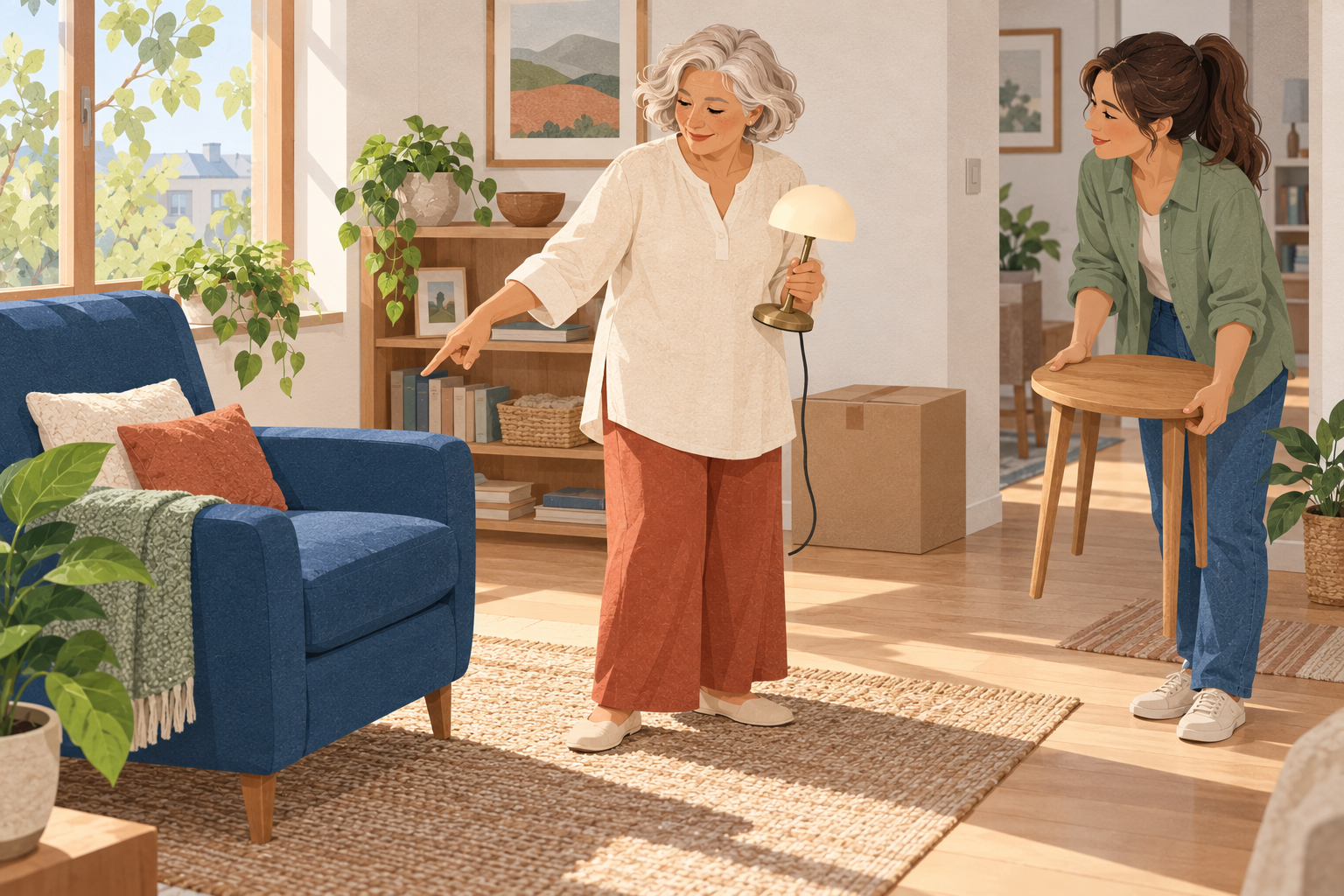
In a fictional example, Irina finds leaving her apartment without a lift difficult. Her daughter proposes moving closer; Irina values neighbours and familiar streets. This is no choice between stubbornness and obedience. Separate necessary activities, actual assistance, and what matters to preserve. Staying at an address differs from preserving every arrangement: help, tasks, or room use may change. A possible option nevertheless establishes no provided support.
NHS Housing options describes different housing forms whose support varies. This is local information, not a worldwide service inventory. Ask what the actual place includes. Proximity to a daughter proves no daily help; an attractive accommodation label establishes neither care, cost, nor continued occupancy. Check actual terms, with legal and professional questions addressed within their own scope.
Irina remains a participant; age transfers no automatic authority to relatives. UN Principles,5 and14, relate environment to preference and retain care-decision participation in a facility context. These norms determine neither local housing rights nor individual capacity. The daughter's resources also have limits; agreed assistance differs from an assumed duty of continual availability.
Compare actual options through activities, costs, contact, privacy, and assistance. Mark unknowns rather than count wishes as availability. Discussion or a visit is no sale or agreement to move. Temporary accommodation has terms too: it is not automatically reversible and should not silently become permanent. Limited options establish no character failure. Neither address guarantees wellbeing. A clear question and confirmed partial support can be an intermediate result while actual needs and the person's voice remain visible.
What this means in practice
Choose one small domestic situation that recurs: searching for keys, evening noise, an occupied table, or watering a plant. Do not take on the entire dwelling or begin with somebody else's mistake. Write down the activity you want to make possible, what obstructs it, and who else uses the place. Record material constraints separately: limited space, insufficient money, an arrangement you cannot alter, or consent that is needed. This prevents turning an external condition into self-accusation.
Propose one reversible step: relocate your own possession, label a box, give advance notice of a visit, or discuss the timing of a shared activity. Agree first if another person's belongings or rest will be affected. Set a time to check after a few days: has the particular activity become easier, and has it become harder for anyone else? The result can be negative. Restore the previous arrangement or try another step while retaining what you observed.
Finally, ask who will notice the next need and who will complete the entire task cycle. That conversation may help more than a purchase. Do not use the exercise as a personality score, a way to compel someone to care, or evidence of therapeutic effectiveness. Where safe housing is absent or a threat exists, actual safety conditions and appropriate assistance retain priority; a small routine cannot replace them. A sufficient outcome is one clear observation and one manageable decision in which participants retain the right to agree, decline, and revise.
Key quotation
The life which men praise and regard as successful is but one kind.
— Henry David Thoreau, Walden, Economy; English original. This follows his comparison of literary work with selling baskets. It neither dismisses material security nor supplies everyone with a single life prescription.
Connections between traditions
| Text and approach | What it illuminates | Difference and limit |
|---|---|---|
| Aristotle, Politics I.1–2 [3] | Everyday needs within an association | Historical slavery and patriarchy are not contemporary norms; living alone is not devalued. |
| Dao De Jing 11 [1] | Use depends partly on available space | A philosophical image does not establish minimalism's superiority. |
| Analects I.12; X.12 [4] | Ritual form and the priority of people | Historical li is not a household schedule; the comparison raises a question. |
| Marcus Aurelius IV.3 [5] | Portable inner support | Stoic practice does not replace shelter, privacy, or safety. |
| Thoreau, Walden, Economy [2] | The burden of maintaining a chosen way of life | A particular author's experiment is not compulsory guidance for families. |
| Ruskin, The Lamp of Memory, VI, IX–XI [6] | A dwelling as memory and care for later inhabitants | A Christian architectural ideal does not demand retaining every object or unsafe building. |
| NHS Housing options [7] | Housing labels differ from actual included assistance | Local guidance establishes no reader-specific availability, price, or right. |
| UN Principles 5,14 [8] | Environment, preference, and participation belong together | Norms establish neither representation nor individual capacity. |
These connections are the editors' limited comparison. The texts are not presented as a single doctrine; their grounds and historical circumstances differ.
Primary sources
[1] Laozi. The Tao Teh King / Dao De Jing. Ancient text; Legge translation 1891. Chapter 11; context of vessel, wheel and room. James Legge English translation, Project Gutenberg #216. Actually read: Chapter 11 in full, neighbouring chapters 8–12 as displayed in the primary text
[2] Henry David Thoreau. Walden. 1854. Economy: opening; necessities of life; paragraphs containing private business and The life which men praise. Project Gutenberg #205, English original. Actually read: Economy opening through displayed paragraph beginning My purpose in going to Walden Pond, selected relevant passages read; not entire book
[3] Aristotle. Politics, Book I. Fourth century BCE. Book I, parts 1–2, household for daily needs. Benjamin Jowett English translation, Internet Classics Archive. Actually read: BookI parts1–2 passages about communities, household, village and historical hierarchy read
[4] Confucius / Analects compilers. The Analects. Ancient compilation; historical Legge translation. I.12 and X.12 (harmony in ritual; stable fire). James Legge English translation, Project Gutenberg #3330. Actually read: I.12 in full and neighbouring I.5–13; X.7–15 including X.12 fire response
[5] Marcus Aurelius. Meditations, Book IV. Second century CE. IV.3, inner retreat and return to action. George Long English translation, Internet Classics Archive. Actually read: IV.1–4 including complete IV.3 as displayed
[6] John Ruskin. The Seven Lamps of Architecture. 1849. Chapter VI The Lamp of Memory, VI and IX–XI. Project Gutenberg #35898, English original. Actually read: ChapterVI opening and passages VI, IX–XI concerning homes, memory and later inhabitants; selected scope not complete volume
[7] NHS. Housing options for older people or people with disabilities. Substantive page read October 19, 2026; marked reviewed May 23, 2024. Used narrowly for housing forms and varying support; linked services, documents, and applicable rights were not examined.
[8] UN General Assembly. United Nations Principles for Older Persons, A/RES/46/91 Annex, principles 5,14 in context. Read October 19, 2026; normative direction, not an individual finding.
Original historical-reading records date from October 11, 2026. This revision rechecked Laozi 11 and selected Walden context including the key quotation; other historical records remain provenance, not newly claimed full-book reading. Thoreau's historical judgments about age and peoples are not guidance here. Irina and her daughter are illustrative; health, individual housing safety, rights, and a need to move are not determined.
Tags
home, dwelling, ownership, renting, practice, care, space, rhythm, everyday life, relationships, boundaries, hospitality, labour, agreements, memory, objects, change, moving, safety, autonomy, responsibility, Aristotle, Laozi, Confucius, Marcus Aurelius, Thoreau, Ruskin, philosophy, participation, enough
About the authors
Andrey Zarinsh is the author and founder of United Wisdom. He explores inner transformation, the unity of traditions, intercultural dialogue, and contemporary spiritual discipline. Instagram: @andrey.zarinsh.
Maria Evilkut is a co-author of United Wisdom. Alongside her research, she seeks to test these ideas in practice and observe how principles of unity and mutual understanding work in real life between people and cultures. Instagram: @ilkutki.