
World & consciousness
Astrology: Cultural History and the Question of Testing Predictions
Astrology’s history, Ptolemy’s causal argument, and the difference between symbolic conversation and a testable forecast.
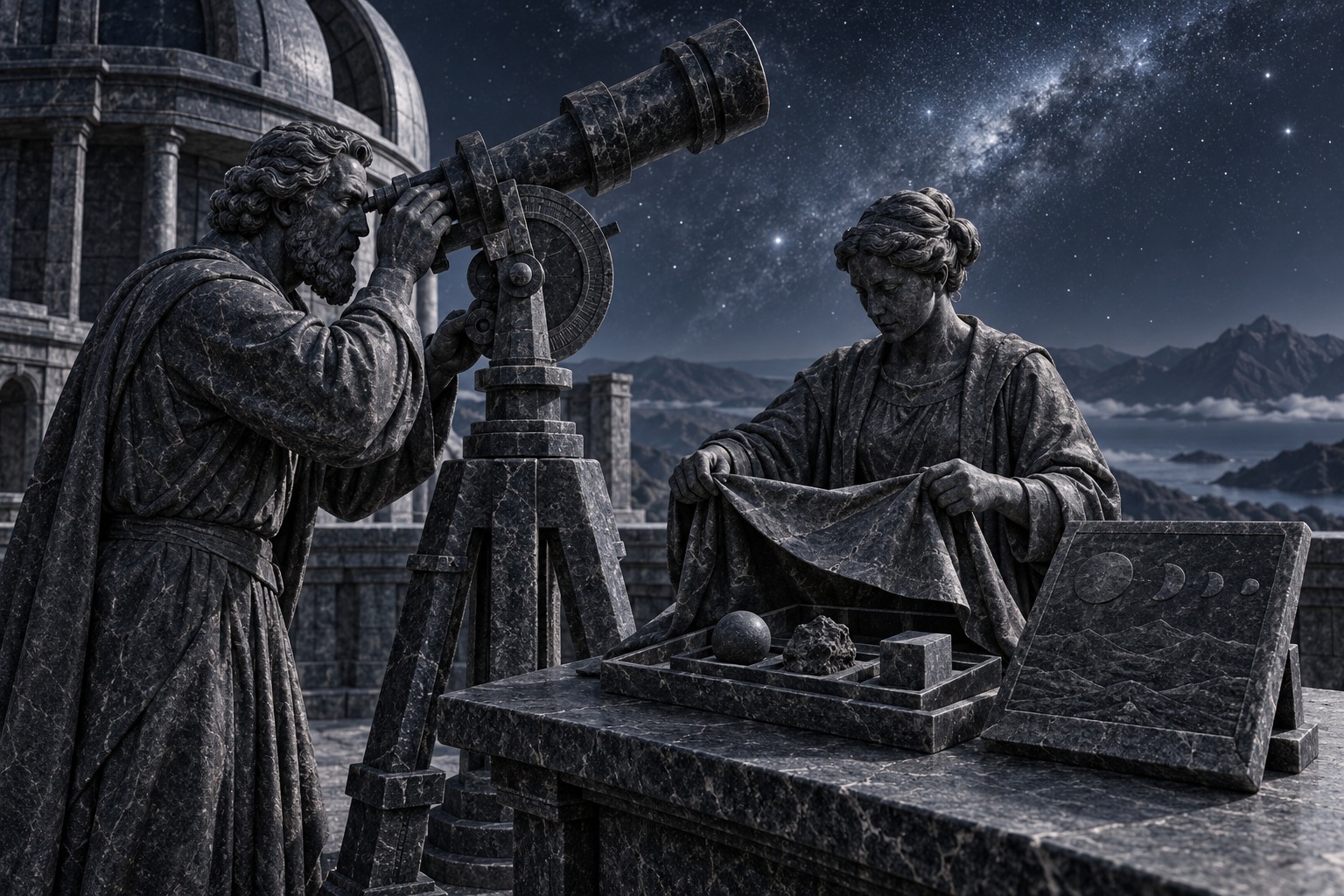
“no positive or infallible rules… can be here set forth”
Claudius Ptolemy, Tetrabiblos, I.1, abbreviated passage; English translation by J. M. Ashmand, 1822: I.1. The omission is marked by an ellipsis; the subject is prediction in a changing material domain, not modern scientific recognition of astrology.
Two people look at the same circle marked with planetary symbols. The first sees a promise of learning what will happen. The second sees a way to talk about what is already happening. Until they distinguish these tasks, their dispute about astrology will keep changing its subject.
About this article
Astrology has a cultural history that cannot be described by the single word “superstition.” Yet historical significance does not establish the accuracy of a prediction, and recognizing oneself in a description does not establish the cause of that recognition. This article separates three questions: how a language of celestial correspondences developed, what an astrological interpretation specifically claims, and how its claimed ability can be tested. We turn to Ptolemy's ancient treatise, contemporary history of science, and a well-known experiment involving natal charts. A study of one task will not be declared a definitive test of every possible school. We examine why calculating celestial coordinates and drawing conclusions about human fate require different grounds, how symbolic reflection differs from a prediction, and what an honest test means. The practical section helps preserve an interest in a cultural language without quietly handing it the right to decide for a person.
I. Astrology is not a single, unchanging teaching
The word “astrology” gathers different ways of connecting celestial phenomena with earthly life. Predicting a state's events, drawing a birth chart, choosing a time to act, and holding a contemporary symbolic conversation are different tasks. They cannot be considered identical merely because they use the names of planets. Historical and critical discussion requires us to specify what we are examining.
It is especially important to distinguish a tradition of celestial omens from the familiar mass-market horoscope based on one sign. The latter does not automatically represent the complexity of historical astrology. Yet a system's complexity does not, in itself, establish its accuracy either. A more detailed description may be better suited to interpretation, but the ability to interpret and the ability to predict remain different qualities.
John Michael Steele's project The Babylonian Zodiac in Image and Text studies the development and social role of the zodiac in first-millennium BCE Babylonia. Its description shows that historians consider texts, images, computational practices, and social settings together. This is a description of a research project, not proof of a particular astrological prediction.
Distinguishing the questions changes the conversation's tone. We can acknowledge that a system mattered to a particular culture while doubting a contemporary claim about personality based on birth date. We can study symbols without recognizing their causal power. We can also agree to test a particular promise without accepting its author's other beliefs.
A simple preliminary formula helps the reader: “We are now discussing astrology as…” What follows should name a historical practice, a worldview, a method of prediction, or a means of personal reflection. This is more than bureaucratic precision. It prevents a pleasant impression of a conversation from suddenly serving as proof of accurate knowledge about the future.
II. How Ptolemy builds the passage from the heavens to a person
Consider a field before sowing. Season, warmth, and moisture do change the conditions of a farmer's work. Yet how does this dependence lead to a conclusion about the character of someone born at a particular hour? The second chapter of the first book of Tetrabiblos lets us see the transition within the argument, rather than attribute a contemporary discussion of personal archetypes to the ancient author.
Ptolemy starts with the effects of the Sun and Moon, then extends the explanation to other celestial bodies and their combinations. The environment surrounding the earthly world becomes the connecting link. Through it he explains the formation of living things, moving from the conditions of formation to human constitution, inclinations, and fate. He also takes account of ancestry, birthplace, upbringing, and social position; celestial configuration is not considered the sole difference between people. I.2, main text, pp. 2–7 in Ashmand's translation.
Two steps of different strength appear here. The first connects life with observable environmental conditions. The second assigns specific configurations of the heavens a fairly particular role in individual life. The plausibility of the first does not automatically pass to the second. This is our analytical distinction, needed precisely because the author seeks to show the continuity of a single causal explanation. Break his reasoning apart in advance, and a caricature of arbitrary fortune-telling remains; accept its continuity without testing, and the disputed link disappears.
The system of qualities in chapter I.4 makes the connection more definite. Heat, cold, dryness, and moisture describe the planets' action; Mercury's qualities also depend on its position relative to the Sun and Moon. This variability belongs to the model, rather than signifying a modern psychological diagnosis of an “inconstant person.” I.4. The reader sees why a set of popular sign characteristics cannot replace historical physics: the explanation uses interactions, as well as labels.
This complexity has a philosophical cost. The more circumstances are considered, the harder it becomes to determine which part of the explanation belongs to the celestial factor. If upbringing and position are known to the interpreter, they may explain the successful account independently of the chart. The question of testing therefore concerns both the number of parameters and what additional information the astrological part itself provides. A modern test can isolate it; the ancient author sought to include it within an overall picture of nature.
The historical content of the chosen text becomes visible: it is an attempt to ground prediction in the causal coherence of the cosmos. Neither “everything is decided by the stars” nor the promise of a psychological conversation describes it adequately. Through an 1822 translation, we examine a particular argument of Ptolemy's, keeping a distance both from his model and from contemporary uses of its vocabulary.
III. Accurate calculation does not yet make interpretation accurate
Astronomical coordinates can be calculated with great care. An astrological conclusion, however, adds another claim: that a particular configuration means a particular inclination or event. The reliability of the first operation does not automatically transfer to the second. This general rule of reasoning applies far beyond astrology.
At the beginning of Tetrabiblos, I.1, Ptolemy himself distinguishes knowledge of celestial configurations from consideration of their supposed earthly changes. He also acknowledges the lesser certainty of the second domain. This qualification shows that an internal question about the limits of prediction is already present in the primary text, rather than arising only among modern critics.
Consider a hypothetical birth chart. Date, time, and place provide the starting information. Coordinates and relationships are constructed under the chosen rules. Interpretation follows. An error may occur at any stage, but correcting a time error does not establish that the rules of interpretation are sound. Such a conclusion requires showing that applying these rules consistently distinguishes suitable descriptions from unsuitable ones.
Technical detail creates an impression of objectivity: numbers, tables, angles, and specialized terms look convincing. Yet the question of grounds remains. What observations link this indicator with this human quality? How often is the relationship found? Under what conditions does it cease to work? Can another specialist obtain the same result? When answers are absent, precision of notation does not fill the gap.
This distinction does not require contempt for an astrologer's work. It requires the same standard for any method claiming to identify a person's qualities. A complex questionnaire, a computer diagram, or an ancient scheme is also subject to testing. The reader can assess a chart's beauty and a conversation's quality separately from whether the chart provides knowledge unavailable without it.
Ptolemy also offers two explanations for failures: the interpreter's insufficient preparation and the difficulty of the subject itself. I.2. Distinguishing them is useful before assessing a particular case. One person's error does not disprove every possible system. Yet this does not mean that the system is already well founded: results must be shown under sufficiently definite conditions of use. Otherwise, competence is established retrospectively through success, while every failure becomes evidence of a lack of competence. The reasoning comes full circle, even if the positions of celestial bodies have been calculated perfectly.
IV. A prediction must be defined before the event
Testing a prediction does not begin after something suitable has happened. It begins with a clear record of what is expected. The broader the wording, the more events can later be recognized as fulfilling it. “An important change awaits you” is therefore very different in testability from naming a specific outcome and deadline.
Not every astrological statement is a prediction. “Think about your relationship to obligations” is an invitation to reflect. “You will lose your job next month” is a prediction. “The chart shows a period of reconsideration” can move between these two kinds, depending on what its author counts as reconsideration. Testing requires the meaning to be defined in advance.
A hypothetical example: a consultant promises that someone will change jobs within three months. Before that period begins, a decision is needed about whether a move to another company, promotion, change of duties, or only dismissal counts as a change. If the list of acceptable outcomes expands after the event, a different formulation is being tested. This does not mean that flexible interpretation is always useless. It means it cannot be presented as a precise prediction fulfilled.
Failure must also be defined in advance. If every event confirms the scheme, and the absence of an event is explained by a hidden inner process, the scheme may retain symbolic value but loses a definite criterion for testing. A testable claim risks being wrong. That is what makes its result informative.
The question of comparison remains. Some events are common independently of the method: people change plans, argue, meet others, and grow tired. A correct forecast of an ordinary event needs to be compared with its frequency and with an alternative means of prediction. Without this comparison, it is hard to tell whether new knowledge has been obtained or something that might have happened anyway has merely been named convincingly.
V. Recognizing oneself is a real experience, but incomplete evidence
A person may read a description and feel that it concerns them precisely. That experience deserves attention. Yet it does not tell us why it arose. The text may contain an accurate observation, a widely applicable statement, information gained in conversation, or an image to which the reader gave personal content. Further checking helps distinguish these possibilities.
Take a hypothetical sentence: “Being independent matters to you, but sometimes you wait for support.” For one person it recalls a recent conflict, for another a relationship with parents, for a third a choice at work. In each case the description may begin a meaningful conversation. Yet the variety of fitting stories means recognition does not yet show the method's individual accuracy.
It helps to ask both “does this fit me?” and “who else does it fit?” If many people recognize themselves equally in a description, its diagnostic power is lower than it seems in personal reading. A general statement can be wise and useful; it should simply not be credited with singling out this particular person from a group.
Another question concerns what happened before the interpretation. If the specialist has already heard an account of family, work, and anxiety, some of the accuracy may come from attentive conversation. This does not devalue the conversation. Yet testing the chart's special role calls for separating ordinarily available information from information supposedly obtained from the celestial configuration.
Distinguishing the sources of benefit helps preserve what actually works for a person. If a good conversation allowed a difficult question to be named, its benefit can be acknowledged as a conversation's benefit. It need not immediately be linked to established celestial causation. Personal experience then remains real, while the explanation of its origin stays open to inquiry.
VI. What Carlson's experiment tested
A well-known example is Shawn Carlson's A double-blind test of astrology, published in Nature in 1985. Astrologers took part in the study, and the test design was discussed with their representatives. In the second part, astrologers matched a natal chart with one of three California Psychological Inventory personality profiles. Their first choice was close to chance: about 34%, against a chance expectation of about 33%.
This is the result of a specific task using a specific instrument for describing personality. It does not support the claimed advantage of natal interpretation in that procedure. An honest account must preserve the scope of the conclusion, however: the experiment did not test every historical form of astrology or investigate symbols' aesthetic or conversational value.
It is particularly revealing that the author did not consider the first part, in which participants chose their own descriptions, a sufficient independent test: a question arose about their ability to recognize their psychological profile. This offers a useful methodological lesson. Even a negative result requires assessing whether the test itself can distinguish the abilities being tested. Strong criticism need not exaggerate the power of every available measure.
Something else matters for the reader: an experiment should be challenged through its design, data, and procedures, rather than whether its conclusion is agreeable. If a different test is proposed, the claim it tests and the criterion of success need to be stated clearly. The possibility of criticizing one study does not mean the opposite claim has already been proved.
Discussion of the study can become productive when both sides are prepared to agree on a test in advance. If the task is replaced after every inconvenient result, the dispute becomes hard to conclude. An honest limit on the conclusion therefore works both ways: the researcher does not declare one procedure an answer to every question, and the method's advocate does not turn that procedure's limits into positive evidence of accuracy.
VII. A probabilistic claim also needs testing
An objection about inaccuracy is often answered with “Astrology speaks of tendencies, not inevitability.” This can be a meaningful clarification. Much knowledge takes a probabilistic form. Yet moving from a guarantee to a tendency does not remove the need for testing: it now requires showing that a particular outcome really occurs more often under the stated conditions.
A hypothetical example: people with a certain chart indicator are said to prefer independent work more often. The kind of work must then be defined, along with the comparison group and what difference is significant. If comparison follows a selection of only convenient cases, probability is no longer assessed honestly. Cases that did not match the expectation also need to be visible.
A quantitative claim cannot be replaced with “sometimes.” Almost anything common enough happens sometimes. If a method promises only that a person may face a choice, it conveys very little new information. A forecast becomes more meaningful when it identifies conditions, a time frame, and a relative expectation, then preserves its original formulation regardless of the result.
Explanation also differs from prediction. After an event, a coherent story can be constructed about why a particular configuration corresponds to it. That story's coherence does not show whether its author could have selected this outcome from alternatives beforehand. This is why a prior record and independent assessment help even with very complex systems.
A person need not organize a scientific study alone to see the problem. It is enough to request a precise statement of the promise and ask what would change confidence in it. If the answer permits no possible revision, we may be dealing with faith, symbolic interpretation, or a protected worldview. It cannot be called an empirically established method without additional evidence.
VIII. A symbol can be useful without being a causal law
A symbol's cultural value is not measured solely by predictive accuracy. An image may help a person name a conflict, see a possible role, or tell a story about change. Yet this use needs to preserve authorship of the interpretation: meaning arises through a person's work with an image, rather than necessarily arriving as an objective message about their fate.
A hypothetical conversation about Saturn's symbol can become a conversation about time, limits, and obligations. Someone may discover that they see every rule as a threat or, conversely, hide behind rules to avoid choosing. This is a contemporary use of symbolic language. It does not establish the planet's influence and should not replace the facts of a specific situation.
A good way to check the boundary is to restate the conclusion in ordinary words. Instead of “the chart forbids this path,” say “You find it hard to decide because risks and obligations are involved; let us clarify them.” If only mystical authority disappears in this restatement, while the meaning remains, it helps to acknowledge that the conversation was doing important work. This allows a person to assess the conclusion without submitting to a system of names.
Symbolic use also has limits. It may narrow attention if someone starts noticing only fitting cases. It may reinforce an expectation that then influences behavior. Alternative descriptions are therefore worth preserving. The same refusal of a project may be connected with an actual lack of time, an unclear goal, or unwillingness to participate. A chart should not close off these distinctions in advance.
Separating a symbol from a law does not destroy interest in astrology. It makes that interest more definite. A person can read historical texts, study images, discuss metaphors, and demand grounds for a particular prediction. These activities need not automatically support one another, but can coexist without a hidden transfer of authority.
IX. Can a predicted event be changed, and who has the right to predict?
An objection to prediction may run as follows: if an event is inevitable, knowledge is useless; if it can be changed, the prediction was wrong. Ptolemy addresses this difficulty in the third chapter of the first book. He distinguishes strong general causes from influences that other conditions can oppose. In his view, prior knowledge allows preparation and sometimes mitigation of an expected influence. The physician serves as an example of this relationship between foresight and intervention. I.3, pp. 8–13, main text.
This changes the picture of the ancient teaching. In this reasoning a person does more than await a sentence: counteracting causes operate in the world. Yet the analogy with a physician does not authenticate astrological ability. It explains why reliable foresight would be useful. The question of its reliability remains separate. One can accept the logic of preparing for risk without agreeing with the proposed means of identifying that risk.
Testing makes the next question important: when exactly was the intervention named? Suppose the event, conditions, and action meant to reduce its probability are formulated in advance. Outcomes under different conditions can then be compared. If a previously unknown “counteracting force” emerges after every unfulfilled prediction, the result can no longer change the interpreter's confidence. The distinction lies between conditions specified beforehand and an explanation added to preserve a conclusion.
Deuteronomy presents a different fork. In 18:9–15, the listed means of divination are forbidden and contrasted with the authority of prophetic speech; 18:21–22 separately considers a word that was not fulfilled. This passage connects trust both with an admissible source and with fulfillment of what was promised. “Was the forecast right?” therefore does not exhaust “whom is it permissible to trust?” here.
Consider a conversation between two readers. One questions natal interpretation's accuracy and is prepared to discuss a controlled test. The other considers recourse to a particular form of divination a breach of religious fidelity. Another match may address the first objection but will not remove the second. Establishing that the prohibition is present in the chosen text does not become a scientific test result either. Disagreement grows clearer when a specific reason for refusal is named.
Ptolemy's account of counteracting causes and the biblical distinction of authority meet in taking words about the future seriously, but differ on where those words gain their claim to trust. This is a meaningful connection between traditions, not evidence of a shared astrological system. It reveals two different responsibilities: answering for the conditions of one's forecast, and understanding what kind of recourse to the future one's religious position permits.
X. History and testing can coexist
Astrology becomes clearer when we stop requiring one answer to settle every question. A historian studies how people connected celestial and earthly order. A reader of a primary text reconstructs its argument. A researcher of predictions tests a particular promise. A participant in a symbolic conversation seeks a useful distinction. These actions have different criteria of success.
Inferring a prediction's truth from cultural prevalence is a mistake. Yet it is equally unproductive to suppose that a negative test of one predictive task destroys the significance of the entire history of symbols. Failure of a method in one respect supports a conclusion about that respect. Further claims require their own grounds.
Preserving boundaries also helps an ordinary conversation. We can ask what a person values: a sense of order, a language of self-understanding, a family legacy, or an expectation of precise knowledge. The discussion will differ with the answer. They need not be credited with the strongest claim they never made. Yet when they claim accuracy, the question of testing is appropriate.
Such clarity leaves room for respect without abandoning criticism. We can read an old treatise closely and disagree with its natural philosophy. We can acknowledge that a conversation helped without treating it as proof of celestial causation. We can accept an experiment's limited result without turning it into a universal answer to every cultural question.
The two people at the beginning of the article looked at one chart. They can now name the work they assign to it. The chart may remain an object of interest, while the right to draw a conclusion returns to a clear question and grounds that can be checked. This is where cultural history meets responsibility for speech today: a picture of the heavens should not quietly become the last word on a human life.
What this means in practice
If you use astrological language, try a small exercise in transparency. Choose one statement and record what it is: a prediction, a description of something already known, or a question for reflection. There is no need to abandon your interest immediately. What is needed is to see the exact function the sentence serves.
For a prediction, state the outcome and deadline, and decide in advance what would count as a lack of confirmation. For a description, note what information was known before the chart was read. For a question, formulate what you want to consider and what facts would help answer it. The three records will be structured differently. This distinction is the exercise's useful result.
Suppose someone says, “A time for reconsidering relationships is beginning.” As a question this may mean “Which agreements have stopped working?” As a description, it may point to a conflict you have already reported. As a prediction, it may promise an event yet to happen. Do not let these meanings quietly replace one another. Choose one and preserve the initial record.
Return to it after the stated period. Record matches and mismatches in equal detail. If explanation required adding new conditions, record them as a change, rather than part of the original promise. This habit is not a complete scientific test: one person and a small number of cases cannot support a general conclusion. Yet it helps reveal your own way of interpreting.
For a consequential decision, return ordinary grounds to the picture: the goal, available information, resources, risks, and participants' views. A symbol can prompt a question, but the final choice requires understanding the real situation. A person then retains the ability to say, “This image helped me think, and I make the decision for the following reasons.”
Key quotation
“Mercury sometimes produces dryness, and at other times moisture”
Claudius Ptolemy, Tetrabiblos, I.4; English translation by J. M. Ashmand, 1822: I.4. The wording belongs to a historical system of qualities. It is included to understand an old explanation, rather than as an established physical action of the planet.
Connections between traditions
These are analytical comparisons; historical transmission between the selected sources has not been established.
| Positions and sources | Basis of the comparison | Limit |
|---|---|---|
| Ptolemy, I.2 and Carlson, Nature 318 | Considering additional circumstances raises the question of what contribution belongs to the natal factor itself. | Ptolemy constructs an explanation of nature; Carlson tests a particular matching ability in a controlled task. |
| Ptolemy, I.2 and Chāndogya, VI.1 | Both arguments seek a common explanatory principle behind many particular phenomena. | The environment transmits supposed influences, while the example of clay examines the relationship between material and objects made from it. The content of the causal argument differs. |
| Ptolemy, I.3 and Deuteronomy, 18:9–15, 21–22 | Both texts connect trust in a statement about the future with the conditions that justify it. | The first concerns natural causes and counteracting influence; the second concerns admissible authority and fulfillment of a word. |
| Ptolemy, I.2 and Questions of King Milinda, II.1.1 | Naming a person is insufficient: the factors or components making the description meaningful need explanation. | A set of causes forming temperament is different from an analysis of the conventional designation of a person; Nāgasena offers no natal explanation. |
| Ptolemy, I.3 and Bhagavad Gītā, XII | Human action remains significant when conditions beyond individual control are acknowledged. | Preparing for a supposed influence and religious renunciation of fruits have different grounds and aims. |
Primary sources
-
John Michael Steele. The Babylonian Zodiac in Image and Text. Max Planck Institute for the History of Science, project description, 2019. Historical field of zodiac research.
-
Claudius Ptolemy. Tetrabiblos, I.1, Proem, translation by J. M. Ashmand, 1822. Distinction between calculation and predictive interpretation.
-
Claudius Ptolemy. Tetrabiblos, I.2 and I.3, J. M. Ashmand, 1822. The main chapter texts were read in full; causal environment, additional circumstances, and counteracting causes. The translator's notes are separated from the author's text.
-
Claudius Ptolemy. Tetrabiblos, I.4, The Influences of the Planetary Orbs, translation by J. M. Ashmand, 1822. Historical model of planetary qualities.
-
Shawn Carlson. A double-blind test of astrology. Nature 318, 419–425, 1985. Pages 419–420 and 424–425 were read; procedure and limited conclusion about matching natal charts with CPI.
-
Chāndogya Upaniṣad, VI.1, F. Max Müller, 1879: text. Primary translation; the episode of materials and objects was read solely for a limited analytical comparison.
-
Questions of King Milinda, II.1.1, T. W. Rhys Davids, 1890: text. Primary translation; the chariot dialogue was read for a methodological row in the table.
-
Bhagavad Gītā, XII, Edwin Arnold, 1885: text. Primary poetic translation; the chapter was read in full, and the table uses a distinction in the relationship to action, rather than an astrological teaching.
-
Deuteronomy, 18:9–15 and 18:21–22; Hebrew–English Bible, JPS 1917: text. Primary translation; the specified passage on divination and the criterion of prophetic speech was read.
Tags
astrology, zodiac, Ptolemy, Tetrabiblos, Babylonia, history of science, astronomy, prediction, testing, experiment, Carlson, symbol, interpretation, causation, probability, control, chance, personality, self-description, analogy, cultural history, primary sources, translation, scientific method, philosophy, Bhagavad Gītā, uncertainty, tradition, responsibility
About the authors
Andrey Zarinsh is the author and founder of the United Wisdom project. He researches inner transformation, the unity of traditions, intercultural dialogue, and contemporary spiritual discipline. Instagram: @andrey.zarinsh.
Maria Evilkut is a co-author of United Wisdom. Alongside her research, she seeks to test these ideas in practice and observe how the principles of unity and mutual understanding work in real life between people and cultures. Instagram: @ilkutki.
Keep what resonates with you.