
Traditions and Worldviews
Astrology: Cultural History and the Question of Testing Predictions
Astrology possesses an extraordinarily rich cultural biography, and dismissing it outright with the banal label of "superstition" is historical shortsightedness.
"No certain or infallible rules... can be established here."
Claudius Ptolemy, Tetrabiblos, I.1, abridged excerpt; our English back-rendering of our Russian translation from J. M. Ashmand, 1822: I.1. The omission is marked by an ellipsis; the author was arguing about mutable earthly matter, not swearing an oath to a modern Academy of Sciences.
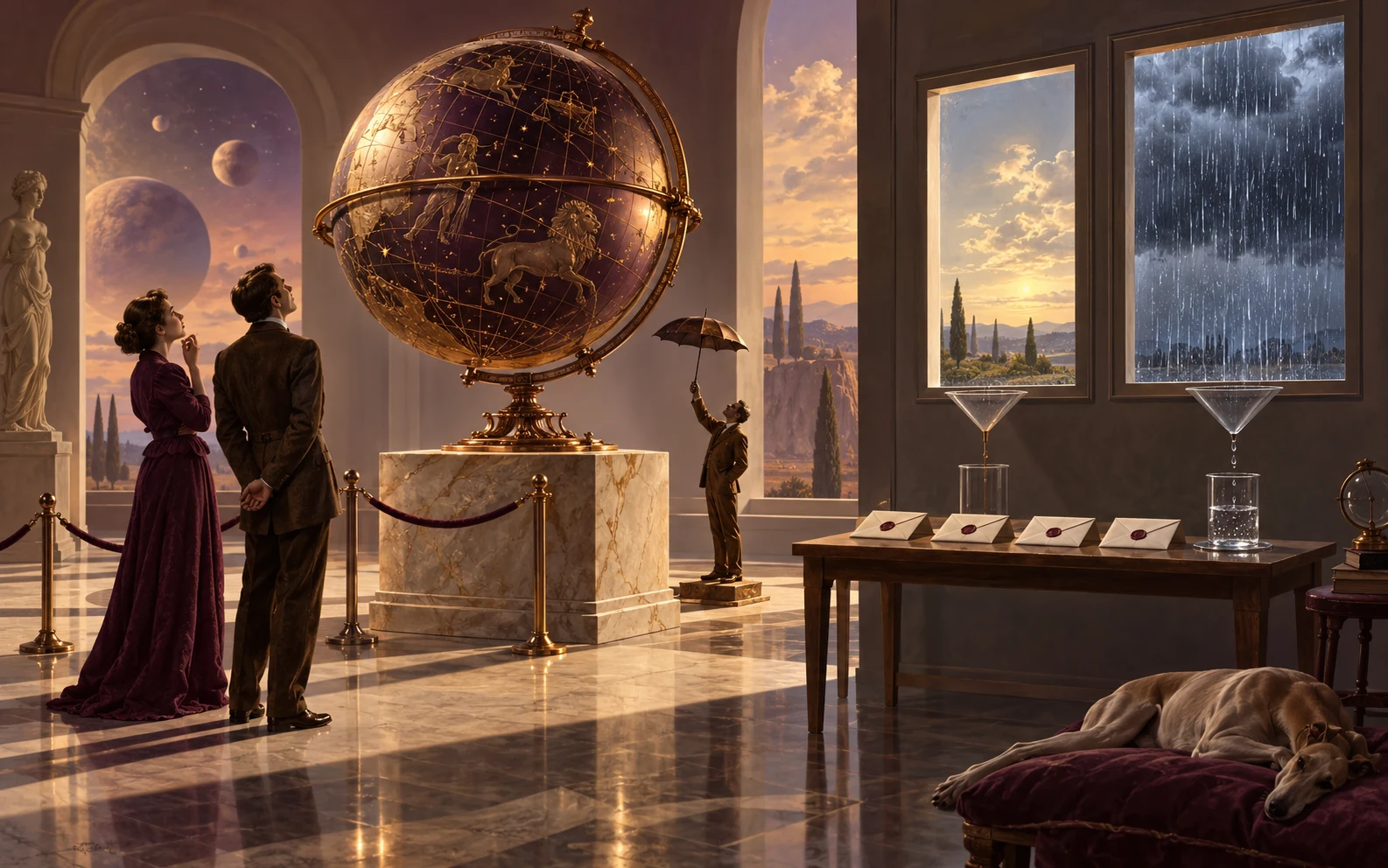
Picture a hypothetical scene: two individuals are staring spellbound at a colorful chart crammed with glyphs, planetary sigils, and mysterious line aspects. The first genuinely expects an operating manual for tomorrow and a lifetime warranty on personal relationships. The second merely sees a convenient excuse for a heartfelt conversation over a cup of tea. Until they realize they are engaging in fundamentally different activities, their heated debate will remain an endless circle of moving goalposts and mid-air pivots.
What This Article Is About
Astrology possesses an extraordinarily rich cultural biography, and dismissing it outright with the banal label of "superstition" is historical shortsightedness. Yet the colossal age of a tradition does not prove the infallibility of its prophecies by a single shred, and the sweet frisson of "oh, that is so me!" does not in itself explain why you recognized yourself in it.
Without misplaced piety, three distinct things must be untangled: how this cosmic vocabulary was forged historically, what astrological interpretation actually claims to achieve, and how its fervent claims can be scrutinized through an honest method. We will examine Ptolemy’s ancient arguments, glance at the history of science, and dissect the famous natal chart experiment—all without putting on the smug airs that testing one isolated task has closed down every conceivable astrological school for all eternity. We will see why the ability to calculate Mars's orbit flawlessly confers zero knowledge of human destiny, how a free poetic metaphor differs from a rigorous prediction, and how to assess someone else's overconfidence with a level head. In the practical section, we will practice keeping a lively interest in culture without handing over the steering wheel of our personal lives to the first cosmic graph that comes along.
I. Astrology Is Not a Single Unchanging Doctrine
Before puffing out one's chest in debate, it is worth grasping that entirely disparate tasks are gathered under the word "astrology." State omens for kings, the meticulous calculation of a personal birth chart, attempting to pinpoint an auspicious hour for a trip to the market, and a profound modern dialogue about symbols are completely distinct trades. Dumping them into one pot simply because Jupiter is mentioned across the board is hardly an intellectual achievement.
Conflating millennia-old omen traditions with the tabloid horoscope on the back page of a daily newspaper ("Taurus should avoid taking out bank loans today") is frankly absurd: a mass-market surrogate does not represent the cumbersome architecture of the subject. However, this is precisely where connoisseurs lay their favorite trap: extreme complexity of formulas and tables does not, in itself, equal accuracy. An intricate system is devilishly convenient to interpret in any arbitrary direction, but virtuosity in spinning an interpretation and the ability to accurately divine a future event are two entirely different skills.
For instance, John Michael Steele’s project The Babylonian Zodiac in Image and Text investigates the zodiac of first-millennium BCE Babylonia. Historians at the Max Planck Institute patiently assemble cuneiform clay tablets, computations, drawings, and contextual period evidence. Notice: this is a description of a historical research project, not a scientific verification that a Babylonian horoscope helped you successfully park your chariot yesterday.
An honest separation of wheat from chaff deflates unearned pomposity. One can genuinely admire the heritage of an ancient civilization while politely shrugging at a modern price list for "personality breakdowns by ascendant." One can savor the poetry of the planets without granting lumps of rock and gas a gravitational mandate to ruin one's weekend. And one can put a forecaster’s specific, bold promise to the test without launching a holy crusade against the rest of their views.
Before any argument, keep a simple, grounding phrase ready: "Right now we are discussing astrology as..."—and then clarify: as a historical artifact, a worldview, a predictive method, or an occasion for reflection. This is not pedantry. It prevents one from mistaking the pleasant impression of an empathetic heart-to-heart for ironclad proof that the stars know next Tuesday’s stock prices.
II. How Ptolemy Bridges the Gap from Heaven to Man
Imagine a plowed field: the spring sun warms the soil, rains arrive, and grain grows; frost strikes, and it withers. Seasons, heat, and moisture undeniably alter the conditions of agriculture. But how does one leap from this obvious agrarian reality to the idea that an infant born at noon on a Tuesday receives specific temperamental inclinations and an individual destiny? In the second chapter of the first book of the Tetrabiblos, one can clearly observe how the author erects this bridge without resorting to modern fables about archetypes of the unconscious.
Ptolemy begins logically enough: the Sun warms, the Moon governs moisture, and the surrounding environment depends on them. Then comes the graceful pirouette: he asserts that the other wandering celestial bodies influence that very same atmospheric mixture, which in turn molds the embryo, directly generating bodily constitution, character traits, and the turns of an individual's fortune. At the same time, the ancient luminary was considerably more sensible than many of his later epigones: he explicitly noted that a person is shaped by origin, birthplace, upbringing, and social position, making it clear that reducing everything solely to the heavens was far from his intention I.2, main text, pp. 2–7 in Ashmand’s translation.
And right here lies the conceptual non sequitur. The link between climate, seasonal cycles, and terrestrial life is visible to the naked eye. But the claim that a specific configuration of planets dictates an individual human destiny is a fundamentally different step that demands separate verification. Taking the smoothness of Ptolemy’s prose for granted means swallowing the primary disputed link without chewing.
In chapter I.4, this model is refined using the standard toolkit of ancient physics: heat, cold, dryness, and moisture. For example, the properties of Mercury are declared mutable simply by virtue of its position relative to the Sun and Moon. Let us emphasize: this is an element of speculative natural philosophy of the era, not a medical or psychological diagnosis for an indecisive citizen I.4.
Yet such theoretical complexity comes at an insidious price. The more confounding variables an expert introduces—from the nurse’s habits to parental wealth—the harder it becomes to discern why a horoscope was needed in the equation at all. If a consultant has already probed into your childhood, career, and income, their perceptive characterization might simply be a triumph of ordinary worldly acumen. The entire crux of testing lies right here: can a celestial chart yield a single drop of novel information beyond what a clever interlocutor already gleaned from your tired face? The ancient classic attempted to embed the stars into a general physics of the cosmos, but his argument cannot be reduced to mindless fatalism or the cozy metaphors of a visiting life coach.
III. Precise Calculation Does Not Make an Interpretation Accurate
Training a computer or a pair of compasses to calculate planetary orbits with high precision is merely technical mechanics. But the moment you transition from the coordinates of Mars to the claim "you are prone to impulse buying," a gigantic leap into the unknown takes place. The flawlessness of geometric calculations does not transmit a shred of truthfulness to interpretations by inheritance.
Incidentally, Ptolemy himself cautioned at the very outset of his treatise Tetrabiblos, I.1 without misplaced arrogance: tracking the trajectories of celestial bodies is reliable, whereas attempting to predict the turbulence of earthly events from them is far more precarious and clouded with uncertainty. The classic author was questioning the boundaries of the method long before modern skeptics took up the task.
Take a hypothetical chart: minutes, degrees, house cusps, and Latin terminology leave a magical impression on the uninitiated. But an abundance of diagrams cannot substitute for substance: where are the documented observations establishing that this angular aspect guarantees irascibility? What is the rate of recurrence? Under what conditions does the rule consistently fail? Can a colleague in the next room arrive at the identical conclusion blindly? Without answers to these mundane questions, any elaborate diagram remains merely an impressive drawing.
Ptolemy elegantly attributed regrettable failures to two things: the clumsiness of an individual practitioner or the extreme complexity of the subject matter itself I.2. These explanations must be kept distinct. The error of a single practitioner certainly does not bury an entire system wholesale. However, declaring the system infallible merely on the grounds that "the heavens are complex, and mortals are fallible" is an old circus trick. When competence is recognized post hoc only when an arrow hits the mark, while every miss is written off as "insufficient qualification," one is dealing with a hermetically sealed circle of self-justification—even if the coordinates of the planets were calculated precisely.
IV. A Prediction Must Be Defined Before the Event
Evaluating a prophecy post factum, once something has already unfolded in a client’s life, is a surefire way to deceive oneself. A genuine test begins long before any drama: on paper, in clear terms. The vaguer and more poetic the wording, the easier it is to retrofit any occurrence whatsoever beneath it, from a falling brick to an unexpected supermarket discount. Hence, a portentous "a time of transformation awaits you" and a specific "in forty days you will be transferred to a branch office" belong to different universes.
Not every obscure pronouncement qualifies as a prediction in the first place. The phrase "listen to your true desires" is ordinary advice. "Next month you will be fired" is a prediction. Meanwhile, the elastic "a period of career ambiguity is visible in the chart" hangs between the two, allowing the speaker to swap the mask of a sage for the mask of an oracle on the fly.
A classic hypothetical example: a consultant announces that the client will change jobs within three months. Let us agree on terms beforehand: does changing jobs mean jumping to a competitor, a long-awaited promotion, a quiet curtailment of duties, or being kicked out the door with a termination slip? If, after the client is merely moved to an adjacent desk, the seer gleefully shouts "I told you so!", they are blatantly rigging the terms of the wager. A statement has value only when it risks crashing down in flames. Without the risk of failure, there is no prediction—only verbal mush.
Nor should one overlook the baseline probability of events. People quit jobs, get married, fall ill, and quarrel without any planetary alignment. Merely guessing a trivial life turn does not demonstrate hidden knowledge; one might simply have named something that happens at every turn with relatively high frequency anyway.
V. Recognizing Oneself Is Real Experience, but Incomplete Proof
When someone reads a text and feels, "This is spot on about me," the experience itself is completely genuine, and brushing it aside is unwarranted. Yet this sincere resonance does not inherently reveal where it came from. The cause remains an open question: the text may have struck a chord through keen worldly observation, leaned on a widespread generalized formula, absorbed details you blurted out moments earlier in conversation, or offered an open-ended image into which you poured personal meaning. Writing off every hit as a sideshow trick is just as rash as hailing it as a celestial miracle.
Consider a hypothetical example: "It is important for you to be independent, yet at times you yearn for dependable support." One person recalls a recent conflict, another thinks of conversations with their parents, and a third reflects on career dilemmas. The description can initiate a meaningful dialogue, but the sheer variety of fitting life stories serves as a reminder: personal recognition does not demonstrate the individual diagnostic accuracy of the method. It is sensible to ask not only "does this fit me?", but also "whom else would this fit?" If a formulation sits comfortably on a multitude of people, its diagnostic discriminative power is substantially lower than it seems during a personal reading, even if the statement itself carries practical utility.
Furthermore, if the consultant spent time listening intently to your accounts of family and anxieties before delivering a verdict, a substantial share of the accuracy may have sprung from empathetic dialogue. This does not devalue the interaction: if a good conversation helped call a problem by its proper name, it is worth valuing precisely as a human conversation, without attaching its efficacy to proven celestial causality. Personal experience remains valid, while the question of the sources of its utility remains open for calm analysis.
VI. What the Carlson Experiment Actually Tested
Perhaps the most famous and methodical reality check administered to overconfident prognostication was Shawn Carlson’s study A double-blind test of astrology, published in Nature in 1985. A critical detail: the experiment was not carried out in ambush, but in open dialogue with practicing astrologers whose representatives were consulted on the design of the test.
In the second part of the experiment, astrologers were provided with a natal chart and asked to match it against one of three California Psychological Inventory (CPI) personality profiles—one genuine profile and two non-matching controls. The first-choice result of the stellar experts was devastatingly telling: approximately 34% hits against a blind random guessing baseline of 33%.
Scientific integrity is paramount here: Carlson did not prove that every historical form of astrology is false, nor did he investigate the aesthetic or conversational value of planetary symbols. He took a narrowly defined, applied task and demonstrated that the asserted ability to "discern character from a natal chart" failed to show the claimed advantage over chance under a double-blind protocol in this procedure.
Carlson himself, notably, did not regard the first part of the trial as an adequate independent test—where clients attempted to identify their own psychological profiles—due to questions surrounding the participants' ability to recognize their own CPI profiles. This serves as an outstanding lesson in critical thinking: a conscientious researcher scrutinizes the reliability of each instrument rather than sounding triumphant fanfares over inadequately supported results. Disputing such studies requires critiquing the protocol, figures, and controls, rather than resorting to an offended tone of "we simply dislike your soulless conclusion." By the same token, critiquing a single specific experiment does not automatically prove the assertions of its opponents.
VII. Probabilistic Claims Also Require Verification
When forecasters are backed into a corner by an unfulfilled prophecy, an armor-plated shield is instantly deployed: "You are oversimplifying! We speak not of fate, but of subtle tendencies and probabilities!" It sounds weighty and scientific. Yet transitioning from an absolute guarantee to a probabilistic tendency does not dispense with verification.
If you claim that individuals with a particular planetary placement gravitate toward freelance work more often, be so kind as to present control groups, rigorous criteria for what constitutes "freelancing," and a statistically significant difference. If a "tendency" is supported solely by cherished, cherry-picked anecdotes while dozens of outright misses are kept quiet, one is dealing not with probabilistic analysis, but with an intellectual shell game.
The word "sometimes" is the archenemy of honest argumentation. "Sometimes" almost anything sufficiently common takes place. Explaining an outcome after the fact is well within the grasp of any articulate storyteller: retrofitting planetary positions onto an economic crisis that already unfolded presents no difficulty at all. But the ability to assemble an elegant puzzle post factum does not imply you could have singled out that specific future scenario from a hundred alternatives before the markets opened.
VIII. A Symbol Can Be Useful Without the Status of a Causal Law
The cultural worth of a symbol cannot be measured solely by predictive accuracy. A metaphor can help a person frame an internal conflict or try on a new perspective, but meaning emerges from the thinker’s own work with the image, rather than descending as an objective decree of fate. A modern reflective conversation surrounding the symbol of Saturn may well become a fruitful dialogue about time, constraints, and assumed obligations: one person might notice a reflex to resist any rule, while another sees how they hide behind someone else's instructions to dodge making a choice. Such symbolic dialogue is entirely legitimate, yet it establishes no physical influence of the planet and must not supplant the concrete facts of a situation.
A sober method for finding the boundary is to translate cosmic rhetoric into everyday human language. Instead of an imposing "this path is blocked by your chart," one can say: "You find it hard to take the leap because there is real risk and a heap of responsibilities; let's examine them." If, after such translation, only the mystical authority evaporates while the practical substance remains, then the dialogue itself did the heavy lifting, and the thought can be evaluated without sacred awe before planetary titles. At the same time, symbolic framing has its own pitfalls: it can narrow attention exclusively to convenient coincidences or entrench an expectation that quietly begins steering behavior.
This is precisely why it is crucial to maintain alternative explanations rather than allowing a chart to foreclose them in advance. A decision to drop a project might stem from a simple shortage of time, a vague purpose, or an elementary reluctance to get involved, and a celestial diagram must not erase these earthly distinctions. A clean demarcation between symbol and causal law does not destroy interest in tradition: one can read ancient treatises with pleasure, unpack metaphors, and simultaneously demand rigorous justification for concrete predictions. These pursuits can coexist peacefully side by side without smugly asserting each other's validity without proper warrant.
IX. Can the Predicted Be Changed, and Who Has the Right to Predict?
One of the oldest paradoxes of divination is ruthless: if the future is carved in granite, issuing warnings is futile; if it can be easily bypassed, the prophecy was not worth a plugged nickel. In chapter I.3 of the Tetrabiblos, Ptolemy attempts to untie this knot using an analogy with medicine: yes, there are global, unavoidable tempests, but there are also particular calamities against which a prudent person can prepare in advance, thereby softening the blow I.3, pp. 8–13, main text.
The analogy with a physician is appealing, no doubt, but it merely explains why a person needs reliable foresight without proving that the stars can provide it. The decisive methodological marker here is the moment when so-called "mitigating counter-causes" are introduced. If the countermeasure was formulated beforehand, the outcome can be evaluated. If an unconsidered "opposing force" surfaces on the seer's lips only after the promised shower of gold failed to materialize, it is an ordinary attempt to save face after a bad guess.
It is instructive to look at the biblical text: in Deuteronomy (18:9–15), various forms of divination are strictly banned and contrasted with the prophetic calling, while in 18:21–22, an unsparing criterion for a false word is explicitly laid down—the non-fulfillment of the utterance text. The religious prohibition rests on the question of legitimate authority ("who is authorized to speak in the name of truth?"), not merely on hit rates. An additional accurate hit does not lift the religious taboo for a believer, just as a religious prohibition does not equal a controlled scientific test. Keeping positions distinct prevents confusion: some demand rigorous protocols and control groups, while others uphold canonical fidelity; mashing these arguments into a single slurry leads straight to intellectual chaos.
X. History and Testing Can Coexist
The world will not collapse if we stop demanding answers to every existential riddle from a single discipline at once. A historian can enthusiastically study the evolution of Babylonian cuneiform records. A philologist can savor the argumentation of an ancient treatise. An experimentalist can test the statistical matching of natal charts in a controlled task. And an ordinary individual can draw on poetic imagery to better understand their own shortcomings. Each of these pursuits has its own yardstick and its own rules of engagement.
Cultural scale and antiquity do not make a tradition an automatic factory of infallible forecasts for tomorrow. Nor does a stern failure in a specific scientific trial erase astrological texts from the treasury of world intellectual history. From the failure of a method in a tested procedure follows a limited conclusion regarding that specific procedure; further claims require their own grounds.
The two debaters from the prologue can finally lay down their weapons. The drawing of the heavens can remain a remarkable monument of human thought and an occasion for deep personal dialogue. But the authority to make the final call in real affairs always rests on level-headed questioning, verifiable facts, and individual responsibility: never allow antique charts to quietly dictate how you live your life.
What This Means in Practice
If astrological language appeals to you, grant yourself a session of unsparing intellectual honesty. Take exactly one assertion and write down its real status on paper: is it a strict prediction, a statement of an already known fact, or merely an exploratory question for reflection?
-
For a prediction: explicitly record the concrete outcome and the deadline, and crucially, pre-register what specific event will unequivocally count as a failure.
-
For a description: honestly note which biographical details the consultant extracted before looking at the chart.
-
For a question: formulate the problem in plain, everyday language and evaluate the facts without a veneer of mysticism.
Suppose the following phrase is uttered: "A period of re-evaluating relationships is setting in." Do not allow the meaning to shift mid-stride. As a question, this means: "Which of our mutual agreements have become outdated?" As a description, it is an acknowledgment of a domestic quarrel you let slip a minute ago. As a prediction, it is a strict promise of a specific breakup or reconciliation by a defined date. Fix one interpretation on paper and place the sheet on a shelf.
Once the deadline expires, retrieve the note and record the hits and misses without leniency. If you feel an urge to invent excuses post factum—"well, hidden influences intervened"—write that down plainly as fitting the answer to the outcome. Naturally, a single personal exercise in one's kitchen is not a comprehensive scientific trial: one person and a small number of instances cannot support a sweeping conclusion, but they can illuminate one's habits of interpretation. For serious life choices, always return to firm ground: resources, risks, facts, and common sense. An image can suggest an angle for reflection, but the decision is always yours to make.
Key Quotation
"Mercury sometimes produces dryness, and at other times moisture."
Claudius Ptolemy, Tetrabiblos, I.4; our English back-rendering of our Russian translation from J. M. Ashmand, 1822: I.4. The statement belongs to a historical framework of elemental qualities and is cited solely to clarify the ancient worldview, not as a verified physical influence of a celestial body upon weather or human beings.
Connections Between Traditions
These are analytical comparisons; historical transmission between the selected sources has not been established.
| Positions and Sources | Ground for Comparison | Boundary |
|---|---|---|
| Ptolemy, I.2 and Carlson, Nature 318 | When confounding circumstances are accounted for, the question arises of what contribution belongs strictly to the natal factor itself. | Ptolemy constructs an explanation of nature; Carlson tests a specific matching ability under a controlled task. |
| Ptolemy, I.2 and Chandogya, VI.1 | Both arguments seek a universal explanatory principle behind an array of particular manifestations. | The surrounding medium transmits postulated influences, whereas the clay analogy examines the relationship between material and products. The content of the causal argument is distinct. |
| Ptolemy, I.3 and Deuteronomy 18:9–15, 21–22 | Both texts link trust in a future utterance to the conditions under which it is vindicated. | The former concerns natural causes and mitigating counter-influences; the latter concerns legitimate authority and the fulfillment of the spoken word. |
| Ptolemy, I.2 and Questions of King Milinda, II.1.1 | Merely naming an individual is insufficient: one must explain which factors or components give the designation substantive meaning. | The aggregate of factors shaping temperament is not equivalent to an analysis of a conventional designation of the self; Nagasena proposes no natal explanation. |
| Ptolemy, I.3 and Bhagavad Gita, XII | Human action retains significance while recognizing conditions that exceed individual control. | Preparation against an anticipated influence and religious renunciation of fruits rest on different foundations and objectives. |
Primary Sources
-
John Michael Steele. The Babylonian Zodiac in Image and Text. Max Planck Institute for the History of Science, project description, 2019. Historical domain of zodiac research.
-
Claudius Ptolemy. Tetrabiblos, I.1, Proem, translated by J. M. Ashmand, 1822. Distinction between calculation and predictive interpretation.
-
Claudius Ptolemy. Tetrabiblos, I.2 and I.3, J. M. Ashmand, 1822. Read the main text of the chapters in their entirety; causal medium, additional circumstances, and mitigating counter-causes. Translator's notes separated from the authorial text.
-
Claudius Ptolemy. Tetrabiblos, I.4, The Influences of the Planetary Orbs, translated by J. M. Ashmand, 1822. Historical framework of planetary qualities.
-
Shawn Carlson. A double-blind test of astrology. Nature 318, 419–425, 1985. Read pages 419–420 and 424–425; procedure and limited conclusion regarding the matching of natal charts with CPI profiles.
-
Chandogya Upanishad, VI.1, F. Max Müller, 1879: text. Primary translation; read the episode of materials and products solely for a limited analytical comparison.
-
The Questions of King Milinda, II.1.1, T. W. Rhys Davids, 1890: text. Primary translation; read the dialogue on the chariot for the methodological row of the table.
-
The Bhagavad-Gita, XII, Edwin Arnold, 1885: text. Primary poetic translation; read the entire chapter, utilizing the distinction regarding the attitude toward action, not an astrological doctrine.
-
Deuteronomy, 18:9–15 and 18:21–22; Hebrew–English Bible, JPS 1917: text. Primary translation; read the indicated passage on divination and the criterion of a prophetic word.
Tags
astrology, zodiac, Ptolemy, Tetrabiblos, Babylonia, history of science, astronomy, prediction, verification, experiment, Carlson, symbol, interpretation, causality, probability, control, randomness, personality, self-description, analogy, cultural history, primary sources, translation, scientific method, philosophy, Bhagavad Gita, uncertainty, tradition, responsibility
About the Authors
Andrey Zarinsh — author and founder of the United Wisdom project. He explores themes of inner transformation, the unity of traditions, intercultural dialogue, and contemporary spiritual discipline. Instagram: @andrey.zarinsh.
Maria Evilkut — co-author of United Wisdom. Beyond research, she seeks to test these ideas in practice and observe how principles of unity and mutual understanding operate in real life between people and across cultures. Instagram: @ilkutki.