
World & consciousness
Cosmogonic Myths: Why Cultures Tell Stories of the World's Beginning
Comparison of specific narratives of beginnings: order, the origin of labor, and limits of knowledge.
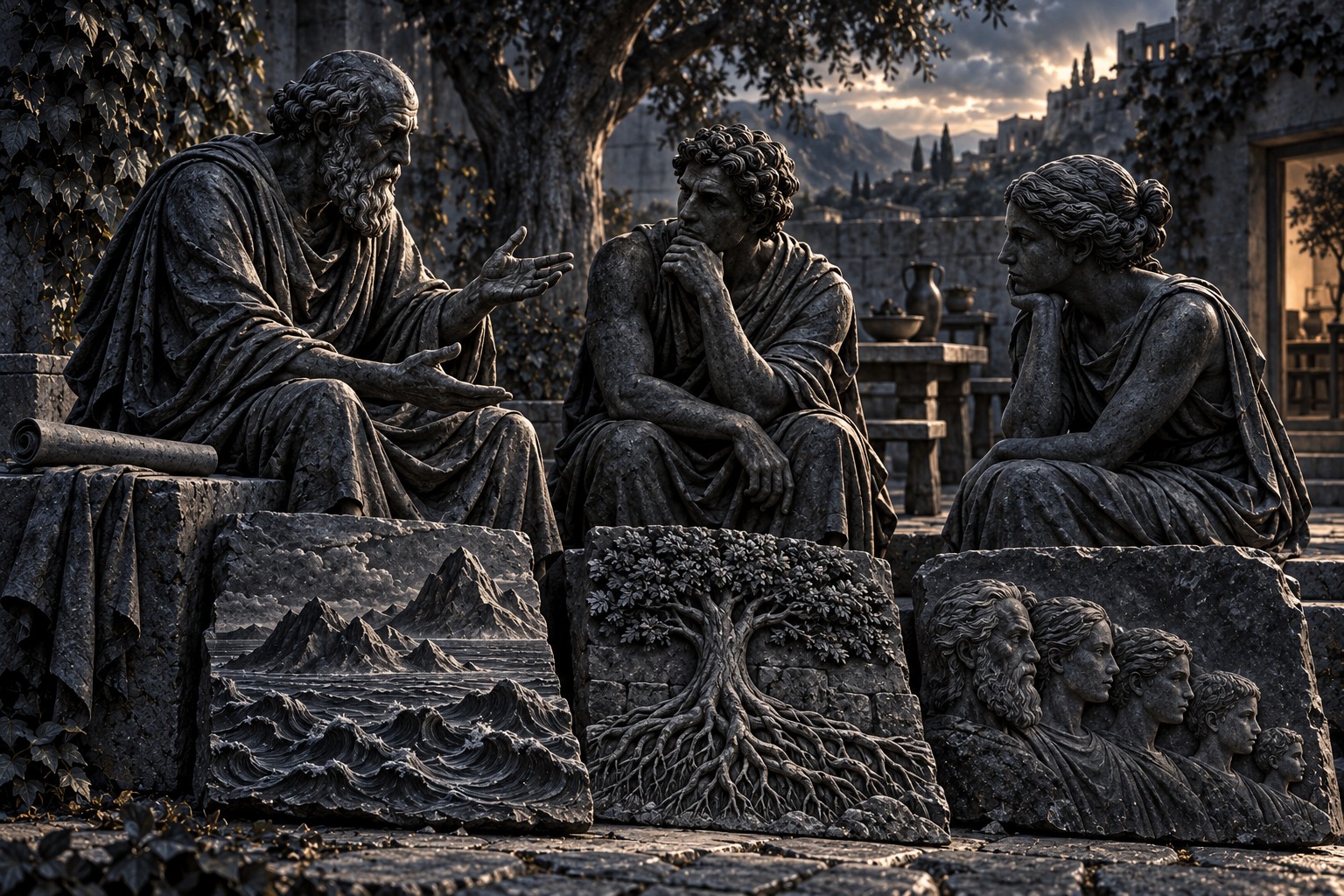
“Who verily knows”
The Rigveda, X.129.6, the hymn on the world's emergence. A fragment of Ralph T. H. Griffith's English translation, available text.
About this article
A child asks what came before the very first day. An adult can name a scientific model, retell a religious narrative, or admit the limit of their own knowledge. But another question is audible behind it: why does the world in which we find ourselves exist at all, and does our place in it have meaning? Cosmogonic narratives answer these questions differently. Some show the establishment of order, others the origin of labor, divine kinship, or the boundary of knowledge. This article compares specific passages from Genesis, the Sumerian work Enki and Ninmah, Hesiod's Theogony, and the Vedic hymn X.129, adding the philosophical example of Plato's Timaeus. We will not search for a unity of all plots known in advance. Instead, we ask what work each story performs, what it says about human beings, and which differences are lost in comparison. The practical result is a way to read stories of beginnings more carefully, including our own family and public histories, without treating their persuasiveness as proof of the universe's structure.
I. A beginning explains more than a sequence of events
A story of beginnings helps connect the existing world with the ground of its order. When a narrative explains where earth, gods, or people came from, it may also show why particular relationships operate. Origin becomes a way of saying what is significant, inevitable, or worthy of attention. This is an analytical question addressed to texts, not an established function of every myth.
“Cosmogony” means a narrative or teaching about the world's emergence. It borders on theogony, a history of the gods' origins, and anthropogony, a history of humanity's appearance. They can occur in one work, but need not coincide. Hesiod's Theogony joins the world's arrangement to divine genealogies. Enki and Ninmah brings the creation of humanity into an already existing world of gods and work. The difference between their narrative tasks itself warns against the general summary “the ancients were explaining the Big Bang.”
In everyday life, a similar tension appears when a family tells of its founding. “We have always helped one another” can mean grateful memory, but can also become a demand never to refuse anything. A story of origins gives the present a language. This example does not make a family recollection an ancient cosmogonic myth. It allows us to notice how a beginning takes on normative significance: the account of what happened becomes a claim about how one should live.
That move is not necessarily mistaken, but it needs to be seen. An institution's origin does not mean all its rules are right forever. Human origins do not automatically entail a specific modern duty. A religious tradition may recognize that link on its own grounds; historical and philosophical reading must clarify those grounds separately.
We will therefore ask several questions. What exactly emerges? How? Who acts? What place do humans receive? What does the author or narrator consider known? These questions do not replace the work with a scheme. They help us read its differences before impressive general words erase them.
II. Genesis: distinction, naming, and the human place
Genesis 1 presents the world's creation through an ordered sequence of divine actions. Light appears and is distinguished from darkness, spaces are separated, living beings emerge. The judgment that what is created is good recurs within the narrative. Humanity is introduced as created in God's image; the text speaks of male and female. This is a brief description of composition, not a conclusion about the chapter's only permissible interpretation. Genesis 1, English version JPS 1917.
What does this composition give the reader? First, it shows a world whose parts can be distinguished. Everything is not reduced to homogeneous material: there are day and night, land and sea, different forms of life. Distinction lets us see order without treating every difference as conflict. Our analysis concerns how the narrative is built; it does not prove that the cosmos arose literally in the stated narrative sequence.
Then comes the question of the human place. If humans are named through a relation to God, their significance is not exhausted by physical composition. But “image of God” itself requires interpretation. Without additional grounds, it cannot be treated as a description of God's appearance or a ready declaration of all modern rights. Later authors answered this within their own systems; the comparative map separately considers Maimonides' philosophical interpretation.
A question of responsibility follows too. Humanity receives a particular position among living things, but readers can dispute how power and the limits of its exercise should be understood. The mere existence of that position does not determine every ecological or political norm today. Moving from an ancient text to a modern decision requires further reasoning, rather than one expressive line.
Genesis matters here precisely for its specificity. It does not merely say that order once emerged. It joins order to divine action, a judgment of the world, and a particular human relationship. Retell it as a general symbol of emerging from chaos and these threads disappear. Comparison must preserve them, or we will compare only our own simplified versions.
III. Hesiod: the world as genealogy and a distribution of power
In the Theogony, the world's appearance unfolds through divine powers' origins and relationships. Lines 116–138 name Chaos first, then Earth and other beginnings; kinship follows. Toward the end of the central narrative, Zeus's establishment of power accompanies the distribution of honors among gods. The passages read ground these observations, but do not exhaust the history of Greek religion. The Theogony, 116–138 and 881–885, translated by Hugh G. Evelyn-White.
To modern readers, “chaos” often means a messy room or lack of management. But a beginning's name in an ancient text cannot automatically be replaced by this everyday meaning. In the sequence itself, Chaos has its own place and offspring. Even without detailed philology, we can see a cosmic picture and genealogy, not a joke about disorganization. The term's more precise meaning needs separate linguistic research; here it is enough not to impose the familiar definition.
Genealogy makes relationship part of origin. The world is not simply manufactured from outside; it grows through the emergence of new powers and generations. The form offers another way to think about stability. Order has a history of relationships, and power must establish itself among other bearers of force. This is our analytical conclusion from the chosen composition, not evidence that all ancient Greeks explained the state through the Theogony in the same way.
For comparison with Genesis, it is especially important not to reduce the difference to the number of gods. The modes of narration differ: unified divine action and the complex origins of powers, repeated judgment of what is created and a history of distributing power. List only shared motifs of earth, sky, and beginning, and we may miss why readers turned to the two works at all.
Hesiod's example also recalls that a story of origins can explain authority. But explaining authority within a narrative and proving a right to power are different operations. We can study how a text makes an order persuasive without accepting that order as a binding model. Such reading preserves the chance both to understand and to ask difficult questions.
IV. Enki and Ninmah: work falls to humanity
In the Sumerian work Enki and Ninmah, humanity's appearance is tied to the need to relieve the gods of heavy labor. At the story's beginning, younger gods work; Namma addresses Enki, and the creation of a human being is linked with clay and the duty to carry baskets. This text grounds an anthropogonic example, not a complete Sumerian account of the cosmos's creation. ETCSL, composition 1.1.2, lines 1–37.
Humans appear here within an order that already exists. No neutral world without expectations opens before them. They are assigned a function. This plot makes labor a question of origin: work belongs to the human condition not by chance, but because of what humanity was created for in this story. This is an analytical reading of the selected episode, not a claim that the text justifies every labor order or that all ancient Mesopotamians understood their condition alike.
The difference from Genesis cannot be hidden by “humanity is connected with the divine.” That connection exists, but its structure differs. One selected passage speaks of God's image and a particular place among living things; the other of replacing laboring gods. A similar general scale of question does not cancel different answers about the human function.
The work also contains a further complex thread: people with different bodily features are created and given a place. That passage was read for context, but is not retold in detail here. No modern conception of equal opportunity or opposite claim of unambiguous exclusion can be derived from it without qualification. Ancient categories, damaged text, and translation variants require careful consideration. An honest boundary is better than a confident moral label.
For our subject, it is enough to notice how a story of beginnings joins existence to purpose. This raises a modern question: do we sometimes explain human worth solely through a useful function? We must seek the answer ourselves. The ancient plot reveals the question, but need not provide a solution matching our beliefs. This distance makes the reading substantive rather than decorative.
V. A Vedic hymn: the beginning as a limit of knowledge
Hymn X.129 of the Rigveda brings doubt into speech about beginnings. Its final stanzas ask who knows the world's origin, allowing uncertainty even concerning a highest observer. This is a specific poetic text within the Vedic corpus; it cannot establish that all Vedic tradition denies possible knowledge or rejects religious claims. Hymn X.129 in full, Griffith's translation.
The example matters because it breaks a convenient scheme: myth supposedly always supplies the final answer, while doubt appears only in later philosophy. Here the narrative of origins itself holds a question open. It does more than leave a technical detail unfilled. It attends to the narrator's position: where does knowledge of a beginning preceding the familiar world come from?
We can read this form as an invitation to intellectual caution. But caution should not become another certainty: “all answers are equally impossible.” The text allows a question and a limit, rather than providing a modern theory of knowledge with ready rules of proof. Its meaning is open to different interpretations; our conclusion is limited to the final stanzas' explicit uncertainty.
For a modern person, the distinction helps. Not knowing the world's complete origin does not mean knowing nothing about it. Scientific inquiry can give grounded answers to particular questions while leaving others open. Philosophy can clarify which question has been posed at all. Religious reading can have its own sphere of trust. None of these operations gains a right to fill the whole remainder with a beautiful formula simply because a remainder exists.
The hymn thus reveals another function of a cosmogonic text: the beginning becomes a meeting with speech's limit. Here not only world history matters, but the narrator's honesty. A narrator can leave readers a question without presenting it as a defect of the work. Sometimes a substantive account preserves uncertainty precisely where a final resolution would be easier and more spectacular.
VI. A philosophical narrative also has a status
In the Timaeus, 27d–30c, Plato, through Timaeus, first distinguishes unchanging being from becoming. The former is grasped by reason, the latter by opinion joined with sensation. Then comes the question of the model: the maker of a beautiful world looks to an eternal model, and the world is its likeness. The account's likely character follows from this difference of subjects. Speech about a changing likeness does not have the same stability as speech about an unchanging model. The limit of knowledge is derived within the philosophical construction, rather than added as a generally polite qualification.
Next, the maker's goodness explains the aim to make the world as good as possible: disorderly motion is brought to order. This explains both the action's direction and why the result deserves a positive judgment. The philosophical account does not merely list things that appeared. It joins their arrangement to a cause understood as good. “Likely” therefore does not mean any invented cosmogony will do. The account must reconcile its own grounds: model, maker, and produced likeness.
The construction's strength also marks its difficulty. Accept the distinction between model and likeness, and we can understand why describing the world needs both explanation and modesty. But readers can question the distinction itself: why should what is accessible to the senses be understood as a likeness of the eternal? An answer within the account cannot be treated as empirical confirmation of its initial metaphysics. Examining the argument makes this question more precise than simply opposing a beautiful legend to real knowledge.
Comparison with the Vedic hymn shows a different form of limitation. In X.129, the question concerns who can know the beginning; Timaeus also explains the mismatch between the stability of the subject and speech about it. Both texts resist unconditional confidence, but through different means. A poetic question does not thereby become Plato's theory of being, nor a philosophical account a translation of Vedic doubt. The difference reveals more than a general compliment to ancient wisdom.
Reading the Timaeus today can therefore mean examining a particular attempt to relate the world's order to the order of explanation. It deserves analysis in its own form, without becoming a hidden modern physics. Its limitations do not erase its question: how much confidence does speech about a changing subject permit? An answer requires testing the philosopher's initial categories, not merely agreeing that the resulting picture is attractive.
VII. Two orders: distinction and genealogy
Now compare Genesis 1 with the selected passages of Hesiod. Both place an ordered world before readers, but show order differently. In Genesis, action involves separation, naming, and judging what is created. In the Theogony, the origins of powers, relations between generations, and distribution of honors as Zeus is established come forward. “Cosmos emerged from chaos” cannot convey this compositional difference: it excludes almost everything that makes the stories recognizable.
In the first case, “what distinguishes one thing from another?” helps us follow the text. Light and darkness are distinguished, forms of life receive their place. In the second, “from whom does this power come, and how does it relate to others?” matters. Sky and earth also become participants in a genealogy. The same familiar names thus work differently. Readers comparing only lists of things that emerged easily take a shared subject for an identical explanation.
The connection between order and judgment differs too. Repeated judgment in Genesis gives each stage of creation a place within a positively marked whole. Hesiod's distribution of honors presents arranged relations among bearers of force. Our analytical question divides: is order described as a quality of what is created or as definite relationships and power? This is no universal definition of two cultures. It helps us read two chosen compositions precisely and avoid losing one ground of judgment when translating another into familiar language.
Adding Enki and Ninmah changes the comparison, since the selected episode concerns humanity's emergence within an existing order. The gods' heavy labor creates a need answered by creating people. The question should therefore not become a contest among three complete histories of the universe's emergence. The Sumerian episode clarifies the human function; its narrative scale differs. Difference of scale is not a textual deficiency to fill with our assumptions.
This result establishes no historical influence. That would require chronology, contacts, and means of transmission. Here the result is different: distinct links between origin, judgment, and function become visible. It is substantive enough on its own. After comparing, we can return to each work with a more definite question, rather than seek confirmation of a unity of all myths announced beforehand.
VIII. Who tells the story, and which text do we read?
A cosmogonic narrative's meaning also depends on the form in which it reaches readers. Manuscript transmission, editorial work, and translation stand between an ancient work and a modern page. Not every detail is equally certain. The scholarly edition of the Sumerian text makes this especially visible: gaps and alternative readings remain visible, rather than yielding to a smooth invented narrative. The ETCSL edition used.
Why does this affect comparison? Suppose one translation calls a beginning an “abyss,” another “emptiness.” Readers may link those words to modern philosophical concepts and build a far-reaching conclusion. But first they need to establish whether the difference concerns originals, translation choices, or their own associations. Otherwise, we compare familiar meanings of words rather than works.
The short quotations in the Russian version of this article were translated from the named English versions. This indirect route is stated openly. Such translation suits a limited discussion of a verified fragment, but is not presented as a philologically final reading of Sanskrit. A more complex term needs separate work with language, variants, and research. The absence of that work narrows the conclusion; it does not authorize pretending it was done.
The chosen extent of reading matters too. A few lines can support an observation about a narrator's doubt, but not a description of an entire religious system. Even a hymn read in full remains one work within a large corpus. Reading's value does not grow by naming it as larger than it was. A precise scope lets others check a conclusion and propose a different passage that changes the picture.
Attention to a version is no technical distraction from meaning. It determines whose words they are and what we can infer from them. When a story of origins touches our most general convictions, this precision is especially needed: the question's emotional importance does not make the source more transparent.
IX. Different questions need different grounds
A dispute about the world's beginning often becomes insoluble because participants answer different questions. One asks about a physical process, another about existence's ultimate ground, a third about human purpose. All say “beginning” and assume they discuss one claim. Every objection is then heard as a refusal to recognize the interlocutor's whole position.
Consider a hypothetical conversation. Someone calls a religious narrative a source of hope. Another replies that hope does not confirm a cosmological model. This is a valid distinction, but may not answer what was said: the first speaker has not yet claimed a physical model. If they then declare their hope proof of a specific chronology of the world, the question of confirmation becomes necessary. The move must be noticed where it actually occurred.
The reverse also holds. Explaining a particular natural process does not automatically say what promise someone should make to a loved one. A physical theory has no duty to replace moral reasoning. But this does not entitle a moral narrative to cancel empirical information. Distinguishing questions preserves both the value and limit of each mode of thought.
Substantive dialogue therefore begins by clarifying status: “I explain what my text claims,” “I offer a philosophical argument,” “I report a testable fact,” “I speak about this story's meaning for me.” These are not four degrees of sincerity. Someone can be sincere in any case. The grounds on which a claim is offered to others differ.
Cosmogonic texts reveal the scale of a human question, but do not remove this work. Even the oldest and most authoritative story enters modern conversation through a particular claim. Name it clearly and another person can answer on the merits. Leave everything within a vague “this is how the world works,” and the dispute grows with the number of hidden transitions.
X. A story of beginnings should not close the present
Origin stories can broaden attention and also limit it. If a beginning already determines who we must be, present experience can become unnecessary. Someone is told: this is how the world works, how it always was, your destiny. Sometimes deep religious conviction stands behind the speech; sometimes an attempt to avoid discussing a specific injustice. Circumstances and grounds distinguish these cases, not the words' solemnity.
Conversely, life without origin stories does not automatically become freer. People continue connecting the present to the history of family, country, profession, or their own character. We tell why we became this way and why some actions seem impossible. Even a skeptic can keep a rigid self-story: “I have always been the one who helps everyone.” The story helps until it forbids recognizing a new need.
Our reading of cosmogonies gives no right to declare these personal histories false myths. It proposes a more precise question: what does the story explain, and what does it quietly demand? Gratitude for the past can coexist with revising an action. Belonging can remain alongside disagreement. Not every new decision destroys everything a person grew from.
Encountering ancient texts reveals space between conviction and overconfidence. We can respect a religious narrative without attributing scientific status to it. We can study science without demanding that a physical model answer every question of human meaning. We can compare traditions while preserving their different grounds.
At the start, a child asked what came before the first day. We return more precisely: what kind of answer is needed now? Sometimes testable information is needed, sometimes an explanation of a particular faith, sometimes an honest acknowledgment of a limit. A mature conversation can name its way of answering. A story of beginnings then does not close further thought. It becomes the beginning of a more attentive relationship to the world and our speech about it.
What this means in practice
Take one short origin story familiar to you. It might be an ancient text from this article or a family explanation of “why everything works this way for us.” First, record what emerges, who acts, and what place humans receive. Do not immediately turn the plot into a general moral. Details help you see what you actually read and what you expected to find beforehand.
Then separate description from demand. The story explains how an order arose; does it follow that the order must be preserved today? If your answer is yes, name the additional ground. It may be religious faith, an obligation, a moral argument, or practical benefit. “Originally” does not replace that ground.
Choose a second text for comparison and one axis: manner of emergence, human function, or the narrator's confidence. Find one similarity and one difference. If the difference vanishes in your formula, check whether the formula has become too broad. Do not declare influence without historical evidence. An analytical comparison already has value if it helps us see both answers more precisely.
Finally, return to your own story. What does it help preserve? What experience does it prevent you naming? Must the story itself change, or must you merely stop deriving a particular demand from it? The exercise neither proves nor refutes cosmogonic faith. Its limited task is to make origin a subject of careful reading, rather than an automatic argument in a dispute about the present.
If you discuss the selected texts with someone else, first ask them to name the most significant detail in their reading. It may differ from your comparative axis. One notices the human place, another the narrator's voice, a third the deity's action. This need not mean someone read wrongly. Return to the passage and see which observations it actually supports. Then clarify where the text ends and your question to it begins. Such conversation preserves the possibility of several substantive readings without declaring every arbitrary association equally grounded. A shared frame helps the encounter while it does not require reaching one conclusion beforehand.
Key quotation
“he verily knows it, or perhaps he knows not”
The Rigveda, X.129.7, a short final fragment of Griffith's English translation. The uncertainty belongs to a particular poetic posing of the question of origins; it does not claim that all knowledge is impossible.
Connections between traditions
The map contains our analytical comparisons. It establishes no historical influence.
| Specific positions | What the comparison reveals | Limit |
|---|---|---|
| Genesis 1 and Hesiod, the Theogony, 116–138 | A beginning makes the world's arrangement distinguishable. | Divine creation and the origin of divine powers have different structures; shared words “sky” and “earth” do not cancel them. |
| Genesis 1:26–27 and Enki and Ninmah, 24–37 | Origin is connected with the human place. | God's image and the assignment to bear the gods' labor are different answers about human function. |
| Hesiod, 881–885, and Plato, the Timaeus, 29e–30c | Cosmic order has a ground. | Distribution of honors as Zeus is established is not identical to the philosophical ordering of the world by a good maker. |
| The Rigveda, X.129.6–7, and Plato, the Timaeus, 29b–d | The narrator marks a limit to confidence. | An open poetic question differs from a philosophical explanation of a likely account's status. |
| Genesis 1:27 and Maimonides, the Guide, I.1 | One image receives a new philosophical reading. | This is interpretation within a tradition: the image is understood through form and intellect, rather than bodily resemblance. |
| The Rigveda, X.129 and the Dao De Jing, chapter 1 | Speech about beginnings meets limits of language and knowledge. | Vedic doubt about origins and the distinction between the named and constant Dao do not produce one shared teaching. |
Primary sources
- Genesis 1, biblical text, English version JPS 1917 at Mechon Mamre. The chapter was read, particularly 1:1–27; used for composition and the human place, not a physical model of the universe.
- Enki and Ninmah, ETCSL 1.1.2, Sumerian primary text in the Oxford ETCSL project's scholarly English translation. Lines 1–101 were read, with 1–37 the central ground. Gaps and alternative readings are not turned into confident retelling; the full corpus was not read.
- Hesiod. The Theogony, translated by Hugh G. Evelyn-White, 1914, Project Gutenberg no. 348. Lines 116–138, 820–906, and nearby context were read; used for origins of powers and distribution of authority. Not the whole anthology.
- The Rigveda, X.129, translated by Ralph T. H. Griffith. The entire hymn was read; used for the question of knowledge's limits, not the whole Vedic corpus.
- Plato. The Timaeus, translated by Benjamin Jowett, Internet Classics Archive. The opening of the cosmological speech, 27d–30c, and nearby context were read. Role: the status of a likely philosophical narrative.
- Maimonides. The Guide for the Perplexed, I.1, translated by M. Friedländer. The chapter was read. Role: philosophical interpretation of the image within Jewish tradition.
- The Dao De Jing, chapter 1, traditionally attributed to Laozi, translated by James Legge. The chapter was read. Role: a limited comparison of language, beginning, and naming.
Tags
cosmogony, myth, origin of the world, cosmogonic myths, theogony, anthropogony, Genesis, Rigveda, Nasadiya Sukta, Hesiod, Theogony, Enki, Ninmah, Sumerian literature, Plato, Timaeus, Maimonides, Dao De Jing, religious studies, comparative reading, order, chaos, human beings, the divine, labor, memory, origin, limits of knowledge, language, interpretation, history of religions, meaning
About the authors
Andrey Zarinsh is the author and founder of the United Wisdom project. He researches inner transformation, the unity of traditions, intercultural dialogue, and contemporary spiritual discipline. Instagram: @andrey.zarinsh.
Maria Evilkut is a co-author of United Wisdom. Alongside her research, she seeks to test these ideas in practice and observe how the principles of unity and mutual understanding work in real life between people and cultures. Instagram: @ilkutki.
Keep what resonates with you.