
World & consciousness
Shamanic Traditions: Why Specific Names and Contexts Are Necessary
Precise names of spiritual roles, community voices, and boundaries of comparison and access.
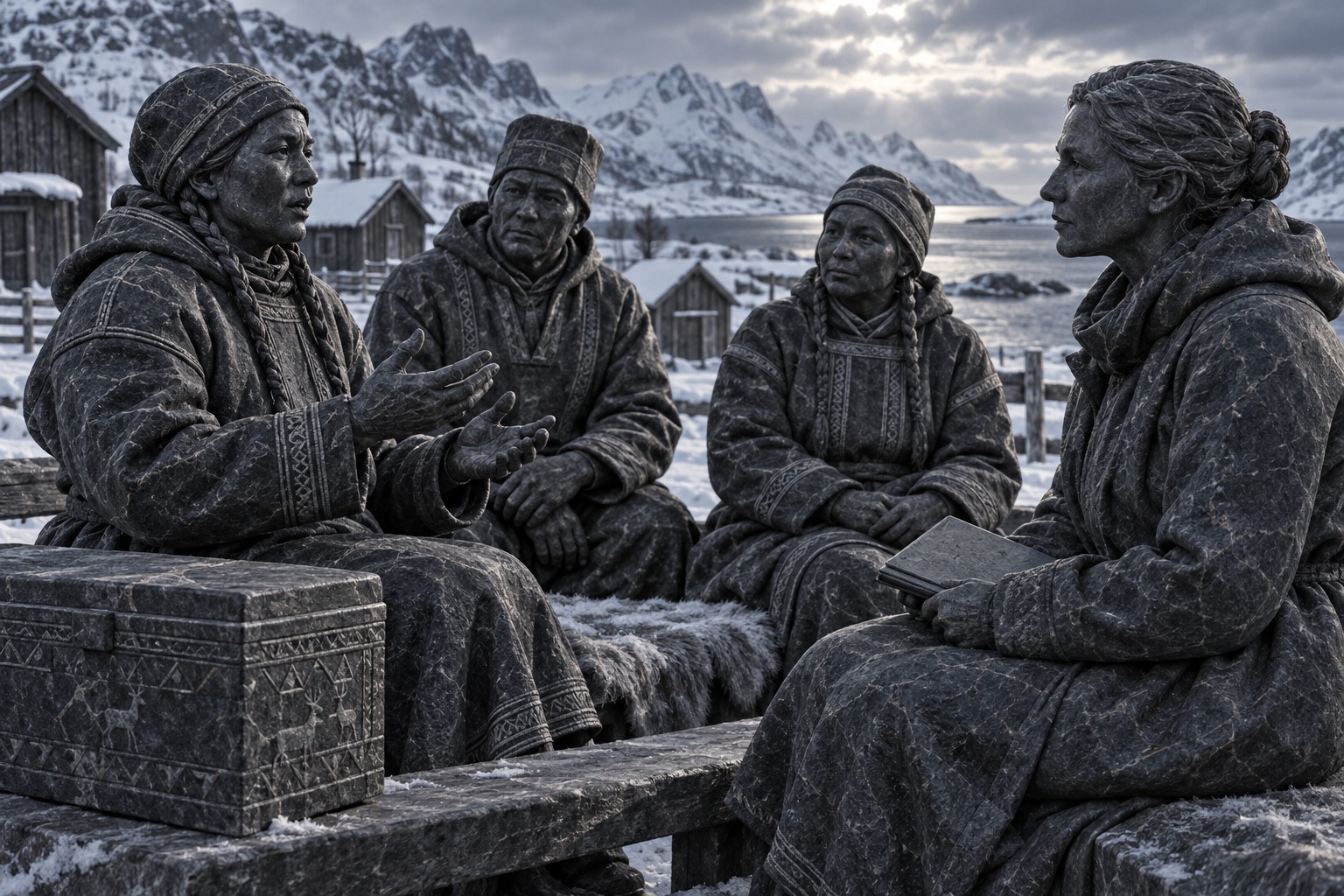
“What is necessary is to rectify names.”
Confucius, the Analects, XIII.3. English translation by James Legge; text and locator. The epigraph raises a question of accurate naming and is not a Sámi or Inuit saying.
About this article
Many readers know “shaman” before the names of the peoples and spiritual roles to which it is applied. It helps us find books, but easily creates a false sense that different societies work alike. A Sámi noaidi, an Inuit angaqoq, a modern artist, and the leader of a commercial class appear under one sign. With names, history, language, relationships to place, and the conditions under which people recognize a spiritual role disappear.
This article examines more precise ways of discussing these traditions. We compare a scholarly description of Sámi poetry with Sámi organizations' public explanations, an Inuit research strategy, and Ngāi Tahu's account of itself. These materials offer different kinds of knowledge: literary interpretation, a cultural position, research rules, and a specific iwi's voice. They do not open every ceremony or make the article's author a participant. The practical conclusion concerns our reading, choice of events, and treatment of others' names. An encounter can be substantive even when it does not end with acquiring a new personal psychological technique.
I. A general word helps us search and hinders understanding
A poster promises an “ancient shamanic ritual.” There is a photograph of a drum, smoke, and a person in a striking costume. No name of a people, language, community, teacher, or place, nor even an answer about who permitted the ceremony to be shown. The announcement tells us much about the organizers' desires: mystery, powerful experience, closeness to nature. It tells us almost nothing about the tradition itself.
The problem starts before we decide to participate. One word suggests a common religion of all peoples, differing only in costume patterns. An individual object then becomes a universal tool, and someone able to handle it a service provider. The meaning for which the object and action exist in a specific world disappears from view.
The term can be a useful library signpost. It leads to studies of specialists credited in particular societies with the ability to communicate with spiritual beings, participate in healing or divination, or accompany significant transitions. But a library heading is not yet a description of an individual. Put it in place of a local name and readers receive a category instead of a cultural relationship.
The difference is between “which phenomena does a researcher consider similar?” and “who is this person for their own people?” The first permits comparison. The second requires knowledge of language, duties, recognition, and limits of authority. The answers can overlap, yet similar actions do not establish identical world pictures. Even “spirit,” “soul,” “power,” and “healing” need checking: a familiar translation can conceal an unfamiliar thought.
In Kathleen Osgood Dana's study of the Sámi poet Áillohaš, Sámi noaidi and Inuit angaqoq are named together. Two names already prevent the outside word from being sufficient. The article offers a literary interpretation of the poet's work, not a catalog of every function in two peoples. It therefore cannot ground a claim that every Sámi poet or every Inuit performs the same spiritual role.
A simple way preserves accuracy. After the general term, place a colon and add the people, region, period, and source. If those spaces cannot be filled, we have a search direction for now. Beginning with that direction is legitimate. Declaring it complete knowledge of a tradition is premature. An accurate formulation is sometimes longer than a poster, but a subject of discussion appears within it.
II. Noaidi belongs within Sámi history
A Sámi name cannot be separated from Sápmi's history, language, and people's relationships with places. Yet the Sámi world is not one motionless set of beliefs. The modern Sámi Parliament of Finland itself shows linguistic diversity: Sápmi, Säämi, and Sääʹmm belong to different Sámi languages. Naming this difference helps more than an invented portrait of a “northern shaman” supposedly representing all northern Eurasia alike.
Dana has a specific subject: the book Beaivi, Áhčážan — The Sun, My Father — by Áillohaš, or Nils-Aslak Valkeapää. Words and archival photographs work together; the poet calls the book jietnagovadas, a voice drum. In her analysis of poem 31, the researcher connects play among related words about images with recurring sounds. English translation carries meaning, but some connections of sound, word, and image become less visible.
Suppose a reader encounters a museum description of a drum. They can learn who made it, which images survive, how it entered the collection, and who now explains its meaning. But we cannot automatically conclude that a modern drum onstage continues the same function. Loss, preservation, research, return, or new artistic work may stand between them. Each path has a history of its own.
A more interesting view of continuity follows. A living culture need not look like an old illustration to remain itself. A poet can work with ancestral memory through a book, a musician through a new composition, a museum through returning an object. Calling all this a rite is as inaccurate as treating art as proof that tradition has vanished. We need to hear how participants name a role and distinguish it from others.
Why does this matter for noaidi? In such a reading, the drum is more than a depicted object. It becomes a way of thinking about a book connecting different times and making the author's world audible. Understanding the analogy requires examining the work of form. A photograph does not show the same as a spoken word; placed together, they can raise a question that neither raises alone. Readers move between them and build the connection. This describes our reading, not a ceremony performed.
Suppose translation kept only a poem's convenient general meaning. We gain an intelligible thought, but lose the chance to hear how words answer one another. The research task is then to restore that connection, rather than find a hidden instruction for trance. We can learn what poetic language does without gaining new religious authority. That is why “the poet as shaman” must be read as an argument, not a status issued by a certifying institution.
Dana proposes seeing art as moving a particular mediating function into the public sphere. This is her research claim. The reader's own question is more precise: what relationships does the book help represent, and how? An answer needs attention to image, sound, and translation. It explains more than simply declaring every expressive poem shamanic. The work keeps a specific author; its interpretation keeps a named researcher; we can agree with an individual reading move rather than a whole theory at once.
III. Whose voice describes the event?
One ceremony can enter four texts: a participant's account, a traveler's record, a missionary's polemic, and later scholarship. The event does not become four events. But the author's interest, access, and vocabulary change. A traveler may have seen action without understanding speech. A polemicist may have understood some words but judged them in advance through their own teaching. A researcher may have a detailed archive without permission to attend a current action.
A source should therefore be read with its position in view. What did the person observe directly? What was heard through a translator? To whom is the record addressed? Why was it preserved? How are participants named? Is their response available? These questions do not cancel archival testimony. They prevent us attributing what it does not contain. An old record's silence about women's roles, for example, does not itself prove those roles absent.
Alongside scholarship, contemporary bearers' voices are needed. This is no demand to find one person who will settle every historical dispute. A community's account of itself answers another important question: how it understands its situation today, what it considers distortion, and what relationships it offers outside visitors. An individual participant's story, a representative body's position, and a research publication have different scales. They cannot replace one another.
Reading sources in pairs helps in practice. If an old author describes “empty wilderness,” seek current place names and explanations of its use. If an advertisement promises the “secret of a vanished people,” find their own organization, museum, school, or publisher. This comparison guarantees no final answer. It returns the conversation to the present, where people whose history we discuss live, and reduces the temptation to treat them as characters of the past.
IV. Traditional knowledge is broader than a spiritual ceremony
Reducing culture to an unusual ritual impoverishes even the part visitors wish to understand. Language, work, seasonal routes, craft, family ties, and rules of hospitality become scenery. Yet without them, the ritual itself loses its place. Knowing an object's meaning does not always mean being able to use it; knowing how to make it does not always mean having the right to perform a particular action with it.
The Reaidu educational project at UiT explains árbediehtu as knowledge and skills transmitted across generations, joining past, present, and future. The union of understanding and ability matters: knowing about something sits alongside being able to do something. This university account references Sámi researchers; it broadens the subject of reading without granting permission to acquire every local practice.
Another route opens for outside readers. Instead of immediately seeking a powerful experience, we can learn how fabric is made, places described, children taught a language, or a family's occupation changed. These subjects are not secondary to spiritual life. Their specific connection still needs to be established through sources, rather than an assumption that every Indigenous activity must conceal a mystical meaning.
Respect does not demand making everything sacred. It asks us to recognize that people themselves distinguish ordinary, festive, professional, religious, and restricted matters. An outside author declaring every everyday detail magical also removes a right to ordinary life. Someone can hold a phone, work as an accountant, and speak their native language. No contradiction exists for a tourist to resolve.
V. An Inuit context cannot be occupied by someone else's scheme
Angaqoq in a scholarly comparison draws attention, but serious acquaintance with today's Inuit world is better begun more broadly. The official ITK National Inuit Strategy on Research discusses Inuit participation in research governance, ethics, setting priorities, access to data, and building capacity. This is a contemporary program of a particular organization, not a collection of ceremonies or proof of every Inuit person's identical position.
Why does a document like this belong in an article about spiritual traditions? It shows that knowledge involves the right to determine what is researched and whom the result serves. If an outside author cares only about unusual states while people care about language, living conditions, and control of information about themselves, a substantial gap appears. The source reveals that gap without inventing restricted details of spiritual life.
Missing information cannot be filled with material about another people. If we do not know how a specialist is recognized in a particular Inuit context, an account of a Sámi noaidi does not close the gap. Similar translations create no authority to speak for both. Sometimes the correct sentence is brief: “The materials read do not explain this particular question.” It leaves the possibility of real research.
Refusing hasty filling differs from refusing to understand. It makes the next step more precise. We can seek an authored book, an open museum explanation, or a public conversation offered by the bearers themselves. We may find that the subject is not meant for outside audiences. In either case, a substantive answer about the form of relationships appears. Not every encounter must become new accessible material. The ITK overview reveals another distinction: bearers' participation in research includes decisions about resources, access to results, and researcher training. “Do these people believe in spirits?” is insufficient in that context. It can distract from who chooses a subject, what knowledge returns to the community, and who can use it. A person may discuss the modern organization of work with an outside researcher; that is no less a real part of their life than information about past spiritual practices.
The history of a religious role and a contemporary research strategy therefore belong in conversation together, but in different places. The former concerns a particular period and social structure. The latter shows how an organization formulates participation's conditions today. A modern strategy cannot yield all old ceremonies. An old account cannot yield contemporary people's consent to any research. Holding time in view prevents a common error: treating a historical record as permanent permission to speak for a people.
VI. First the community, then comparison of roles
The nearby Māori example tests the order of questions. We have a society's public account of itself, not a description of a spiritual office. First, then, we ask which relationships the source actually explains. A local role does not appear simply because outside readers want another participant in a comparative table.
Ngāi Tahu explains its history through connections among Waitaha, Ngāti Māmoe, and Ngāi Tahu, and whakapapa through kinship and relationships with the world, including land and sea. Local rūnanga matter in its organization. This is specific descent and contemporary structure. They cannot be reduced to a religious specialist, while “Māori” does not mean every iwi can be explained by the same story.
A useful sequence is first to identify the community, then the local word the author uses, then the context in which it denotes a role. Only afterward can comparison with another tradition proceed cautiously. Reverse the order, and we force someone else's word to mean what we already know. A confident translation without understanding the original relationship results.
Claims of universal initiation require particular care. If a course promises “becoming a shaman of all traditions” in a weekend, it offers a new activity that needs assessment on its own grounds. One international certificate does not create recognition in different communities at once. A course can honestly call itself a modern practice devised by its author. Dishonesty begins when its origin is replaced by a collective signature of people who granted no such recognition.
VII. Restricted knowledge has boundaries
Curiosity does not always give a right to hear an answer, record it, or pass it on. Someone may tell a guest a story without permitting publication. Permission to publish in scholarship may not cover advertising, sale, or making a digital product. The difference concerns content and relationships, not only a contract's legal form.
Local Contexts describes TK and BC Labels as a way to mark provenance, local protocols, and conditions of using materials. Communities themselves customize their wording. A separate taxonomy distinguishes seasonal restrictions, sensitive content, community access, and research use, for example. A label makes a condition visible; its presence cannot be treated as a universal license or promise of open access.
Consider a hypothetical editorial case. An archive holds a song recording with a collector's caption. An article's author wants it as background for a video on “shamanic trance.” Before choosing the soundtrack, they need to establish the song's function, named bearer, conditions on the recording, and whether the source supports that interpretation. A file's presence online answers none of these questions.
If the needed information is not found, a beautiful video does not matter more than the gap. We can make material about why the archive's description is insufficient, choose an openly published modern work with clear terms, or leave the recording alone. These are substantive editorial decisions. They permit discussion of culture without turning another's restricted information into raw material for our own expression.
VIII. A tourist image also creates a history
Visitors sometimes think they innocently buy a performance: it is meant for guests. But its caption shapes their image of a whole people. If an invented costume is called traditional and a borrowed story an ancient local rite, the audience carries away a mistaken map. That map later becomes a photograph, school report, or new commercial product.
In its tourism guidance, the Sámi Parliament of Finland explicitly links responsibility to the specific communities, families, and siida whose culture and territories are represented. It also challenges the view of Sámi land as nameless untouched emptiness. We use this voice as the position of a named representative body, not an automatically operative protocol for every Sámi region. Source.
A visitor's rule can follow: check a service's relationship to those it depicts. Judge neither by a costume's striking appearance nor spectacle, but by the account's provenance and the organizer's responsibility. Who leads the event? Which community is named? Where can its explanation be read? Is it an artistic program, public celebration, or religious action? Honest distinctions clarify the experience even if they remove some romantic expectation.
Yet we cannot demand that every bearer demonstrate a “real secret.” A public performance may deliberately have a limited format. An organizer need not open what is not meant for guests to prove authenticity. Public art deserves attention on its own terms. Error begins when the tourist's need for the unusual becomes the measure of another culture's value. Read “initiation” and “traditional” in a modern course description especially carefully. Who recognizes the leader? Which community participates in transmission? Are language, teacher, and conditions for students' acquiring a role named? These questions concern claimed provenance, not a way to assess a participant's inward experience. Music or shared action can create a powerful impression, but the impression itself does not establish cultural continuity. If organizers offer a format of their own, an honest name permits discussion of its content without appropriating someone else's status.
IX. Comparison is possible while differences remain visible
Rejecting a shared religion of all “shamans” does not ban comparative study. We can compare recognition of roles, ancestral relationships, the place of song, or objects' histories. But every comparison needs at least two sufficiently described cases. A general word does not replace information about one of them. Nor should the selected feature be declared central for the people without checking.
Suppose two open publications describe addressing beings translators call spirits. We can note a linguistic similarity between translations. Identical understanding of those beings needs further texts about origins, relationships, and duties. An identical mechanism of ceremonial action would need stronger grounds still. Each next conclusion requires what the previous one did not promise.
The opposite error is also possible: declaring every comparison impermissible and missing a shared history of pressure or similar museum problems. Precision permits these connections too when specific institutions, periods, and decisions are named. A shared problem does not turn different peoples into one whole. It can ground cooperation among people who keep their names and independently determine its terms.
A good comparative result often consists of two sentences. The first states a similarity. The second says where it ends. For example: both materials discuss transmitting memory; one concerns authored art, the other research organization. This is more modest than a universal law of spiritual development, but readers know what was compared and which new question remains open. A different family of traditions offers another useful example. In Jinja Honcho's shrine explanation, place, priests, and reverence are connected. But similar individual actions do not turn a Japanese priest into a noaidi described by a researcher. We can compare work with place or rules of access. Identification would require identical authority, history of recognition, and religious meaning; the public pages do not establish that.
Confucius offers another example: in the Analects, III.15, asking questions in a temple is explained as part of propriety. Readers can draw a useful attitude toward an unfamiliar order. But this is the article author's comparative conclusion, not evidence of a shared school of Confucians and Sámi spiritual specialists. A good analogy leaves a specific question behind. If it makes every name interchangeable, it has stopped helping research.
X. Meaning remains where names remain
Interest in spiritual traditions has different motives: seeking meaning, loving art, wanting to understand relationships between humans and places. None by itself makes another world our ready answer. The encounter begins when we allow another person questions unlike ours and words that need not fit a familiar heading.
A specific name does not turn culture into a closed museum cabinet. It opens a path toward people, languages, books, and contemporary decisions. Clarifying time reveals change; clarifying the author distinguishes voices; clarifying access shows a form of respect. Through these details, the faceless “shaman” disappears and a history we can actually meet appears.
The encounter need not produce a new personal technique. It can change how we read a poster, choose a tour, caption a photograph, or discuss a book. These are small actions with real consequences. They reduce false accounts and leave bearers room to explain their own life. Readers gain harder but richer knowledge: no promise of a universal secret, but the capacity to distinguish meanings and hear to whom they belong.
It also helps to check the order of reading: the exact subject first, the comparative explanation afterward. Start with a general theory, and every example found easily becomes its confirmation. Start with language and author, and the theory becomes a testable proposal with which partial agreement is possible. Suppose a reader encounters noaidi in a title, then finds that the book concerns poetry. They can take interest in the art's spiritual images. But “I read an account of a ceremony” now needs separate evidence. This small move from title to content changes the conversation's quality: we can name precisely the knowledge gained and the uncertainty remaining. Not answering every question here is no cultural deficiency, but the boundary of a particular work read.
What this means in practice
Choose one public page about a specific people prepared by its organization, museum, or named author. Record the people and organization's names, the page's language, access date, and one question it actually answers. Then find scholarly material on that question. Do not begin with a list of striking features: drum, costume, ecstasy. Begin with a subject the sources can explain.
On a separate sheet, distinguish observation, the author's interpretation, and your hypothesis. “The text names this object” is an observation about a document. “The author considers it an image of memory” is the author's interpretation. “It seems to me to resemble another tradition” is your hypothesis. The last can be productive while it remains yours. It must not quietly become the community's words.
After reading, try removing “shamanic” from your account and restoring meaning through specific names. If the sentence becomes clearer, the general word was hiding information. If you still want to retain it, clarify whose classification it is. Then check whether restricted knowledge has been presented as public, a literary image as an office, an artistic scene as a ceremony, or a modern course as recognized local transmission.
The practice can be done in pairs. One retells the material; the other asks only about grounds and scale: who speaks, about which place, at what time, for whom? The aim is not to catch each other making mistakes. It is to see where a familiar word accelerated understanding too much. The exercise can end with a new precise question. The ability to ask it already means the encounter has gained substance.
Key quotation
“Untouched wilderness does not exist in Sámi Homeland”
The Sámi Parliament of Finland, Ethical Guidelines for Sámi Tourism, the paragraph about tourism's image of land as empty space. English text; official source.
The quotation recalls that an outside observer often misses relationships binding people and places. It does not describe all spiritual roles or establish a single Sámi teaching. Its exact subject is a mistaken tourist image of uninhabited land.
Connections between traditions
| Comparative line | First side | Second side | Ground and limit |
|---|---|---|---|
| Name and authority | Source | Confucius, XIII.3 | Shared attention to names permits questions; the Confucian theory of order does not explain noaidi. |
| Place and role | Source | Shinto: Jinja Honcho | Places contain relationships and an order of access; a shrine priest is not declared a Sámi specialist. |
| Transmitting knowledge | Source | Ngāi Tahu | Knowledge concerns generations and belonging; árbediehtu and whakapapa have different meanings. |
| Research participation | Source | CARE, GIDA | Both discuss authority over knowledge; an Inuit strategy is not the same as an international framework. |
| Boundaries of access | Source | Te Papa, Karanga Aotearoa | Communities participate in decisions about heritage; a digital label does not establish burial arrangements. |
| A book and ritual order | Dana: the voice-drum image | Confucius: participation, III.12 | Both readings ask what turns outward form into substantive participation; combining sound and image in a book does not equal a Confucian sacrifice. The work of form is compared, not participants' spiritual authority. |
Primary sources
- Kathleen Osgood Dana. Áillohaš and His Image Drum: The Native Poet as Shaman. Nordlit; the opening of the study was read, not the poet's entire work.
- The Sámi Parliament of Finland. Ethical Guidelines for Sámi Tourism. Guidelines adopted September 24, 2018; public explanatory page.
- UiT, Reaidu. Tradisjonell kunnskap. Educational account of árbediehtu.
- Inuit Tapiriit Kanatami. National Inuit Strategy on Research. Official web overview of the strategy.
- Te Rūnanga o Ngāi Tahu. Ngāi Tahu. History, whakapapa, and local structures of a particular iwi.
- Local Contexts. About the Labels. The purpose of TK and BC Labels.
- Local Contexts. Taxonomy. Types of local protocols and restrictions.
All sources accessed October 3, 2026. Modern hypothetical situations and the practical exercise are the authors' examples; they do not reproduce the ceremonies of the named peoples.
- Confucius. The Analects. Translated by James Legge; selected passages III.12, III.15, XIII.3. — comparative context; independent full corpora of the traditions were not read.
- Jinja Honcho. Jinja. Modern explanation of a shrine's arrangement. — comparative context; independent full corpora of the traditions were not read.
- GIDA. CARE Principles. Public explanatory page read. — comparative context; independent full corpora of the traditions were not read.
- Te Papa. Karanga Aotearoa Repatriation Programme. Official program description read. — comparative context; independent full corpora of the traditions were not read.
Tags
shamanic traditions, noaidi, angaqoq, Sámi, Sápmi, Inuit, Áillohaš, poetry, spiritual role, language, translation, precise naming, cultural context, traditional knowledge, árbediehtu, Ngāi Tahu, Māori, iwi, whakapapa, local community, history, accounts of oneself, research, tourism, cultural heritage, access, Local Contexts, intercultural dialogue, religious studies, analogy, art, responsibility
About the authors
Andrey Zarinsh is the author and founder of the United Wisdom project. He researches inner transformation, the unity of traditions, intercultural dialogue, and contemporary spiritual discipline. Instagram: @andrey.zarinsh.
Maria Evilkut is a co-author of United Wisdom. Alongside her research, she seeks to test these ideas in practice and observe how the principles of unity and mutual understanding work in real life between people and cultures. Instagram: @ilkutki.
Keep what resonates with you.