
World & consciousness
Shinto: Place, Ritual, and the Presence of Kami
Kami, a particular shrine, and ritual work: Shinto’s own accounts and historical change.
“This is a rule of propriety.”
Confucius, the Analects, III.15, his response about asking questions in the grand temple. English translation by James Legge; text and locator. This comparative epigraph belongs to Confucianism; it is not attributed to Shinto.
About this article
Shinto is often presented as a love of nature without dogmas. That description captures part of its modern presentation of itself, but leaves shrines, priests, myths, historical transformations, and different forms of reverence outside the frame. Kami is also difficult to translate with one word: it can refer to mythological deities, powers connected with nature, or revered people. It is not a general name for everything that seems beautiful.
We examine Shinto through three connected sides: kami's presence, the specificity of place, and ritual work. A historical question matters too: how reverence connected with local communities interacted with Buddhism and political power. Modern explanations by Jinja Honcho and individual shrines are compared with research into rites' history. This lets us understand the tradition without turning it into either an unchanging national essence or a universal mindfulness technique. The practical section concerns careful reading and respectful visiting; it does not propose appropriating someone else's religious action.
I. Kami: a word no single familiar concept can replace
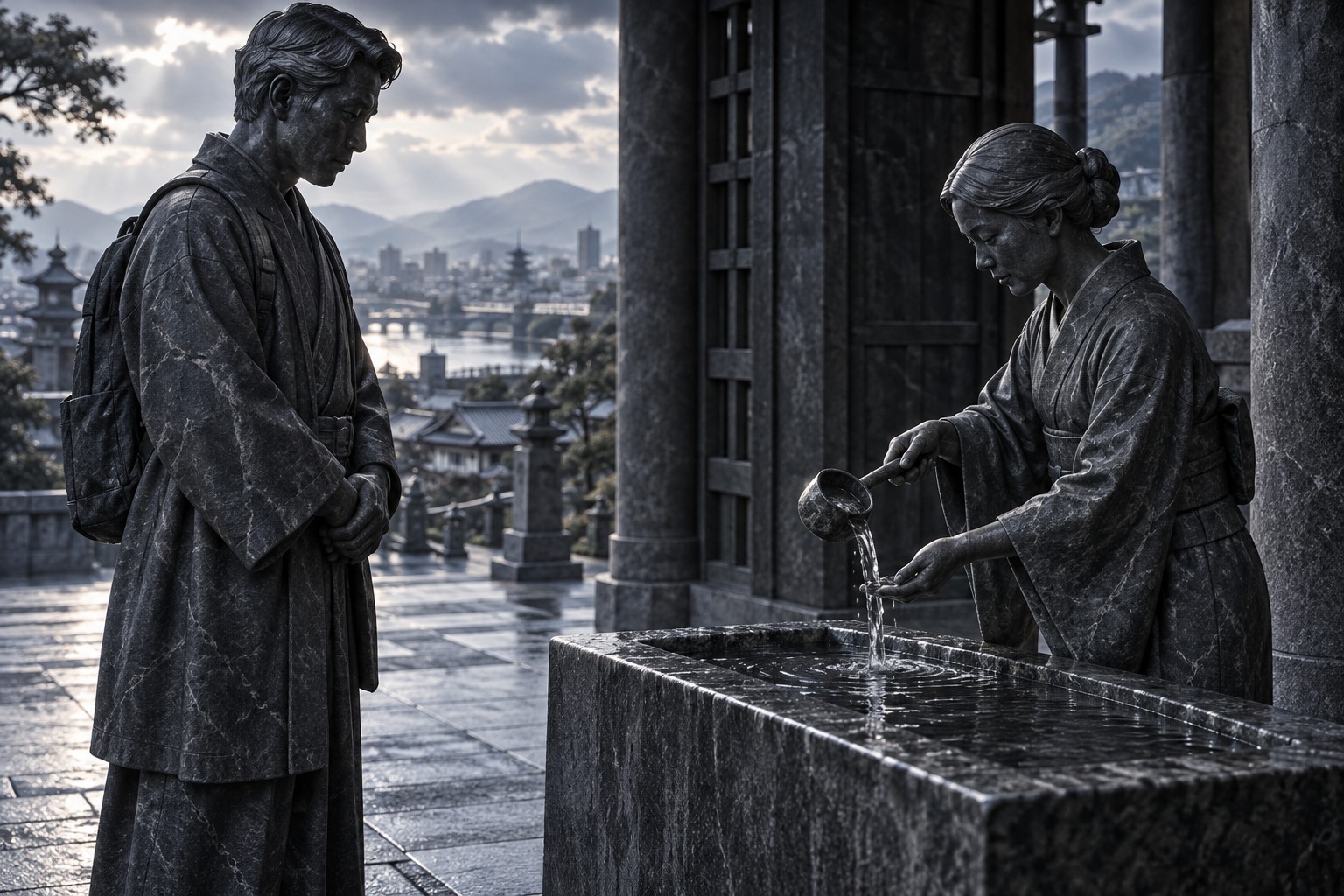
Water runs off a hand, and a few drops fall on stone. Beyond the shrine gates, the city keeps living: someone is late, someone seeks the right subway exit. No one has to stop being a city dweller here. But movement changes. Before entering a place of reverence, a person makes a small gesture that cannot be fully understood as hygiene alone or a way to calm down.
This hypothetical episode does not describe the single correct way to visit a Japanese shrine. It marks a question: what happens when place, water, a bow, and an address to kami form one action? Answering requires distance from both the tourist image of “mysterious Japan” and the idea that any religion can be retold as a set of inner states.
Kami is Shinto's central word, but familiar translations help only partly. “God” may suggest a single Creator; “spirit,” a bodiless being; “energy,” a physical quantity. None can be accepted without clarification. In Jinja Honcho's own explanation, kami relate to natural phenomena, ancestors, and people receiving particular reverence. This is an institution's account of itself, not the measurement of an invisible force.
It helps to consider the difference between a name and a relationship. If a mountain is revered in a particular tradition as connected with kami, we learn more than which class of objects it belongs to. We learn how it is addressed, which stories concern it, where one may walk, and which actions are appropriate. A translation preserving only the object while losing relationships makes the account poorer.
Yet we should not infer that every object is automatically kami or that all kami are identical. A shrine may revere particular kami, while the meaning of the same name changes with place and local emphasis. “Presence” here means religiously understood presence, not a hypothesis confirmed by an instrument. Readers may not share the faith and still understand precisely what its bearer claims.
Substantive intercultural conversation begins here. Before the hasty question “does this really exist?” we can ask, “what is being discussed when this name is spoken here?” The first question remains possible, but without the second it targets a concept we have not yet understood. Respect for a tradition does not require accepting its world picture beforehand; it requires not refuting our own inaccurate translation.
Refusing a single translation does not make the word incomprehensible. We constantly understand familiar concepts through instances of use: a home can be a building, family, or place of return. Similarity in this linguistic situation does not mean the concepts themselves are similar. It merely explains why a definition sometimes needs unfolding. With kami, the same approach helps: learn a particular case of reverence, then compare it with another. A working understanding emerges that permits clarification. It is more reliable than instant certainty that an unfamiliar word already wholly matches one familiar word of our own.
II. A shrine is a place of relationships, not a backdrop for faith
A jinja is a sacred place for revering one or several kami. It need not resemble a temple familiar to a European visitor. Jinja Honcho's explanation notes that particularly revered presence can be connected with a building, mountain, island, waterfall, or forest area. Some spaces are inaccessible to visitors or even hidden from sight. A beautiful photograph therefore gives no complete account of how the place works.
A boundary has meaning here. It separates more than a quieter territory from a noisier one. Gates, a path, a space for address, and the closed sanctuary organize different ways of approaching. Someone can be a welcome guest without gaining access to everything. This is a consistent position: invitation and restriction do not exclude one another.
To understand the place, we need to know who is revered here and who sustains its life. Without these questions, the shrine becomes a universal symbol of “Eastern spirituality.” Daily maintenance, a calendar, the local community, and priests' work give the tradition's presence a concrete form. Even if a visitor comes briefly, the place existed before their impression and will continue after it.
A hypothetical modern example shows the difference. Two travelers visit the same shrine. One chooses the best angle for the gates. The other reads its name, learns which space is closed, and notices local community announcements. Both may be impressed by the architecture. But the second learns how the place acts, not only how it looks. This does not divide people into “spiritual” and “superficial”; it shows two different subjects of attention.
A Shinto place cannot be reduced to a guest's personal experience. It has its own history, affiliations, and duties. Recognizing that independence lets it be more than a convenient stage for our inner life.
III. Myths give relationships a language but do not replace historical inquiry
A modern shrine may tell myths to reveal the connection between ritual and kami's deeds. In Jinja Honcho's published account of Izanagi, for example, the journey to the land of the dead and subsequent purification enter the story of Amaterasu's and other kami's appearance. This is a religious plot, not a record of natural processes' origins. Its importance can be neither proved nor canceled by trying to read it as modern biology.
A myth need not be hidden psychological advice. We may notice loss, prohibition, a crossed boundary, and return; that is our interpretation, not the establishment of the tradition's single meaning. Still less can Izanagi become a client of modern therapy, or purification an ancient formula of emotional self-regulation.
Another officially presented story, the heavenly cave, joins light's disappearance with the coordinated actions of many kami. Making objects, offerings, address, and dance participate. The story reveals that religious action can be complex shared work, not only an individual believer's inward thought. Making it a universal law of team management would, however, transfer too much.
Ancient work and current retelling also differ. On an organization's page, we read how it publicly explains the myth now. We do not automatically receive the complete Kojiki or Nihon Shoki, their variants, and the history of commentaries. This limit preserves an important question: which part of the inheritance did a particular narrator select, and for which audience?
Precision makes reading more interesting here. A mythical story need not pass a geology examination to become a subject of careful discussion. But neither does it release an author from stating what was read: an ancient text, translation, fragment, or modern account by the tradition itself.
For a historical question, ask separately who retells the myth today and which audience they address. For a religious question, ask what relationship the story sustains within the tradition. For personal reading, ask which images draw our attention. Joining these questions is legitimate while an answer to one is not passed off as an answer to the others. A story's beauty does not date an institution, while historical inquiry does not exhaust the faith of someone addressing kami.
IV. Purification: action before address
Purification in Shinto cannot be explained as simply “washing away bad thoughts.” In its account of matsuri, Jinja Honcho discusses ritual preparation of participants and priests, offerings, and prayers. On the same page, purification belongs to the religious event's arrangement. It concerns how a person begins an address, rather than only how they judge their mood.
A modern observer seeing water or a cleansing gesture can easily translate it immediately into personal effectiveness. “This custom helps one switch gears.” A particular person may indeed experience such a change. But an account of experience does not exhaust a rite's meaning. Within the tradition, the action concerns relationships with kami and a religiously understood order of participation.
To preserve that meaning, it helps to distinguish three sentences. “In this place, this action precedes the address” describes a custom. “The participant understands it as purification” describes faith and meaning. “The person is calmer afterward” claims an experience needing a separate ground. The sentences may be compatible, but none automatically proves the others.
It is equally important not to turn religious language of purity into an assessment of human dignity. Concepts of ritual order give an outside author no right to declare people “dirty,” inferior, or deserving exclusion. The historical and local conditions of a specific rite need separate inquiry. An everyday moral metaphor can quietly replace a traditional term and create a false meaning.
A visitor can participate respectfully without claiming complete understanding. They can read the available instructions, follow local rules, and avoid making the rite a performance for a camera. Understanding sometimes begins not with a powerful experience, but with refusing to explain hastily what is not yet familiar.
V. Matsuri: solemnity and celebration in one event
Matsuri is more than a Japanese word for festival. In Jinja Honcho's modern account, it involves reverence for kami, gratitude, offerings, and community. Some events remain within the shrine, others include processions and public celebration. Even a lively form does not mean the religious side has disappeared. Conversely, the presence of merriment does not make a ceremony less serious.
This union is difficult to see if the sacred is assumed to look only still, quiet, and individual. Shared labor, movement, food preparation, and changing roles can also belong to religious life. But one observation cannot establish an identical scenario for every shrine. Local calendars and history matter.
What changes when an event returns each year? It stops depending solely on whether an individual felt like remembering what matters. A time appears that is prepared beforehand and exists for many. Such return sustains a recognizable form, but guarantees no identical attitude among participants. One comes through faith, another through family custom, another performs necessary work. These differences deserve attention rather than suspicion of insufficient sincerity.
A hypothetical modern scene: an adult helps for the first time at a local celebration they previously only admired. They find hours of organization, distributed duties, and knowledge of the order behind a few minutes of procession. Matsuri is now more than spectacle to them. The change of view can be explained without attributing a new religious conviction to them.
The festival shows how incomplete an account of culture through ideas alone is. We can list kami's names correctly and still miss how the habit of acting together is transmitted. Shinto becomes visible in this work: not only what is said about the world, but how people prepare place and time for reverence.
VI. Ise: the calendar, rice, and renewal of the shrine
Ise offers a particularly clear example of joining place, offering, and repetition. Its official ritual page links the annual calendar with rice cultivation and describes Kannamesai as an offering of the first harvest. It also explains Shikinen Sengu: building a new shrine on an adjacent site and transferring the revered presence into it. This is Ise's specific tradition and cannot automatically be extended to all jinja.
An interesting problem of preservation appears. Antiquity is usually imagined as unchanged original material: that very stone, that very board. In renewing a building, continuity is arranged differently. Form, actions, skills, and relationships can preserve meaning while the physical shell changes. This does not mean material is unimportant; on the contrary, its making and transfer receive complex ritual work.
We can examine this logic without turning it into a universal Japanese philosophy. Preservation can involve retaining an old object, reproducing a form, or transmitting a skill. A concrete case makes us choose “authentic” more carefully. What exactly do we want to preserve: the material's age, a method of making, a religious bond, collective memory? The answer depends on the subject, not a general slogan.
Ise's official account also has its own religious and imperial context. Rites do not become a neutral course in sustainable architecture simply because a modern reader likes renewal. They should also be discussed as an institution's account of itself, joining reverence for Amaterasu with a particular historical continuity.
This approach leaves room for admiration while making it more exact. We can see beauty in preserving a skill without declaring every renewal equivalent to this rite. And we can ask about our own work with inheritance, clearly recognizing that the question arose in reading, rather than being issued by the tradition as a binding instruction.
VII. A medieval calendar connected shrine, court, and Buddhist service
Historical change becomes visible when it acquires a place and time. Suzuki Satoko studies shrines in the group of twenty-two closely connected with the imperial court. Her account of the late eleventh and early twelfth centuries shows Buddhist monks entering shrine organizations and Buddhist services becoming established in the calendar. Different clergy could act within one territory, with buildings for reading and storing sutras. Study, first five PDF pages.
This detail changes the question of interaction. We face not only similar words from two religions, but organized work: who conducts a service, where it occurs, how often it returns. Consider the difference between a guest's rare visit and a permanent place in a schedule. In the latter case, time, duties, and resources sustain the relationship. It affects an institution's life even when no one formulates a shared philosophical teaching.
Kamo Wakeikazuchi gives an even more specific example. From a record of 1303–1306, Suzuki reconstructs a seasonal rite: opening the sanctuary, passing offerings among the officiants, prayer, then a meal elsewhere. The sequence matters, not only the list of objects. A closed space opens for a defined action; after the address, the place and form of participation change. One photograph of an offering does not show this temporal structure.
We can draw our own analytical conclusion: a repeated ceremony sustains a relationship with kami while reproducing people's coordinated work. Knowing one's moment of action means knowing one's place among participants. Call this only an expression of personal faith and the arrangement of shared labor disappears. Call it only an administrative procedure and the address's recipient disappears. The specific rite requires both sides to be preserved.
The court is also more than a distant symbol of power here. The study compares shrine events with the court's seasonal calendar. But a familiar date and similar form do not yet make every ceremony a ruler's direct order. Such a conclusion needs the history of an individual case. A political connection can act through a model's prestige, institutional support, or assigned roles; those relations must be distinguished.
Continuity becomes clearer this way. People may experience a custom as a return to an old order while researchers find the time of its establishment and participants in change. History does not cancel religious significance. It shows which actions made a form able to return. A modern visitor encounters no motionless essence of Japan, but a place whose stability was sustained by change and many generations' work.
VIII. The absence of a single dogma does not mean an absence of thought
“Shinto has no founder and no single scripture” often leads to a wrong conclusion: that there are no conceptions, interpretations, or differences of position here at all. Yet having no single center of dogmatic norms differs from having no substantive thought. Meiji Jingu's account of itself contains clear value terms, including magokoro, a sincere heart. Shrine publications explain kami, myths, and ways of addressing them.
Comparing these explanations already shows specific readers being addressed. One introduces general concepts to an international visitor; another discusses a particular shrine; historical research asks about a rite's emergence. The same genre should not be expected of all three. Their different tasks explain why their languages do not match literally.
Jinja Honcho's own warning about jinja's diversity is revealing too: local instructions may differ from general ones. Forget that qualification and an article makes the official source more categorical than it is. Accurate transmission of a tradition sometimes begins with preserving its own modesty about universal rules.
In our analysis, this means recurring features can be discussed while leaving room for exceptions. “Often occurs” does not become “must exist everywhere.” A particular priest need not speak for every school, family, and local custom. Living diversity remains without sacrificing an intelligible general account.
Serious attention to Shinto requires more than admiration for its lack of dogmas. It requires reading what people actually say about reverence, noticing which differences matter to them, and avoiding attributing a philosophy convenient for us. A tradition can be oriented toward ritual and still contain complex work with meaning.
IX. Nature need not be pleasant here
Reverence for nature easily becomes a beautiful postcard: forest, water, blossoms, harmony. But Jinja Honcho's explanation of kami explicitly includes nature's harsh side. Respect concerns more than what comforts. This corrects a romantic image of religion as belief that the natural world always cares for human convenience.
Our analysis raises a different question: how do humans live with what they depend on and do not wholly control? Religious address offers its own way of relating. But it does not cancel building, forecasting, maintaining a place, or ordinary practical work. Reverence gives neither proof of supernatural protection nor permission to disregard known dangers.
The difference between gratitude and guarantee matters especially. We can thank for what was received without claiming prosperity will last forever. We can ask for protection without promising the request will be granted. If an outside article translates faith into a guaranteed outcome, it adds a claim to the tradition it has no right to make.
A hypothetical urban example examines this without religious borrowing. Someone begins seeing a river as more than a view from the window: a source of water, part of a place, and a force needing attention. This changed view may prompt responsible action. But calling it “Shinto” solely because it respects a river would be inaccurate: religious belonging and traditional reverence require more than one shared motif.
The ability to hold this boundary lets us learn in meeting another culture. We can notice an important question about dependence without declaring our interpretation an ancient teaching or making every care for nature confirmation of kami's presence.
X. Ending: a presence not reducible to our impression
Understanding Shinto means letting familiar words become a little less convenient. “Nature” becomes both blessing and harsh dependence. “Temple” becomes a place with different access boundaries and its own calendar. “Tradition” becomes continuity within which historical changes occur. “Ritual” becomes address and shared work, not exhausted by a participant's personal mood.
Kami remain kami: a term of specific religious life, neither disguised physics nor a poetic name for anything we like. Keeping the word helps us avoid rushing to appropriate it. We can understand some relationships it names without declaring ourselves their fully authorized interpreters.
Shinto gives substantive cause to consider how a place outlasts our visit. People we did not meet clear the path; labor we did not see prepares the calendar; a closed area matters even when absent from the photograph. An attentive gaze notices that independence. The world grows no less interesting because it is not all meant for our immediate use.
A personal conclusion is possible here, clearly separated from religious teaching. Meeting a tradition can teach us to ask about a place before making it a symbol of ourselves. To whom does it belong? How is it sustained? What is revered here? What actions are expected of a guest? These questions do not replace Shinto, but allow an approach without hasty translation.
A few drops of water at the start of a path need not tell a visitor the universe's secret. Sometimes they mark something harder and simpler: stopping before another's space, understanding what occurs here, and entering attentively to what keeps living independently of us.
What this means in practice
For readers outside the tradition, a useful practice starts with specificity. Choose one shrine open for visiting or public study. Learn its name, revered kami, and at least one custom from the place's own account. Record what you established and what remains a question. That small step gives more than trying to “understand all Japanese spirituality” in an evening.
If an actual visit is possible, follow that shrine's rules. The general page on jinja explicitly asks visitors to prioritize local guidance. Open grounds do not give a right to enter closed space, film every ceremony, or disturb participants. If uncertain, observe from a permitted place and decline an action whose meaning is unclear.
After reading or visiting, divide a note into three parts. First, what was actually said or seen. Second, how the source or a bearer of the tradition explains it. Third, your own questions and analogies. For example: “the calendar includes a thankful harvest offering”; “the shrine connects it with Amaterasu”; “I wondered how I notice others' work on which my life depends.” The final line can have substance, but is not an account of Shinto.
This practice requires neither accepting faith, rejecting it, nor displaying a special experience. Its result is more modest and reliable: knowing one place more accurately and seeing the boundary between its meaning and your response. Sometimes that boundary opens the possibility of real conversation.
To continue, move from a specific source to the next question. Not every internet collection of “Japanese secrets of life” informs us about Shinto; check who explains a concept, which version of history grounds the account, and which local differences remain beyond it.
Key quotation
“sincere heart”
Meiji Jingu, About Shinto, first paragraph: explanation of magokoro. The English fragment sincere heart; official text.
The short expression reveals a moral side of the shrine's account of itself. It gives no universal test of spiritual authenticity and does not replace local ways of participating. A visitor's sincerity matters alongside attention to what occurs around them.
Connections between traditions
| Comparative line | First side | Second side | Ground and limit |
|---|---|---|---|
| Ritual attention | Source | Confucius, III.15 | In both traditions, appropriateness requires learning the order of actions; a Chinese temple context does not explain a Japanese shrine. |
| Presence and memory | Source | Confucius, III.12 | Reverence permits discussion of presence; kinship sacrifice and the plurality of kami are not identical. |
| Place and community | Source | Ngāi Tahu, whakapapa | Place concerns human relationships and history; whakapapa cannot be translated as kami. |
| A guest's responsibility | Source | Sámi Parliament | Both sides set conditions for visiting; tourism ethics is not a shared religious doctrine. |
| Reverence and worship | Source | Catechism, §§956–958 | Comparison requires clarifying an action's recipient; the Catholic distinction between reverence and worship does not establish Shinto's categories. |
| Continuity through action | Ise: Shikinen Sengu | Ngāi Tahu: whakapapa | Both accounts connect the present with what preceded it; rebuilding and transmitting craft at Ise do not equal relationships of descent of a specific iwi. The comparison concerns ways of continuing, not one theory of inheritance. |
Primary sources
- Jinja Honcho. What is Shinto? — a modern institutional account of itself, general concepts, and the place of myths.
- Jinja Honcho. Kami — kinds of revered kami and nature's beneficial and harsh sides.
- Jinja Honcho. Jinja — the sacred place's arrangement, local diversity, and rules of participation.
- Jinja Honcho. Matsuri — rituals, offerings, purification, and forms of celebration.
- Jinja Honcho. Yomi-no-Kuni and Amaterasu-Omikami — a modern account of a myth; not a complete reading of ancient compilations.
- Jinja Honcho. The Cave of the Heavens — a modern account of the Amaterasu story.
- Ise Jingu. Rituals and Ceremonies — the official calendar and explanation of Shikinen Sengu.
- Meiji Jingu. About Shinto — the shrine's account of itself and magokoro's meaning.
- Suzuki Satoko. The Background to the Formation of Shinto Shrines’ Annual Events: Seasonal Celebration Rites, translated by Dylan Luers Toda, Kokugakuin Japan Studies 4, 2023 — the introduction and opening historical analysis were read, PDF pages 1–5.
- Confucius. The Analects. Translated by James Legge; selected passages III.12, III.15, XIII.3. — comparative context; independent full corpora of the traditions were not read.
- Sámi Parliament of Finland. Ethical Guidelines for Sámi Tourism. Public explanatory page. — comparative context; independent full corpora of the traditions were not read.
- Te Rūnanga o Ngāi Tahu. Ngāi Tahu. Public section on whakapapa and history read. — comparative context; independent full corpora of the traditions were not read.
- Catechism of the Catholic Church, §§946–961. Official English text. — comparative context; independent full corpora of the traditions were not read.
Tags
Shinto, kami, shrine, jinja, matsuri, Ise, Meiji Jingu, Amaterasu, myth, purification, offering, magokoro, Japan, religious history, ritual, place, seasonality, calendar, community, nature, comparative religious studies, translation, hospitality, visiting, tradition, accounts of oneself, historical context, Buddhism, reverence, intercultural dialogue
About the authors
Andrey Zarinsh is the author and founder of the United Wisdom project. He researches inner transformation, the unity of traditions, intercultural dialogue, and contemporary spiritual discipline. Instagram: @andrey.zarinsh.
Maria Evilkut is a co-author of United Wisdom. Alongside her research, she seeks to test these ideas in practice and observe how the principles of unity and mutual understanding work in real life between people and cultures. Instagram: @ilkutki.
Keep what resonates with you.