
Traditions and Worldviews
Tarot: A History of Pictures, Great Mystifications, and How Not to Lose Your Mind Over a Spread
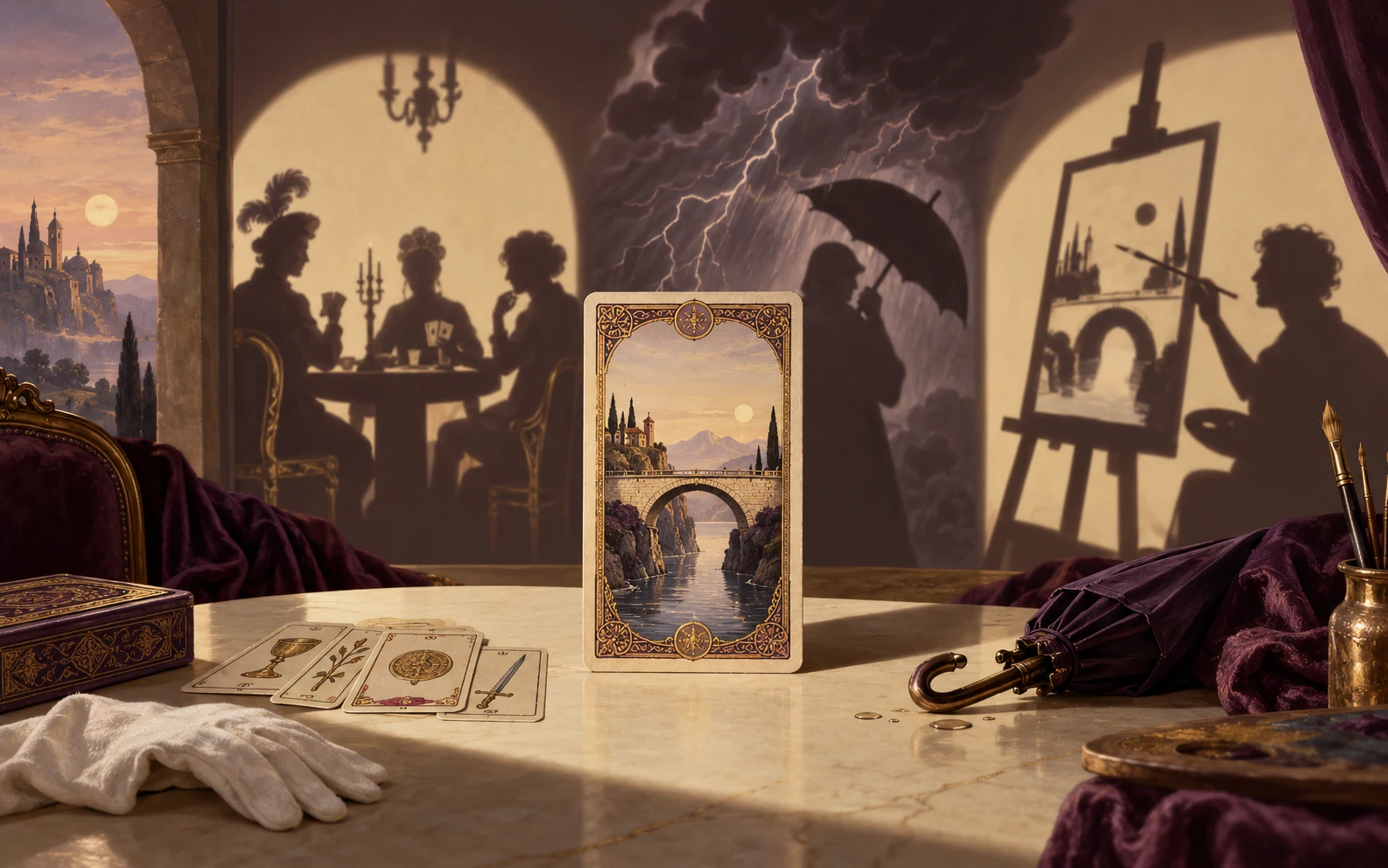
Picture a hypothetical room: three people are sitting in front of the exact same card. A historian yawns and recognizes a trump card originally crafted for the parlor games of Renaissance aristocrats.
"The field of divinatory possibilities is inexhaustible."
Arthur Edward Waite, The Pictorial Key to the Tarot, 1911, Part III, §1. Note: this is an English back-rendering of our Russian translation, not an official verbatim quotation. Waite is speaking strictly within the working hypothesis of the divinatory art itself—it serves as an operational premise for his reasoning, not a scientific demonstration that printed cards genuinely predict stock market crashes or the return of an ex-partner. Source.
What This Article Is About
Picture a hypothetical room: three people are sitting in front of the exact same card. A historian yawns and recognizes a trump card originally crafted for the parlor games of Renaissance aristocrats. An anxious occult enthusiast spots a terrifying omen of destiny targeting next Thursday. An artist ignores both of them, loudly admiring the compositional balance, the figure's foreshortening, and the dynamic use of negative space. The piece of cardboard is identical; their actions are radically different. An honest history of Tarot begins the precise second we stop dumping all of this into a single blender labeled "ancient secret wisdom".
Tarot originated within European card-playing culture, while the familiar fog of secret fraternities and astral planes was draped over it centuries later. Between lavishly painted 15th-century northern Italian miniaturesand your contemporary meditation deck lies an immense canyon of printing presses, commercial rebrandings, occultist fantasies, and shifting interpretive fashions.
We intend to dissect these layers, take apart the anatomy of a standard deck, and demonstrate why a symbol communicates nothing on its own outside a concrete context. We will render proper credit to artist Pamela Colman Smith and system architect Arthur Edward Waite, while drawing a sharp, uncompromising line between an illustration, an interpretive system, and loud prophecies about the future. Finally, we offer a grounded practical workflow: how to examine a card with the clear eyes of a cultural researcher without joining a sect or digging for phantom curses.
I. The Beginning: A Game at Court
If your heart yearns to trace Tarot’s origins back to wandering Bedouins, the mages of Atlantis, or the high priests of Isis, brace yourself for a rather unromantic reality check. The earliest surviving decks point directly to 15th-century Northern Italian court culture. The sumptuous cards commissioned by the Visconti and Sforza families are hand-painted luxury artifacts bearing dynastic emblems and associated with games of the nobility.
The Morgan Library catalog classifies them squarely as aristocratic gaming equipment rather than manuals of Egyptian initiation. At the same time, museum curators honestly maintain scholarly caution, noting that exact dates and individual attributions for certain cards remain uncertain. Morgan, "Visconti-Sforza Tarot Cards".
Once that historical setting is grasped, the esoteric fog evaporates. The Emperor, the Pope, the Cardinal Virtues, or Death were not necessarily coded memos regarding a player’s future; they spoke the fluent contemporary language of political power, Christian theology, and festive carnival pageantry. The cards were an aristocratic amusement, yet one created by people steeped in an elaborate religious visual culture. The fact that an object served as a game does not make it primitive.
Here, critical thinking requires keeping three distinct phenomena separate—threads that popular literature loves to tangle into an unrecognizable knot: the origins of ordinary playing cards; the appearance of a special set of trumps; and the emergence of later occult interpretations. Just as paper manufacturing does not validate European Hermeticism, chronological age does not transform a card deck into an infallible oracle. It makes it a museum artifact. The tangible human history of personal ambition, artistic patronage, and workshop craftsmanship remains far more compelling than any manufactured fable.
II. How the Standard Deck Is Built
The prevailing modern deck consists of 78 cards: 22 so-called "Major Arcana" and 56 "Minor Arcana" divided across four suits of pip and court cards. Let us establish right away: 78 cards represents the most widespread modern convention, not a divine law carved into stone tablets, nor does it define all historical regional patterns or modern experimental decks. V&A, "A history of tarot cards".
The late occult terminology of "Major" and "Minor" inherently generates an illusion of hierarchy: as though the former holds the metaphysical secrets of the cosmos while the latter is mere trivial background noise. In reality, this is a much later classification framework.
To a 15th-century Milanese cardplayer, what mattered were the functional ranks and the rules of the trick. To an art historian, the distinction lies between an allegorical figure and an ornamental suit marker. To a fortune-teller, it becomes a memorized grid of divinatory prompts.
Waite himself, in his 1911 manual, methodically segregates the suits and court cards from the primary allegories, advancing his own distinct early 20th-century framework whose historical assertions warrant careful scrutiny rather than blind acceptance. Waite, "The Four Suits", 1911.
The neat geometric symmetry of a 78-card deck is aesthetically pleasing, but systematic design offers zero guarantee of predictive accuracy. Structured tiers prove only that the organizers enjoyed tidy taxonomy. One can effortlessly engineer an exquisite correspondence matrix aligning card suites with the zodiac, alchemical metals, or the stages of brewing espresso; doing so produces no causal link to tomorrow’s traffic jam or foreign exchange rates.
III. The Image Outlives Its Original Function
Visual artifacts love switching careers. An engraving from an alchemical treatise ends up as a tattoo; an apotropaic charm turns into an airport souvenir; an Italian court game is re-costumed as the apparatus of an occult salon. There is no crime in this: that is simply how culture evolves. The intellectual dishonesty begins when someone retroactively declares this secondary reinvention to be the "original, hidden, and authentic" purpose, pretending Milanese courtiers were secretly performing esoteric divination between military campaigns.
Tarot lent itself effortlessly to divinatory projection because of its inherent theatrical drama. The cards depict high-stakes narratives: a traveler teetering on a cliff edge, crowned majesty shadowed by collapse, stillness yielding to sudden catastrophe. These archetypal tensions make it remarkably easy for a viewer to project their own professional frustrations or romantic dilemmas onto the scene. Yet this psychological resonance explains only why the image serves as an evocative mirror for self-reflection—it provides not a shred of evidence for an unbroken lineage of ancient initiates.
Furthermore, every physical card reflects its creator’s visual craft. Scale, line weight, drapery, and tonal palette inevitably direct the viewer's gaze. Strip an allegorical figure of its halo, alter its posture, or turn its back to the viewer, and the interpretive possibilities shift entirely. The life of an artwork is never reducible to the brief catchphrase printed beneath it.
Consider a pre-revolutionary postcard: it originally carried a holiday greeting to someone's aunt, but today hangs in an exhibition on Art Nouveau. A museum docent may spot the artistic anxieties of the fin-de-siècle within its borders, but they cannot legitimately project that curatorial thesis onto the aunt who received it. The same discipline applies to Tarot: respecting a cultural artifact means acknowledging it was not drawn to cater to our modern personal readings.
IV. The Egyptian Myth: An Influential Story, Not Historical Evidence
In 1781, Antoine Court de Gébelin examined a pack of cards and announced with supreme confidence that Tarot preserved the sacred wisdom of ancient Egyptian priests. It was an important reinterpretation in the history of occult Tarot. However, launching an influential cultural narrative is not equivalent to producing historical proof.
The Morgan Library catalog straightforwardly characterizes this Egyptian hypothesis as an armchair misconception born out of late 18th-century Egyptomania, which nevertheless profoundly influenced how the deck was received and adapted by later occultists. Morgan Catalog. One need not slander every occult author of that period as a cynical charlatan; the presence of an erroneous narrative does not automatically define the personal sincerity or intentions of every historical writer.
Why did the Egyptian myth prove so remarkably resilient? Because it packaged antiquity, pedigree, and romantic intrigue. It is rather mundane to admit that you are laying out an Italian Renaissance trick-taking pastime, but endlessly intoxicating to believe your hands cradle the lost, guarded mysteries of the Pharaohs. Any puzzling ornamental scroll can instantly be hailed as a veiled hieroglyph—after all, a sacred secret is supposed to confound the uninitiated.
Thus closes the classic ouroboros of circular logic: "These cards are ancient because they conceal deep esoteric secrets, and they must hold deep esoteric secrets because they are ancient Egyptian!"
Only mundane material evidence can dismantle this loop: documents, dated artifacts, and traceable transmission. A vague visual echo between a Renaissance trump card and an ancient stone relief may make for a fun curiosity, but without documentary trail, it establishes no historical transmission.
Dispensing with the pyramid fable does not cheapen modern symbolism. It simply puts things in their proper place: what we have before us is a brilliant, highly stylized intellectual movement of the modern era with its own distinct aesthetic aims. A modern concept has every right to exist on its own merits, without hiding behind the borrowed authority of antiquity.
V. Different Esoteric Systems, Different Maps of Meaning
Throughout the 19th and early 20th centuries, Tarot was fed into the gears of systematic catalogers. Éliphas Lévi, followed by the founders and adepts of the Hermetic Order of the Golden Dawn, set about synthesizing the deck with letters, numbers, and other symbol systems. V&A Overview.
Yet these intricate correspondences were specific conceptual frameworks designed by Victorian gentlemen and French occultists—not an eternal blueprint of the cosmos sleeping inside the cardstock.
Internal disagreements were fierce. The moment an author swapped the numerical placement of two major cardsthe neighboring positions and possible connections shifted accordingly.
Prioritize the assigned number, and the picture becomes a flat illustration of an external system. Prioritize the visual dynamics, and the numerological sequence fractures. An esoteric system does not decode a self-evident "hidden truth"; it dictates what the reader is permitted to notice in the first place.
Therefore, whenever a practitioner authoritatively states, "The Tarot says…", behind that monologue stands a complex collective production:
-
A publisher who financed and printed a specific batch of images;
-
The author of a companion booklet who codified an interpretive manual;
-
A reader who framed a specific inquiry and wove the pulled cards into a plausible narrative;
-
An occult subculture that legitimized those particular interpretive rules as "authentic".
Here we are dealing exclusively with living human beings, complete with their cultural biases, stylistic preferences, and theoretical agendas. No disembodied "ancient egregore" steps in to make decisions on their behalf.
And let us avoid confusing marketing branding with primary traditions. The esoteric Kabbalah of European Hermeticism is an idiosyncratic, highly selective adaptation of specific loan terms, not the vast, complex, centuries-old body of rabbinic Jewish Kabbalah. Similarly, naming a card sequence after Thoth or Osiris does not turn a London drawing room into the temple complex of Luxor. Borrowed cultural motifs are fascinating precisely because they show how ideas mutate when transplanted into entirely new hands.
VI. Waite and Smith: Who Creates the Scene
The famous 1909 deck is inextricably tied to Arthur Edward Waite and the artist Pamela Colman Smith. To attribute the deck solely to the male name on the cover is to completely erase Smith’s monumental artistic contribution. The image on each card is not a passive backdrop to someone else's occult glossary—it establishes distance, posture, spatial tension, and emotional atmosphere long before the reader ever consults an instructional booklet. V&A.
Waite explicitly noted that the illustrative scenes created for the numbered Minor Arcana were intended to assist the diviner without exhausting the broader scope of symbolic meanings. Moreover, he acknowledged earlier individual illustrations on numbered cards.
Consequently, the triumphant modern claim that "Smith was the very first person in history to illustrate all the cards!" is historically inaccurate. Waite, "Distinction between the Greater and Lesser Arcana".
A fully realized genre scene fundamentally alters how a person interacts with a card. It is one thing to stare at an austere grid of eight chalices, which offers little without a manual; it is an entirely different experience to see a cloaked figure turning their back on stacked cups to walk away into the midnight mountains.
Even someone wholly indifferent to esoteric lore will instantly sense the narrative friction. This is a triumph of dramatic composition, not proof of supernatural precision. A figurative scene simply makes it extraordinarily effortless to generate hypotheses.
At the same time, responsible attribution must be grounded strictly in documentary evidence rather than romantic speculation. We can describe the visible illustration in detail and cite Waite's 1911 textual commentary alongside it. But without concrete documentary proof, we cannot casually assign every minor decorative detail, blade of grass, or facial expression to Smith’s autonomous personal agenda. The viewer’s modern aesthetic impression, Waite’s doctrinal text, and the documented intent of the artist are three fundamentally distinct entities, and blurring them for the sake of an appealing legend helps no one.
VII. The Card, the Spread, and the Story
No card exists in a vacuum. Its operational "meaning" is invariably generated by the friction between the picture and the question brought forward by the seeker. The very same image can easily be interpreted as an internal resource, a dead end, a mood, or a call to decisive action. And when several cards are placed side by side in a spread, their proximity becomes pliable clay for the storyteller's imagination.
Consider a hypothetical example: show an illustration of a wanderer pausing at a crossroads to two different people. One is completely exhausted by an unfinished doctoral thesis; the other is agonizing over whether to resign from a corporate job. The first will likely see an admonition to "persevere and finish the path," while the second spots a clear invitation to "walk away into the sunset". The printed ink did not move. What shifted was the attentional filter applied by each person's unresolved anxiety.
In this limitless elasticity lies the central problem of empirical verification. If an interpreter can stretch any real-world outcome to fit a card after the fact ("You pulled the Tower and then dropped your favorite ceramic mug—you see, a cosmic catastrophe in miniature!"), the concept of prediction loses all falsifiable meaning.
A genuine forecast requires three strict conditions:
-
A clearly predefined event;
-
A definitive timeframe for occurrence;
-
Explicit error conditions (specifying what observable outcome would definitively prove the reading false).
If an interpretation can be endlessly renegotiated after the facts are already known, what we are witnessing is creative fiction, not hypothesis testing.
Yet reducing all engagement with Tarot to mere gullibility is equally shallow. People draw cards for aesthetic enjoyment, creative writing exercises, narrative brainstorming, or simply as an unscripted conversation starter.
All of these activities are entirely legitimate. A problem arises only when a pleasant conversation over tea is rebranded as a validated session of fortune-telling.
VIII. What the Card Shows and What It Cannot Establish
Let us separate our categories cleanly:
-
From the card itself, we observe visible compositional features and register our own spontaneous cognitive reactions.
-
From a museum catalog, we learn the century of production, geographic provenance, physical condition, and the scholarly confidence of its attribution.
-
From an occultist's companion manual, we encounter the doctrinal claims and esoteric philosophy of a specific historical school.
Neither the physical card, nor the museum catalog, nor the most authoritative occult guide automatically establishes external facts: they cannot verify what an absent third party is thinking, nor do they guarantee the outcome of a future business choice.
In a hypothetical scenario involving an uneasy business partnership, a card may serve as a creative catalyst helping you articulate your own vague worries, but it does not confirm the real motives, secret thoughts, or integrity of your partner. Sources of external fact here include direct communication, explicit agreements, observable actions, and objective records. If a striking image encourages you to hold a direct conversation, it has served as an incidental prompt; if it is substituted for verifiable facts, it merely widens the gap between the viewer's private anxieties and reality. This distinction is neither an invitation to paranoia nor a mandate for an external audit—it is simply standard cognitive clarity.
By the same token, cards should never be used to perform amateur psychotherapy. If an image evokes feelings of abandonment, that does not constitute a clinical diagnosis of unresolved childhood trauma. Conversely, if someone looks at an Arcanum and shrugs, saying, "I feel nothing, it's just a guy sitting in a patterned robe," that reaction is not a pathological "defense mechanism" or a "blocked third eye". They are entirely within their rights to see nothing beyond the ink. Any interpretive framework in which every disagreement or lack of emotional response is pathologized as hidden proof of the practitioner's insight is manipulation, plain and simple.
A card can be a fantastic catalyst for the imagination. But the imagination is under no obligation to masquerade as an objective reality. A card can be a stimulating conversation partner, but never a judge, a factual witness, or a diagnostician.
IX. Three Images and Three Distinct Inquiries
To move past generalities, let us examine how Arthur Edward Waite described three central cards: The Fool, The Hanged Man, and The World. This is his personal theological perspective circa 1911. It does not explain Renaissance court decks, nor does it represent the consensus of all esoteric thinkers.
The Fool
Waite depicts the Fool as a youth poised at the edge of an abyss, interpreting him not as an ordinary jester or simpleton, but as the spirit seeking experience. Waite, Part II, "The Fool". That frozen stance beside the precipice represents, for Waite, an elevated mystical gesture.
A contemporary observer looking at the same scene might perceive an incurable romantic, a reckless youth, or a prime candidate for the Darwin Awards. That gap is instructive: it shows exactly where the visual scene ends and where Waite's personal theological doctrine takes over. The drawn cliff edge does not contain an inherent command to leap blindly into a new lifestyle.
The Hanged Man
With the Hanged Man, Waite focuses intently on symbolic details: the living, budding wood of the gallows tree, the figure's serene, luminous expression, and the fundamental philosophical nature of the scene—a deliberate pause in being, a suspension of active life, but emphatically not physical death or punitive execution. Waite, "The Hanged Man".
Waite constructs a strict theological relationship between the divine and the Universe, using this Arcanum to engage in biting polemics against competing occultists whose interpretations he dismissed as vulgar. He does not indulge in a permissive "everyone sees whatever they wish": he draws sharp, contentious doctrinal boundaries.
The modern coaching cliché that the card merely instructs us to "look at things from another perspective" can certainly function as an independent, clever metaphor for personal use. However, it cannot be retroactively attributed to Waite's specific paragraph without checking the original paragraph. Respecting a demanding historical writer requires recognizing his theological polemics rather than flattening them into generic self-help jargon.
The World
In the World card, Waite speaks of cosmic completion and the soul’s ecstasy within a divine vision, vigorously critiquing alternative interpretations offered by his contemporaries. Waite, "The World".
When a modern project manager draws the World card and cheers, "Fantastic, we closed the sprint and wrapped up the quarterly report!", the semantic scale collapses comically. Waite’s visionary cosmology is not a Jira board, and equating a mystical realization of the cosmos with clearing a backlog of corporate tasks is an amusing trivialization of both.
Here, a three-part distinction becomes necessary:
-
Visual description: what is physically depicted on the cardstock;
-
Author's doctrine: the specific religious philosophy Waite embedded into his manual;
-
Personal application: whatever everyday problem the modern reader is attempting to navigate.
Keeping these levels distinct prevents confusion. You can use an image to brainstorm a stalled work project without imagining that the deck telepathically detected a slacker in the marketing department.
Furthermore, an explanation of an image is not an exhaustive inventory of its uses across culture. The same card might be displayed in a museum gallery, shuffled across a table in an Italian card tournament, analyzed in the study of a religious mystic, or sketched on an illustrator's tablet. Each of these environments raises entirely different questions. A grounded discussion of practice must identify the concrete physical setting and living participants, rather than naively deriving all human behavior directly from an illustrated figure.
And let us return once more to Pamela Smith. Her compositions are visually autonomous: they capture attention long before anyone opens Waite's prose. Waite constructed a rigorous, idiosyncratic system; Smith's visual staging proved far more spacious, leaving room for open-ended questions thanks to its aesthetic richness.
Waite's writing crackles with sharp, uncompromising debate: he did not hand out validation to every opinion, but fought rigorously for precise doctrinal terminology. Our personal impressions are under no obligation to match his canon—and that dynamic friction is precisely what keeps an engagement with culture alive.
X. The Artist's Authority: Two Ways to Construct a Scene
Waite's "The Hanged Man" and "The World" demonstrate the sheer power of visual composition without any need to fabricate myths about secret Alexandrian libraries. In the Hanged Man, the living tree trunk and calm, untroubled countenance turn the grim motif of public execution on its head. In the World, the dancing figure framed by a laurel wreath opens the composition into total cosmic triumph. Waite, "The Hanged Man", Waite, "The World".
This comparative analysis of Waite’s texts illustrates two distinct compositional modes. The first suspends the viewer in a paradoxical space between immobility and quiet transformation. The second asserts the ecstasy of cosmic harmony.
Appreciating the resonance of these images does not require buying into their monopoly over divination. On the contrary, once you set aside the demand for an authoritative fortune-telling cipher, the mastery of the composition takes center stage.
Pamela Smith’s contribution remains foundational: her draftsmanship operates ahead of the text. Waite bound the cards to his complex mystical worldview, but Smith’s expressive scenes give them life even for viewers who know nothing of her collaborator’s esoteric theories.
Clearing away occult pseudo-history does not diminish the artwork: the tension, expressive beauty, and narrative edge remain fully intact. Yet honoring the visual brilliance of the deck does not make it an oracle. It remains an early 20th-century cultural artifact with documented dates and identifiable creators.
Decide your focus in advance:
-
Are you studying Waite's personal mystical theology?
-
Are you evaluating Smith's theatrical illustration style?
-
Or are you using an evocative visual aid to reflect on your own thoughts?
All three avenues are valid. The only imperative is to avoid self-deception and not mistake one pursuit for another.
XI. Images Without Mandatory Prophecy
Tarot has traveled an extraordinary historical trajectory: from the hand-painted luxury card games of Northern Italian princes, through commercial printing houses and occult revival salons, into 21st-century popular culture. It is not a monolithic survival of an ancient mystery cult, but an evolving mosaic of human imagination, psychological projection, and artistic ingenuity. Tracking this cultural evolution is far more intellectually rewarding than memorizing rigid fortune-telling formulas.
A card retains its capacity to evoke wonder even when its claims of clairvoyance are firmly dismissed. A potent visual image can direct your attention toward subtle details you had overlooked. The value of an evocative deck lies in prompting an unexpected question, not in providing an authoritative, prefabricated answer. At the same time, the image owes nobody an insight: it may simply remain a beautiful historical illustration.
A committed esotericist and a museum conservator view Tarot through completely different conceptual lenses. Attempting to forcibly reconcile their perspectives or homogenize their language is an exercise in futility.
One can fully respect an individual's personal attraction to symbolic contemplation while remaining completely unwilling to accept unverified occult lore as historical reality.
We began with three observers debating a single card. By the end, there is no need to declare one of them the victor. All that is required is knowing where historical evidence ends, where aesthetic appreciation begins, and where personal projection takes over. In doing so, we keep our critical thinking sharp, while the cards remain what they have always been: a fascinating mirror of human culture, rather than the masters of our fate.
What This Means in Practice
If you wish to examine a card with clarity and practical insight, here is a grounded framework you can apply to any digitized museum specimen or published deck:
-
Neutral Description (Pure Visuals). Choose a card deliberately (no dramatic midnight rituals required). Note only what is physically visible: Where is the figure positioned? Which way are they looking? What objects are held in their hands? What elements stand out in sharp relief, and what fades into shadow? If a museum label is available, examine it only after conducting your own independent observation.
-
Historical Data (Contextual Layer). Identify the production date, place of publication, the engraver or artist (if documented), and the card's original social function. If an attribution reads "attributed to" or "probable," refrain from attaching a celebrated master’s name purely for dramatic flair. Clarify the origin of any interpretive claim: which specific companion manual or text supplies it?
-
Personal Association (Reflective Layer). If the image suddenly brings to mind a tense workplace dynamic or a lingering dispute, acknowledge that response. Then ask yourself a concrete check-question: what visual detail specifically triggered that thought? The posture of a figure? The angle of a raised sword? Now, challenge your initial impression by coming up with an entirely contrary reading of that exact same visual cue. Does physical distance signify estrangement, or long-overdue personal boundaries? This exercise helps demarcate where the artwork stops and where your own narrative begins.
-
Reality Check (Grounded Action). Step back from metaphorical associations. What requires attention in your actual environment? If an image prompted thoughts about an unresolved misunderstanding, consider sending a concise message to schedule a conversation. That step is taken not because "the cards commanded it," but because you chose to address a practical situation. And if no action is needed, simply appreciate the illustration as fine graphic art.
This exercise is neither amateur psychotherapy nor an esoteric ritual. It serves solely to illuminate how interpretive meanings are formed. As an entirely voluntary personal reading and artistic practice, you have the full freedom to pause, step away at any stage, or reject an unwanted association entirely.
If you examine a card with another person, establish ground rules beforehand: determine whether you are analyzing visual art, discussing historical texts, or sharing personal reflections. No one is obliged to reveal private vulnerabilities simply because an interlocutor sees a dramatic archetype in the layout. A participant retains every right to say, "That association does not resonate with me"—a comment that clarifies the boundaries of the discussion rather than signaling any kind of "spiritual blindness".
Finally, if an inquiry involves practical decisions (such as launching a new venture), conclude the discussion with an objective balance sheet: assess available capital, hours per week, and clear allocations of responsibility. A card can provoke useful questions about risk, but operational budgets and contractual terms must be settled with actual partners, not cardboard monarchs.
Key Quote
"Pictures are like doors that open into unexpected chambers."
A. E. Waite, The Pictorial Key to the Tarot, 1911, Part III, §1; our own English back-rendering of our Russian translation, not an official verbatim quotation. Source. Waite grandly characterizes the multiplying branches of interpretation within his esoteric framework. We adopt the phrase here as a metaphor for the capacity of visual art to pose unexpected questions—without offering any guarantee that your personal answers will be infallible.
Connections Across Traditions
This comparative table reflects our own independent analytical synthesis. It does not claim a singular historical root for diverse philosophical traditions, nor does it attempt to blend disparate worldviews into a generic soup of "universal truth".
| Positions and Sources | Basis of Comparison and Critical Limits |
|---|---|
| Waite on the image, III, §1 and Epictetus, Enchiridion, I | An image generates a swarm of immediate interpretations, whereas the Stoic philosopher insists on rigorously testing every initial impression. Shared problem: how to distinguish an unexamined impression from a deliberate judgment? Stoic discipline does not endorse occultism, nor can a card determine what lies within human control. The comparison highlights intellectual rigor when engaging with symbols. |
| Waite, "The Hanged Man" and Sendivogius, Author's Preface and First Treatise | A mystical concept is projected onto an image of nature. We compare the structure of allegorical interpretation while rejecting any blanket equivalence between all symbols of death and renewal. Waite’s static figure does not reflect Sendivogius's laboratory processes of alchemical transmutation. No direct historical influence is established; the comparison serves solely to contrast their interpretive scale. |
| Waite, "The World" and Dao De Jing, §1, trans. Legge | Waite depicts a cosmic culmination, while the classical Daoist text opens by asserting that no name can exhaust the enduring Reality. We examine the tension between symbolic suggestion and claims to ultimate knowledge. We do not claim the Dao is equivalent to the "divine vision" of a Victorian Christian mystic like Waite. The comparison illustrates where observable phenomena end and conceptual labels begin. |
| Waite on interpretation, III, §1 and Gospel of Matthew 7:16–20, KJV | Unbounded interpretations are evaluated through the biblical maxim: "ye shall know them by their fruits". Applied to Tarot, the question is straightforward: what concrete actions does an interpretation encourage in daily life? This Gospel passage does not address Tarot or validate its use; a constructive conversation sparked by an artwork does not prove occult efficacy. |
| Waite, "The Fool" and Crowley, Liber II | Waite's concept of the "spirit seeking experience" and Crowley's core distinction between True Will and fleeting impulse both explore human purpose and directional intent. A thematic parallel does not imply shared doctrine: Waite follows his own distinct iconography, while Thelema articulates its own radical Law. We do not equate the Fool with an enactment of True Will, nor do we validate every passing whim as sacred guidance. |
Primary Sources
As part of this study, three chapters from Waite's volume addressing specific cards were consulted in full: The Fool, The Hanged Man, and The World. Note that these constitute individual chapters within the same work, rather than three separate books.
-
The Morgan Library & Museum. Visconti-Sforza Tarot Cards, MS M.630.1–35. Curatorial commentary consulted via search-extracted records (direct digital opening for tools restricted). Evaluated as a museum record rather than an exhaustive summary of late-medieval Italian scholarship.
-
Rebecca Billingham, Ruth Hibbard, Josephine Nardecchia. A history of tarot cards. Victoria and Albert Museum, updated 16 July 2026. The curatorial overview was evaluated critically; generalized assertions regarding ancient origins or the absolute first instance of illustrating numbered pip cards were not adopted uncritically.
-
Arthur Edward Waite. The Pictorial Key to the Tarot, 1911. Part I, §3: The Four Suits. English-language primary source detailing a specific early 20th-century interpretive system.
-
Arthur Edward Waite. The Pictorial Key to the Tarot, 1911. Part III, §1: Distinction between the Greater and Lesser Arcana. Examination of the author's reasoning regarding illustrated pip cards and the limits of divinatory connotation.
Primary Texts for Comparative Analysis:
-
Epictetus. The Enchiridion, trans. Thomas Wentworth Higginson. Sections I–IV and XXIV consulted; focused on the Stoic evaluation of appearances and the locus of personal control, excluding introductory commentary by modern editors.
-
Laozi. The Dao De Jing, trans. James Legge. Sections 1–2 and 8 consulted via Legge's English translation, not the Chinese original; focused on the limits of naming phenomena and non-contention.
-
The Gospel According to Saint Matthew, 7:16–20, King James Version. Consulted in its entirety; focused on evaluating claims by their observable fruits, avoiding artificial syncretic conflation.
-
Michael Sendivogius. A New Light of Alchymie, trans. John French, 1650. Author's Preface and the First Treatise consulted; analysis of allegorical discourse.
-
Aleister Crowley. Liber II (The Message of The Master Therion). Consulted in full; focused on distinguishing True Will from transient personal whim.
Tags
Tarot, history of Tarot, card games, Italy, court culture, Visconti, Sforza, imagery, iconography, deck, Major Arcana, Minor Arcana, Waite, Pamela Colman Smith, Court de Gébelin, Éliphas Lévi, Golden Dawn, The Fool, The Hanged Man, The World, interpretation, spread, divination, symbol, artistic intent, authorship, history of esotericism, critical reading, prediction, personal agency
About the Authors
Andrey Zarinsh — author and founder of the United Wisdom project. Explores themes of internal transformation, cross-traditional unity, intercultural dialogue, and modern spiritual discipline. Instagram: @andrey.zarinsh.
Maria Evilkut — co-author at United Wisdom. Alongside her research, she tests these ideas in practical contexts, observing how principles of shared understanding function across communities and cultures in everyday life. Instagram: @ilkutki.