
World & consciousness
Indigenous knowledge: the right of its holders to explain their own world
Knowledge as relationships: particular holders, provenance, data governance, and the limits of an outside retelling.
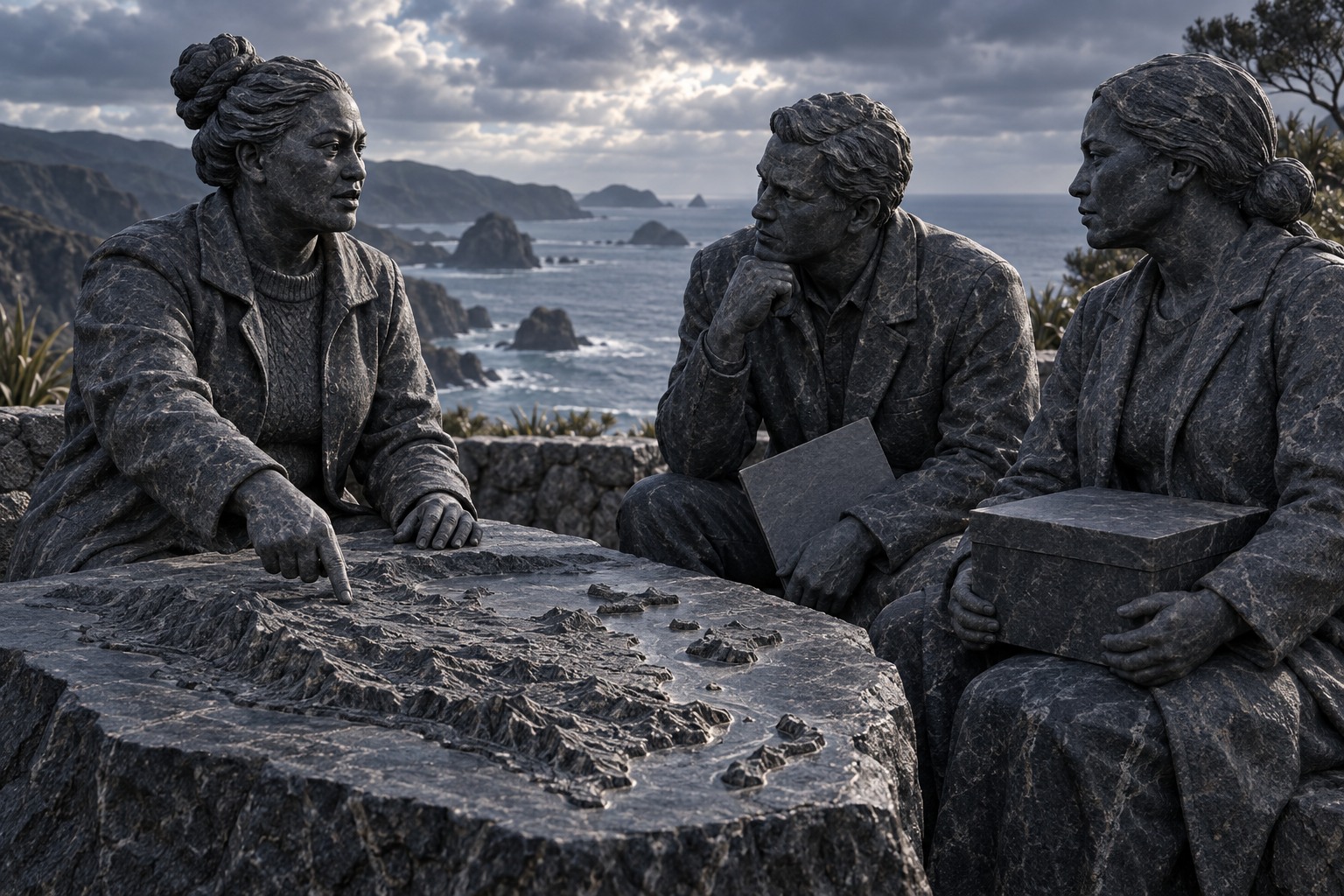
“Whakapapa is the ancestral link which binds all Ngāi Tahu whānau.”
Te Rūnanga o Ngāi Tahu, Ngāi Tahu, Whakapapa / Who We Are, first explanatory paragraph. Original English wording; whakapapa retains the name of relationships of descent, and whānau refers to family communities.
About this article
Consider an editor gathering material on “Indigenous wisdom.” He finds a beautiful story, cuts the place name out of it, and publishes it as universal advice for a contemporary reader. The meaning seems more accessible. But the reader no longer knows who is speaking, whose story it is, or which relationships made it possible to hear it. This loss changes the knowledge itself: an explanation of one's own world becomes a resource for someone else's project. This article considers another way of reading, in which Inuit, First Nations, and a particular Māori iwi remain participants in the conversation. We will distinguish observation, memory, spiritual meaning, and data governance, and see why openness does not mean the absence of conditions. The practical result is not mastery of someone else's knowledge. It is the ability to distinguish a source, a knowledge holder, and our own interpretation, find someone to address a question to, and acknowledge the limits of the access we have received. Similarities between these positions are compared analytically; the article does not assume a common doctrine shared by all Indigenous peoples.
I. Knowledge always belongs to someone
When a story is detached from its speaker, the conditions for understanding it disappear. The words remain, but we no longer know who can correct the retelling, how its accuracy is checked, or why this story is being told now. Even a scientific text has an author, a date, a subject, and rules for its use. It is strange to expect another people's knowledge to be free of such connections merely because it was passed on differently.
The word “Indigenous” helps us discuss a particular historical and political position. It does not name a single school of thought. Inuit Tapiriit Kanatami speaks for its organization and describes Inuit research priorities. Ngāi Tahu tells the history of a particular iwi. These two voices can be heard side by side, but they cannot be combined into a single anonymous speech by “ancient keepers.”
Clarifying where knowledge comes from is sometimes seen as an unnecessary difficulty. In fact, it improves the conversation. If a claim concerns a particular place and activity, its conditions become clearer. If it concerns kinship, it cannot be assessed as an instruction that simply needs downloading. If it expresses a religious relationship, a scientific account can explain the context without having to confirm a belief through experiment.
Accuracy begins with a small change in the question. Instead of asking “What do Indigenous peoples think about nature?” we can ask “How does this author describe the relationship between this community and this place?” The answer becomes narrower, but it gains a name, a scale, and a way to check it. A broad picture is built from such answers, not from an averaged formula. Diversity is a source of understanding here, not an obstacle to future unity.
II. The right to explain includes the right to choose the question
Taking part in research involves more than answering someone else's questionnaire. What matters is who decided what needed studying, whom the result serves, and how participants will be able to use it. Every word can be recorded carefully while unequal relationships remain intact, if only the outside party makes all the decisions about what the work means.
In its official web overview of the National Inuit Strategy on Research, ITK identifies research governance, ethical conduct, alignment of funding with priorities, access to and control of data, and capacity building. The strategy shows a change of role: people want to help define research, not merely be its object. We are reading the overview, without presenting it as the full program or extending it to every Indigenous person in the world.
Consider a hypothetical project on local changes in weather. An outside specialist is interested in rare, unusual accounts. Residents are more concerned with how the findings will help them decide on routes or preserve the language used to describe places. A good conversation needs to recognize both questions and establish how they relate. The first cannot be declared scientific and the second an emotional addition: the aims differ, but not necessarily the ability to think.
This also applies to an article like ours. Choosing a topic already shapes whom we look for and which phrases we consider significant. An honest author therefore acknowledges the frame they bring. They can explain that they are considering public knowledge governance, rather than reconstructing a closed cosmology. This clarification gives sources room to speak about matters that concern them. It also lets the reader notice when the author's subject begins to pass itself off as the knowledge holders' collective interest.
The right to answer includes the right not to enter the proposed conversation. A refusal may concern a particular topic, audience, or form of use. It does not need to be explained at once as hostility to knowledge. A person may simply lack time. An outside author does not know the reason until it is stated. They therefore record the available state of affairs: there is no answer or permission, and no further conclusion has been drawn.
This distinction reduces the motives we attribute to others and leaves room to return to the question differently. We can choose material that is already open, change the scale of the project, or find a publicly identified representative for the relevant subject. Work continues within what is available. An invitation alone does not guarantee a real dialogue, but dialogue becomes more possible when a participant is not obliged to serve our need for a finished answer.
III. OCAP®: four relationships to information
Knowledge about people can become a body of data managed far away from them. A dispute over accuracy then cannot be separated from a dispute over ownership, control, and access. The OCAP® principles were developed in a First Nations context: ownership, control, access, possession. FNIGC emphasizes their particular origins and the different ways individual nations apply them. OCAP® is a registered trademark of the First Nations Information Governance Centre (FNIGC).
Ownership concerns collective ownership of information; control concerns the ability to govern processes; access concerns access to data and decisions about its conditions; possession concerns actual custody. These distinctions matter because a general promise to “share the results” may leave every substantial lever with the existing database owner. Providing a report does not necessarily give control over later uses of the records.
Consider a hypothetical interview. A researcher promises to send the text but keeps the original recording in a system whose terms the participant does not know. Later, the recording is used to train software or tell a story in advertising. The participant gained access to one result but did not determine the other uses. This is not an example of a particular violation. It is a way to see the difference between relationships that one general signature can easily conceal.
The principles themselves do not give us ready-made permission to handle any data. They cannot simply be declared a universal protocol for all Indigenous communities. The practical conclusion is more precise: find out which arrangements the relevant people and institution have established. FNIGC's public explanation helps us understand the structure of the questions. It cannot answer on behalf of another nation. Respect for a model includes respect for the limits of its origins.
IV. CARE and the limits of technical openness alone
Data may be easy to find, accessible, and compatible with other systems, yet this does not answer whether it benefits people. Technical usability matters. By itself, it does not measure the fairness of relationships, the history of acquisition, or the right to decide what happens to information next.
The Global Indigenous Data Alliance explains CARE as a complement to FAIR that focuses on people and purposes. In Stephanie Carroll and colleagues' article, the section The CARE Principles and Their Supporting Concepts develops collective benefit, authority to control, responsibility, and ethics.
An important difficulty arises here. Sometimes open publication helps preserve a language or gives a young person access to knowledge unavailable nearby. Sometimes the same technical access makes commercial extraction easier and removes knowledge holders' control. We cannot therefore decide in advance that restriction is always good or openness is always good. We need to discuss the particular material, purpose, recipient, and party making the decision.
For the reader, this changes a habit. We usually judge a source by convenience: can it be opened, downloaded, or quickly searched for a quotation? A fuller assessment includes origins and relationships. Who expects to benefit? Who will be able to challenge the interpretation? What conditions apply to a new use? These questions do not replace checking the content. They make that check more adequate where the subject itself is tied to people and their collective life.
V. Whakapapa cannot be reduced to a list of ancestors
The same word may mean more than a familiar translation suggests. In Ngāi Tahu's account of itself, whakapapa connects family communities and relationships with the land, sea, and wider world. The iwi's history includes Waitaha, Ngāti Māmoe, and Ngāi Tahu; local rūnanga show its internal diversity. This is the public voice of a particular organization, which must not become a template for all Māori.
If whakapapa is translated only as “genealogy,” a reader may picture a table of names. Such a table can be useful, but the account describes connections with a broader meaning. The original word should be retained, with an explanation of which part of those relationships the source addresses. More importantly, we should not invent the other details that the page does not give.
This example shows why the right to explain one's own world matters for knowledge. A knowledge holder does not simply supply data for an existing classification. Their language can change the classification itself. An outside reader arrives with divisions between nature, family, and spirituality; the source reveals relationships among them. Hearing this takes more than cutting out the most beautiful phrase. The explanation must be allowed to reshape the initial question.
Recognizing another conceptual world does not require immediately adopting all its propositions as our own beliefs. We can understand what a relationship means for the author without claiming the role of participant. Respect differs from agreement. This distance allows an adult dialogue: both sides retain their own grounds, while understanding becomes more precise. Without it, reading swings between distrust of another's experience and romantic dissolution into it.
VI. A place is not empty because a visitor has not read it
Looking at an unfamiliar landscape, a person can easily mistake the absence of visible buildings for the absence of history. Their eyes do not know the local names, seasonal routes, and memory. An outside description of “untouched nature” can conceal living relationships. The mistake begins in language and may then affect which actions a visitor considers unconditionally permissible.
The Sámi Parliament of Finland's tourism guidelines set the cultural landscape against the image of an unnamed emptiness. The document ties responsibility to particular communities, families, and siida. This is an official voice on cultural representation and visiting territories, not our reconstruction of every historical Sámi belief. Its scale matters even when a more general problem is being discussed.
A hypothetical visitor may sincerely want nature without people. They see beauty and miss a working system of relationships. Learning from a local explanation need not destroy the beauty. It adds understanding: a person can be a guest here, not a discoverer. A place name becomes a key to what already exists independently of our arrival, rather than a decoration in a guidebook.
This change applies beyond tourism. A scientific project, a photography book, or a lesson also chooses what counts as visible. If people appear only on the last page as colorful figures, the account of the place has already been built without them. Adding a portrait is not enough to correct it. Their explanation needs to enter the argument itself, and we need to check which initial conclusions should change as a result.
Translation introduces another limit. A local name may have several uses, while the chosen Russian word narrows them. An author can usefully explain which part of the meaning they convey and why they retain the original. This does not mean burdening every sentence with unfamiliar terms. One clear explanation usually does more than many decorative words. It shows the reader that translation works with differences rather than simply replacing sounds.
Consider an educational page that translates a place name only as a beautiful landscape. If the knowledge holders' explanation shows that the name concerns a particular event or relationship, the translation may be incomplete. The correction does not consist in imagining a hidden sacred meaning in every name, but in restoring a verified detail. We add only what the source can explain and leave the rest as a question. This gives expressive writing a foundation.
VII. A protocol is part of the meaning, not an outside obstacle
A story may have a particular audience, a time for telling, or a way of being passed on. These conditions are sometimes seen as obstacles to spreading knowledge. But they can reveal the relationship the story itself assumes. Removing the conditions and keeping the words changes the form of the encounter, even if not a single letter is altered.
Local Contexts describes TK and BC Labels, through which communities identify materials' origins and their own protocols. Its taxonomy distinguishes restrictions and purposes: seasonality, sensitive content, use within the community, research, and commercial use. Knowledge holders customize the labels; they cannot be turned into universal automatic permission or treated as decorative ethnic badges.
Consider a hypothetical archive with the label “for research.” An editor working on advertising sees that a file is accessible and decides to use it. From technical access, they have inferred the right to undertake a different activity. It is this transition that needs checking. Permission may be granted, or the chosen form may be unacceptable. Neither the convenience of the file nor the editor's sincerity can answer on the recipient's behalf.
A protocol's meaning becomes clearer if the question is brought into our own lives. We may tell a friend a family story without wanting it published. This does not make the story meaningless or unreliable. It shows the limits of the relationship in which it was told. The analogy helps understanding but does not prove that family privacy and collective rules are identical. Each particular condition must be learned separately, not inferred from personal convenience.
The digital environment makes the difference even clearer. A file can move between websites and lose its attribution without anyone deliberately intending to conceal its origins. Attribution therefore needs to accompany the material in a new, permissible use. A short caption without conditions may be insufficient where a source has stated restrictions. The connection to the original explanation needs preserving, not merely the beautiful name of a people.
Automatically combining materials is a special case. Software may merge two similar stories into one answer and remove differences of time, place, and author. The convenience of the answer does not justify the combination. An editor needs to look at which sources receive attribution for the shared conclusion and whether they support it. A mechanically accurate link must go together with reading: a working address does not itself prove that the page says this particular thing.
Suppose an archive contains two descriptions of the same material: an old record considers it publicly available, while a later community record states a restriction. We cannot silently choose the convenient label from this disagreement. First, we need to establish the origins of both records, their dates, the speaker's authority, and the use each statement concerns. This is an author's example of working with a contradiction, not a retelling of a particular archival case. Its point is that accurate documentation includes more than the latest attractive wording. It preserves the history of a decision, the grounds for a change, and a question still unresolved. A future reader can then understand why the material was handled in this way and will not mistake a technically accessible file for unconditionally permitted knowledge.
VIII. Returning ancestors changes the museum's position
A subject of research cannot always be ethically described merely as an object. In the case of ancestral remains, the language of collections can conceal relationships that continue for descendants. Accuracy here requires hearing who determines belonging and what counts as the completion of museum work.
Te Papa's Karanga Aotearoa program works to return Māori and Moriori remains. The museum describes its role as temporary guardianship, while decisions about return to communities and a final resting place lie with iwi. Research into origins combines archival and oral evidence. This is a particular contemporary program; it does not prove that every museum already works this way or that every question of provenance is settled.
Its significance for our subject lies in a change in who has the last word. An institution may have professional skills in preservation and resources for research. But those skills do not necessarily entitle it to decide the final fate of another people's ancestors. Competence in custody and authority within relationships are different things. Cooperation begins when this difference is acknowledged rather than disguised by good intentions.
This example also resists setting living memory against documents. A search for origins may require both kinds of evidence, comparison between them, and recognition of uncertainty. An oral account does not automatically become an archival certificate; an archival record does not become neutral merely through age. What matters is the origin of each piece of evidence, the conditions for checking it, and the decisions of those directly affected by the result. The right to explain a world joins the right to participate in action here.
For a museum, this is also a question of language. The subject of explanation changes between the word “collection” and the word “ancestors.” The first describes the material's position in an institution. The second names a human relationship. One word cannot simply be banned in every situation, but it matters what it makes visible and what it hides. A detailed professional record may remain necessary for investigating origins without exhausting what an ancestor means to descendants.
A hypothetical museum visitor may initially see only a historical rarity. After reading an account of repatriation, they learn that something within the logic of display does not necessarily have to remain an exhibit. Their interest remains, but the question changes: instead of “Why will they not show it to me?” it becomes “Which relationships determine what happens next?” This is a substantial gain in understanding. It allows a person to learn from an institution through both what it has exhibited and a reasoned decision to end a particular form of display.
IX. Respect does not remove the need to distinguish claims
A reader sometimes sees only two options: declare every traditional claim an established fact, or reject everything that is not framed as an experiment. Both simplify. Observation, a norm, memory, a belief, and a political aim may appear side by side in a source. They have different ways of being supported and answer different questions.
An account of a place can give a verifiable detail about a route and explain a religious relationship. Discussing the first requires checking the conditions of observation. Discussing the second requires conveying accurately whose belief it is and what it means within the relevant world. Scientific measurement does not have to confirm a spiritual ontology for a cultural meaning to deserve understanding. At the same time, cultural meaning does not cancel the need to test a particular empirical conclusion.
The philosophy of models offers a useful connection. Roman Frigg and Stephan Hartmann show that a representation selects particular features and has limits. In this article, the application is an author's analogy: every outside retelling makes some things visible and leaves others outside its frame. It does not turn traditional knowledge into a scientific model, but it helps us check our own simplifications.
An adult conversation can hold several levels without mixing them. A person's competence in a local matter can be recognized, the grounds for a particular conclusion can be questioned, and they need not be asked to answer for an entire people. Spiritual content can be discussed without presenting it as medical advice. Accuracy here is not a form of cold detachment. It lets respect remain a relationship to real words rather than an ideal image we have made ourselves.
The knowledge holder's place in contemporary life matters just as much. A person may write in two languages, use scientific methods, and change how knowledge is passed on. These actions do not entitle an outside reader to declare the knowledge less their own. Expecting an authentic knowledge holder to remain outside technology and modern education turns respect into a demand that they fit our romantic image. Authorship rests on a real position and relationships, not resemblance to an old illustration.
A public representative also need not express every opinion within a community. If a source is institutional, we name the institution. If it is personal, we retain the person's name. Internal disagreement does not make a people unable to explain itself: it shows living participants in thought. The conversation becomes more adult when they are not required to achieve an impossible unanimity we do not expect from our own family, professional circles, or society.
X. Dialogue leaves room for an answer we did not expect
Knowledge holders' right to explain their own world means that the result of an encounter will not always confirm our initial idea. A source may reject the chosen generalization, narrow the question, or show that we have approached the wrong person. If only a pleasing answer about eternal wisdom is allowed, we already have a script in which others are assigned the role of illustration.
Return to the editor at the beginning. He can keep his interest in the story but change how he works. The publication will contain a named author and community, clear conditions of access, and a precise statement of what is retold and what is the editor's comparison. The beautiful universal advice may disappear. Instead, the reader will see a more complex question about memory, place, and responsibility that would otherwise never have arisen.
This does not deprive us of the right to develop our own thoughts. An author can compare, object, ask questions, and use open materials within permissible limits. But their thought should carry their own responsibility. It cannot be strengthened with the authority of “all Indigenous peoples” when one page from one institution has been read. Particular origins preserve freedom of reasoning while preventing it from taking another person's voice.
Knowledge finally ceases to be something extracted. It becomes an encounter between participants who can determine its conditions and continuation. This does not guarantee agreement or remove difficulty. It does allow real correction: the people being discussed can change the account of themselves. For a serious reader, this possibility is worth more than a finished legend in which everything is clear only because no one else can answer.
What this means in practice
Take one public publication you want to use and make a short reading record: author or organization, particular people, place, date, subject, and conditions of access. Write down one supported conclusion and one question the material does not explain. If the speaker is unknown, that is a separate gap; do not fill it with the name of a continent or the word “ancient.”
Then separate the retelling from your application. An author's family story does not become a universal exercise through an attractive formulation. Consider which transition you are making: from a particular world to general advice, from research to selling, from a public text to a digital product. Conditions may change at each transition. Technical access remains only one fact.
If an inquiry is needed, find a channel identified by the source itself and formulate a specific question about specific material. No answer does not mean consent. Ordinary reading does not require a ceremony of permissions for every thought; using restricted materials requires taking account of real conditions. This distinction helps avoid both appropriation and turning respect into an empty fear of encounter.
Finish by checking the language of your own retelling. Is the name still there? Can the limit of the claim be seen? Can a reader find the original explanation? If so, your text leaves room for the knowledge holder. It may still need revision, but it is already arranged so that a correction can come from the source rather than only from your own confidence.
Key quotation
“The CARE Principles for Indigenous Data Governance are people and purpose-oriented”
GIDA, CARE Principles for Indigenous Data Governance, main explanatory text, paragraph 3. Original English fragment. This short formula holds the central turn: a file's properties matter, but they do not replace relationships with people.
Connections between traditions
These are the authors' analytical comparisons; historical influence between the parties is not established.
| Positions | Basis of the connection and its limit |
|---|---|
| Ngāi Tahu: whakapapa ↔ The Analects, III.12 | Kinship and ritual presence allow relationships between generations to be discussed; whakapapa is not identical to the Confucian order of sacrifice. |
| ITK: research governance ↔ GIDA: CARE | People help determine the aims of knowledge; one program is Inuit, the other cross-regional, and particular protocols do not automatically coincide. |
| FNIGC: OCAP® ↔ Local Contexts: Labels | Both make conditions for handling data visible; a First Nations governance model and labels for local protocols serve different functions. |
| Sámi Parliament: cultural landscape ↔ Jinja Honcho: jinja | A place has meaning within relationships; Sámi use of territory is not a Japanese form of shrine or the same ontology. |
| Te Papa: repatriation ↔ Ngāi Tahu: descent | Both sources help reveal connections between people and ancestors; the museum program does not determine a particular iwi's beliefs or decisions. |
| GIDA: purposes and benefit ↔ Frigg and Hartmann: models | Both readings require the purpose of a representation to be clarified; philosophy of science does not replace collective authority and cultural conditions. |
Primary sources
- Te Rūnanga o Ngāi Tahu. Ngāi Tahu. A particular iwi's primary public account of itself; Our History and the explanation of local structure were read.
- Inuit Tapiriit Kanatami. National Inuit Strategy on Research. Official web overview; the full strategy document is not claimed to have been read.
- First Nations Information Governance Centre. OCAP®. Official explanation of the principles, not legal advice or a protocol for all peoples.
- Global Indigenous Data Alliance. CARE Principles. Official description of their purpose and development history.
- Stephanie Carroll and colleagues. The CARE Principles for Indigenous Data Governance. Data Science Journal, 2020, DOI 10.5334/dsj-2020-042; selected passages on the principles' purpose, development, and content, PDF pp. 2, 4, 6, and rights information were read; the available PDF contains editorial placeholders.
- The Sámi Parliament of Finland. Ethical Guidelines for Sámi Tourism. Primary official voice; explanatory page for the 2018 guidelines.
- Local Contexts. About the Labels. Primary explanation of a tool for local protocols.
- Local Contexts. Taxonomy. Reference for types of conditions; not an independent universal license.
- Museum of New Zealand Te Papa Tongarewa. Karanga Aotearoa Repatriation Programme. Primary account of a contemporary program; the main text was read.
- Confucius. The Analects, III.12. English translation by James Legge, The Chinese Classics, Vol. 1; the named passage was read, not the entire corpus.
- Jinja Honcho. Jinja. Official account of shrines; used only for a limited comparison.
- Roman Frigg, Stephan Hartmann. Models in Science. Stanford Encyclopedia of Philosophy, revision of April 2, 2025; a philosophical reference study, introduction and §1.
Accessed: October 3, 2026.
Tags
Indigenous peoples, knowledge, self-description, Inuit, ITK, First Nations, FNIGC, OCAP®, CARE, GIDA, Māori, Ngāi Tahu, whakapapa, whānau, rūnanga, Sápmi, Sámi, siida, cultural landscape, provenance, research ethics, data, collective benefit, control, access, Local Contexts, TK Labels, BC Labels, repatriation, Te Papa, oral history, intercultural dialogue
About the authors
Andrey Zarinsh is the author and founder of the United Wisdom project. He researches inner transformation, the unity of traditions, intercultural dialogue, and contemporary spiritual discipline. Instagram: @andrey.zarinsh.
Maria Evilkut is a co-author of United Wisdom. Alongside her research, she seeks to test these ideas in practice and observe how the principles of unity and mutual understanding work in real life between people and cultures. Instagram: @ilkutki.
Keep what resonates with you.