
H
Disability, accessibility and participation: growing up with a voice
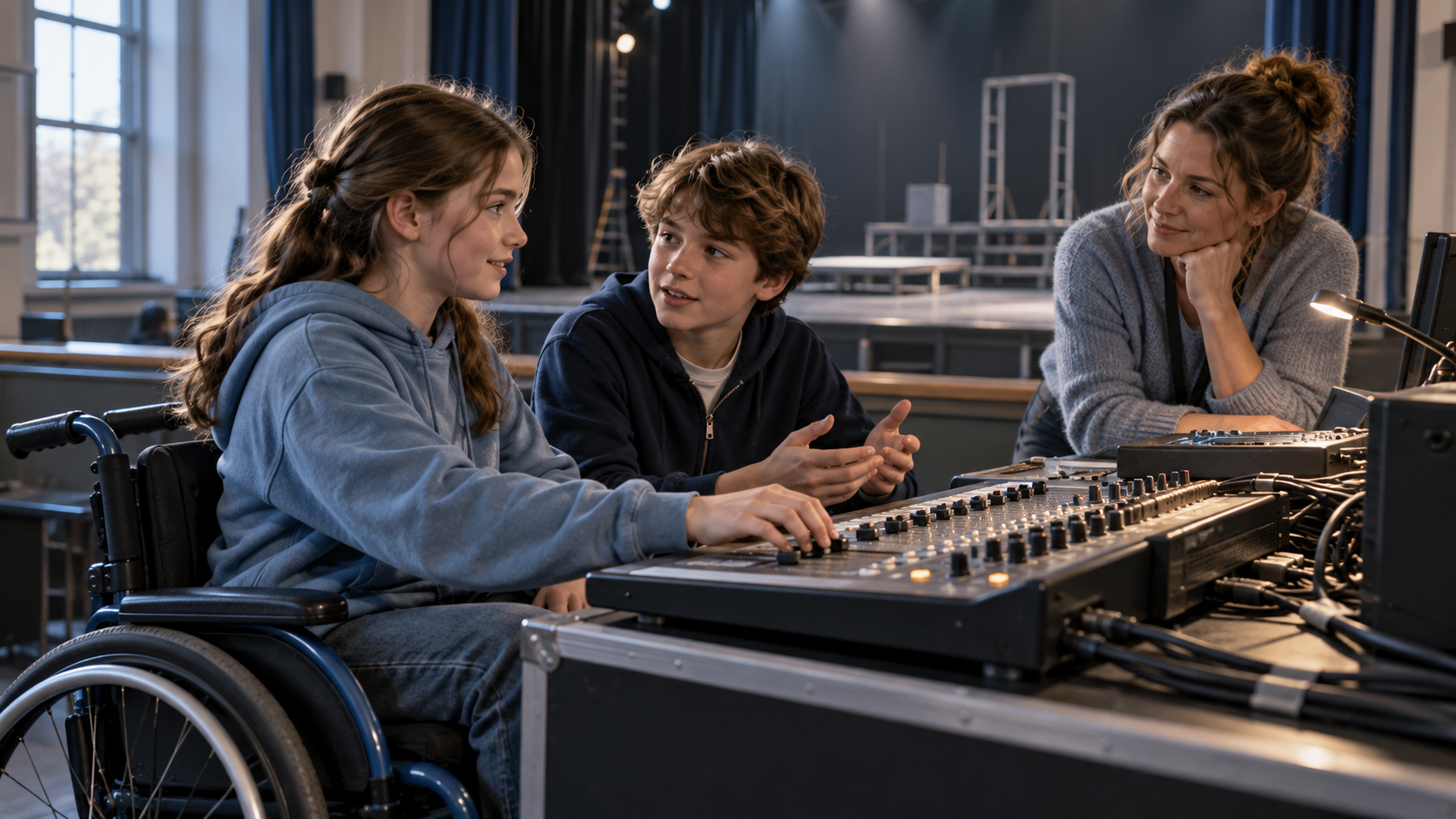
Twelve-year-old Lena wants to join the school theatre group. Adults discuss getting into the hall, where she will wait and who will assist her. Nobody has yet asked which role interests her. When someone finally does, she explains that she wants to work with sound and music, rather than deliver the short line offered “so she can perform too.” Getting into the room matters. It does not by itself make participation her own.
Epigraph
“freedom to make one’s own choices” — a brief excerpt from Article 3(a), Convention on the Rights of Persons with Disabilities. A principle, not confirmation that a particular place is accessible.
What this article is about
Twelve-year-old Lena wants to join the school theatre group. Adults discuss getting into the hall, where she will wait and who will assist her. Nobody has yet asked which role interests her. When someone finally does, she explains that she wants to work with sound and music, rather than deliver the short line offered “so she can perform too.” Getting into the room matters. It does not by itself make participation her own.
This hypothetical story cannot explain every disability. For another child the barrier might be an inaccessible message, a response format, the organisation of an activity or other people’s attitudes. A person’s condition and actual needs matter; the environment matters too. Neither distinction allows others to decide everything in advance.
For caring adults and young adults, this article distinguishes presence from participation, assistance from ownership of decisions, and an available opportunity from a promise. A child needs a voice alongside adult protection. Adolescents need opportunities to expand participation without an examination in complete independence. Access requires actual organisation, beyond a family’s attitude.
I. Begin with an activity, rather than a verdict
“That is inaccessible to her” can conceal several questions. Can she reach the place? Is the information understandable? Can she use the method required for this particular task? Does she need assistance? Does Lena want to participate in this way? Combining these questions into a verdict about a child’s abilities makes it difficult to see what needs changing and what remains unknown, requiring appropriate assessment.
The WHO overview considers disability through the interaction of health conditions and contextual factors; people and needs vary. This does not say every limitation disappears when an environment changes. Pain, fatigue and other actual difficulties cannot be removed through respectful wording. Equally, an inaccessible arrangement does not provide a final measurement of someone’s possibilities. An unsuccessful way of participating first tells us about that particular situation.
Lena is offered a chance to test only whether she can go onstage. Her interest concerns music. A more precise question is what actual tasks exist there, what they require, and which conditions and participants are needed. This promises neither any desired role nor exemption from an activity’s requirements. It changes the basis of discussion: an actual activity, interest and circumstances replace the general question of what “a child like that” can do.
Such clarification helps without a complete solution. Adults can recognise one barrier without using it to explain a whole life. They may find a particular task currently unsuitable without declaring every future wish unsuitable. There is no need to choose between unlimited promises and abandoning efforts to understand someone. What has not been considered remains unknown; it does not become evidence of inability by default.
Adults retain the work of arranging and clarifying conditions. Children can describe a difficulty and an interest without having to write a technical specification, find providers or prove that their presence is economically beneficial. Their wishes deserve attention before an ideal plan exists.
II. Presence does not establish participation
Lena reaches the hall and receives a chair. A report could already claim that participation has been provided. Yet rehearsal moves too quickly for her to know when to play the sound, instructions pass her by, and decisions happen after she leaves. This hypothetical example separates being nearby from doing what someone came to do. A photograph of the whole group cannot resolve that distinction.
Name the substance of participation. It might mean contributing to a shared task, learning, talking with peers or choosing an activity. Each requires its own conditions. A recording can offer useful information without necessarily replacing joint action and feedback. A separate room can help in one respect while removing wanted companionship. The name of a measure does not establish its adequacy for every purpose.
Difference does not automatically make an arrangement bad. Different approaches may suit different people. The question is whether the option preserves a significant part of the intention and how the person concerned experiences it. Someone can benefit from a partial solution while identifying what remains unavailable. This is more accurate than demanding unconditional gratitude or denying the value of everything already done because difficulties remain.
With children, adults remain responsible for necessary conditions and protection. An independence test should not mean withdrawing help to see whether a child can prove readiness. Nor should worthwhile participation mean only an outcome requiring almost no adult effort. Limited resources need consideration with actual responsible people, separately from any conclusion about a child’s lesser value.
Sometimes the desired format remains inaccessible. Renaming exclusion as inclusion cannot repair that fact. An honest conversation allows a temporary option, a further question and an unfulfilled wish to coexist. An unfinished solution does not make the child responsible for an arrangement designed without them in mind.
III. Information and communication can create barriers
An announcement has been published, but the child has not received understandable information. Instructions have been spoken, but there is no suitable way to clarify them. An adult notices silence and decides there is no interest either. Necessary connections are missing between these events. Sending information, making it accessible and enabling participation are different tasks. An instruction to listen harder and answer faster cannot supply those connections.
Articles 2 and 9 of the Convention encompass different communication formats and information access. This is a normative reference, rather than a prescribed list of tools for every child. A suitable format depends on the person and circumstances. Written text does not help everyone; spoken language is not universal either. A picture or device does not itself establish that meaning is understood and a response is possible.
In Lena’s case, it helps to establish how rehearsal changes reach her and how she can report a problem. These questions do not require a public account of her entire medical history. They require people able to agree an actual method of communication. Specialist tools need appropriate expertise in selection and setup. A general article does not recommend choosing equipment independently or treating something similar as a suitable replacement.
Address the child as well as the accompanying adult. This does not forbid explanations from a helper or require an unsupported answer. Allow time and an agreed form of assistance without turning the conversation into a speed test. A response through a helper or communication tool is not automatically less the child’s own. Equally, adults should not attribute an opinion merely because it is convenient for them.
Misunderstanding should not immediately be explained by diagnosis or character. Perhaps the conditions prevented a question. Perhaps the person really does not want this activity. Accessible exchange helps distinguish these possibilities; compulsory agreement does not. Participation includes reporting difficulty, changing one’s mind and being heard without proving perfect command of everyone else’s customary speech.
IV. Assistance does not purchase every decision
A parent helps Lena prepare for rehearsals and knows a great deal about her daily needs. That knowledge matters. It does not mean the parent should permanently choose every piece of music, friendship and role. The extent of assistance needed does not automatically equal the extent of authority over another life. Particular decisions require consideration of age, circumstances and applicable rules.
Support can be active: explain options, assist expression of a preference, arrange a necessary contact. It need not mean watching passively. But notice when explanation becomes the only permitted answer. “I have done so much, so you must want this” changes the meaning of care. Gratitude does not constitute agreement to every later form of control or publicity.
A child needs adult protection, and participation develops. Not every wish is safe or possible. That does not justify cancelling someone’s entire voice when a particular action must be restricted. Adults can explain an actual boundary accessibly, consider alternatives and retain responsibility. A child should not first have to solve the safety problem before their opinion deserves consideration.
For young adults, consent and representation cannot be inferred from the name of a disability either. Legal arrangements depend on actual circumstances and jurisdiction; this article does not establish them. Needing help with one action gives readers no basis to declare universal inability to make decisions. At the same time, someone’s clear expression of preferences does not remove an actual need for assistance.
Helpers have limits too. They can explain that they cannot perform a particular task. This concerns resources and organisation, separately from any demand that the recipient surrender their interests in payment for assistance. Respectful support allows disagreement, actual constraints and other participation without bargaining for ownership of a whole person.
V. Peers are more than helpers
During rehearsals, Lena repeatedly hears how kindly the other children care for her. She wants to argue about music, joke and share a favourite recording. When every connection is described through assistance, ordinary reciprocity has little room. The child becomes an educational assignment for classmates; peers become a small support service. Neither role exhausts the possible relationship.
A shared activity does not require identical abilities or equal contributions every minute. One participant selects sounds, another remembers sequences, another is learning. This promises no perfect friendships and creates no duty to like everybody. What matters is that access should not depend entirely on one peer’s kindness and constant provision of every necessity. Adults and responsible participants continue to hold the organisational responsibilities.
Do not give a classmate an unagreed responsibility for another child’s health, movement or safety. Feasible friendly assistance differs from an ongoing duty to accompany someone. The child receiving help should not have to agree with that friend about everything for fear of losing access. Ordinary boundaries and personal relationships remain meaningful on both sides, even while necessary support continues.
Bullying, humiliation and dangerous treatment are not useful lessons in independence. Adults need to consider what is happening and provide appropriate protection. This article does not recommend testing resilience by repeatedly leaving a child in a harmful situation. Reciprocity cannot be used to allocate blame equally without considering facts, or to demand that respect be earned through convenient behaviour and silence about difficulties.
A child also need not turn every encounter into an explanation of disability. People can agree the information needed for a joint activity while keeping other matters private. Connection is built from more than shared accounts of hardship. Sometimes the significant outcome of accessible organisation is the ability to discuss music, become bored during a long rehearsal and have ordinary preferences as a participant.
VI. Education requires substance and conditions
Once getting into class becomes easier, ask what happens to learning. A pupil may be present without accessible materials, feedback or a meaningful task. They may receive an easier activity disconnected from the content being taught. Changes may be needed, but their purpose needs specific consideration. Presence alone establishes neither skill acquisition nor sufficient support.
Article 24 of the Convention connects education with inclusion and individual support. This international normative framework does not say which procedure or service is already available in a particular school. Practical discussion needs responsible local participants. Distinguish the learning objective, response method and actual assistance rather than treating the name of a measure as proof of its result.
For example, additional time may be provided while the pupil still cannot access the task’s content in a suitable format. Time can help without removing that barrier. Alternatively, a changed response method may preserve the substantive learning goal. This need not mean lowered expectations. Assess an arrangement against the particular task and actual needs, beyond its resemblance to a uniform process for everybody.
Learning difficulties also cannot automatically be explained by disability or lack of effort. Children can have different strengths, gaps and other difficulties. Appropriate educational assessment, and other professional assessment when needed, matters. This article prescribes no programme and establishes no capacity to learn a subject from one example. Respect includes continuing to learn, receiving help and avoiding a ceiling imposed in advance.
Pupils can discuss what helps them. Preparing every request, proving needs and coordinating school actions should not become their only project in place of education. A young adult may need help with organisational tasks as well. Asking for it does not abandon participation; it may make participation actually possible.
VII. Ordinary life need not justify itself through usefulness
Every wish need not serve rehabilitation, skill development or proof of family strength. Sometimes a child wants to watch a play, choose clothes or talk to a friend. These interests matter without compulsory therapeutic benefit. Actual restrictions and clinical recommendations require attention, but their existence does not make the rest of life superfluous. Suitable conditions and permission to want ordinary things are different questions.
In Seneca’s Letter 9, inner resources do not mean the absence of relationships: a person still desires friends and neighbours. This is a bounded philosophical comparison, not a requirement to endure pain and loss without support. The ancient author establishes no modern accessibility arrangements. His text helps us avoid confusing independence with a duty to stop needing people before joining life.
An adult may notice that their anxiety makes every activity appear only in terms of possible danger. That anxiety deserves attention, but is not a complete assessment of a particular risk. Facts and appropriate expertise are needed. We cannot promise all events are safe, or declare every relationship an excessive luxury. The actual task is considering conditions, rather than achieving one supposedly correct emotional attitude.
A child need not become an inspiration either. Public stories, photographs and grateful speeches are not compulsory payment for access. Someone can enjoy an event without discussing it with an audience, become tired, decline a role or choose another activity. Adults need to consider applicable rules and privacy protection; this article promises no absolute confidentiality in every circumstance.
Dignity does not increase after an impressive performance or decrease after failure. Participation includes learning, ordinary boredom, differing interests and changed plans. When access is maintained only for a beautiful outcome, the person becomes a means of confirming something for others. Respectful organisation leaves room for a life that does not continually prove its exceptional value to spectators.
VIII. Growing participation does not erase needs
At ten, Lena’s parent explained the timetable. At twelve, she wants to discuss music herself while still needing organisational assistance. Change need not happen identically across every area. One new ability does not establish readiness to take on every task immediately. One continuing need does not cancel other developments. Review actual participation rather than waiting for a single day of total independence.
Ask which conversation an adolescent wants to lead, where they prefer assistance and what remains an adult responsibility. This is no universal consent process or assessment of legal capacity. The useful distinction concerns tasks. Participation can expand alongside accessible explanations and support. Unsupported success is not a prerequisite for further learning and choice.
A new group or institution often changes conditions. Earlier success does not guarantee that arrangements already exist in the new setting. Adults can clarify actual contacts, necessary conditions and responsibility while preserving the young person’s involvement. Sending one message does not complete a handover, and an adolescent should not become the sole person expected to notice and repair every absence of assistance.
Nor does every new contact need an entire private history. The task helps determine which information responsible participants need to discuss; formal requirements need separate clarification. A promise never to disclose anything may be impossible to keep. Yet a possible need for certain details does not authorise unrestricted accounts of a child in group discussions, correspondence or public reports.
For young adults, reliance on assistance does not automatically make parental decisions permanent. Actual rules and circumstances matter, rather than an indefinite continuation of previous arrangements. Growing up may bring a different way of acting together, with a more visible personal voice and more reliable support. It need not mean the disappearance of every other participant.
IX. What ethical comparisons offer and leave unresolved
Kant’s principle of treating a person as an end, rather than merely a means, permits a bounded question: whose life is this activity organised for? The selected passage uses particular philosophical language about rational nature. We do not use it as an intelligence test, a way to establish children’s rights or a criterion of dignity for people with cognitive difficulties. Their dignity is not conditional on passing such a test.
Confucian reciprocity in Analects XV, XXIII helps identify imposition. But “what would I want?” is insufficient when its answer substitutes for another person. A helper’s needs may differ. The comparison therefore requires a further step: an accessible opportunity for the person to express preferences, and consideration of actual circumstances. It creates no obligation to forgive harm or tolerate humiliation for harmony.
Seneca leaves space for relationships within self-sufficiency, but demanding images in his writing should not become standards of childhood resilience. The Convention belongs to another domain, international norms; WHO describes interactions of condition and environment. These are different sources and grounds. Listing them together does not turn them into one ancient teaching, clinical evidence or confirmation that a local theatre is accessible.
Their bounded comparison sustains distinctions between a person and a convenient result, reciprocity and sameness, independence and the absence of helpers. Practical tasks remain practical. They need suitable premises, accessible exchange, responsible people and professional involvement where required. A beautiful idea does not replace actual help, just as physical access alone cannot answer questions about wishes and relationships.
Ethics helps when it reveals a substitution and sharpens the next question. It is misused when it ends discussion: “dignity is within, so nothing else is needed.” Inherent worth supplies no reason to leave an environment inaccessible. We can respect resource limits and name what remains unresolved without describing someone’s need as an incorrect attitude.
X. A feasible step and an unfinished solution
Return to Lena. An initial result might be modest: an organiser has heard her interest, clarified the sound task and identified an adult to coordinate necessary conditions. Participation is not yet arranged. The opportunity still needs to exist in practice. But the discussion no longer demands a choice between complete independence and symbolic presence in a role selected by others.
With limited energy, select one part: what activity the person wants, which barrier prevents it now and who can actually consider that barrier. Writing these distinctions is neither a diagnostic instrument nor a compulsory dossier. It simply prevents an argument about a whole life at once. Begin with a short conversation with a responsible participant and acknowledge open questions without promising to remove everything quickly.
Actual medical needs require appropriate professional care. Serious new acute deterioration should not be treated as an ordinary feature of disability or postponed for a scheduled accessibility discussion. This article provides no treatment regimen, independent equipment selection, transfer techniques or technical safety assessment. An ethical call to avoid restricting someone cannot settle these tasks. Voice and necessary protection remain meaningful together.
When one exhausted adult carries the support, other people’s promises do not yet constitute replacement. An actual agreed action, suitable provider and continuation of necessary care are needed. Adolescents should not become the family’s only coordinators. Helpers’ needs deserve separate attention without blaming a child for existing and continuing to need real conditions for living.
Sometimes disappointment and an inaccessible option remain after the first step. Name that honestly and continue considering suitable participation with actual people. Children do not owe gratitude for exclusion, and adults do not owe impossible promises. The aim is to make voice and activity possible where this can be achieved, while preserving dignity in what has not yet worked.
What this means in practice
Begin with a specific interest: what does the person want to do, with whom and in which format? Do not demand advance proof of total independence or therapeutic benefit. Separate condition, task, environmental barrier and necessary support. One unsuccessful approach does not establish all a child’s abilities.
Clarify participation’s substance. Entering a room, receiving information, understandable exchange and the ability to act are different results. Value a partial solution without naming it complete. Photographs, links and a named helper do not confirm conditions actually provided.
Address children accessibly with necessary support. Their voices do not replace adult organisation and protection. A peer can be a friend without responsibility for every necessity. Assistance to young adults should not automatically acquire all decisions; consent and representation require specific clarification.
Keep unnecessary history private while considering actual requirements and confidentiality limits. Publicity and correct gratitude are not payment for help. Do not select treatment, equipment or transfer methods through a general article. Serious new acute deterioration requires appropriate urgent care rather than a scheduled agreement.
With limited resources, choose one question and an actual responsible participant. Check what changed in practice and what remains a promise. Access can require further work; dignity and being heard should not wait for its completion.
Key quotation
“on an equal basis with other children” — Article 7(3), Convention. The context concerns expressing views and appropriate assistance for doing so; it does not require an identical method of participation.
Connections between traditions
- An end and a convenient result. Kant’s distinction questions whether a child’s presence serves a good report. It is no intelligence test and establishes no modern legal rights.
- Reciprocity and difference. Confucius’s passage limits imposition, but an adult’s preferences do not describe a child’s needs. An accessible personal voice is still needed.
- Independence and connection. Seneca’s Letter 9 separates inner resources from friendlessness. Ancient endurance is not prescribed as a child’s standard.
- Voice and assistance. Article 7 adds a modern normative framework in which support for expressing views accompanies participation. Its genre differs from philosophical reciprocity; it is no ready local procedure.
- Conditions and personal value. WHO helps name interactions of health and environment; ethical texts help identify appropriation and instrumental treatment. Neither removes medical needs or actual barriers through explanation alone.
- Shared questions, different grounds. These comparisons distinguish tasks without proving identical teachings, therapeutic effects or actual service accessibility. Conditions require separate checking.
Sources
- Convention on the Rights of Persons with Disabilities, official multilingual UN Treaty Collection PDF: English Articles 1–3, 7, the main beginning of 9 and Article 24 read to the stated extent, 23–24 October 2026. Brief quotations from 3(a) and 7(3). International norms; local implementation and individual legal procedures not established.
- WHO, Disability, 7 March 2023: Overview and Factors contributing to health inequities read. Interactions and diverse needs; no statistics, individual prognosis or treatment transfer.
- Immanuel Kant, Fundamental Principles of the Metaphysic of Morals, Thomas Kingsmill Abbott: title and selected Section II passage on humanity as an end read. Neither the whole treatise nor German original; no cognitive test of dignity. Gutenberg states public domain in the US with a qualification for other jurisdictions.
- Confucius, Analects XV, XXIII, James Legge: selected passage and edition details read, not the whole collection or Chinese original. Bounded reciprocity comparison; the same Gutenberg jurisdiction qualification.
- Seneca, Moral Letters to Lucilius, Letter 9, Richard Mott Gummere, volume I, 1918, reprint 1925: full letter and title details checked in this queue, not the Latin original. Connection and inner resources without a childhood endurance requirement.
Tags
disability, accessibility, children, adolescents, young adults, participation, personal voice, adult responsibility, environment, communication, information, assistance, choice, dignity, school, learning, peers, friendship, ordinary life, boundaries, privacy, development, transitions, family resources, disability rights convention, WHO, Kant, Confucius, Seneca, United Wisdom
About the authors
Andrey Zarinsh is the author and founder of United Wisdom. He explores inner transformation, the unity of traditions, intercultural dialogue and contemporary spiritual discipline. Instagram: @andrey.zarinsh.
Maria Evilkut is a co-author of United Wisdom. Alongside her research, she seeks to test these ideas in practice and observe how principles of unity and mutual understanding work in everyday life between people and cultures. Instagram: @ilkutki.