
F
Parenting with a Disability: Help with Tasks and a Voice of Your Own
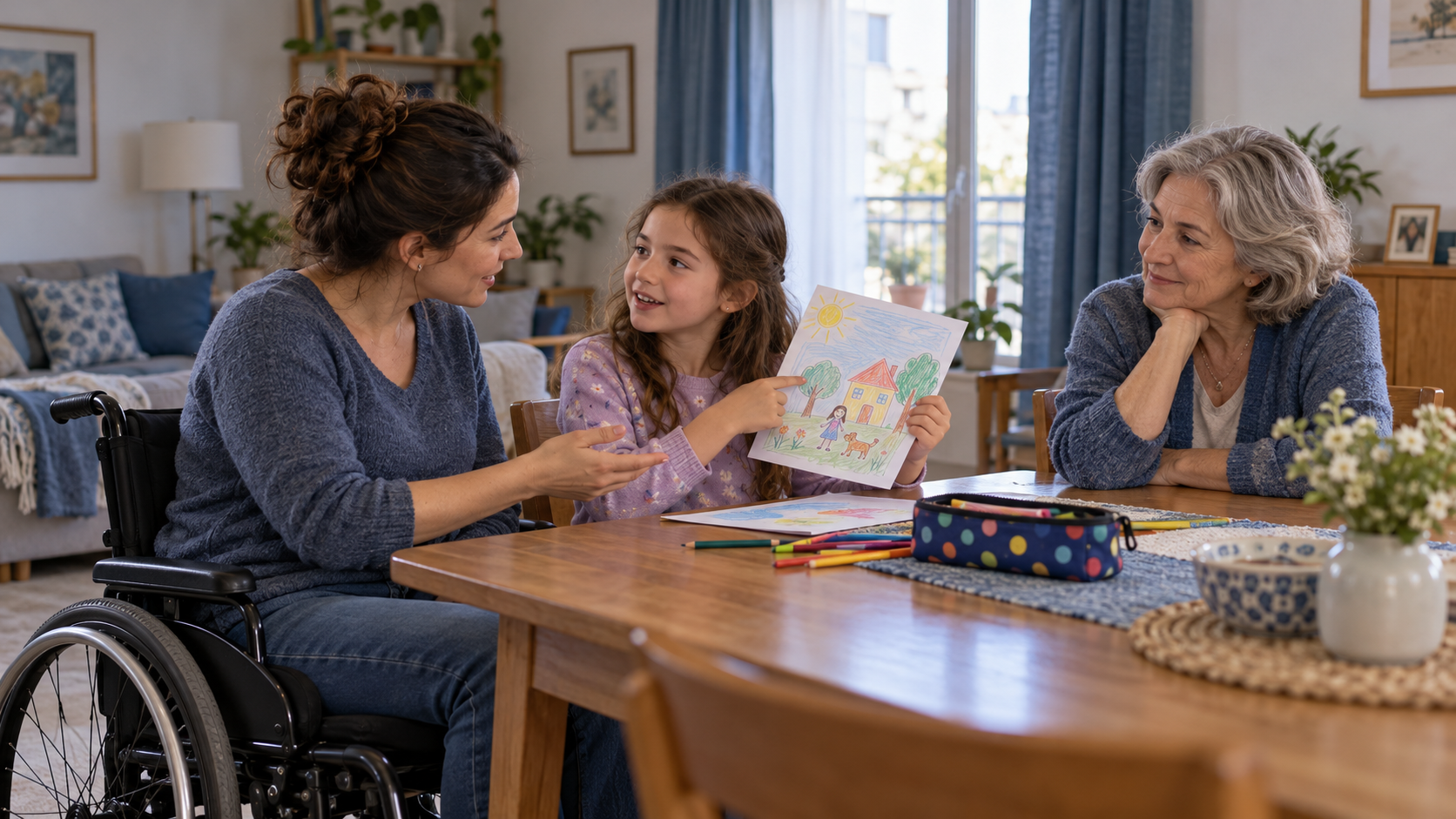
A teacher asks the grandmother which activity the child should attend. The grandmother does indeed bring the child every day. The mother is present, but the conversation bypasses her: because she needs help, others have made a further inference that parental decisions have also passed to the helper. Sometimes that transition occurs without a single argument. Everyone believes they have simply made life more convenient.
Epigraph
“Your children are not your children.”
Kahlil Gibran, The Prophet, “On Children,” 1923. The passage continues by describing children's lives as their own. The sentence does not deny kinship or adult responsibility. The Russian and Thai epigraphs explicitly translate its meaning as children not being one's property.
What this article is about
A teacher asks the grandmother which activity the child should attend. The grandmother does indeed bring the child every day. The mother is present, but the conversation bypasses her: because she needs help, others have made a further inference that parental decisions have also passed to the helper. Sometimes that transition occurs without a single argument. Everyone believes they have simply made life more convenient.
This article distinguishes the parental role, performing particular tasks, accessible participation, and the child's own interests. A disabled person can be a caring adult while receiving substantial support. Lifelong disability does not mean there was once another, “real” parent who must first be restored. Acquired changes do not erase a relationship's history. Yet recognising the parent's voice does not make the child property or remove actual safety needs.
We approach a family scene through the Confucian distinction between provision and respect, Buddhist household reciprocity, Gibran's literary image, and contemporary norms concerning parents' and children's rights. These have different foundations rather than forming one ancient law for today's family. A useful outcome is naming one task, the assistance needed, and a decision in which the parent should participate. No service, favourable custody outcome, or medical suitability for particular exertion is promised. The readers are adult parents and chosen adults around them. The child has a voice without being appointed to organise adult care.
I. Parenting is not measured by tasks performed without assistance
A picture of good parenting often consists of visible actions: accompanying, lifting, driving, cooking, and writing in the school chat. When someone else performs some tasks, they can quietly become the only adult perceived as acting. But carrying out an action and participating in a relationship do not entirely coincide. Who notices the child, discusses their life, makes decisions within their role, and carries the relevant responsibilities matters alongside whose hands appear in the photograph.
Imagine Sofya, the mother of a schoolgirl, who uses help with journeys and some household tasks. She discusses friendship with her daughter, chooses a book with her, and communicates with school through an accessible method. The grandmother makes some journeys possible. Her contribution is real and should not disappear in the name of respecting Sofya. Yet the number of journeys does not establish that the mother has become an outsider in her child's upbringing.
In Analects II.7–8, respect for parents is not reduced to material provision or performing difficult tasks. The context is historical filial piety and ritual hierarchy, rather than a contemporary model of equal family rights. The useful distinction is limited: providing for someone and respecting their position are not the same act. This does not impose unquestioning obedience or adult care duties on a child.
A parent needing assistance with their own daily life does not automatically become their helper's child. Equally, a beautiful account of their role does not cook dinner or remove a dangerous support gap. Recognising parenthood and organising necessary actions belong together. If nobody can perform something essential, a concrete solution is needed rather than a willpower examination or reassurance that love replaces everything.
II. “Help me do it” does not always mean “decide for me”
Sofya asks the grandmother to take her daughter to an activity. The grandmother changes the activity herself, explaining: “I do the driving, so I should choose.” A real condition of assistance has collided with an unspoken transfer of a decision. The grandmother can say where and when she is able to travel. Her limit should be stated directly rather than treated as evidence that the mother's view is no longer needed.
A particular matter can be separated into a question, a decision, and carrying it out. Where does the child want to go? Which conditions are available? Who has the relevant authority and participates in choosing? Who can provide the journey? This is not a homemade legal guardianship scheme. Existing court orders, another parent's rights, and a lawful representative's role are governed by applicable local rules; this article does not cancel them.
Communication support need not transfer authorship either. If a parent uses an alternative communication method, a chosen adult may help convey their thought. They should not quietly add their own decision as though translating. Lack of speech does not itself establish lack of understanding or preference. Article 21 of the Convention on the Rights of Persons with Disabilities includes different communication forms, without establishing that a suitable resource exists in a particular family.
A parent may genuinely wish to delegate some decisions within permissible limits. That can be their choice too. Chosen delegation differs from an automatic transfer: “Since they need help, we no longer ask.” Clarifying one task need not require official language: “I am asking for help arranging the journey, but want to discuss the choice with my daughter and you.”
III. An environmental barrier is not a ready-made parenting assessment
The school meeting is in a room Sofya cannot enter. An organiser says she does not participate in school life. The arrangement of the meeting has disappeared from the observation. Absence from an inaccessible room does not establish lack of interest in a child. Similarly, an unsuitable written format or unavailable interpretation should not become lack of understanding without examination.
Article 23 of the Convention addresses nondiscrimination in family life and parenting, assistance with child-rearing responsibilities, and no separation based on the disability of the child or parents alone. These are international obligations, not a guarantee of a particular service or an individual dispute's outcome. The same provision includes children's interests and legally established procedures. Equality means neither automatically removing a role nor refusing to notice actual harm.
The U.S. Department of Justice's explanation of disabled parents' rights identifies individual assessment and avoiding stereotypes in certain agencies and courts. This is a U.S. legal framework and informal guidance rather than law for every country. For the scene here, it illustrates an important movement of thought: consider particular circumstances and conditions of participation instead of inferring an answer from a category of people.
Requesting an accessible format does not prove someone can handle every task without support. It removes one false substitution. Lack of time, a difficult disagreement, a need for intelligible explanation, or unavailable transport may remain. One barrier and one needed way to participate can be named without promising the institution will immediately comply. If local procedure is unknown, that is uncertainty rather than grounds for inventing a universal application form.
IV. The child has a voice of their own
Protecting a parent against exclusion can lead to another extreme: treating every disagreement from the child as undermining parental authority. Yet the child is not confirmation of another person's adequacy. They may dislike the chosen activity, want time with friends, and have varied feelings about arrangements at home. Their view need not match a convenient public story of a harmonious family.
In Gibran's “On Children”, love differs from possessing a child's thoughts; the image of a future life limits parental ownership. This is literary spiritual speech rather than a demonstrated developmental theory. It does not release adults from care or make a young child responsible for every choice. It helps reveal that love and identical wishes are different things.
Article 12 of the Convention on the Rights of the Child concerns freely expressed views receiving due weight according to age and maturity. Articles 3, 5, and 18 connect children's interests, evolving capacities, and adult responsibility. Legal procedures depend on place. In an everyday scene, hearing a preference differs from transferring all responsibility: asking a daughter about an activity does not assign her the money, transport, and search for another adult.
A child can communicate in a way available to them without becoming an eloquent defender of one parent against another. If adults disagree about assistance, the child should not be appointed judge of who is sufficiently tired or loves more. Adults can explain limitations without making reconciliation the child's job. Disagreement alone does not establish that somebody's voice must be removed.
V. Mutual care does not make the child a coordinator
Children and adults offer things to each other in family life. A child may freely bring a book, join a familiar household task, or delight a parent with a story. Not every act of help is an inappropriate adult burden. Yet occasional participation differs from responsibility for whether an adult receives essential assistance.
In the Sigalovada Sutta, DN 31 §§27–28, family duties are reciprocal: parents receive respect and also guide, teach, and pass opportunities to their children. The addressee is a young householder; historical ideas about lineage, marriage, and inheritance differ from contemporary rights. This does not appoint a present-day minor as a medical organiser or turn being born into an endless debt.
Sofya can enjoy her daughter bringing a drawing without making her the only person monitoring necessary adult assistance. Medical decisions, arranging essential care, and coordinating crises remain adult tasks. A child's age-appropriate contribution need not be belittled, but “reciprocity” cannot conceal the absence of a responsible adult.
If that adult is missing, “Find support” does not solve the problem. One immediate gap can be named and a suitable, available local source asked what assistance exists, without promising it will be obtained. The parent need not become an expert in every system, or the child fill its gaps. A current safety threat calls for appropriate urgent help; reading the article and negotiating family roles must not delay it.
VI. Actual difficulties deserve assistance rather than denial
A disabled parent may find describing a particular difficulty hard when every need is treated as evidence of unfitness. A public image of independence then protects against a stereotype at the cost of hidden exhaustion. The opposite story—that disability necessarily makes parenting untenable—also crudely replaces life with a predetermined conclusion.
A fact, its consequences, and an assessment of the person can be distinguished. The fact: nobody is available to perform a necessary action today. The consequence: the child or adult has an unmet need. No universal verdict about all parents with that diagnosis follows. Yet respect does not make the need disappear. Specificity makes support discussable instead of producing an endless argument about whether the family is good in general.
The convention frameworks consider parental rights alongside children's interests. Article 23 of the disability Convention does not prohibit a lawful determination by competent authorities, subject to judicial review, that separation is necessary for a child's best interests; it rules out disability as a basis in itself. Article 19 of the children's Convention concerns protection from violence and neglect. These norms do not let an article pronounce a particular family safe or unsafe without facts and local procedure.
Actual risk needs discussion on its merits, with accessible parental participation and attention to the child where possible. Necessary assistance must not be stopped to prove independence. This text prescribes no infant-care, lifting, feeding, or exertion technique. Individual practical and medical conditions need an appropriate professional basis. Recognising the article's limits keeps the subject clear: what assistance this life needs, rather than which heroic personality should replace a missing resource.
VII. An ordinary parenting day need not inspire
It is tempting to tell stories of a disabled parent only as tragedy or achievement. Either story can lose ordinary life. An exhausted argument about socks becomes a symbol of victory, while a quiet evening seems insufficiently interesting. The parent must explain the meaning of their existence to observers rather than talk to their child.
Sofya may dislike the school chat, mistake a date, request help, and understand well what has upset her daughter. These aspects can coexist. Parenthood's significance does not require infallibility. The ability to make mistakes also does not remove the need to repair particular harm. Ordinariness is neither a medal nor an exemption from responsibility.
Reading together, arguing about a fairy tale, or being quiet after a hard day can have value of its own. Every minute need not become a compensatory exercise, evidence of a child's development, or a report on parental resilience. Where a suitable format exists, help may remain its condition without occupying the entire story. If a format does not work, love does not require enduring it for an attractive family image.
Gibran distinguishes love and possession; Confucian questioning distinguishes respect and provision; the Buddhist scene connects household positions with duties in both directions. They understand family and spiritual order differently. Contemporary rights have a different language and procedures. Similar useful questions neither make them interchangeable nor establish that ancient writers had already solved today's accessibility problems.
VIII. Assistance can extend participation rather than replace it
In a well-arranged task, both adults remain visible. The grandmother says where she can actually travel. Sofya discusses the choice within her parental role. Her daughter explains what she wants and dislikes. The conversation guarantees no accessible activity. It does mean nobody disappears simply because another participant performs more physical actions.
Relevant authority, obligations, and constraints cannot be inferred from an affectionate tone alone. Another parent may have an equal role; a lawful representative a defined function; a professional responsibility within their field. Sofya's own voice does not mean everyone must carry out her every decision. It means her participation should not be replaced in advance by discussing everything with the most convenient helper.
When a condition fluctuates, arrangements may change. Assistance chosen for one day does not necessarily transfer the entire role forever. Where feasible, an open question and a possible return to it can be clarified without a compulsory review schedule. Participation may be slower or differently arranged for a parent with substantial support needs. Speed of response does not by itself determine authorship.
A first result may be modest: school addresses the parent, adults clarify one task, or the child stops being assigned adult coordination. Sometimes that change has not happened yet. An unrealised right differs from an established absence of a right. Needing assistance differs from permission to stop hearing someone as a mother or father.
What this means in practice
Choose a particular matter, if possible now: school communication, a journey to an activity, or the family's evening. Distinguish the decision, relevant roles, and actions needing help. One sentence can replace a table: “I need assistance with this action; I want to discuss the question itself with my child and another responsible adult.”
Check whether the parent is heard through their own accessible method. An intermediary can convey a response without replacing it with their convenience. Familiar family interpretation cannot be declared legally sufficient for every institution: local requirements and authority need checking. One request for a suitable format may clarify the barrier even before a resource is found.
Ask the child about their experience in a way suited to age and communication. Do not assign them the choice of who is responsible for adult safety, treatment organisation, or resolving adult disagreement. Their ordinary contribution can be accepted without making saving the family their duty.
Name one missing resource. Money, another adult, or a suitable service does not appear because an arrangement sounds good. Where available, a responsible professional or local service can be asked about particular assistance and conditions. Do not promise it beforehand or cancel necessary actions to prove independence. Urgent danger needs appropriate current help.
After talking, look at facts: is it clearer what is decided and by whom, was the child heard, and is the needed task provided for or a gap identified? This is no parental adequacy score. Naming one's role and a particular need changes “Am I doing enough alone?” into “How can participation and care be arranged in our actual life?”
Key quotation
“You may give them your love but not your thoughts, / For they have their own thoughts.”
Kahlil Gibran, The Prophet, “On Children”; two adjacent lines, with the line break marked by a slash. A literary limit on possession rather than abandonment of age-appropriate care and responsibility.
Connections between traditions
| Comparison | What it helps distinguish | Limit |
|---|---|---|
| Analects II.7–8 / parental participation today | Tasks done for someone do not exhaust respect for them. | Historical hierarchy and filial piety do not oblige children to remain silent or provide adult care. |
| DN 31 §§27–28 / children's Convention Article 18 | The parental role involves obligations and needs support; family life exceeds receiving services. | Householder ethics differs from international state obligations; the child does not acquire adult responsibility. |
| Gibran's “On Children” / a child's right to be heard | Love does not require possession of another's thoughts. | Spiritual poetry is neither developmental theory nor a procedure for weighing views; adults retain responsibility. |
| Disability Convention Article 23 / children's Convention | Parental nondiscrimination and children's interests need attention together. | No dispute outcome is guaranteed and actual harm cannot be ignored; local authority and procedure matter. |
| Confucian respect / Gibran's literary independence | Neither adult provision nor owning a child exhausts a relationship. | A hierarchical family foundation differs from an independent future life; the tension is not smoothed into one doctrine. |
Primary sources and materials used
- Confucius. Analects, James Legge, II.5–8 and surrounding context read; main use II.7–8. Not the whole work, Chinese original, or contemporary law.
- DN 31. Sigalovada Sutta, John Kelly, Sue Sawyer, Victoria Yareham, 2005. Opening §§1–2 and family §§27–28 read with neighbouring relationships §§29–33; limited paraphrase. Not the whole Pali Canon or instructions for a minor's care duties.
- Kahlil Gibran. The Prophet, 1923, On Children. Entire children section read; both quotations verified. RU/TH are own translations from English, the epigraph interpretive; not biography or family research.
- Convention on the Rights of Persons with Disabilities, Articles 21 and 23, Australian Human Rights Commission. Complete provisions used read; Article 23 checked again in full. International norms do not establish local implementation.
- Convention on the Rights of the Child, UNICEF, Articles 3, 5, 9, 12, 18–19 fully read. Interests, voice, responsibility, assistance, and protection; not a particular custody consultation.
- U.S. Department of Justice. Rights of Parents with Disabilities. Entire substantive text and guidance-status qualification read. A U.S. example of individual assessment and access rather than every country's law or a service promise.
Web versions checked on 24 October 2026. Sofya and other scenes are hypothetical, not interviews or the experience of all disabled parents. Actual readers have not tested the practice's usefulness.
Tags
parenting, disability, mothers, fathers, children, family life, assistance, parental voice, decisions, performing tasks, accessibility, supported communication, children's rights, best interests, nondiscrimination, stereotypes, custody, adult responsibility, family roles, assistance boundaries, school, resources, dignity, Confucius, Buddhism, Sigalovada Sutta, Kahlil Gibran, ordinary life
About the authors
Andrey Zarinsh is the author and founder of United Wisdom. He explores inner transformation, the unity of traditions, intercultural dialogue, and contemporary spiritual discipline. Instagram: @andrey.zarinsh.
Maria Evilkut is a co-author of United Wisdom. Alongside her research, she seeks to test these ideas in practice and observe how principles of unity and mutual understanding work in real life between people and cultures. Instagram: @ilkutki.