
F
A Child Alongside an Ill Parent: What to Explain and Who Can Be There
A child hears fragments of telephone conversations, notices a changed day, and asks who will collect them from school. Adults answer: “Everything is fine. Do not think about it.” They want protection, but the actual question remains unanswered and family life has already changed. A teenager may receive far more detail while quietly acquiring another assignment: they must now prevent the parent becoming upset and ensure assistance does not fall through.
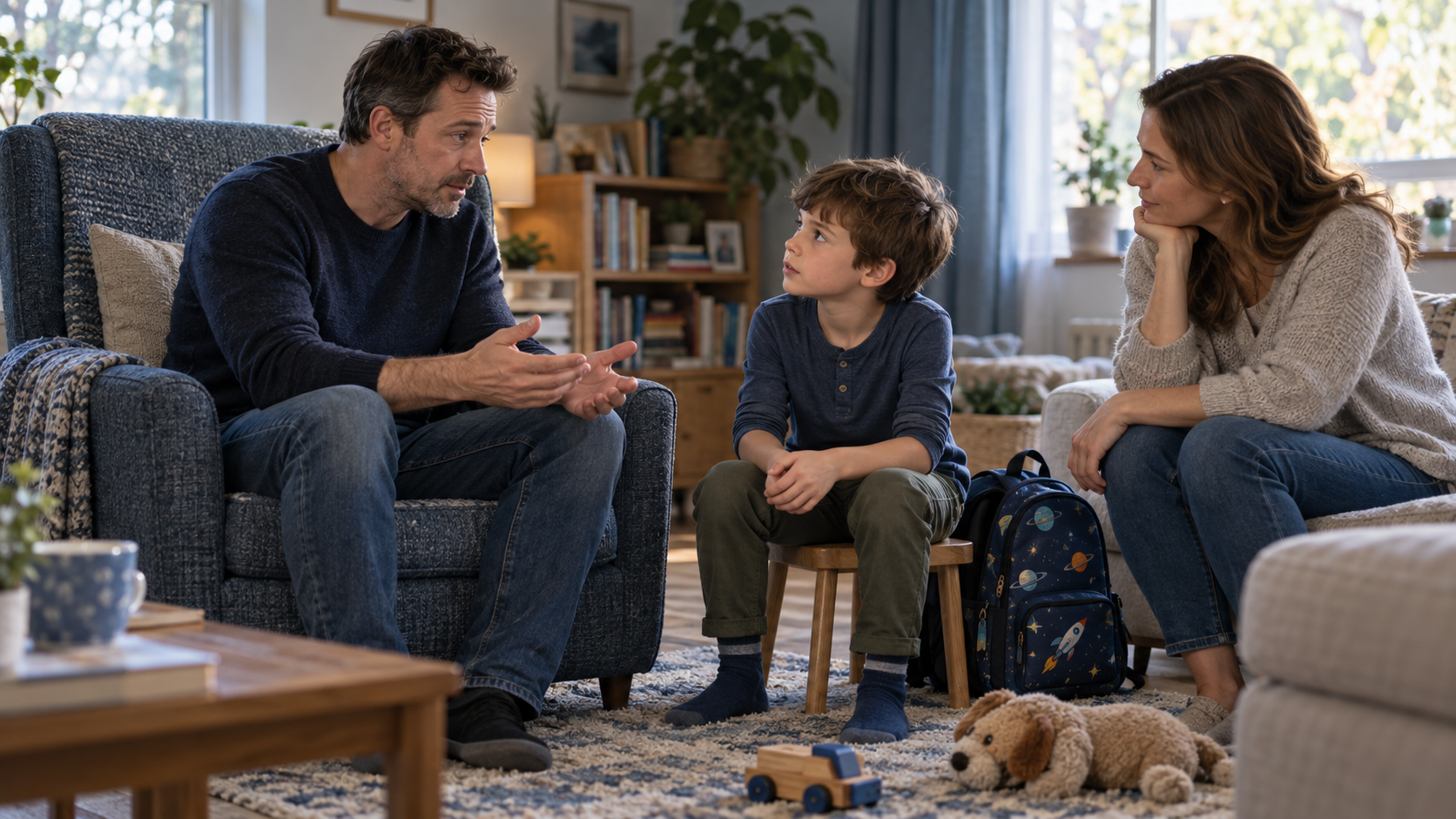
Epigraph
“and none spake a word unto him”
Job 2:13, King James Version; part of the verse. Friends sit beside Job in his grief. This is an image of presence, not a rule to keep a child uninformed or a waiting period before seeking assistance.
What this article is about
A child hears fragments of telephone conversations, notices a changed day, and asks who will collect them from school. Adults answer: “Everything is fine. Do not think about it.” They want protection, but the actual question remains unanswered and family life has already changed. A teenager may receive far more detail while quietly acquiring another assignment: they must now prevent the parent becoming upset and ensure assistance does not fall through.
This article addresses adults: the parent who is ill, another caring adult, and chosen people close to them. It distinguishes an accessible explanation, the child's own feelings, and organising adult support. The child does not become this article's patient or acquire responsibility for treatment. Parental disability is not equated with illness: where it is lifelong or already part of family life, no sudden story of losing the former family needs inventing.
A useful outcome may be one honest statement about today, an identifiable adult for a question, and an unsuitable responsibility lifted from the child. Biblical presence and listening, Buddhist family duties, Gibran's literary independence of children, and contemporary family guidance offer different perspectives. They establish neither illness causation nor a guaranteed psychological outcome. An unknown prognosis remains unknown; an unavailable adult cannot be replaced by promising that someone will certainly appear.
I. Begin with the life that has changed
An adult may be thinking about a diagnosis while a child wonders who will be home this evening. The questions do not compete in seriousness. One concerns illness; the other the child's position alongside it. Explaining investigation names without discussing immediate changes can leave the child unsure what is happening to their own day.
Imagine Denis, noticing his father leaves more often and his mother answers calls in another room. Asking about tomorrow's walk, he hears that this is no time for trivialities. Yet the walk belonged to their relationship and familiar arrangements. Naming the change does not place recreation above treatment. An adult can say his father cannot go tomorrow and explain actual alternatives without promising an unarranged replacement.
The U.S. National Cancer Institute's information for parents recommends honest communication and room for children's questions. It concerns cancer rather than all conditions, and does not demonstrate every conversation's effectiveness. The limited principle used here is discussing visible changes intelligibly without presenting customary reassurance as information.
A parent may be unready for a long conversation or lack energy now. A first answer need not contain the whole diagnosis. “I know you have noticed changes. Today I can explain who will be here this evening” is possible if the fact is known. If that is unknown too, adults need to address the gap rather than leave the child to work out how the household will function.
II. Honesty does not mean a complete adult report
A child need not know every investigation detail, financial dispute, or medical conversation to receive an honest answer. Distinguish what is known, unknown, and relevant to their life. Age, understanding, and actual questions matter more than a rigid universal script. A nonspeaking child is not presumed unaware or without a need for explanation.
A young child can hear briefly about today's event. A teenager may want more detail or no conversation at the moment. These are possibilities rather than a chart of compulsory reactions by age. Chosen support, familiar words, or an image may assist where available. A digital app is not required for entering a family conversation.
Unknowns must not quietly become promises of recovery. An adult can say: “We do not know that yet. This is what we actually know now.” That does not abandon presence. What can be promised is a real action of one's own—for example, returning to a question after obtaining an answer, if possible. A general article cannot guarantee timing, outcome, or the medical safety of contact.
Information about transmission, causes, and suitable actions needs a basis for the particular illness. NCI's statement that children's thoughts and actions did not cause their parent's cancer belongs to that context, not a universal medical account of every condition. Yet a child's fear and a coincidence of events do not themselves establish guilt. Adults must not assign curing illness through good behaviour to the child.
III. Different feelings can exist together
Denis misses his father and is angry that the promised walk was cancelled. He may go and play immediately after a serious conversation. These scenes do not let an article determine how much he loves his father or how he experiences illness. An adult can avoid requiring one correct expression: sadness, continual sympathy, or cheerfulness for the parent's benefit.
In James 1:19, listening comes before hurried speech and anger. This is a religious exhortation to a community rather than child psychology research. Here it addresses the adult: do not rush to tell a child what they must feel. It must not become a command that children never become angry or hide uncomfortable questions.
Feelings differ from actions too. Acknowledging anger does not permit harm. An adult can set a limit on a particular action while leaving room to discuss disappointment. If an exhausted parent answered sharply, that can be acknowledged without first requiring the child to comfort them and demonstrate understanding of their difficult position.
Attention need not look like conversation. It can mean listening to what the child wants to tell, remaining available in a familiar way, or allowing a pause. A missing response does not establish an absence of questions, but neither permits endless interrogation. Significant concerns about the child's condition call for appropriate professional help where available. A school mark, silence, or one angry episode does not establish a diagnosis in this article.
IV. Presence and explanation do different jobs
Job's friends in 2:11–13 come to share his grief and initially sit silently. In 42:7–9, their speech about God is rebuked. These passages provide neither a complete account of the book nor a medical explanation of suffering. Their limited comparison reminds us that wanting to comfort does not make every explanation correct.
A child alongside an ill parent differs from Job's adult friends. They may need concrete information. The image of silent presence cannot justify postponing an answer about who will be there or turning illness into an unmentionable family secret. Quiet matters when it does not replace necessary explanation or keep someone involuntarily uninformed.
An adult can lack an explanation of why illness occurred while remaining responsible for the next actual arrangement. They can admit not knowing comforting words without leaving the child to organise the day. A higher meaning need not be found. Family religion may matter without establishing medical causation or obliging children to heal a parent through faith.
Parents also need support and cannot necessarily conduct every conversation themselves. A chosen adult can help explain known facts, agreeing their role where possible. This assists the parent rather than proving their disappearance from family life. Distributing conversations does not automatically justify handing every decision to the most convenient relative.
V. Family participation is not managing adult assistance
A child may want to draw a card, bring a familiar object, or join a manageable household task. Participation need not be declared meaningless because they are a minor. Wanting to help does not, however, establish an ability or duty to coordinate treatment, monitor essential care, or maintain every adult's emotional stability.
In DN 31 §§27–28, parents and children have reciprocal obligations. The addressee is a young householder within historical family arrangements. This cannot directly become instructions that today's child replace an absent adult. Family reciprocity does not amount to unlimited debt for being born.
NHS information about young carers distinguishes a minor's contribution from adult caring responsibilities, with attention to school and the child's own life. It describes a particular support system that cannot be promised to readers everywhere. The relevant distinction recognises contribution without appointing the minor as the final foundation for all assistance.
Denis can ask where the card is without becoming responsible for checking his father's medical plan. An older teenager need not hold every password, contact every service, and decide when an adult needs urgent assistance as the sole person responsible. If that is already family life, condemning the parents solves nothing. A concrete adult alternative needs seeking where available, with missing resources acknowledged honestly.
VI. Adult support needs a name rather than an imaginary presence
“Someone will always take care of you” can sound warm while failing to describe the family's circumstances. Naming someone who has actually agreed, what they can do, and an accessible way to reach them is more useful. Their absence is neither a reason to lie nor a task for the child to build a network themselves.
Article 18 of the Convention on the Rights of the Child connects adult responsibilities with family assistance, while Article 12 retains the child's voice. These international norms do not establish a local service. In everyday application, children can be asked whom they find comfortable to speak with without being assigned to select a professionally suitable adult or arrange every condition of meeting.
A teacher, familiar adult, or professional is an option only where actually available and accepting the relevant role. Complete secrecy must not be promised: confidentiality and child-protection requirements depend on institution, role, and local law. An intelligible account of who might receive information and why is preferable to a promise the adult cannot keep.
Without money, family, or a convenient telephone, a first step can be small: one adult names a particular gap to an accessible local support source. No elaborate diary is required. If a child's or adult's safety is currently threatened, suitable urgent help takes priority over planning a conversation or obtaining family unanimity. It must not wait for a perfect network.
VII. The parent remains a parent and the child a child
Illness can change shared activities without removing the relationship's significance. A father may miss the walk and still care about his son's school story. A mother receiving care may remain the person a child approaches with news. Every change need not be compensated by a more useful activity or continuous proof of family continuity.
In “On Children,” Gibran distinguishes adult love from possessing a child's thoughts. This literary spiritual image is neither illness theory nor an instruction to abandon care. Here it helps retain a separate life: children can have friends, interests, and joy that are not services to an ill parent.
A shared joke, familiar story, or suitable quiet may have value of its own. They need not be therapeutic practices. Touch, a visit, or a particular activity does not become medically appropriate merely because it matters to the family; conditions depend on the situation. An unavailable familiar format and an absence of an attractive replacement do not establish lack of love.
The child need not perform comfort to preserve parental dignity. The adult need not appear invulnerable to remain significant. An honest limit—“I cannot talk for long now”—can coexist with attention. It requires adult consideration of what remains unanswered rather than ordering the child to stop needing anything.
VIII. Conversation can continue without claiming control of the future
One conversation need not solve everything. Denis may ask about the walk today and illness later. A teenager may decline speaking in front of everyone but choose another moment or adult. This is not the failure of the first discussion or grounds for demanding feelings on schedule. Changed facts may need another explanation without compulsory daily emotional checks.
Adults can distinguish what they know, what they are still clarifying, and what they cannot promise. Even limited clarity can be concrete: who is home today, which agreed task will happen, and whom to ask. An uncertain prognosis does not justify invented certainty. Knowing a diagnosis does not mean knowing the entire future.
Biblical listening and presence, Buddhist reciprocity, and Gibran's separateness address different questions. Contemporary sources add specific guidance and rights within stated scopes. Their intersection is limited: be present, hear another person, and retain adult responsibility. No shared spiritual idea establishes this exercise's effectiveness or replaces needed help.
The result may be a heard question rather than a calm child; adults with one clearer task rather than a confident parent. Feelings and facts remain alive and sometimes difficult. The aim is not removing every fear through correct words, but making relationships honest enough that illness does not appoint the child as culprit, rescuer, and sole keeper of family life together.
What this means in practice
An adult can prepare one short part of an explanation: what is actually known and which change affects the child's day. Answer one question rather than provide the entire medical report. If the answer is unknown, say so without promising an outcome or date. Wording about the particular illness can be checked with a responsible professional where available.
Allow a question, feeling, or no reply for now through the child's familiar accessible method. Listening requires no interrogation. Anger is not evidence of missing love; silence is not agreement to new duties. A manageable contribution can be welcomed while adults remain responsible for treatment, safety, and assistance coordination.
Name a real adult and a particular form of support: who has agreed to discuss a school issue, be present, or arrange a task. If nobody has, name the gap first and seek available support without assigning the search to the child. Money, an app, and a large family are not presumed. An absent resource remains absent until found.
Clarify what the child wants shared with school or a chosen adult, considering age, safety, and local rules. Promise no absolute secrecy. Current urgent help does not wait for the conversation to end, and family decisions do not establish the medical suitability of actions.
Afterwards, check clarity rather than calm: was a question heard, a near-term change explained, an adult task actually accepted, or a gap made visible? This is an editorial suggestion, not a parenting test or demonstrated prevention. Sometimes a worthy outcome is an honest pause in which a child no longer needs to pretend they have noticed nothing.
Key quotation
“let every man be swift to hear, slow to speak, slow to wrath”
James 1:19, King James Version; the exhortation, with the opening address omitted. Here it questions the adult listener rather than requiring children to suppress feelings.
Connections between traditions
| Comparison | What it helps reveal | Limit |
|---|---|---|
| Job 2:11–13 / James 1:19 | Presence and listening need not explain everything immediately. | Comforting an adult friend differs from supporting a child needing information; silence is no universal solution. |
| Job 42:7–9 / honest uncertainty | Wanting to comfort does not make every explanation true. | Judgement about speech concerning God is neither medical causation nor an assessment of a particular parent. |
| DN 31 §§27–28 / young carers and adult responsibilities | Reciprocity can coexist with distinct roles and responsibilities. | A historical householder is not today's minor; NHS arrangements are not guaranteed elsewhere. |
| Gibran's “On Children” / children's Convention Article 12 | Children retain their own lives and voices during family difficulty. | A literary image is neither a rights procedure nor abandonment of age-appropriate care. |
| James on speech / NCI guidance | Adults can allow questions without requiring a set reaction. | Religious exhortation is not clinical research, and cancer guidance does not cover every illness. |
Primary sources and materials used
- Job 2:11–13 and 42:7–9, King James Version. Both passages fully read, not the entire book or all the friends' speeches. The epigraph is part of 2:13.
- James 1:19, King James Version. Full verse read earlier in this assignment; the key quotation retains the exhortation and omits the address.
- DN 31, John Kelly, Sue Sawyer, Victoria Yareham, 2005, §§1–2 and 27–33 read earlier; main use §§27–28. No universal duty of children to provide adult care.
- Kahlil Gibran. The Prophet, 1923, On Children. Complete section read earlier in the assignment; a limited literary comparison.
- NCI. Talking to Children about Your Cancer, updated 26 September 2018. Entire substantive text read; guidance on explanation, feelings, contribution, and support for minors used. The adult-children section is not transferred to minors; no universal prognosis or demonstrated practice effect.
- NHS. Being a young carer: your rights, reviewed 27 March 2024. Entire substantive text read. England's particular system; local services, benefits, and assessment outcomes are not promised.
- Convention on the Rights of the Child, UNICEF, Articles 12 and 18–19 fully read earlier. Voice, family assistance, and protection provide a normative framework rather than individual legal advice.
Web versions checked on 24 October 2026. Denis and other scenes are hypothetical, not a child assessment or a report of testing with actual families.
Tags
children, ill parents, family, explaining illness, honesty, uncertainty, questions, listening, children's feelings, adults, support, care, family roles, young carers, adult responsibility, accessible communication, school, privacy, safety, ordinary life, play, closeness, Job, James, Buddhism, Sigalovada Sutta, Kahlil Gibran, children's rights
About the authors
Andrey Zarinsh is the author and founder of United Wisdom. He explores inner transformation, the unity of traditions, intercultural dialogue, and contemporary spiritual discipline. Instagram: @andrey.zarinsh.
Maria Evilkut is a co-author of United Wisdom. Alongside her research, she seeks to test these ideas in practice and observe how principles of unity and mutual understanding work in real life between people and cultures. Instagram: @ilkutki.