
G
A paid helper in my home
When a paid helper enters a home, privacy, particular work and continuing need meet. Payment does not buy an entire person; need does not transfer the recipient’s whole life. This article distinguishes task, access, agreement, appropriate competence and actual performance. We first consider an adult supported since childhood, then retain Galina’s family scene as another possibility. Family, replacement money and earlier independence are not assumed for everyone. NHS is a bounded British example; international norms have their scopes; the Analects and Gospel have different moral contexts. There
Epigraph
“the labourer is worthy of his hire”
Luke10:7, a complete clause in the KJV. Context10:1–9, concerning sent disciples and hospitality, was read. This religious source supplies neither a rate, labour classification nor permission for clinical action.
What this article is about
When a paid helper enters a home, privacy, particular work and continuing need meet. Payment does not buy an entire person; need does not transfer the recipient’s whole life. This article distinguishes task, access, agreement, appropriate competence and actual performance. We first consider an adult supported since childhood, then retain Galina’s family scene as another possibility. Family, replacement money and earlier independence are not assumed for everyone. NHS is a bounded British example; international norms have their scopes; the Analects and Gospel have different moral contexts. There is no care technique, household capacity test, universal contract or safe period without assistance. One possible result is a clear question about particular work and access, in which both recipient and worker are heard.
I. Home and work do not absorb one another
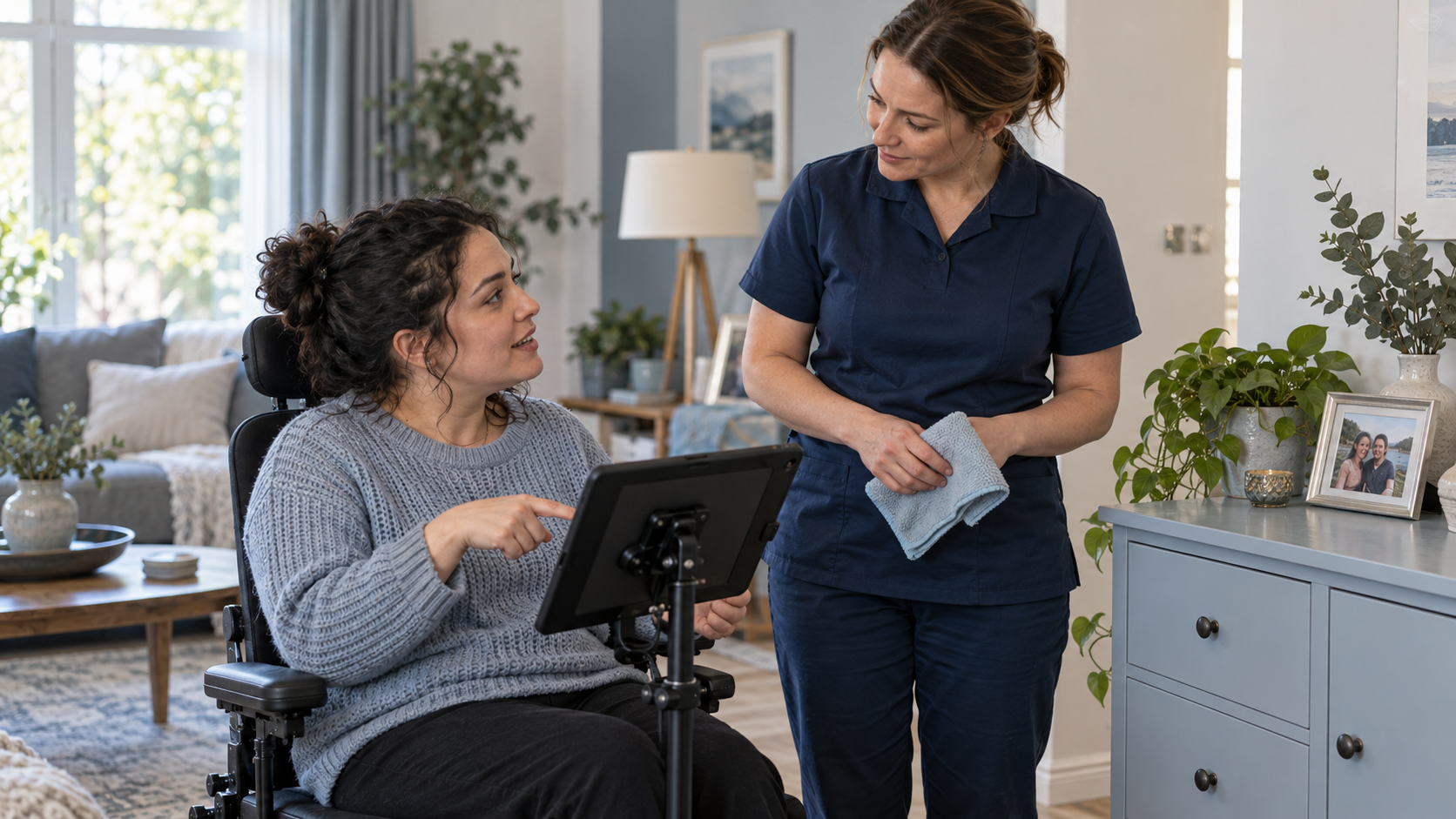
Samira is thirty-four, has used support since childhood and communicates in her chosen way without speech. A helper comes for agreed tasks. One day he opens a private drawer “to put everything in order”, then answers a relative for Samira because he knows what to say faster. This fiction establishes no violation. It shows two expansions: from task to access and from assistance with action to answering for someone. A well-cleaned room does not settle either question.
One place can be clarified: why does the agreed task need this drawer, and how is Samira’s answer established? A pause becomes no convenient agreement; help understanding or expressing a position transfers no entire life to the most fluent speaker. CRPD12/19/22 provides international participation, support and privacy frameworks rather than a household examination or domestic legal finding. Extensive needs require suitable accessible communication and competent consideration where necessary.
Samira may lack a family organiser or money for another worker. That does not make her sole dispatcher of every service. Organising assistance may itself need support; reporting an absent worker may produce only a partial answer. Naming a service does not close the issue. The following family scene is one possibility rather than a compulsory model. Essential assistance remains necessary in both: examining access does not recommend abrupt withdrawal or testing an unfamiliar action on its recipient.
II. A person is invited for particular participation
Maxim is arranging a helper for his mother, Galina. In this fictional situation she needs particular assistance at home; that is established in the scene, not inferred from age. Elena can visit on Thursday. Maxim already imagines everything covered. Galina does not know which actions were agreed, while Elena has heard only a general description of helping an older person. Shopping, accompaniment and another part requiring appropriate clarification have entered one conversation. A role’s name has joined tasks that cannot all be accepted through one unspoken agreement.
First name the action Galina needs. The word helper does not say what will happen on Thursday. Cleaning a particular area, bringing shopping, accompanying a journey and performing an action with specific requirements have different subjects. Agreeing to discuss a visit accepts none automatically. Content and conditions need an actual answer. Clarity begins before arrival through understanding the particular participation proposed, rather than a complete character assessment of Elena. The family needs to know which part is accepted before her name becomes evidence for everything they hope will happen.
Recipient need and organiser convenience may overlap without being identical. Maxim wants less shopping work; Galina needs an understandable way to obtain things and retain her response. One outcome does not establish another. His workload may ease while her need remains unmet. Shopping may be completed while organisation stays with him. These are different arrangements. Incomplete assistance need not be dismissed as worthless. Yet everything cannot be called settled before the accepted part and what remains outside the visit are known. An honest partial outcome is more useful than a complete solution nobody has actually agreed.
Duration also has particular meaning. One hour of presence does not mean readiness for every action within that hour; one visit creates no permanent role. Elena may accept one task and decline another without rejecting a caring relationship. Naming a family need does not expand work automatically. More assistance is a separate question. The missing part cannot be recorded as agreed because asking again feels awkward or because finding a person is easier to regard as the end of difficult organisation. A person’s availability needs its own content, limits and real acceptance.
The recipient need not first prove complete helplessness. Galina can do many things and still need particular support. Conversation does not establish capacity for every household action; difficulty in one action defines no whole life. The scene is no individual assessment. A precise description frames a bounded support question without a global judgment of the person. Where appropriate professional assessment is needed, the article stops before prescribing what is safe and sufficient for an unknown reader. Naming a real need can matter without supplying every specialised answer about how it should be met.
III. Household tasks, accompaniment and specialised care differ
The NHS page on paid help at home distinguishes domestic tasks from broader homecare content. This is a bounded example of British terminology, not legal categories for every country. In our scene, the useful question concerns content: what does Elena’s offer include and which part needs different competence or participation? The whole NHS task list cannot be assigned to everyone a family calls a caregiver. A service name can begin clarification without certifying each worker for every action found under that heading.
Cleaning and accompaniment have conditions of their own. Route, communication and actual ability do not arise from a friendly introduction. For specialised help, medication, movement or another procedure, domestic experience is no universal preparation. This article gives no instructions and assesses no authorisation for Elena. Appropriate professional grounds and applicable local rules are required. Her willingness does not replace competence, just as willingness to pay does not make an unfamiliar task suitable for any available participant. The relevant question concerns this action and these conditions, rather than whether everybody has good intentions.
Limits remain relevant within a familiar role. Elena may perform certain tasks well without having the conditions for another action today. A good earlier visit does not establish every new capacity. This need not immediately become a judgment of bad character. Identify the changed task and obtain an appropriate answer. An unagreed extension does not make earlier assistance deceptive. Equally, a name on a schedule cannot cover a new part before the person accepts a suitable role and significant conditions are clarified. Previous trust matters without becoming unlimited authorisation.
A domestic setting does not automatically simplify a complex action. The absence of uniform, consulting room or institution removes no actual requirement. Conversely, a professional signboard alone proves no fit with Galina’s need. Content and conditions need verification. This article audits no provider and recommends none. It keeps service name, particular task, appropriate preparation and actual possibility distinct. Otherwise an invitation can become a promise nobody made but on which everyone already relies. The familiarity of home should not conceal the point where a different kind of assessment or participation is needed.
IV. Organising and paying do not replace recipient voice
Maxim may pay without directing his mother’s whole life. His arrangement cannot automatically represent Galina’s consent to every entry, action and communication method. Her response belongs to relevant questions. This does not make every case identical: particular capacity, authority and decision procedures require appropriate grounds. Age, kinship and payment create none by themselves. A planned discussion can begin with a proposal to Galina without supplying convenient consent in advance for everyone else’s reassurance. Making organisation easier is a purpose, not evidence of authority over the person receiving help.
The UN Principles for Older Persons support participation, dignity and privacy when help is received. Norms assess no individual, create no available service and hand no son every decision. Galina preferring another method matters; that preference also does not create an absent resource. Both facts can remain visible. Respect requires neither invented possibilities nor dismissing her response as caprice because an option suited its organiser. An actual constraint and a person’s own answer can belong in the same conversation without one erasing the other.
Galina might accept shopping and decline a particular accompaniment method. That need not reject all support. Clarify the affected part rather than transferring one consent to another subject. Door, kitchen, possessions and information involve different purposes of access. No universal consent form is established here. Preserve the real scope so recipient participation is more than a formality before actions others have already selected. The question is what she accepts about her own life, alongside appropriate conditions for the work, rather than whether she has generally agreed to be helped.
Special decision support or an established procedure is a separate question. Helping someone express an answer does not authorise inventing it. The absence of an immediate answer does not transfer the decision to the most confident speaker. Appropriate work is needed, not a family vote through this article. Immediate danger requires suitable assistance without waiting for ideal discussion. A planned visit should nevertheless not be described in advance as an emergency basis for removing every voice and boundary. Convenience alone cannot make any chosen method permissible and sufficient for every participant whose life it affects.
V. An agreed scope preserves the meaning of help
Participants can identify action, time, significant conditions and what is not yet accepted. This is no universal contract or substitute for appropriate professional documentation. The useful distinctions are proposal, accepted involvement and open part. Elena can state a task outside her role; Galina can identify an unsuitable method; Maxim can report an unavailable condition. Honest answers need not coincide immediately. They are clearer than a broad promise to do everything, after which each expects a different visit. Agreement needs actual content before it can serve as a reliable basis for planning.
Paid assistance also permits no indiscriminate assignment. Payment concerns agreed content and conditions; the worker remains a person. The article establishes no country’s employment rules or tariff. Relevant contractual questions require local norms and circumstances. Here the point is to avoid quiet expansion: one task is not permanent readiness, and gratitude for flexibility is no right to repeat it without another answer. Respecting a limit preserves the value of real assistance without inventing unlimited involvement. A contribution need not become endless before the family can recognise that it matters.
Organisation around a visit also needs a performer. Who agrees times, passes necessary information and obtains answers when conditions change? If Maxim retains that work, it has not disappeared. If Elena accepts an organisational part, its actual scope matters. Frequent presence does not appoint her to coordinate all family life. Nor should Galina alone explain the whole arrangement to every new participant while others consider transfer complete because a telephone number and friendly message were exchanged. The visible visit and the work that makes it possible can have different participants and outcomes.
The NHS page on care and support plans discusses agreed support content. This bounded administrative example supplies neither a universal form nor proof of a service begun. A clear outcome description should not be replaced by an impressive document name. A record can preserve an agreement without establishing arrival or completion. Changed content requires suitable clarification; a previous line does not become more accurate because it was once carefully stored and distributed. Recording a plan and the plan becoming an actual part of life remain different results.
VI. Paid time does not buy endless availability
A worker can accept a particular visit without accepting evening messages as additional work. Living in the home, where applicable, also describes no complete work timetable. ILO Convention189, Articles6–10, addresses understandable conditions, residence, rest and on-call time, with the latter’s extent determined through national grounds. Definitions, ratification and domestic application need examination. This supplies no rate, sleep regime or automatic rule for every helper.
Distinguish a payment to an organisation, agreed work and a particular person’s actual involvement. Gifts and warmth replace no remuneration due under applicable conditions. Family financial difficulty is real but makes no missing part an accepted unpaid shift. Rest matters in the worker’s life; equally, saying “break” provides no replacement for necessary assistance. Both tasks need actual participants rather than choosing whose voice disappears.
In Luke10:1–9, payment concerns sent disciples, hospitality and religious mission. It can draw attention to work behind attractive language of service, but establishes no modern employment, amount or professional powers. Neither this source nor ancient virtue replaces current contractual and clinical grounds. Discussing limits permits no abrupt departure without necessary continuity. In immediate danger, suitable urgent help does not wait for a pay dispute; this article establishes no local channel or safe waiting period.
VII. Getting acquainted is not a complete character test
Galina may need an understandable introduction and time for questions. This creates no duty to trust immediately. Elena can also clarify work conditions. Courtesy helps discussion without determining qualification, authority or suitability for every action. A smile proves no safety; reserve proves no unreliability. This scene supplies no way to read character from a first visit. Relevant information can be obtained while unknowns stay unknown. Personal impressions need not become a final assessment of every kind of assistance the family might later require, even when the conversation feels reassuring to everyone present.
Communication should allow Galina’s response to be heard. A particular pace, format or way of receiving information may suit her; this should be established without prescribing need by age. Appropriate specialists or communication support have roles of their own. Maxim should not automatically answer every question for her, while Elena need not guess all conditions without information. Asking is not deficient care. It helps agree particular involvement without expecting a good helper to understand everything instantly and never need another question. An accessible conversation is part of clarification, not a guarantee that all subsequent tasks fit.
Unfamiliarity may remain even under a suitable arrangement. It proves neither a wrong decision nor a compulsory stage with a predictable outcome. A particular difficulty can be explored. No promise should require Galina to become accustomed, grateful or emotionally close. Work assistance need not create a family bond. Respect still matters whether affection develops or not. Action content, personal experience and relationships may have different outcomes. Combining them into one verdict makes it harder to recognise useful work alongside a remaining difficulty or a polite encounter alongside a task that did not happen.
A familiarisation period permits no dangerous trial. Elena should not demonstrate an unfamiliar procedure on Galina, nor Galina be asked to accept it as a test of skill. Appropriate preparation, assessment and conditions precede the relevant action. This article establishes no professional authorisation procedure. It preserves the difference between ordinary acquaintance and a competent decision. A friendly meeting does not make an uncovered need safe or allow necessary continuity to disappear because conversation was calm. The importance of getting to know a person does not replace the requirements of a particular care action.
VIII. Entry into a home is not access to an entire life
The home remains Galina’s place of life. One job does not make every room, possession and conversation shared. Clarify access and purpose under actual conditions. This is neither lock advice nor a universal legal rule. Particular authority and documentation require appropriate clarification. An opened door is no permission to direct everything inside. Payment, a relative’s anxiety and a new participant’s goodwill do not independently cancel privacy. The invitation concerns help in someone’s own space, and that space need not become common property before assistance can count as meaningful and practical.
NHS examples of respectful entry include identifying a visitor and keeping access codes confidential. We import no complete procedure or guarantee of safety from one sign. In our scene, knowing who is coming and which entry conditions are accepted matters. A changed visitor is not verified by acquaintance with the previous one. An appropriate response needs actual clarification, not automatic trust in anyone who knows a service name or says the family sent them. The family’s intention to arrange assistance and the identity of a person arriving at the door are different facts.
Information also follows purpose. Elena needs significant conditions of her task, not necessarily Galina’s correspondence, financial history or private relationships. Information relevant to safe professional action must still reach an appropriate professional. Privacy and necessary information belong in the same consideration rather than competing slogans. No medical data set is prescribed. The article rejects sharing everything with everyone by default or treating one organiser as owner of another person’s history because he pays and handles messages. A practical need for particular information does not create universal access to the rest of a life.
Monitoring and recording also do not automatically follow an invitation. Anxiety grants no universal permission for covert filming or widespread image sharing. Particular grounds, local rules and appropriate consents matter; no technical scheme is supplied. Total access is no substitute for trust, and a camera is not safety delivered. Evidence of an event, professional competence, participant rights and an actual response have different subjects. A device does not settle them by making an image potentially viewable. The existence of a channel is different from a person accepting responsibility for a suitable action when needed.
IX. Assess the first visit against the accepted action
Suppose Elena arrives on Thursday and completes the agreed domestic task. That is one outcome, not evidence for every kind of care. Galina may confirm completion and separately describe uncomfortable communication. Maxim may report remaining organisation. These facts coexist. The visit need not be declared wholly unsuccessful before another difficulty can be named. Equally, a pleasant meeting cannot cover all needs while another necessary task lacks a suitable performer or significant answer. A completed contribution can keep its value without being enlarged into every outcome the family originally hoped to obtain.
Presence differs from content. Someone may arrive without necessary information or conditions. The article does not judge professionalism; it asks for a particular mismatch and appropriate response. Maxim’s absence cannot be filled by assuming Elena surely did everything. Galina need not display gratitude before an uncompleted task is heard. Information about an action, impressions and specialised questions differ. Some require competence outside ordinary family discussion. Naming what happened can help locate the next question without diagnosing anybody or pretending that one reassuring account establishes the whole visit’s adequacy.
Checking should not become a clinical trial. A successful purchase establishes no suitability for movement assistance, medication or another specialised task. Each needs its own grounds. A new difficulty likewise does not make someone wholly bad. Perhaps the subject changed; perhaps earlier conditions were not met. Before the cause is established, preserve fact and question instead of inventing motive. Circumstances determine the response, including appropriate urgent participation in danger. A wish to give acquaintance another chance at any cost cannot establish that an uncovered interval or unfamiliar procedure is now acceptable.
Feedback can be particular and available according to role. What happened, what remains and who needs clarification? This requires no publication of Galina’s private details to the family. A useful record serves continuity without turning the recipient into an object of collective control. Where professional records or special procedures are needed, a domestic table cannot replace them. Promised, agreed, begun and completed remain different states even when everybody wants to call the first visit successful and end organisational anxiety. A record can support that distinction without becoming proof of an event it only proposes.
X. Changed roles and absence need real continuity
If Elena cannot come next time, a condition has changed. Previous help retains value without covering a new interval. Actual availability must be known. A reserve name is neither consent, competence nor arrival. This article supplies no universal backup protocol. A significant need requires an appropriate response, not waiting for family correspondence to become orderly again. A service’s or relative’s sincere search for replacement does not establish a safe interval. Searching and provision are different contributions, and the outcome still depends on what is required and what actually happens.
Returning every task to Maxim should not happen silently either. He may accept a particular part or be unable to do so. Earlier involvement is no infinite reserve. Acknowledging his limit permits no demonstrative abandonment of Galina. Both questions remain: what is actually required and which appropriate response is available? An absent resource is significant and needs further consideration. It cannot disappear behind an assurance that family must cope, nor prove insufficient love in everyone involved. A material gap can remain real alongside commitment and the willingness to keep working on a particular response.
A new task needs a new answer too. Galina requests another part, Maxim considers another time and Elena reports changed conditions. Relationships need not restart, but old consent does not automatically extend to everything. Preserve history and present scope. If involvement ends, necessary continuity and appropriate contractual conditions have their own subject. The article determines no local duties or notice periods. Communication of change, an accepted decision and an actual transfer differ. Announcing a transition cannot supply assistance that has not begun, however clearly the announcement describes everyone’s intentions for the next stage.
A partial outcome can be named partial. Organisation eases, a domestic task happens and other support remains in search. That is neither complete safety, independent living nor release of the family helper from every task. Better relationships need not be promised to decorate it. Preserve achievements and the open part for a discussion grounded in actual conditions. A temporary answer should not become an indefinite undertaking. Each new part has a human participant and actual limits, which survive a convenient day and friendly introduction that once made beginning assistance possible.
XI. The Analects distinguishes one’s action and speech
In Analects Book I, I.4, Zengzi examines his own actions for others, relationships and learned teaching. This is ancient ethical cultivation, not three questions with which an employer can certify a worker. Our bounded comparison concerns accepted participation rather than a general image of kindness. We import no historical hierarchy, submission, duty to exhaust oneself or guaranteed reading of character. Philosophical seriousness neither establishes Elena’s competence nor replaces appropriate verification of particular care conditions. The source can raise a question without becoming an instrument for passing judgment on a newly introduced person.
I.14 connects speech with care in speaking. For a home invitation, our own question is whether participants promised more than they accepted. Maxim may have declared everything settled too soon. Elena may lack content; Galina may not have answered about method. The source identifies no guilty person and promises no agreement after careful wording. It helps distinguish intention, speech and action. An honest bounded answer is not bad because it cannot confirm everything immediately. It lets someone rely on real participation rather than a larger, imagined commitment that its supposed performer never actually accepted.
I.13 considers agreement alongside what is right. It permits neither arbitrary broken promises nor every dangerous or unsuitable task performed for the sake of keeping a word. Our situation requires competence, consent and actual conditions. The ancient saying supplies no contract or local legal determination. Readers need not accept an entire Confucian system to clarify an offer. Nor should the source become a contextless management slogan whose meaning is exhausted by organiser convenience and immediate obedience to every family instruction. The worker retains a response within the same human situation being considered.
NHS information, UN principles and the Analects have different grounds. Information, international norms and ethics are not one clinical protocol. Two aspects of a book are not two independent traditions. The comparison preserves a human scale: recipient, family organiser and paid helper remain separate people with responses and real participation. Reflection reveals a substitution when a role’s attractive name or kind promise stands in for competence, agreed content, appropriate access and assistance actually begun. It contributes to clarity without claiming to establish any of those conditions through reflection alone.
XII. An invitation becomes assistance through an actual outcome
Suppose Galina receives the agreed part, Elena works within a clear scope and Maxim spends less time on particular organisational work. These are three outcomes, not necessarily identical or evidence of every future need resolved. Ask what happened for each and what remains. Dignity requires no symmetrical enthusiasm. Absence of complaint also does not establish the whole arrangement. Relevant responses matter without a duty to become grateful or more independent as proof that help justified its price and the family’s hopes. The recipient’s life is not an evaluation exercise staged for the organiser’s reassurance.
An unsuitable option need not be forced into a beautiful story of trust. Clarify the cause. Sometimes a part changes; sometimes another method or participant is needed. This article selects no service. A new search does not justify hiding essential need while everyone feels reluctant to organise again. Appropriate professional or urgent responses retain importance. Additional courtesy does not answer every question; a strong desire to finish searching confirms no unknown outcome. Disappointment can have room without becoming either evidence that all assistance fails or a reason to continue an unsuitable arrangement indefinitely.
Continuation can concern one particular change, such as clarified domestic content and an actual answer about another form of participation. This need not reopen all family life. But a new answer cannot be replaced by habit: Elena will agree, Galina endure and Maxim stay available. Consents and resources have actual owners. Their defined scope allows useful involvement without turning a temporary visit into a permanent service, the family helper into limitless backup or the recipient into someone whose sole role is accepting choices already made for her by other people.
External help may change a particular part of life. It need not become perfect before having value and does not become complete through a first agreement or visit. Distinguish need, proposal, competence, consent, access and outcome. An unresolved part remains a question for an appropriate response. Inviting a person home then need not mean handing over an entire life or surrendering voice. It becomes particular participation with real limits, where clarity does not remove care and a promise of kindness and convenience does not replace clarity. Each useful result can count within its actual scope.
What this means in practice
For one planned invitation, name a task and time. Distinguish domestic action, accompaniment and a part needing specialised competence. Do not determine clinical urgency or procedure safety through the article; immediate danger requires appropriate local emergency assistance without waiting for this practice.
Discuss the proposal with recipient and performer through a suitable format. Clarify accepted scope, significant conditions and open parts. Payer, relative and actual recipient are not automatically one decision-maker. Particular authority, capacity and documentation require appropriate grounds.
Agree task-related entry and necessary information while preserving everybody’s privacy. Do not try an unfamiliar procedure on the recipient or interrupt essential care for an introduction. A device, request, agreement or reserve name is not assistance already begun.
After an actual visit, check the accepted part and remaining question. Partial results guarantee neither safety, permanent resources nor release from every organisational task. Further change requires its own answer. Earlier goodwill creates no infinite consent for recipient, family organiser or paid helper.
With limited energy, one accessible question can be enough: were this action and access actually agreed, and which need remains after the visit? Formulating the question may itself need support. An absence of family, money or replacement remains a real gap; do not fill it with a child’s, neighbour’s or earlier worker’s name. A service contact has not yet accepted the task.
Key quotation
“When agreements are made according to what is right, what is spoken can be made good.”
Youzi, AnalectsI.13, a complete sentence in James Legge’s translation. This everyday scene does not determine moral rightness. The quotation permits no dangerous performance, replaces no domestic contract and certifies no competence.
Connections between traditions and approaches
| Comparison | Connection, difference and limit |
|---|---|
| ZengziI.4 — YouziI.13 | Examining one's action relates to words that can be fulfilled. Different sayings in one book are neither independent traditions nor worker certification. |
| AnalectsI.13–14 — Luke10:1–9 | Serious promises and attention to work help examine involvement. Confucian self-cultivation differs from Christian mission; neither creates a modern contract. |
| Luke10:7 — ILO189 | Work can be seen behind the language of help. Religious hospitality is not labour rights; Convention definitions/scope matter and a quotation sets no payment. |
| CRPD12/19/22 — UN Older Persons Principles | Voice, support and privacy matter in distinct frameworks. They classify neither all older people as disabled nor a payer as representative. |
| NHS homecare/plans — AnalectsI.4 | Actual participation can be questioned. Neither an information page nor moral reflection verifies worker competence, permissible access or a service actually begun. |
Primary sources
-
The Analects, BookI, James Legge. Whole selected BookI, chaptersI–XVI, read in this assignment; not the whole Analects or Chinese text. Metadata0–9 identifies author/translator/dates; exact print basis and worldwide rights not established. The new key is YouziI.13’s complete sentence, ownRU/TH from English. ZengziI.4 and ConfuciusI.14 are considered in the same book’s context. Historical hierarchy is not adopted as modern labour rules.
-
NHS, Help at home from a paid carer. Full substantive text and further pointers read; reviewed 18 January 2024, next review 18 January 2027. Video not viewed. Bounded information about content and conditions; no transferred tariffs, UK funding/benefits/CQC/employment rules, whole procedural list or guaranteed service.
-
United Nations Principles for Older Persons. Resolution 46/91, 16 December 1991; official Welsh commissioner reproduction. Verified earlier complete reading of all18principles inherited; exact receipt in the package source ledger. Normative dignity, participation and privacy, not capacity assessment or authority appointed to a payer.
-
NHS, Care and support plans. Verified earlier complete reading of main text and dates inherited; reviewed 30 June 2026, next review 30 June 2029. Bounded administrative content/review example, not local duty, universal form, payment or assistance begun.
-
ILO Convention189, official PDF. English preamble and Articles1–10 read completely here; not the entire40-page collection, Burmese or Recommendation201. Ratification and domestic applicability not checked.
-
Luke10:1–9, KJV. Entire selected passage read; KJV labelled Public Domain. Not the whole chapter or authority for procedures; ownRU/TH from English rather than Greek.
-
CRPD12/19/22, official OAS copy. Complete selected articles read earlier in this assignment; not the whole Convention or national implementation.
Tags
disability, lifelong support, accessible communication, ageing, home assistance, helper, domestic tasks, accompaniment, professional care, competence, role content, consent, recipient, family organiser, payer, paid worker, time, entry, privacy, information, dignity, voice, introduction, first visit, transfer, actual outcome, partial assistance, backup, Zengzi, Confucius, Analects, NHS, next step
About the authors
Andrey Zarinsh is the author and founder of United Wisdom. He explores inner transformation, the unity of traditions, intercultural dialogue, and contemporary spiritual discipline. Instagram: @andrey.zarinsh.
Maria Evilkut is a co-author of United Wisdom. Alongside her research, she seeks to test these ideas in practice and observe how principles of unity and mutual understanding work in real life between people and cultures. Instagram: @ilkutki.