
Traditions and Worldviews
Ancestral Memory: Intergenerational Connection Without Mystical Fog or Puffed-Up Cheeks
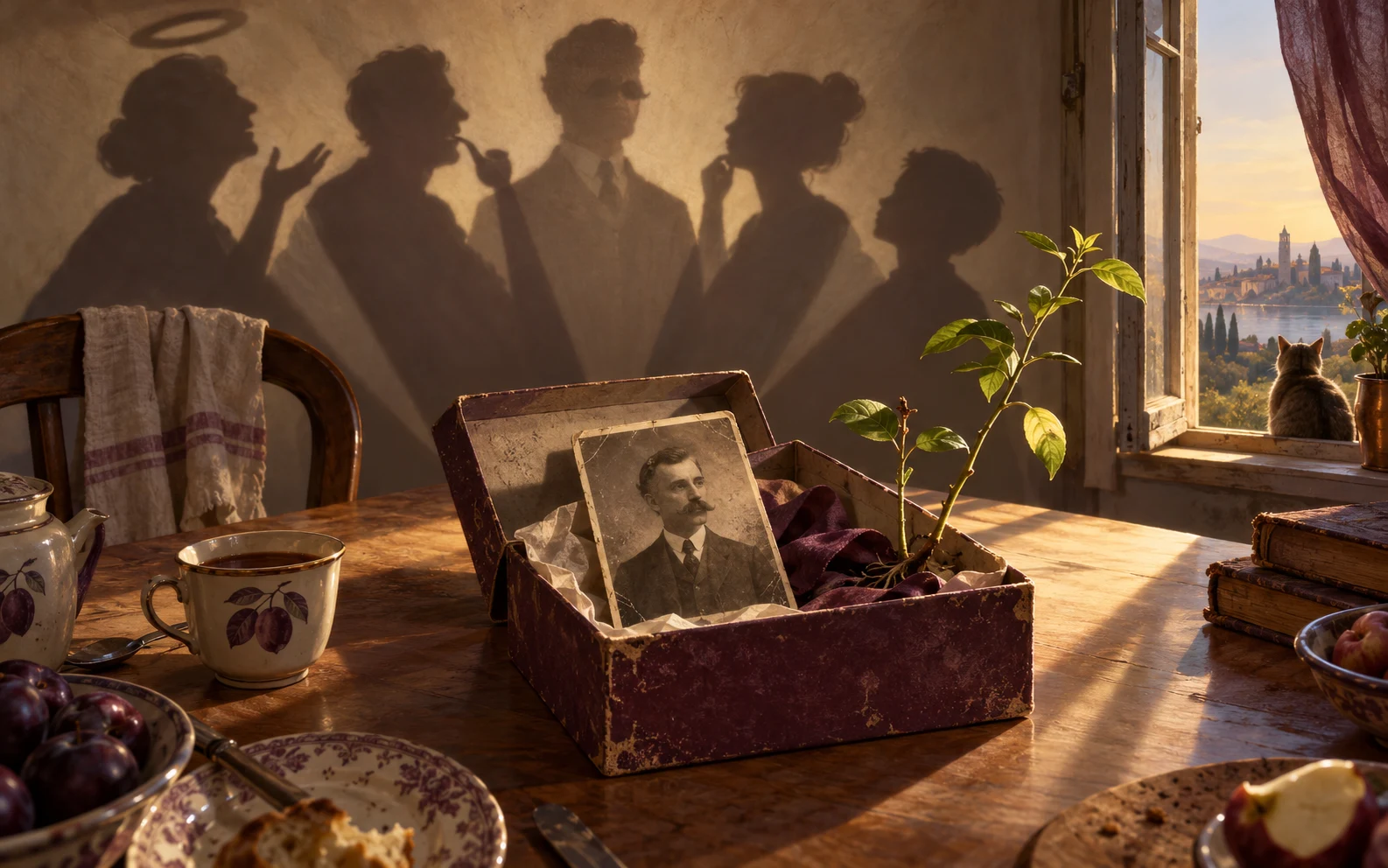
Gathering dust in a battered old shoe box is a black-and-white photograph of a mustachioed gentleman whose name nobody in the third generation quite remembers anymore.
"He sacrificed to the dead, as if they were present."
The Analects, III.12, a description of Confucius participating in a sacrifice from the perspective of an external narrator, not a direct quote from Confucius himself. English translation by James Legge, The Chinese Classics, Vol. 1. English back-rendering of our Russian translation, not a direct quotation from an established translation.
What This Article Is About
Gathering dust in a battered old shoe box is a black-and-white photograph of a mustachioed gentleman whose name nobody in the third generation quite remembers anymore. Naturally, the snapshot is guarded like a sacred relic, yet the family dinner table erupts into Shakespearean-scale battles over the character's true personality. An aunt swears the great-uncle was a saintly benefactor; an uncle smirks, recalling his phenomenal pigheadedness and epic drinking binges; while the youngest generation can only manage an uncertain mumble about the approximate date of his funeral.
This hypothetical kitchen-table vignette vividly highlights a universal paradox: What genuinely connects generations when everyone’s memory is idiosyncratic, forms of veneration diverge beyond recognition, and living human beings actually need to carry on living their own lives rather than turning into museum exhibits?
Instead of puffing up our cheeks and draping humanity in a single sentimental cookie-cutter, let us contrast four fundamentally different phenomena: the Confucian emphasis on honest personal participation in ritual, public explanations of the concept of whakapapa by the specific iwi Ngāi Tahu, a museum announcement for the Xantolo festival, and Catholic dogmatic teaching on the communion of saints.
Let us immediately disappoint enthusiasts of esoteric hodgepodges: this is not one and the same "ancient sacred cult" wearing four different theatrical costumes. It is precisely their differences that provide a sober perspective on why ancestral memory can manifest as biological kinship, church prayer, a public civic ceremony, a rigorous archival inquiry, or simply an argument over tea at home. Our practical task is strictly grounded: learning how to preserve real names, documents, and facts without turning deceased relatives into flawless, infallible overseers of our contemporary lives. We strictly separate religious dogmas from our own critical analysis, and the fictional characters in these vignettes bear no relation to the project authors' personal biographies.
I. Intergenerational Connection Does Not Equal a Monolithic Cult
Outward appearances regularly deceive lovers of superficial generalizations. A lit candle, food arranged on a plate, a yellowed portrait, and a reverently uttered name can be encountered in a temple, at a state war memorial, or on the counter of a regular urban kitchen. Yet common stage props do not make these practices identical twins. To avoid spouting pretentious nonsense, it is prudent to first clarify elementary fundamentals: Who exactly is being commemorated here? Who is being addressed? What do the participants themselves believe is taking place? And who sets the rules of engagement in the first place?
An ancestor in the literal biological sense is someone from whom you directly descend via a genealogical lineage. A collateral relative is a relative, not a direct ancestor. A Christian saint has no obligation to share a shred of genetic kinship with you. Meanwhile, the historic founder of a city or nation plays a role in collective consciousness entirely distinct from the role of your late grandmother in your childhood recollections. The difference seems obvious enough on your fingers, yet the bombastic, elastic term "veneration" flattens these distinctions with the blunt grace of a bulldozer.
In the official self-description of Ngāi Tahu, whakapapa weaves living people together with ancestors, land, water, and the wider world. In the Catechism of the Catholic Church, the communion of saints is articulated strictly through the Church and Christ. Treating a Māori lineage tree and Roman Catholic dogma as mere synonyms for a single "perennial wisdom" is the pinnacle of intellectual laziness. The only sane general question is far more modest: How do concrete, living people calibrate distance and contact with those whose physical lives have concluded?
Cross-cultural comparison works only when the inquirer does not rush to force every head into the same hat. Blood kinship, religious faith, secular calendars, and family folklore can certainly intersect within an individual life. But that mundane domestic intersection must not be proclaimed as a prefabricated universal formula. The more soberly we respect the boundaries and specifics of each tradition, the less vulnerable we are to arrogant fantasies.
II. Confucian Ritual: Presence Demands Participation
In The Analects (III.12), ritual action is framed through a posture of presence: sacrifice is offered as though the deceased were actually right there. Immediately following, the text introduces Confucius’s own speech with a crucial emphasis: if he does not personally participate in the sacrifice, it is as though he did not sacrifice at all. The text in James Legge's translation allows us to sharpen the question of the quality of personal participation without hastily improvising a reconstruction of the entire expanse of Confucian metaphysics on the back of an envelope.
This ancient formulation by no means implies that a participant must haul laboratory instruments to prove the post-mortem presence of souls as empirical fact. Nor does it reduce ritual to a cheap psychological spectacle designed to lift spirits. In this specific passage, the meaning of the rite is anchored in the seriousness of one’s own participation rather than a formal delegation of bows. At the same time, the text does not claim that any distracted repetition of physical gestures automatically annuls the ceremony. Emphasizing personal attention and presence is our own analytical deduction drawn from the composition of the excerpt, not a clinically proven medical effect or an off-the-shelf psychotherapeutic technique.
Consider a hypothetical modern vignette: Relatives gather at a restaurant to mark the anniversary of a grandfather’s passing. For ninety percent of the evening, guests loudly vent about workplace stress, haggle over the price of auto parts, and tap out messages on smartphones, acknowledging the guest of honor with a fleeting toast squeezed between the main course and dessert. Someone present might self-righteously declare, "Well, we gathered, duty fulfilled!" Another leaves with the heavy feeling that the evening was a total waste. The excerpt from The Analects zeroes in on this precise tension between external form and internal presence, but it hands out no prefabricated indulgences and does not brand every mundane distraction a mortal sin.
The analogy has strict limits. Putting your smartphone aside during a family dinner does not magically transform you into a Confucian noble person. Another culture's ancient text simply offers food for thought regarding our own conduct while remaining a monument of its own civilization. Rather than clumsily aping an alien ceremonial form, it is far more fruitful to ask ourselves honestly: How attentive are we ourselves toward those whom we undertake to remember?
III. Whakapapa: Lineage Reaches Beyond a Private Photo Album
When Māori of Ngāi Tahu speak of whakapapa, they do not mean a tidy pedigree chart neatly cataloging the names of grandparents. For them, it is a foundational web of interconnections linking a person to the land, the sea, and the wider world. The official portal of the iwi directly traces history back to the ancestors of Waitaha, Ngāti Māmoe, and Ngāi Tahu, rooted in an operational network of local assemblies—rūnanga. Let us underline: this is the stated position of one specific iwi (tribal entity), which it would be illiterate and presumptuous to generalize across all Māori or indiscriminately project onto "all Indigenous peoples of the Earth."
Such an understanding completely disrupts a narrow bourgeois perspective. In our hypothetical example, an individual flips through a family album seeking validation for their personal exceptionalism. In the Ngāi Tahu tradition, descent defines your real place and tangible responsibility within a vast ecosystem of connections. Hence, rendering whakapapa simply as "pedigree" or "genealogy" limps on both feet; a flat diagram fails to convey the multi-dimensional scope of the concept. We deliberately retain the original term whakapapa to avoid creating the illusion that everything has long been translated and understood at a glance.
For an outside observer, this is emphatically not an invitation to invent "totem ancestors" on the spot or adopt the birch tree outside the window as a second cousin to chase a trendy sensation of cosmic oneness with nature. Real community bonds cannot be replaced by armchair fantasies. Our sober takeaway lies elsewhere: it is helpful to realize that our personal biographies do not unfold in a vacuum; they depend on tangible locations, human labor, and cultural contexts that we foolishly ignore. Yet this takeaway remains strictly our own thought experiment; it does not make the reader a participant in the Ngāi Tahu people by a single millimeter.
Nor is there any reason to breathlessly romanticize traditional communities, imagining them as seamless monoliths without friction or debate. The source material itself underscores the autonomy of local structures (rūnanga). Intergenerational continuity binds people together, but it does not churn out carbon-copy clones. A living descendant is under no obligation to parade around in a great-grandfather's garments or freeze into an archaic posture to remain part of history. Living tradition is not a wax museum exhibit, regardless of what connoisseurs of outward ethnographic pathos might desire.
IV. Xantolo: How a Museum Makes a Specific Community Visible
Consider the official museum announcement from the National Museum of Anthropology in Mexico (INAH), dated October 21, 2022. The museum announcement designates a concrete subject: the exhibition altar (ofrenda) is dedicated to the Nahua culture from the village of Acatitla (municipality of Chicontepec, state of Veracruz). The celebration of Xantolo (or mihcailhuitl) is framed specifically through this local community. What we have before us is a curated museum exhibit carved out from the amorphous tourist myth of Día de Muertos. Naturally, the brief text of an announcement does not remotely encompass the full domestic, private schedule of family rites.
This example is instructive precisely because of its surgical precision. On a generic commercial poster, a passerby would see standard painted calaveras and bombastic slogans about a "joyful Mexican death cult." The museum, by contrast, slaps the hands of over-generalizers and pins down exact coordinates: ethnic identity, language, a specific village. This demands a change of tone. Instead of patronizing pontifications about an abstract "Mexican soul," an inquirer is compelled to examine how a defined community celebrates and precisely whom it commemorates. We may not possess every detail, but at least we are cured of the foolish habit of speaking for an entire nation in a single breath.
Nor should we overlook the mediator itself: the museum. A state institution decides how to design the display case and what to showcase to an urban public. We are dealing with two entirely distinct registers: the living relationship of the people of Acatitla with their departed, and the relationship of a museum with a casual visitor. Confusing them means naively imagining that reading a display label grants entry into a private family bedroom or a rural cemetery. The museum merely marks a phenomenon for an outside gaze without substituting itself for the life of the community.
Let us draw a cautious analogy with our family shoe box: A pencil notation on the reverse of a card reading "Ivan Petrovich, 1912" will not reveal the entire drama of his marriage or bankruptcy, but it ties the image to an identifiable individual and prevents the invention of fables. A museum label operates identically: it preserves a name and an address, checking fantasies about an abstract "folk spirit." This is solely our analytical comparison; no one is equating a museum presentation of Xantolo with a domestic box of family snapshots.
Such an example neatly deflates the arrogance of an outside spectator. One does not need to participate in everything personally; it is beneficial enough to learn how to read museum exhibitions intelligently, distinguishing where the community speaks and where the state curator is framing the narrative. A reader may discover with surprise that remembrance of the departed is not necessarily a mournful wail in liturgical gloom, but can be a vibrant, colorful feast. Even so, it does not follow that every resident of Veracruz is obligated to dance around the clock, or that the museum has codified the single correct norm of grief.
V. Catholic Communion: Founded on Faith, Not Lineage
In the Roman Catholic tradition, the bridge between this world and the next is not constructed by right of blood. The Catechism of the Catholic Church (§§946–958) formulates the doctrine unambiguously: the communion of saints (communio sanctorum) rests upon a sharing in spiritual goods and the unity of the members of the Church in Christ. Prayerful intercession for the dead and the veneration of martyrs fit strictly within these theological boundaries. Let us underline with total clarity: we are setting forth the internal dogma of faith of one specific confession, not an empirically proven physical reality, and certainly not the collective consensus of all Christian churches across the globe.
Here, genealogical chest-thumping falls flat. A faithful Catholic can pray fervently to Saint Thérèse of Lisieux without sharing a single drop of genetic code with her. Shoving this into the category of an "ancestral kinship cult" is ignorant nonsense. Furthermore, internal Catholic dogmatics strictly distinguish between veneration directed toward saints and adoration or worship reserved exclusively for God. If a casual tourist spots someone kneeling before a statue or portrait of a saint, this does not in the least demonstrate that the supplicant considers that piece of carved marble or painted canvas an omnipotent deity.
Attempting to collapse this practice into cheap psychotherapy ("well, it's just comforting for a person to recall a kindly grandfather figure to boost morale") hollows out the very essence of the tradition. The Catholic text speaks of the Mystical Body of the Church and grace, not a self-help routine of auto-suggestion. Yet it is equally foolish to commit the opposite blunder: waving the Vatican Catechism around as universal "proof" that any spiritualist séance or folk superstition is metaphysically verified and sanctioned from above.
Juxtaposing these examples reveals a common nerve: the drive of the living to maintain dialogue with those who have passed away. Yet the foundations are fundamentally divergent: for one, it is bloodline and landscape; for another, the disciplined execution of ritual presence; for a third, a localized communal feast of the calendar cycle; for a fourth, Eucharistic unity in Christ. The external resemblances among these practices do not substantiate a secret "universal proto-religion." Humanity has engineered distinct languages for speaking of eternity, and acknowledging these genuine divides is far more intellectually honest than shoving everyone into one warm, mushy heap.
VI. Domestic Memory and Kami Veneration Do Not Automatically Coincide
Even within a single nation and a single culture, domestic ancestor remembrance and institutional religious practice do not necessarily share an equals sign. Take the institutional explanation of the concept of kami by the Association of Shinto Shrines (Jinja Honcho). Ancestral spirits and prominent historical figures are indeed referenced there. However, the organization does not place an equals sign between a domestic ancestral altar and the shrine-based cult of kami. This official source reflects the contemporary institutional doctrine of Shinto, rather than recording the interior thoughts of every individual Japanese household.
This fundamental detail dismantles a beloved tourist stereotype that reflexively bundles everything Japanese into a neat package labeled "Shintoism." If someone lights an incense stick at home before a photograph of their late grandfather, it in no way follows that they regard their grandfather as equal to a kami enshrined at the Grand Shrine of Ise. Nor can domestic family gestures be mechanically evaluated against Western religious templates. To grasp the meaning, one must look at the specific context and native terminology rather than slapping labels on from the outside.
It is far more reasonable to differentiate several non-identical registers: deeply personal private memory, domestic family anecdotes, temple or shrine liturgies, and official state commemorations. A single living individual can organically combine all these levels in daily life, and this coexistence does not inherently signal an internal psychological contradiction. But peaceful coexistence does not mean the practices are interchangeable. Everything requires precision in details, rather than syrupy fairy tales about the "eternal harmony of all things."
Return to our shoe box of family relics: A battered snapshot of a great-grandfather in a cracked frame can serve as an informational source, a sentimental keepsake, or even sit beside a domestic icon. Yet its exact meaning is determined solely by the members of that family. Neither a researcher nor an enterprising journalist has the right to declare that photograph a "sacred tribal relic of the clan" simply to turn a pretty phrase in an article. Respecting another’s memory means honoring its sovereignty, even when it resists trendy academic pigeonholing.
VII. Repatriation: Ancestors Do Not Terminate at a Museum Label
Relations with ancestors have tangible, physical ramifications. The issue of repatriating ancestral remains proves conclusively that memory cannot be neatly contained within internal pious sentiments alone. Here, institutions, formal documentation, temporary custody, and the decisions of descendants take center stage.
The Karanga Aotearoa Repatriation Programme at the Museum of New Zealand Te Papa Tongarewa describes the operational practice of returning Māori and Moriori ancestral remains to their communities, underscoring the decisive role of specific iwi in determining their final resting place. The museum itself explicitly conceptualizes its custody as a temporary intermediary stage, not the final destination. What we have here is the institutional self-description of a specific modern program, rather than a triumphant dispatch proclaiming that every repatriation across the globe has been settled. It stands as a living example of an institutional relationship where a state body prudently refrains from claiming the final word.
Our analytical conclusion centers on a sober distinction between professional craftsmanship and sovereign authority. Museum specialists possess professional skills to preserve, catalog, analyze, and conserve historical material. However, the possession of these commendable skills does not transform the living relationship between descendants and their ancestors into the exclusive administrative jurisdiction of museum curators. When an institution concedes that communities possess a different, inherent basis for making final decisions, the interaction transforms: an ancestor ceases to be an indefinite specimen stored on a shelf in a collections vault.
At the same time, it is absurd to imagine that historical research and documentary evidence can now be dumped in the trash. Quite the contrary: archival records and oral testimonies of communities are cross-referenced to clarify provenance, keeping in mind the limitations inherent to each source. In this context, intergenerational memory demands honest investigative labor, not high-minded sloganeering about eternal bonds.
Such work requires patient endurance in the face of inevitable uncertainty. It happens that provenance remains unresolved, data remains fragmentary, and different testimonies flatly contradict one another. No matter how burning the desire to swiftly "correct the past," good intentions do not grant the right to fabricate missing links or paper over chasms with pleasant guesswork. Precision helps prevent compounding historical injuries under the banner of virtue.
Finally, it is essential to perceive the distance between transferring remains to an institution and their ultimate return home to the community. Temporary safe-keeping at Te Papa may represent a crucial milestone, but the subsequent stage remains an open process. Consumers of celebratory news headlines would do well to temper their excitement: not everything received by a museum has arrived at its final resting place, and not every provenance inquiry has been sealed by a definitive communal resolution. Respect for the process requires acknowledging facts as they stand, without crediting events with more finality than has actually transpired.
VIII. An Inconvenient Ancestor Is Also Part of History
Family memory loves cheap cosmetic touch-ups of the past. Imagine: a deceased grandfather was a brilliant mechanic, but also an abusive domestic tyrant; descendants enthusiastically highlight the former while shamefacedly sweeping the latter under the rug. Yet intergenerational connection does not bind us to salute inherited harm or destructive habits as patterns worthy of imitation. This is our own ethical stance, not a dogma excerpted from Confucius or Vatican theologians.
Respecting the fact of a person's life does not constitute a blanket pardon for all their abuses. One can gratefully acknowledge that a great-grandfather built the family house and pulled the household through famine, while flatly refusing to reproduce his methods of disciplining children with his fists. We preserve his name on the genealogical chart, but we are under no obligation to turn his cruelty into a family code of conduct. Religious traditions possess their own parameters for evaluating the departed; we are discussing the space of honest family reckoning.
One must be prepared for the reality that the recollections of relatives will fiercely clash. To an older sister, grandfather was a gentle magician who took her on beach vacations; to a younger brother, he was an inescapable source of dread. These two accounts do not cancel each other out. They merely reveal different facets of the same complex, living human being. Attempting to force everyone to sing the same sentimental lullaby flattens the family album into a sanitized lie, stripping victims of their voice. Honest disagreements recorded in family chronicles can offer future generations far more genuine understanding than an obituary dripping with syrupy praise.
It is high time for an adult to stop ricocheting between two infantile extremes: either worshiping ancestral portraits while scrubbing out every character flaw, or angrily setting the family archives on fire and blaming ancestors for every personal failure today. It is far more mature to separate three things: what we objectively inherited from the past; what damage was inflicted upon us or others in the process; and what we personally choose to do today. Memory ceases to be a tribunal where ghosts dictate our life script. It becomes raw material for critical reflection, the consequences of which rest on our shoulders alone.
Generational distance is inevitable. A child knows a great-grandfather strictly through adult storytelling; that child is under no obligation to experience the identical emotional grief or nostalgic ache felt by an aging parent. Demanding that a teenager weep tears of tender emotion over a faded union card amounts to a petty loyalty test. It is far more honest to lay out the bare facts, share the photographs, and leave the child the sovereign right to ask calm, uncoerced questions.
This is not a license for rampant fabulation. There is no need to invent noble heroics for "educational impact." One can simply say outright: "Here is what your grandmother personally remembered; here is a certified archival certificate; and here, we know absolutely nothing and are left with vague guesses." A young person gains the opportunity to practice elementary intellectual honesty, distinguishing a document from a family myth, while understanding that love for one's ancestors does not require a conspiracy of silence or deceit.
Finally, the narrator of a family lore would do well to look critically in the mirror. Why, from generation to generation, do we obsessively retell this specific heroic episode while maintaining absolute silence about other relatives? Whom does this neat little anecdote render invisible? These uncomfortable questions are addressed to ourselves, not to the dead, who can no longer answer for anything.
IX. Archives Help Only If They Leave Visible Gaps
Genealogical excavations are a sober, beneficial exercise, but they guarantee no heartwarming picture. A parish register records a sterile bureaucratic entry, a photograph freezes one-hundredth of a second, and an aunt's oral reminiscing conveys her subjective experience. When the ends fail to meet, a conscientious researcher leaves the contradiction open as an unresolved question, rather than plastering over the cracks with pleasant fiction just to hang an immaculate pedigree tree on the living room wall.
It is critically important to separate a document statement from an objective fact. The phrasing "the 1895 archival certificate records this date" is incomparably more honest than the sweeping declaration "he was definitely born in May." A clerk could make an error; a date could have been added retrospectively. Likewise, the phrase "great-aunt always told the story this way" is far more grounded than grandiose boasts like "our clan has known this since time immemorial." Such meticulousness does not devalue oral tradition; it simply affords descendants the liberty to cross-check claims.
Here, it is illuminating to draw a cautious analogy with the Local Contexts initiative, which tags the provenance of traditional cultural materials and their distribution rights using specialized digital Labels. Naturally, an old suitcase of love letters discovered in an attic cannot be mechanically equated with collective Indigenous data governance protocols. Yet the baseline ethics share a striking similarity: stumbling upon intimate letters or compromising photos of relatives in a storage closet does not grant you the moral license to plaster them across social media without the consent of living participants. Family privacy is a boundary that demands respect.
The capacity to preserve blank spaces is a hallmark of intellectual maturity. Writing "Name and fate unknown" on a file folder leaves descendants a fighting chance to unearth the truth. A distinguished aristocratic name pulled out of thin air blocks that path permanently, degenerating into a fake. An old shoe box may contain plenty of insoluble puzzles. Sane memory safeguards both documented facts and documented lacunae, without fabricating myths or discarding torn paper fragments merely because they refuse to fit into an attractive narrative.
It also happens that an individual possesses no family archives whatsoever: everything vanished in wartime fires or dissolved in the passage of time. This does not make a person defective, nor does it require buying counterfeit heraldic scrolls online. A legitimate personal history can begin with the single ancestor you actually remember, with your childhood street, or with your own honest labor. Genealogy is an optional personal inquiry, not an entrance ticket into an elite tier of humanity. Let us stop measuring the depth of our family trees like prize-winning poodles at a dog show.
One must also maintain the boundary between private grief and official state pageantry. A granite state monument may glorify a monumental battle in which a family lost a nineteen-year-old boy, leaving behind only raw horror and broken lives. An official victory march does not cancel private tears, but neither will a private tragedy rewrite a national history textbook. We do not need to reconcile these incommensurable scales artificially; it is enough simply to perceive the gap between them.
The material medium of memory also requires sobriety stripped of mystical fog. An authentic yellowed original, a digital copy on a smartphone, and a family oral retelling accomplish entirely different tasks. A scan certainly saves an image from fading and lets you distribute it to cousins in seconds, but it preserves the reverse side with its faint pencil inscription only if you bothered to scan it rather than cropping it away as "blank space." A digital file cannot replicate the physical texture of the paper; notations and archival ordering can be recorded separately, while a casual retelling easily drops exact dates and geographical locations. In domestic practice, it is prudent to bridge these forms: note where the physical original is kept, record inscriptions and context, but never pass off a handy folder on a hard drive as an exhaustive family history. This practical advice is an everyday tip for a domestic archive, not a binding manual derived from professional archival science.
X. Continuity Is Expressed Through Chosen Action
Intergenerational connection can equally be expressed through chosen action. Genuine continuity is a deliberate choice: keeping a rare dialect alive, pursuing a traditional craft, tending a garden, or, conversely, exerting a conscious act of will to break an inherited cycle of domestic violence. These are our personal choices in the here and now. They do not require a ghostly stamp of approval from our forebears, and they certainly do not need us to arrogantly preach in their name.
Gratitude to ancestors does not entail an obligation to repeat their mistakes. We can genuinely appreciate a grandfather for our survival through his fortitude, while categorically rejecting his racism or his alcoholism. Remembering past loss does not mean immolating our future on the altar of past ghosts. This approach does not substitute for religious commitments where they exist; it simply allows us to discuss human agency without relying on superstitious notions of "ancestral karma."
The continuation of a tradition frequently hides in tiny details: jotting down a grandmother's pie recipe, recording the correct pronunciation of a family surname, preserving a wartime letter, or taking a child to the riverbank where one grew up. These simple steps do not necessarily carry religious weight, and there is no need to inflate their importance with phony solemnity. Sober, thoughtful care is far more valuable than DIY "shamanic rituals" clumsily cobbled together from fragments of alien traditions to which you have no connection.
Living people have an absolute right to take a pause. You are not obligated to rummage through family skeletons in the closet this evening, and no one is demanding that you immediately air family laundry for public consumption. Working through memory requires maturity and emotional energy; its pace must remain manageable for all living participants. If you lack the emotional bandwidth to handle old letters right now, set them aside. Life consists of immediate concerns, and memory work can be calibrated to the readiness of living participants.
In the final analysis, our hypothetical shoe box of photographs asks for elementary order: Note known names on a separate sheet; record conflicting oral accounts side by side without trying to force them into a uniform mold; honestly sketch a question mark where dates have faded. Show a photograph to your children and calmly explain why this person matters to you, while sparing the child any obligation to live someone else's unfinished life. Then the family album can remain an arena of freedom and honest dialogue rather than a domestic prison.
Remembrance of the dead provides no magic psychological cures for life's troubles. The traditions we have surveyed—from Chinese sacrificial rites to Catholic intercession and Māori tribal practices—demonstrate the diverse ways humanity approaches the same human challenge. Yet this comparative analysis returns us to the central question: What do we personally choose to do with the connections handed to us at birth? The answer may be religious, secular, or entirely domestic. What matters is that it is measured not by the volume of hypocritical speeches about "time-honored roots," but by the honesty of our archival notes and adult responsibility for our own actions.
What This Means in Practice
Put aside abstract philosophy and take one elementary practical step: select exactly one family artifact or document. It might be a soldier's letter, an old watch, or that very same yellowed photograph.
-
On a separate sheet, record everything reliably known: to whom the object belonged, approximate dates, and how it came into your hands.
-
Firmly and mercilessly divide the information into three separate columns: - What is recorded verbatim in surviving documents; - What was told orally by relatives (naming the specific relatives who provided the account); - What is solely your personal deduction or speculation.
-
If the oral accounts of family members irreconcilably diverge, do not assign blame: write down both accounts side by side. Do not attempt to plaster over blank spaces with pleasant inventions.
Next, consider boundaries. Before eagerly uploading a digitized letter to social media, pause and ask: How will living family members feel about this? The fact that a great-aunt allowed you to snap a picture of an old letter for a private family album does not grant you an open license to publish it on a public blog accompanied by sarcastic commentary. This is a basic matter of respect for living individuals, requiring no legal notary, but demanding basic human tact.
Draft two short lists:
-
What aspects of your family baggage you consciously choose to carry forward (a trade, a culinary recipe, an ancestral tongue, a holiday gathering habit);
-
What you categorically refuse to drag into the future (a family habit of screaming at children, lingering grudges, chronic neglect of health).
These two short lists can help differentiate personal choice from external expectations: memory remains memory, while blind obedience to someone else's script is severed. This exercise is entirely voluntary and original to the authors. It is not an imported ancient ritual, does not replace qualified psychotherapy, and certainly provides no foolproof guarantee of immediate reconciliation in entangled family disputes. Its aim is far more modest: to help you clearly identify which actions you are prepared to stand behind in your own name.
If you initiate a conversation with older relatives, start with a microscopic detail: verify a caption beneath a single photograph or double-check a single disputed date. Do not turn afternoon tea into an aggressive police interrogation. If a grandmother insists a wedding was in June while the legal certificate clearly reads September, record both dates without argument. If a relative flatly refuses to speak about an episode, write "not discussed" in your notepad, rather than patronizingly attributing profound psychological motives to them. This discipline does not promise to erase generational friction, but it helps distinguish testimony and the boundaries of the conversation.
Finally: if you find yourself studying someone else's religious or ethnic tradition, begin by reading its official sources and scholarly publications rather than purchasing cheap souvenir amulets. Do not attempt to parody sacred rites on a weekend lawn. Respect for another culture is expressed not through exotic carnival dress-up, but through recognizing the strict limits of one's own understanding and honestly refusing to fantasize where one knows nothing.
Key Quote
"I want to spend my heaven in doing good on earth."
Thérèse of Lisieux, a statement quoted in the Catechism of the Catholic Church, §956, footnote 495. English back-rendering of our Russian translation from the citation in the official English edition of the Catechism; the primary French texts of Thérèse's sources have not been read separately. This is a strictly Catholic expression of faith regarding the ongoing prayerful bond of the saints with the living, not a generalized claim applicable to all traditions examined in this article.
Connections Across Traditions
All juxtapositions are exclusively analytical; no historical influence, genetic lineage, or direct continuity is claimed between them.
| Perspectives | Basis of Connection and Inherent Boundaries |
|---|---|
| The Analects, III.12 ↔ Ngāi Tahu: whakapapa | Both sources articulate an intergenerational connection; ritual participation is not identical to iwi kinship relations. |
| Catechism, §§955–958 ↔ The Analects, III.12 | One's stance toward the deceased is not exhausted by past history; church communion and Confucian sacrificial rites rest upon entirely different foundations. |
| NMA: Museum of Anthropology of Mexico, altar dedicated to Acatitla ↔ Ise Jingu: harvest offering | In both descriptions, the action designates a named recipient; presenting the remembrance of a specific community's deceased and a shrine-based address to Amaterasu rest upon different grounds. The museum webpage does not describe the local Xantolo calendar in exhaustive detail. |
| Te Papa: Repatriation of ancestors ↔ Ngāi Tahu: Lineage and origin | Generational relations encompass an active present; a museum procedure does not establish the cosmology of a specific iwi. |
| Jinja Honcho: Kami ↔ Catechism: Saints | Venerated departed figures may enter into a religious relationship; kami are not Catholic saints, and veneration is not worship. |
| Local Contexts: Provenance and Labels ↔ UiT/Reaidu: árbediehtu | Cultural transmission involves custodians and conditional access; digital provenance labels are not identical to living traditional knowledge transmitted through practical labor and experience. |
Primary Sources
-
Confucius. The Analects, III.12, translated by James Legge, The Chinese Classics, Vol. 1. A primary passage in a historical English translation; the complete corpus is not claimed to have been read.
-
Te Rūnanga o Ngāi Tahu. Ngāi Tahu. Primary public self-description; sections Our History, Whakapapa, Papatipu Rūnanga.
-
Museo Nacional de Antropología, INAH. Ofrenda de Día de Muertos: Xantolo, October 21, 2022. Brief official museum announcement concerning the Nahua of Acatitla.
-
Catechism of the Catholic Church, §§946–958. Official primary doctrinal source; primary webpage text, specifically §956 and footnote 495 for the citation.
-
Jinja Honcho. Kami. Contemporary institutional explanation of Shinto; not a blanket description of all Japanese households.
-
Museum of New Zealand Te Papa Tongarewa. Karanga Aotearoa Repatriation Programme. Primary description of the museum programme, not an exhaustive worldwide history of repatriation.
-
Local Contexts. About the Labels. Informational overview of local protocols; limited analogy to questions of family provenance and privacy.
-
Ise Jingu. Rituals and Ceremonies. Official ceremonial calendar; consulted solely for a limited comparison of seasonal calendar forms.
-
UiT, Reaidu. Tradisjonell kunnskap. Educational overview of Sámi árbediehtu, not a primary liturgical or ceremonial manual.
Access date: October 3, 2026.
Tags
ancestors, memory, generations, kinship, family, provenance, genealogy, whakapapa, Ngāi Tahu, Māori, whānau, rūnanga, Confucius, Analects, ritual, presence, Xantolo, nahua, Acatitla, Día de Muertos, Catholicism, communion of saints, Thérèse of Lisieux, kami, Shinto, repatriation, Te Papa, family archive, oral history, inheritance, freedom, responsibility
About the Authors
Andrey Zarinsh is an author and the founder of the United Wisdom project. He explores themes of internal transformation, the unity of traditions, intercultural dialogue, and contemporary spiritual discipline. Instagram: @andrey.zarinsh.
Maria Evilkut is a co-author of United Wisdom. Alongside her research work, she strives to test these concepts in practice and observe how principles of unity and mutual understanding operate in real life between people and cultures. Instagram: @ilkutki.