
World & consciousness
Remembering ancestors: connections between generations in different cultural forms
Remembering ancestors through ritual, kinship, museum representation, and Catholic communion while retaining their differences.
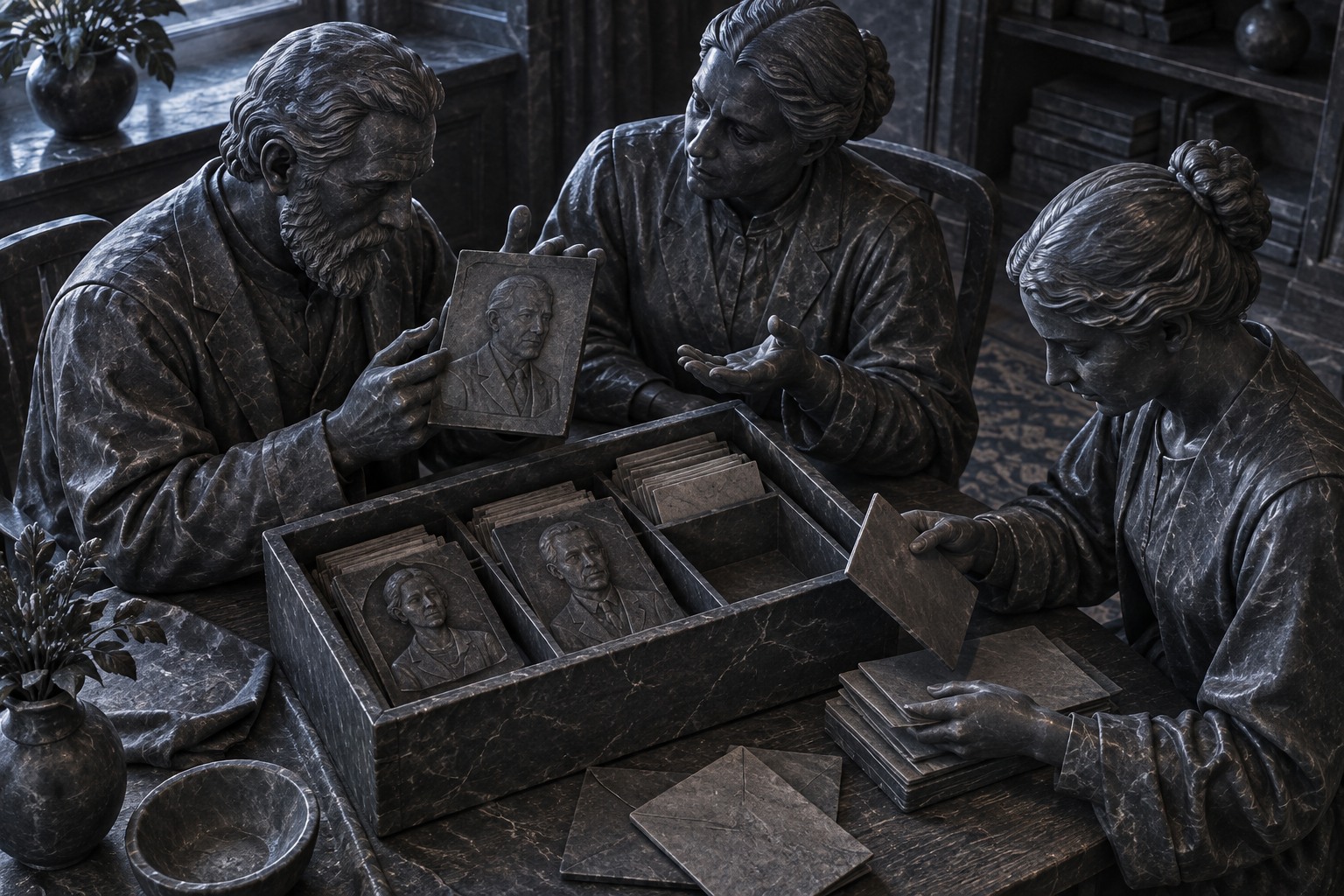
“He sacrificed to the dead, as if they were present.”
The Analects, III.12, an account of Confucius taking part in sacrifice, not his direct speech. English translation by James Legge, The Chinese Classics, Vol. 1. Wording restored from that English translation; the Russian article uses the authors' own translation, not a published Russian version.
About this article
A family box holds a photograph of a person whose name almost no one remembers. The picture is treasured, but relatives disagree about its subject: one remembers generosity, another a difficult character, a third knows only a date. Consider this ordinary scene as an entry into a broader question. What connects generations when memories differ, forms of honoring vary, and continuing to live requires decisions of one's own? The article compares the Confucian understanding of ritual presence, the public explanation of whakapapa by the particular iwi Ngāi Tahu, a museum presentation of Xantolo, and Catholic teaching on the communion of saints. These forms cannot be reduced to one cult. Their differences help explain why remembering ancestors can involve kinship, prayer, ceremony, investigating origins, or a family story. The practical task is to preserve names, evidence, and conditions of transmission without turning the dead into flawless judges of the living. We will distinguish beliefs from our own analysis; accounts in hypothetical scenes are not attributed to the project's authors.
I. Connections between generations do not amount to a single cult
Remembering the dead takes shape within different relationships, and objects that look similar from outside do not make those relationships the same. A photograph, a candle, food, and a spoken name may belong to a religious rite, a family remembrance, or a public ceremony. Understanding the action requires knowing whom people remember, whom they address, what they believe is happening, and who determines the order.
An ancestor in the family sense may be someone from whom a descendant comes. A deceased relative is not always a direct ancestor. A saint is not necessarily related to the person honoring their memory. A community's publicly recognized founder does not automatically have the same role as a grandmother in a story at home. These distinctions seem simple, but the broad word “veneration” easily erases them.
In Ngāi Tahu's account of itself, whakapapa connects people with their descent and their world. In the Catholic catechism, the communion of saints is defined through the Church and Christ. There is already no basis for declaring a lineage and ecclesial communion two names for the same teaching. A different shared question is possible: how is the presence of a living person connected with those whose bodily lives have ended?
Comparison becomes substantive when it does not rush to answer for every side. A similar theme of connection can be noticed, followed by a detailed account of its different grounds. Kinship, faith, a calendar, and civic memory may intersect within one person's life. But that intersection cannot be turned in advance into a worldwide scheme. The more precise the differences, the more we learn about each way of continuing relationships through time.
II. Confucian ritual: presence requires participation
In The Analects III.12, the action is described through a relationship of presence: sacrifice to the dead is made as though they were here. The importance of personally taking part in the ceremony follows. James Legge's translation lets us ask about the quality of the action without settling every metaphysical question on the author's behalf. We are reading a particular passage, not claiming to reconstruct the whole history of Confucianism.
The formulation does not mean that the participant must prove the presence of the dead by scientific measurement. Nor does it mean the ceremony is merely a performance for improving mood. In the selected passage, serious participation constitutes the meaning of the action. Outwardly repeating gestures without the corresponding attitude does not exhaust it. This is our conclusion from the passage's composition, distinct from a psychological recommendation.
A hypothetical modern example helps reveal the problem of form. A family gathers for a memorial evening but spends most of the time discussing business, mentioning the person's name between messages on their phones. Someone objects that the required order was observed: everyone came. Another feels the gathering happened only outwardly. The Confucian passage helps clarify the question of participation, but it gives no universal instructions for this evening and does not declare every distraction a moral failing.
The limit of the analogy also matters. A modern family remembrance does not become a Confucian ritual because we have thought about attention. The text can help us formulate a thought of our own while remaining a text from another tradition. Such reading enriches memory: we notice that there are different ways of being present and ask which fits our own connection, rather than mechanically borrowing another's ceremony.
III. Whakapapa: descent is broader than a private album
For Ngāi Tahu, whakapapa describes more than a list of relatives: it includes relationships with the land, sea, and wider world. The iwi's official page connects the history of Waitaha, Ngāti Māmoe, and Ngāi Tahu with a shared belonging and describes local rūnanga. This is a particular organization's voice; it cannot quietly be extended to all Māori or all Indigenous peoples.
This account changes the familiar scale of the subject. In a private album, a person may look for their own family's history. Here, descent helps explain a position within a broader system of relationships. Translating it as “genealogy” therefore requires explanation: a useful table does not necessarily convey the word's full meaning. Retaining whakapapa leaves room for further reading instead of declaring the translation complete.
This is not an invitation for an outside reader to invent a comparable lineage. Real relationships cannot be replaced with imagined descent for a feeling of rootedness. Another possibility remains: noticing how a personal history depends on places, work, and connections we often leave out of the account of ourselves. This conclusion belongs to our analysis; it does not make the reader a participant in Ngāi Tahu.
Kinship, meanwhile, should not be romanticized as an absence of internal differences. The source itself emphasizes the particular features of local structures. Memory can unite without making people identical bearers of one biography. A substantive connection between generations leaves room for different lives and contemporary occupations. It does not require a living person to resemble an image of an ancestor to count as a continuation of history. Clarifying this limit is especially important when tradition is judged only by outward sameness.
IV. Xantolo: how a museum makes a particular community visible
In a notice dated October 21, 2022, the National Museum of Anthropology in Mexico makes a particular choice: the offering is dedicated to Nahua people from Acatitla, in the municipality of Chicontepec, Veracruz. Xantolo, or mihcailhuitl, names this community's celebrations for the dead. We can examine this museum presentation: it draws a local form out of the broad image of Día de Muertos. The short page does not describe the order of ceremonies in homes.
The way of naming is itself revealing. A general poster might show a reader only the country and the theme of death. Here the subject gains an address: people, language, and settlement. This precision is not decorative. It changes the possible next question. Instead of seeking “the Mexican attitude toward death,” a person becomes interested in how a particular community celebrates and whom it includes in remembrance. We do not yet have a detailed answer, but we have stopped asking for everyone at once.
There is a second participant: the museum. The institution chooses which form to present to an outside audience and announces the offering. We therefore encounter two relationships: the community's relationship to the dead and the museum's relationship to the living visitor. The first is the subject of representation; the second determines how the visitor meets it. Mixing them makes it easy to think that an institution's accessible description gives full access to a family's life. Museum openness serves a different purpose: making a particular subject recognizable to someone arriving from outside.
Compare this with the family box at the beginning. A caption below a photograph can give a name and date without conveying every family relationship with the person. But the absence of a full account does not make the caption useless. It retains belonging and permits the search to continue. The museum notice works in a similarly limited way: it matters that it preserves a particular subject rather than an anonymous image of a people. This is our analytical analogy; it does not equate Xantolo with a family archive.
This example enriches the subject of memory with another form of participation. Not everyone encountering a tradition performs a rite; someone may first learn to read its public representation. Their attention goes to which connection the institution has shown and whose voice remains to be heard. Readers may discover an expectation of their own — for instance, that remembrance must always look like quiet sorrow. Knowing about celebration already helps revise that expectation. It does not follow that the whole community experiences it identically or that the museum has established the only permissible emotion. Instead of a ready-made psychological portrait, a particular question arises about the form of continuing relationships.
V. Catholic communion: its basis is not descent
The connection between the living and the dead in Catholic teaching is explained through ecclesial communion. The Catechism, §§946–958, distinguishes communion in holy things and communion among holy persons, referring to unity in Christ. Remembering saints and the prayerful relationship with the dead belong within this frame. We are describing a particular Church's belief, not an established experimental result or the views of all Christian denominations.
A substantial difference from genealogical language appears here. A person can venerate a saint with whom they have no family relationship. Calling this “the cult of one's own ancestors” is therefore inadequate. Furthermore, the distinction between veneration and worship belongs to the teaching's internal meaning. An outside photograph of someone before an image does not allow us to conclude that the participant considers the depicted person a god.
This distinction helps explain the limits of a general psychological account. Remembering an exemplary life can support someone, but the Catholic source also speaks of an ecclesial and spiritual relationship. Reducing it all to a useful memory excludes what the tradition itself considers essential. The opposite mistake is to use Church teaching as proof that every form of communion with the dead is equally recognized or produces the same results.
Comparison with the earlier examples is possible at the level of a question about a continuing connection. The answers remain different: particular descent, ritual participation, local festive veneration, communion in Christ. What emerges is not a single hidden religion, but human communities' ability to explain the continuation of relationships in different ways. Knowing the differences does not weaken the subject of memory. It restores the content a universal formula would have left out.
VI. Remembrance at home and veneration of kami do not automatically coincide
Even within one cultural context, remembrance of relatives and public shrine veneration can differ. Jinja Honcho's explanation of kami mentions venerated people and ancestors, while veneration at home should not automatically be extended to every shrine. The source offers a contemporary institutional explanation of Shinto, not an account of every Japanese family.
This detail interrupts the familiar move from an image to a general system. If someone remembers a deceased person at home, it does not prove that this person has the same role as the kami of a particular jinja. If a family action has religious meaning, it cannot be assigned to one outside category without further information. We need to know what people call the relationship and which forms belong to it.
For our subject, it helps to hold several levels side by side: a personal story, family transmission, religious veneration, and a public calendar. One person can take part at several levels without feeling the contradiction an outside scheme sees. Coexistence, however, does not mean complete interchangeability. It should be explained through particular sources and situations, not through a promise that all cultural forms are easily compatible.
The hypothetical photograph from the family box becomes more complex again. It can be a document, a treasured object, and part of a religious space, but its meaning depends on people. The author has no right to declare it a sacred object for the sake of an expressive account. Preserving this distinction is a way to respect remembrance living in someone else's home. It does not have to fit our vocabulary to remain important and real for the family.
VII. Repatriation: ancestors do not end at a museum label
Relationships with the dead have material consequences. The question of returning ancestral remains shows that memory cannot be confined to an experience within consciousness. Institutions, documents, belonging, temporary guardianship, and descendants' decisions are at work here.
Te Papa's Karanga Aotearoa program describes returning Māori and Moriori remains to communities and the role of iwi in determining a final resting place. The museum treats custody as an intermediate stage. This is a contemporary program's account of itself, not proof that all repatriations are complete. It shows a particular relationship in which a professional institution does not claim the final decision for itself.
Our analytical conclusion concerns the distinction between skill and authority. A museum may know how to preserve, study, and document material. But possessing those skills does not make every relationship between descendants and ancestors a matter of museum competence. If an institution recognizes a different basis for a decision, the structure of cooperation itself changes. An ancestor ceases to be described only through their value to a collection.
This does not imply that documentary research is unnecessary. On the contrary, precise provenance may be necessary for return. The question is not a choice between memory and an archive, but whom their combination serves and who decides what happens next. Oral evidence and a collector's record can complement one another while retaining different limits. Generational memory then includes the work of checking, not just a solemn formula about an eternal connection.
Return may demand patience with uncertainty. Sometimes origins are not yet established, information has been lost, or documents contradict one another. A general wish to correct the past does not allow the missing route to be invented. We are not describing a particular unfinished case; the point concerns what a conclusion requires. Where a decision affects real people and ancestors, accuracy becomes a way to avoid replacing one mistake with another, now made with good intentions.
There is also a difference in timing between return to an institution and return to a community. An intermediate stage may be a substantial achievement while the next remains unfinished. Readers benefit from noticing this scale in celebratory news. Not everything received by a museum is already at its final resting place, and not every provenance study ends in a decision by descendants. Respecting a result does not require attributing more to it than happened.
VIII. An uncomfortable ancestor is part of history too
Memory easily becomes a demand to idealize. A person was generous and domineering, caring and unfair; descendants choose one side because the full picture is uncomfortable. But connections between generations do not require every inherited norm to be considered unconditionally right. This is our ethical framing of the question, not a doctrine attributed to every tradition considered here.
Respect for memory can differ from an assessment of an action. A person can be acknowledged for working for their family without excusing the harm they caused. A name can be preserved without turning a family habit into a compulsory model. This does not imply that every form of religious veneration allows the same kinds of criticism. A particular tradition requires its own reading; here we are discussing possibilities within our own family account.
It matters especially that relatives may have different evidence. One remembers a celebration, another fear, a third care during illness. Their accounts do not necessarily cancel one another. They may describe different relationships with the same person. Enforced agreement sometimes makes an album beautiful on the surface while depriving part of the family of the right to speak. Preserving the disagreement lets the next generation understand why remembrance was not unanimous.
For an adult reader, this offers a way out of two extremes. There is no need either to accept the past whole or to declare it meaningless. What was received, what was inflicted, and the continuation one chooses can be distinguished. Memory then ceases to be a court in which the living must reproduce the decisions of the dead. It becomes a source of questions that a living person answers on their own responsibility, retaining the fact of descent and the right to act differently.
Memory can differ between generations. A child knows a person only through other people's stories, while an adult tries to pass on an experience the child never had. Requiring the same strength of feeling turns the account into a loyalty test. Providing a name, a history, and room for a question of one's own is more substantive. The next generation continues the connection differently simply because it lives at another time and cannot literally repeat our experience.
This does not make memory arbitrary. Actions and words should not be invented to serve a convenient educational role. We can explain that one account rests on a personal recollection, another on a document, and a third piece of evidence is still missing. The young listener receives more than an image of a hero: they receive an example of dealing honestly with the past. They learn to distinguish fact, assessment, and love that need not erase a contradiction.
It also makes sense to ask about our own place in a retelling. Why do we keep repeating this particular episode? What does it help preserve, and which other story does it make inaudible? These questions address the author of the family history, not the dead person as an imagined conversation partner. They allow us to correct our own work of remembrance without inventing an answer on behalf of someone who can no longer give one.
IX. An archive helps when it leaves gaps visible
Family research can support memory but does not promise a complete picture. A document gives particular information, a photograph shows a moment, and a story holds someone's perspective. If they disagree, honest work keeps the disagreement as a question. The history does not need smoothing out for the pleasure of a finished family tree.
It helps to distinguish a record from a claim. “The document gives this date” is more precise than “The person was definitely born then” if an error or later entry is possible. “This relative told the story this way” is more precise than the anonymous “The family always knew.” These formulations do not reduce the evidence's value. They allow a later reader to keep checking and understand the grounds for a conclusion.
A limited connection with Local Contexts is possible here: a material's origins and conditions of transmission help us understand it. A family archive does not automatically acquire the collective protocols of Indigenous communities. But who may tell and pass on a particular story matters practically at home too. Access to a family photograph does not necessarily mean that every living person pictured agrees to public publication.
Preserving a gap is also a form of transmission. “The name is not yet established” leaves a future person a route for searching. An invented name closes that route because it begins to look like a fact. Much may be unknown in the original box. Honest remembrance can preserve both the known and the unknown, without turning the latter into a mysterious legend or throwing away the former merely because it is incomplete.
Sometimes a person has almost no family documents. This does not deprive them of the right to remember or oblige them to invent an ancestral legend. An available history may begin with a person actually known, the place of current life, or a chosen way of caring. Genealogical research remains a possibility, not an examination of one's worth. Different cultural forms of remembrance cannot be used to judge whose life is supposedly more deeply rooted.
The boundary between family and public memory should also be retained. A state monument may speak of an event a family remembers differently; an official date does not exhaust a private loss. These differences call for a conversation of their own. Our hypothetical scene does not need to settle them for everyone. It is enough to acknowledge that one public language does not cancel separate evidence, and that preserving different scales helps memory stay accurate.
Material preservation matters too. An annotated original, a digital copy, and a retelling serve different purposes. A copy helps transmission and reduces the risk of accidental loss, but does not always preserve a photograph's reverse, its paper, or the context of its folder. A retelling conveys meaning but may lose a precise locator. In our own archival practice, it helps to connect these forms and note where the original is kept, without presenting a convenient digital folder as the complete family history.
X. Continuation takes shape in a chosen action
A connection between generations has a future if memory extends beyond storage. Sometimes continuation consists in a preserved language, a craft passed on, or care for a place. Sometimes it consists in ending a habit that caused harm. These are decisions of the living; they do not automatically receive every ancestor's approval or need an invented speech in their names.
Distinguishing gratitude from a duty to repeat matters especially here. We can be grateful for a chance we received without accepting every way of life of the person who gave it. We can remember a loss without building the whole of our future around one image. This approach does not replace religious relationships where they exist. It helps us speak clearly about a personal action that can be checked in the present.
Continuation can be very small. Record how a name is pronounced, ask about a recipe, preserve a dated letter, introduce a child to a place. Not every action has religious significance, and there is no need to give it that significance artificially for the sake of depth. Ordinary care can pass on a real connection. Its accuracy matters more than the grandeur of an invented ritual supported by neither one's own tradition nor permitted participation in another's.
A person also has the right to pause. Not every box must be opened today; not every family question requires an immediate account to everyone. Memory develops over time, and the pace of the work can follow participants' actual readiness. Preserving what is available does not oblige us to force completion of what is inaccessible. This keeps connections between generations alongside life, where current tasks, different feelings, and a person's right to choose their next step remain.
Return to the photograph. The family can label known names, preserve different stories separately, and acknowledge an unknown date. They can show a child an object and explain why it is dear. They can choose a skill that can still be passed on and give up the demand that the child live someone else's life. The album then holds more than faces: it passes on the ability to learn, ask, and continue freely.
Remembering ancestors does not give one universal technique for inner work. The forms examined here reveal different relationships that cannot be merged without loss. Comparing them does, however, help us see a shared human question: what do we do with a connection we did not create from nothing? A substantive answer can be religious, familial, or civic. Its quality depends not on loud declarations about roots, but on accurate memory and responsibility for the continuation chosen.
What this means in practice
Choose a family object or document you want to preserve. Record its known origins, its owner's name, and its date or the absence of one. Separate what was read in a document from what someone told you and from your own guess. If the information differs, keep both versions with the storytellers' names. Do not try to finish the history at any cost.
Then ask who else may have a relationship with the material. Living relatives may see the publication of a photograph or story differently. Agreement to private reading should not automatically be understood as agreement to an open website. This is an ordinary question of relationships, not a reason to turn all family work into a complicated procedure. Clarification is needed where use actually changes.
Separately, write down what you want to continue: a skill, a language, care for a place, a habit of gathering. And what you do not want to continue. These two lines help distinguish remembrance from submission. They do not guarantee reconciliation or replace help in a serious conflict. The result is more modest: the action possible now becomes clearer, along with the meaning you are willing to give it in your own name.
In a conversation with relatives, a small subject can first be agreed on: a caption for one photograph, one person's name, a place to keep one letter. Limiting the subject does not make memory less significant. It lets people notice where information agrees, where it differs, and where no one must answer immediately. If one relative remembers a date differently, recording two versions is more honest than hastily appointing a winner. If someone does not want to discuss an episode, “not discussed” is more precise than an invented explanation of their feelings. This discipline, proposed by the authors, concerns one's own family conversation. It is not a borrowed rite and does not promise to resolve conflict between generations. Its result is more modest and more checkable: people know better what was preserved, who told it, and what remains open.
When approaching another tradition, begin with its public explanation. Do not copy a ceremony from a general description of ancestors. The question of presence can be understood while leaving another's order where it belongs. Sometimes the best remembrance of an encounter with a culture is the source's precise name and a refusal to tell more than was actually learned.
Key quotation
“I want to spend my heaven in doing good on earth.”
Thérèse of Lisieux, a saying quoted in the Catechism of the Catholic Church, §956, footnote 495. Wording restored from the English citation; the primary French text was not read separately. This is a Catholic expression of belief about a continuing connection, not a claim shared by all the traditions examined.
Connections between traditions
The comparisons are analytical; historical influence is not established here.
| Positions | Basis of the connection and its limit |
|---|---|
| The Analects, III.12 ↔ Ngāi Tahu: whakapapa | Both sources allow connections between generations to be discussed; ritual participation does not equal an iwi's kinship relationships. |
| Catechism, §§955–958 ↔ The Analects, III.12 | Relationships with the dead are not exhausted by the past; ecclesial communion and Confucian sacrifice have different grounds. |
| NMA: museum offering dedicated to Acatitla ↔ Ise Jingu: a thanksgiving offering of the harvest | Both descriptions give an action a named recipient; representation of remembrance of a particular community's dead and a shrine's address to Amaterasu have different grounds. The museum page does not describe Xantolo's local calendar in full detail. |
| Te Papa: returning ancestors ↔ Ngāi Tahu: descent | Relationships between generations have a present; a museum procedure does not establish a particular iwi's cosmology. |
| Jinja Honcho: kami ↔ Catechism: saints | The venerated dead may belong within a religious relationship; kami are not Catholic saints, and veneration does not equal worship. |
| Local Contexts: provenance ↔ UiT/Reaidu: árbediehtu | Transmission has holders and conditions; labels for materials are not identical to knowledge passed on through work and experience. |
Primary sources
- Confucius. The Analects, III.12, translated by James Legge, The Chinese Classics, Vol. 1. A primary passage in a historical English translation; the whole corpus is not claimed to have been read.
- Te Rūnanga o Ngāi Tahu. Ngāi Tahu. Primary public account; Our History, Whakapapa, and Papatipu Rūnanga sections.
- Museo Nacional de Antropología, INAH. Ofrenda de Día de Muertos: Xantolo, October 21, 2022. A short official museum notice about Nahua people from Acatitla.
- Catechism of the Catholic Church, §§946–958. Official primary doctrinal source; the page's main text, with §956 and footnote 495 separately for the quotation.
- Jinja Honcho. Kami. Contemporary institutional explanation of Shinto; not an account of every Japanese family.
- Museum of New Zealand Te Papa Tongarewa. Karanga Aotearoa Repatriation Programme. Primary description of the museum program, not a complete history of repatriations.
- Local Contexts. About the Labels. Reference description of local protocols; limited connection with the question of origins.
- Ise Jingu. Rituals and Ceremonies. Official calendar; used only for a limited comparison of calendar forms.
- UiT, Reaidu. Tradisjonell kunnskap. Educational explanation of Sámi árbediehtu, not primary ceremonial instructions.
Accessed: October 3, 2026.
Tags
ancestors, memory, generations, kinship, family, origins, genealogy, whakapapa, Ngāi Tahu, Māori, whānau, rūnanga, Confucius, The Analects, ritual, presence, Xantolo, Nahua, Acatitla, Día de Muertos, Catholicism, communion of saints, Thérèse of Lisieux, kami, Shinto, repatriation, Te Papa, family archive, oral history, inheritance, freedom, responsibility
About the authors
Andrey Zarinsh is the author and founder of the United Wisdom project. He researches inner transformation, the unity of traditions, intercultural dialogue, and contemporary spiritual discipline. Instagram: @andrey.zarinsh.
Maria Evilkut is a co-author of United Wisdom. Alongside her research, she seeks to test these ideas in practice and observe how the principles of unity and mutual understanding work in real life between people and cultures. Instagram: @ilkutki.
Keep what resonates with you.