
Traditions and Worldviews
Shinto: Place, Ritual, and the Presence of the Kami
In the mind of the average wide-eyed tourist hooked on social media quote feeds, Shinto is some magical dissolution into buttercups and cherry blossoms—a realm devoid of dogma, brimming with "Zen vibes," promising the…
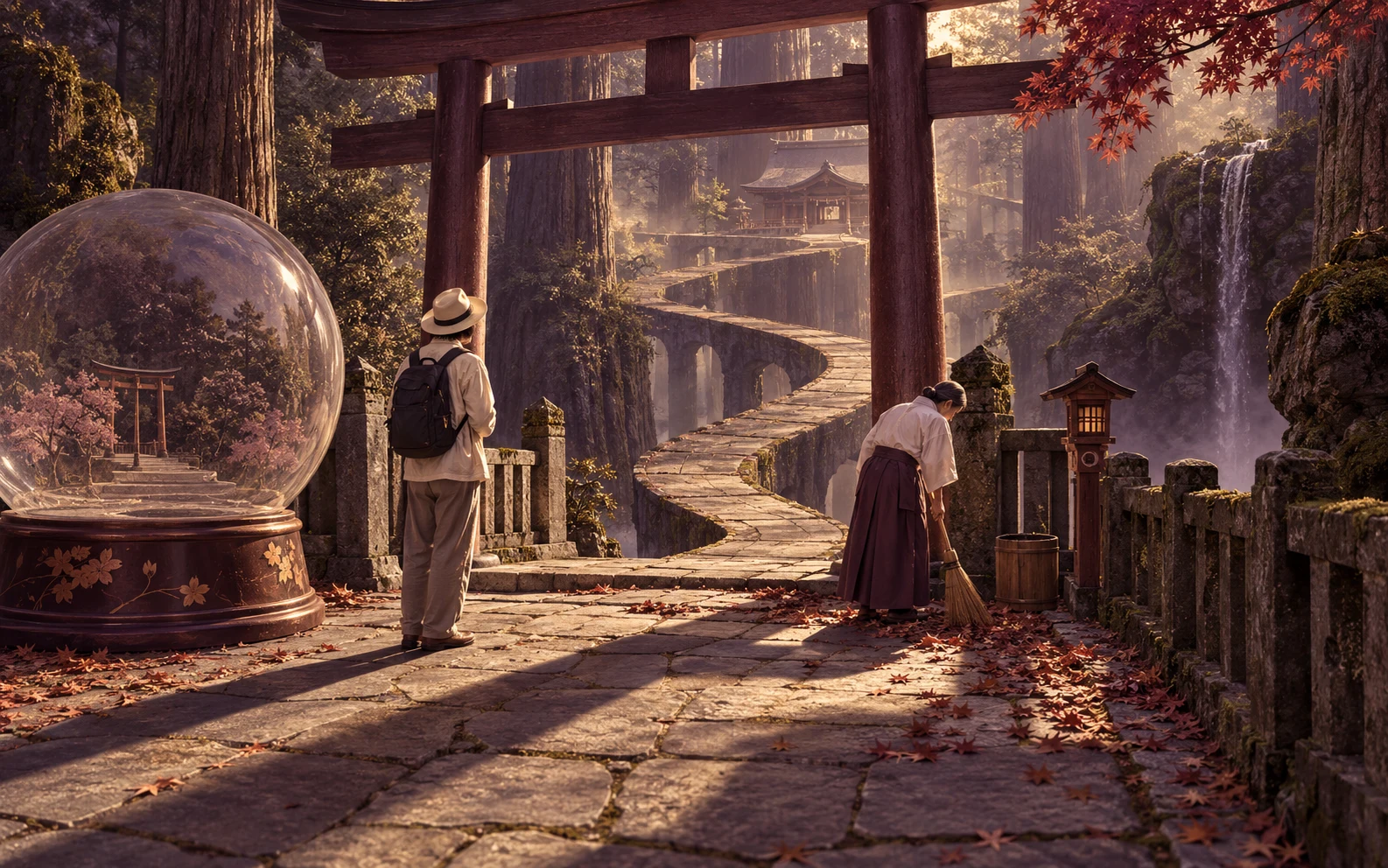
"This is a rule of propriety."
Confucius, Analects, III.15, answer regarding inquiries in the Grand Temple. Back-translation of our Russian translation based on James Legge's English version; text and locator. This comparative epigraph belongs to Confucianism; it is not attributed to Shinto.
What This Article Is About
In the mind of the average wide-eyed tourist hooked on social media quote feeds, Shinto is some magical dissolution into buttercups and cherry blossoms—a realm devoid of dogma, brimming with "Zen vibes," promising the secret to eternal youth and conferring the unalienable right to hug ancient cryptomerias for the sake of an aesthetic story. This convenient delusion sells briskly in books peddling "five-minute Japanese secrets of happiness," yet the lived reality of Shinto does not consist of lounging on meditation mats. It is built out of very specific shrines, ritual officiants, mythological narratives, rigorous historical reorganizations, and strictly codified forms of veneration.
Nor can the word "kami" be casually glossed as "God," "cosmic vibration," or "universal love." It designates mythological figures, formidable natural elements, or actual historical persons deemed worthy of a community's veneration. Kami is not a wholesale marketing label slapped across everything you happen to find quaint, pretty, or photogenic.
We will unpack Shinto through three tangible pillars: the religiously understood presence of the kami, the strict locality of a concrete site, and demanding ritual work. Along the way, we will examine history: how localized veneration interacted with Buddhism and political power. We will cross-examine modern institutional self-descriptions from Jinja Honcho and specific shrines alongside historical studies of rite. This approach allows us to grasp Shinto stripped of syrupy platitudes about the "timeless essence of Japan" and free from absurdities framing it as a "universal mindfulness hack." In the practical section, a grounded guide awaits: how to approach a shrine with open eyes and basic respect toward its custodians, rather than acting like a spiritual colonizer hijacking someone else's rite to nurse personal inner balance.
I. Kami: A Word That Cannot Be Reduced to a Single Familiar Notion
Picture a hypothetical scene at a shrine entrance: a tourist clad in linen trousers dips a ladle into water, freezes theatrically for a social media snapshot, and declares the droplets splashing onto the cobblestones an "act of cleansing the chakras from big-city negative energy." Beyond the precinct gates, Tokyo commuters dash for metro transfers, delivery couriers pedal ramen, and the city hums along in its pragmatic routine. Entering a shrine does not require playing the detached hermit or slipping into an altered state of consciousness. Yet the sweep of the hand with the ladle answers to a strict etiquette that cannot be trivialized into basic pre-meal handwashing or an office stress-relief exercise.
The shrine was never erected as a backdrop for an outsider's self-actualization. It raises a sharper question: what actually takes place when a physical place, water, a bow, and an address to the kami are woven into a single whole? To make sense of this, one must discard both travel-brochure varnish about the "mysterious Orient" and the chronic habit of evaluating every religious tradition solely by how comfortably it strokes one's own ego.
"Kami" is the central word of the tradition, but forcing it into standard Western conceptual molds yields pure comedy. Label kami "God," and the imagination may conjure an omnipotent monotheistic Creator of the Universe orchestrating the Last Judgment. Call them "spirits," and a disembodied ghost or poltergeist floats into view. Blurt out the trendy buzzword "energy," and suddenly a scalar physical quantity or a Geiger counter reading usurps a religious phenomenon. In the official self-description of Jinja Honcho, kami are explicitly linked with natural phenomena, ancestral spirits, and prominent figures singled out for veneration. This is an institutional formulation offered by a religious body, not a sensor reading measuring invisible physical fields.
Here, drawing a sharp line between a hollow label and a living relationship is essential. When a rock or mountain is recognized as a site of kami, that designation is hardly a botanical or geological categorization. It represents an elaborate protocol: how to stand before it, which myths have been passed down across generations, where foot traffic is categorically forbidden, and which offerings are deemed fitting. Strip away this fabric of relational commitments to leave behind merely a "scenic peak," and nothing remains of the tradition but a puff of smoke.
This does not imply that every random shrub along your walking trail is automatically a kami, nor that all kami dissolve into a generic slurry. A shrine honors strictly identified kami, and the meaning of a familiar name may shift depending on the locality and its local emphasis. In Shinto, "presence" denotes a religiously experienced presence, not the readout of a laboratory sensor detecting a sudden surge of microparticles. You are entirely free to remain an atheist or a committed skeptic; however, if you intend to comprehend the tradition, you must listen to what its practitioners actually articulate, rather than fabricating a convenient substitute.
Before rushing in with demands like "prove via instruments whether kami actually exist," one should first ask: "What specific relationships and obligations do the shrine custodians invoke when speaking this name?" Without that second question, the first turns into a dialogue of the deaf. Respecting a tradition does not mean abruptly pledging faith to its entire pantheon; it simply requires not waging war against your own sloppy translations.
The word "kami" requires no sacred fog of unfathomable mystery. We readily understand the word "home" according to context—sometimes as a brick house, sometimes as a family, sometimes as a native country. Unpack the concept of kami in the same manner: study a specific cult, the rules of one particular shrine, and compare them with its neighbor. What emerges is a workable, disciplined understanding free of the silly illusion that one has cracked the "ancient secrets of the East" over five minutes of scrolling.
II. The Shrine: A Site of Relationship, Not a Setting for Belief
A jinja is a sacred precinct dedicated to the veneration of one or more kami, and it is not necessarily structured like a church familiar to a Western visitor. As Jinja Honcho emphasizes in its description, kami may be tied to a building, an entire mountain, a secluded island, a roaring waterfall, or a cordoned-off grove. Moreover, certain precincts remain entirely inaccessible to visitors or shielded from sight. Consequently, an ultra-wide-angle panoramic photo reveals next to nothing about how the space is actually structured.
Boundaries and gates do not stand here for vintage atmosphere. A boundary does not carve space into "noisy city" versus "Instagrammable meditation zone." The gate, the approach path, the area for offering prayers, and the enclosed sanctuary structure a gradual, disciplined progression. Access to open grounds confers no right to trespass into closed sanctums. A shrine's hospitality goes hand in hand with strict prohibitions against entering interior sacred precincts, no matter how desperately a tourist yearns to peek behind the curtain.
Grasping what a jinja is requires answering two questions usually deemed tedious by esoteric hobbyists: precisely who is venerated here, and whose physical hands sustain this place? Without these facts, the shrine instantly collapses into a generic postcard of "Oriental serenity." Daily upkeep, the ritual calendar, the local community, and the routine labor of the officiants keep the tradition afloat. The site stood long before you chose to tap your camera shutter, and it will carry on undisturbed without your aesthetic validation once you depart.
Consider a hypothetical comparison: two visitors standing by the gate. The first spends thirty minutes dialing in a camera angle to edit out other people and capture a "mystic ray of sunlight." The second reads the notice board by the entrance, checks where entry is barred, and reviews the calendar of community rites. Both may appreciate the aesthetic setting. Yet the second recognizes a living public institution, whereas the first remains fixated primarily on an image.
The precinct of a jinja has no interest in catering to the personal moods of a passing stranger. It sustains its own obligations, history, local constituency, and rules. Acknowledging that autonomy means refusing to treat another culture as a boutique service tailored to soothe your emotional demands.
III. Myths Provide a Vocabulary for Relationships, Not a Replacement for History
When the contemporary organization Jinja Honcho retells ancient myths, it does so to anchor living rites in the deeds of the gods, not to sit for a high-school natural science examination. In the official Jinja Honcho account of Izanagi, his journey to the land of the dead and subsequent lustrations culminate in the birth of Amaterasu and other kami. This is a religious narrative ordering sacred ritual action, not an archaic biological protocol on embryology or hydrology.
Attempting to retrofit pop psychology onto such mythology is just as misguided. To be sure, one can trace themes of loss, prohibition, transgression of boundaries, and return. Yet labeling Izanagi a "client navigating an acute grief cycle" and rebranding Shinto purification as an archaic life hack for occupational burnout simply demonstrates intellectual laziness. Ancient myth never volunteered to serve as a complimentary psychotherapist for modern urbanites.
The same principle applies to the official retelling of the Heavenly Cave narrative: the disappearance of light is resolved not through solitary introspective meditation, but through the coordinated activity of many kami. Working together, they craft objects, bring forward offerings, deliver addresses, and perform dance. This religious narrative illustrates that cultic practice can be an intricate collective undertaking, rather than merely the quiet stirring of private thoughts within an individual worshipper's mind. But leaping from this religious story to proclaim an ancient corporate blueprint for team building or personnel management is cheap trivialization.
Furthermore, it is naive to mistake a web summary for ancient source texts. Reading the online portal of Jinja Honcho exposes us to a modern, public institutional presentation geared toward a general audience. It is not an encounter with the unabridged critical texts of the Kojiki or Nihon Shoki, complete with their variants, textual divergences, and centuries of philological commentary. A source must always be evaluated soberly: who is speaking, to what purpose, and which portion of the inheritance has been curated for public display?
Myth has no obligation to defend its validity before a department of paleontology. By the same token, an analyst must not blur distinct registers: an ancient textual layer, its translation, a selected fragment, and a modern institutional summary are four entirely different things. The beauty of a sacred story does not transform it into a secular history textbook, nor does historical criticism extinguish the living faith of someone bowing before an altar.
IV. Purification: An Action Preceding Address
Shinto purification (harae) is frequently cheapened into the trite slogan of "washing away negative energy and bad vibes." Yet in the official description of matsuri provided by Jinja Honcho, harae appears in a completely different light: it is a strict ritual preparation undertaken by priests and lay participants before prayers and offerings are made. Purification is an element of protocol for sacred action, not a rapid-fire technique to steady the pulse of an anxious city dweller.
Confronted with ritual water, modern commentators love translating everything into the vocabulary of personal productivity: "Notice how wonderfully grounding this is, how sharply it resets your focus." A personal sensation of calm may well arise in an individual observer, but the rite is not performed to optimize their emotional comfort. Within the tradition, the action is directed toward the kami and the maintenance of an established religious order that cares nothing about personal time-management routines.
To prevent slipping into casual speculation, keep three distinct propositions strictly separated:
-
"At this site, this specific action is performed before addressing the kami"—an objective observation of ritual fact.
-
"Participants and officiants understand this as purification prior to encountering the kami"—a statement of religious meaning within the tradition.
-
"Following this rite, an individual feels tranquil and refreshed"—a subjective psychological reaction requiring independent verification, not identical with the meaning of the rite itself.
Most crucially: a ritual concept of purity provides an external observer with zero license to judge human dignity. Ritual standing cannot be hijacked to brand living individuals as "unclean," morally inferior, or intrinsically deficient. Those who attempt to warp subtle rules of sacred restriction into an instrument of domestic moralizing or social exclusion fundamentally distort the tradition.
Inside a shrine, the visitor is asked not for theatrical ecstasy, but for elementary manners. Read the signage, respect the designated paths, and cease thrusting a smartphone lens into an officiant's face. Understanding another culture begins with knowing when to bite your tongue and refraining from instantly slapping personal labels onto practices you do not yet comprehend.
V. Matsuri: Solemnity and Celebration in a Single Event
On commercial travel websites, the word "matsuri" is routinely rendered as a "lively Japanese festival with street food." Yet in the self-description of Jinja Honcho, matsuri is defined through the veneration of kami, thanksgiving, ritual offerings, and the community. Certain observances unfold entirely within the shrine sanctum, while others encompass processions and public celebration. The fact that fried noodles are sold along the perimeter and drums boom through the streets does not cancel the sacred character of the event; conversely, the solemn gravity of the rite does not preclude exuberant communal joy.
Western frameworks often stall at this intersection, presuming that "authentic religion" must be universally subdued, mournful, austere, and strictly interior. Communal labor, dynamic movement, food preparation, and shifting social roles strike casual tourists as worldly distractions. In reality, these form the very fabric of the tradition. Moreover, it is foolish to imagine a uniform operational standard across the country: each jinja moves according to its own calendar and local history.
The cyclical rhythm of the festival pulls the rug out from under devotees of spontaneous "spiritual epiphanies." A matsuri takes place not when an individual citizen happens to wake up in an elevated mood, but when its appointed date arrives on the communal calendar. This regularity can unite people driven by entirely divergent motivations: one prays earnestly for family health, another hoists the portable shrine to uphold lineage custom, while a third simply manages traffic diversions and clears away trash. Accusing participants of "insufficient spirituality" simply because they are absorbed in logistics and hard physical labor is pure snobbery.
Imagine someone who spent years observing a colorful procession from the sidewalk and subsequently decided to assist the neighborhood committee. In place of a vague "mystic festival vibe," they suddenly encounter hours of scheduling, assigned tasks, and mandatory protocol. The matsuri ceases to be an aesthetic spectacle and reveals itself as collective labor. Yet the individual had no need to adopt a new faith simply to appreciate the actual scale of the undertaking.
Shinto cannot be grasped solely through abstract theorizing. One might memorize the genealogical lineages of the gods yet completely miss how the tradition reproduces itself across generations through the unglamorous, collective toil of readying a time and place to meet its kami.
VI. Ise: Calendar, Rice, and Shrine Renewal
Ise Jingu stands as a quintessential illustration of how Shinto weaves together concrete geography, the agricultural cycle, and rigorous ritual recurrence. In the official calendar of Ise, the rhythm of the year is anchored to the cultivation of rice, with the central Kannamesai rite dedicated to presenting the first harvested ears of grain to the kami. The calendar likewise details the practice of Shikinen Sengu: on an adjacent lot, a new shrine sanctuary is constructed, and the revered presence is transferred into it. This is a specific tradition of Ise that must not be carelessly projected across all ordinary shrines throughout the country.
Typically, an outside observer conceives of antiquity as the material preservation of relic fabric: if an object is sacred, it must supposedly remain the very same moss-covered stone or ancient timber. Yet in the periodic rebuilding at Ise, continuity operates differently. Meaning can be carried forward through the architectural form, the repeated actions, the living skills of master craftsmen, and established relationships, even as the physical structure itself is replaced. This does not imply an indifference to matter; on the contrary, shaping every component and executing the transfer ceremony demands immense, meticulous ritual labor.
Still, one must not inflate Ise's building protocol into some cheap, "universal Zen philosophy of transience." Cultural transmission assumes diverse forms: one community preserves an ancient pottery fragment, while another transmits carpentry joinery from generation to generation. The term "authenticity" depends on the specific enterprise at hand, not on sweeping rhetorical slogans.
Nor should one forget that Ise Jingu does not exist within an ecological vacuum. Its official history links the veneration of Amaterasu to religious and imperial contexts. Attempts by green activists to rebrand Ise's practice as an ancient manifesto for "sustainable eco-architecture" provoke only an ironic smile: what stands here is a strict religious and dynastic ceremonial system within its religious and imperial context, not an urbanist sustainability manual.
Admiring the craftsmanship of the builders at Ise is entirely warranted. But it should be done without sweeping generalizations suggesting that every Japanese resident tears down their house for "spiritual renewal," and without the delusion that Ise handed humanity a handbook on modern recycling.
VII. The Medieval Calendar Linked Shrine, Court, and Buddhist Services
Those searching for an "unspoiled, purely autonomous Japanese archaism" quickly find themselves perplexed when confronted with actual historical records. Scholar Suzuki Satoko examines the group of twenty-two elite shrines closely tied to the imperial court. In her survey of the late eleventh and early twelfth centuries, an uncomfortable reality emerges for purists: Buddhist monks were embedded within shrine organizations, Buddhist services were firmly scheduled into the annual ritual calendar, and dedicated structures for chanting and housing sutras stood directly within jinja grounds (Suzuki Satoko's study, first five PDF pages).
This historical documentation dispels romantic vapor. It is one thing to envision a rare, courteous visit by an outside guest; it is an entirely different matter to uncover permanent provisions for another tradition's services within the regular shrine schedule. The relationship was maintained through recurrent time allocations, clear divisions of roles, and material resources. Such dense institutional life proceeded along the shrine calendar whether or not participants formulate a shared philosophical account.
A striking case study is Kamo Wakeikazuchi Shrine. Drawing on records from 1303–1306, Suzuki meticulously reconstructs the sequence of a seasonal rite: the ceremonial unlocking of the shrine, a complex chain of passing offerings hand-to-hand among officiants, prayer, and a subsequent communal meal held in a separate area. The essence of the rite resides in a precise temporal choreography: when the gates swing open, who presents the vessel first, and where the officiants proceed following prayer. No glossy photograph of an altar can convey this temporal structure.
From this follows a clear analytical conclusion: ritual continuity relies not merely on reverence toward the kami, but on the synchronized labor of human actors. Each participant recognizes their appointed moment of intervention and their physical place in the procession. Reducing this to an "inner spiritual flight of the individual soul" ignores the institutional architecture; dismissing it as empty bureaucracy discards the sacred recipient. An account of this rite needs to preserve both aspects.
The imperial court similarly appears in the research not as a storybook monolith, but as a subject for cautious analysis. Shrine events are compared with the seasonal court calendar. Yet when dates align and ceremonial forms look similar, one cannot rashly conclude that every shrine ceremony was executed by direct court command. The political linkage could operate in different ways—through the prestige of a court model, support for the institution itself, or the distribution of ritual roles—and each such hypothesis must be demonstrated through the granular history of a specific case, not asserted through broad speculation.
Institutional continuity is the product of painstaking administrative labor, not magic. What today strikes a casual visitor as a "timeless, motionless essence of Japan suspended in amber" proves, on inspection, to be the outcome of historical change and the work of many generations.
VIII. The Absence of Unified Dogma Does Not Mean the Absence of Thought
Popular discourse loves the tired refrain: "Shinto has no binding scripture and no founding prophet; therefore, it has no dogmas, anyone can believe whatever they fancy, and it is all pure personal freedom!" This is nonsense. The absence of an infallible pontiff or a comprehensive volume of dogmatic theology does not denote an absence of rigorous theological and ethical thought. The official text of Meiji Jingu identifies specific ethical commitments, chief among them the concept of a "sincere heart" (magokoro). Shrine publications articulate kami, myths, and ways of addressing them.
Moreover, different texts address distinct tasks. An English-language web page introduces a foreign visitor to rudimentary courtesy; a monograph from an individual shrine details a localized cult; an academic study unpacks medieval court politics. Expecting an identical honeyed tone across all these sources is a mark of provincialism.
Jinja Honcho consistently reiterates that the customs and regulations of a specific shrine take precedence over the association's general recommendations. The tradition is structurally decentralized. When an author of a popular paperback declares, "In Shinto, things are done strictly like this and never otherwise," they simply broadcast their own unfamiliarity with the field. The officiants themselves are far more cautious in their assertions than their self-appointed interpreters.
The analytical takeaway is straightforward: while recurring patterns can be identified across Shinto, one must always leave room for local exceptions. "Typical of many" is never equivalent to "obligatory for all." An individual officiant speaks on behalf of their own sanctuary and local heritage, not as an authorized global spokesperson for the "entire Japanese people."
Respecting the tradition means paying close attention to what the custodians themselves state, rather than projecting fantasies of a blissful, formless paganism onto them. The fact that Shinto is centered on ritual action rather than on memorizing dogmatic catechisms does not render it intellectually vacant.
IX. Nature Here Is Not Obligated to Be Gentle
In the imagination of a Western spa enthusiast, the Shinto veneration of nature is an idyllic glade fluttering with butterflies, a babbling brook, and a soothing breeze. Yet in the institutional explanation of kami by Jinja Honcho, it is plainly stated: nature is not merely beneficent; it can be mercilessly harsh. Typhoons, tsunamis, earthquakes, and landslides are equally its expressions. Veneration is directed toward the elements in their formidable and uncontrollable totality, not merely toward those scenic fragments that look charming on a phone screen.
For a grounded observer, a clear conclusion follows: Shinto nature veneration is not an insurance policy against natural catastrophes. Prayer to the kami does not supplant earthquake-resistant engineering, meteorological forecasting, sea-wall construction, or slope reinforcement. No ritual offering provides a license for complacency in the face of hazard.
Distinguish clearly between religious gratitude and a transactional guarantee. One can offer thanksgiving for a harvest without demanding perpetual summer from the climate. One can petition the kami for protection against a tempest while understanding that a shrine does not underwrite an insurance policy. When dubious guidebooks assure readers that Shinto "guarantees harmony and physical safety," they misinform their audience.
Consider an everyday example: a city dweller develops an appreciation for an urban river—monitoring its cleanliness, refraining from littering, and enjoying its current. This reflects an admirable civic and ecological mindset. But exclaiming, "Congratulations, you are now a practitioner of Shinto!" is a preposterous stretch. Respecting nature is an ordinary, decent human impulse; religious affiliation and traditional cultic veneration require far more than an overlapping sentiment, and cannot be equated with sorting plastic bottles.
Cultural boundaries ought to be respected, not dissolved into soup. One can learn attentiveness to natural cycles from Japanese practice without plastering the label "jinja" onto a suburban garden plot or fancying oneself an ancient priest simply for not snapping a branch during a morning stroll.
X. Conclusion: A Presence Not Reduced to Our Impressions
A disciplined understanding of Shinto inevitably shatters cozy consumerist clichés. "Nature" reveals itself not as a wellness retreat, but as a formidable element. The "shrine" is not an aesthetic portrait studio, but an intricate institution with restricted zones and demanding schedules. "Tradition" is not static antique clutter, but the product of centuries of political and cultural transformations. "Ritual" is an address to the kami and a collective enterprise that cannot be boiled down to an individual's fleeting mood.
Kami remain kami—a category native to a specific Japanese religious tradition, not a pseudoscientific "quantum energy field" or an emotional gasp before a blooming flower. Forgoing hasty analogies allows us to view another culture without condescension and without the infantile urge to immediately claim ownership of everything we see.
The site existed long before you booked an airline ticket. The gravel paths are swept by people whose names you will never learn; the ceremonial rice is harvested by farmers you will never meet; the sanctum holds religious meaning even when no camera lens is focused upon it. The surrounding world does not exist to provide nonstop entertainment for travelers or raw material for personal "spiritual quests."
The core lesson when encountering Shinto is simple: before turning someone else's sacred precinct into a mirror for vanity, take the trouble to ask the basic questions. Who is the custodian here? Who is venerated? Through whose physical labor is this space maintained? What rules govern those who step inside? These questions will not turn you into a Shinto practitioner, but they will help you approach the tradition with greater precision.
A few drops of cold water over the palms at an entrance pavilion will not unlock the secrets of the cosmos, nor will they grant instant enlightenment. In a modern reading, they can point to something far more modest: pausing on the threshold of another's home, curbing self-absorption, lifting the finger from the camera button, and demonstrating basic respect for a life that unfolds perfectly well without our unsolicited opinions.
What This Means in Practice
If you genuinely wish to engage with this subject, put aside generic anthologies of "ancient wisdom" and select a single shrine—either in person or through documented study. Ascertain its official name, the identities of the kami venerated there, and at least one local annual rite using official materials produced by the site itself. Note the concrete facts and candidly mark what you do not yet understand. This yields vastly more insight than absorbing clichés about the "inscrutable Japanese soul."
When visiting an actual jinja, remember: the foundational guidance from Jinja Honcho specifies that local customs and sanctuary regulations always override general handbook advice. If a sign indicates "no entry," do not slip past the barrier for a "unique shot." If the officiants request that cameras be put away, put them away without debate. If the meaning of an action is unfamiliar, step aside and observe quietly, rather than mimicking the gestures of worshippers.
Following a visit or textual study, organize your notes into three non-overlapping columns:
-
What actually took place (verifiable fact free of assumptions: "the calendar lists an offering of harvest thanksgiving").
-
How the tradition explains it (official commentary: "the shrine notes this is a thanksgiving offering of the first harvested crops to Amaterasu").
-
Your personal thoughts and reactions ("I reflected on how rarely we consider the physical labor of those who cultivate our food").
Your reflection in the third column may be thoughtful and sincere, but it does not constitute a tenet of Shinto.
This practice requires neither theatrical reverence, nor conversion, nor strained "mystical ecstasy." Its possible outcome is modest: understanding a single place more accurately and discerning the boundary between its intrinsic meaning and your personal reaction. Real intercultural dialogue begins precisely at that sober boundary.
A final piece of advice: steer clear of literature promising "Shinto for Business Success" or "The Daily Japanese Secret to Happiness." Always verify who wrote the text, which primary sources they cite, and whether they are simply peddling standard corporate coaching dressed up in the robes of a traditional Eastern religion.
Key Quote
"A sincere heart."
Meiji Jingu, About Shinto, opening paragraph: explanation of the term magokoro. Back-translation of the Russian rendering of the English phrase sincere heart; official text.
This phrase from the Tokyo shrine's self-description captures the ethical core of the tradition, yet it grants no visitor the right to proclaim every emotional whim "authentic Shinto." Within a jinja, sincerity functions only hand in hand with respect for external order and consideration for the people around you.
Connections Between Traditions
| Point of Comparison | First Side | Second Side | Basis and Boundary |
|---|---|---|---|
| Ritual Attentiveness | Source | Confucius, III.15 | In both traditions, propriety demands ascertaining the established order of actions; a Chinese temple context does not explain a Japanese shrine. |
| Presence and Memory | Source | Confucius, III.12 | Veneration permits speaking of presence; ancestral sacrifice and the multitude of kami are not identical categories. |
| Place and Community | Source | Ngāi Tahu, whakapapa | A place is bound to human relationships and history; whakapapa cannot be translated using the word kami. |
| Responsibility of the Guest | Source | Sámi Parliament | Both parties define terms for visitors; tourism ethics do not constitute a shared religious doctrine. |
| Veneration and Adoration | Source | Catechism, §§956–958 | Comparison requires identifying the recipient of the action; the Catholic distinction between veneration and adoration does not establish Shinto categories. |
| Continuity Through Action | Ise: Shikinen Sengu | Ngāi Tahu: whakapapa | Both accounts link the present to what came before; the rebuilding of structures and the transmission of craft at Ise are not equivalent to the descent relations of a specific iwi. What is compared is the mode of continuation, not a unified theory of heritage. |
Primary Sources
-
Jinja Honcho. What is Shinto? — Contemporary institutional self-description, core concepts, and the place of myth.
-
Jinja Honcho. Kami — Categories of venerated kami and the beneficent and severe aspects of nature.
-
Jinja Honcho. Jinja — Layout of sacred space, local diversity, and rules of participation.
-
Jinja Honcho. Matsuri — Rituals, offerings, purification, and forms of celebration.
-
Jinja Honcho. Yomi-no-Kuni and Amaterasu-Omikami — Contemporary retelling of the myth; not a reading of the unabridged ancient compilations.
-
Jinja Honcho. The Cave of the Heavens — Contemporary retelling of the Amaterasu narrative.
-
Ise Jingu. Rituals and Ceremonies — Official calendar and description of Shikinen Sengu.
-
Meiji Jingu. About Shinto — Shrine self-description and the meaning of magokoro.
-
Suzuki Satoko. The Background to the Formation of Shinto Shrines’ Annual Events: Seasonal Celebration Rites, translated by Dylan Luers Toda, Kokugakuin Japan Studies 4, 2023 — Introduction and initial historical analysis examined, PDF pages 1–5.
-
Confucius. Analects. Translated by James Legge; selections III.12, III.15, XIII.3. — Comparative context; the complete corpora of the respective traditions were not examined.
-
Sámi Parliament of Finland. Ethical Guidelines for Sámi Tourism. Public explanatory page. — Comparative context; the complete corpora of the respective traditions were not examined.
-
Te Rūnanga o Ngāi Tahu. Ngāi Tahu. Public section on whakapapa and history examined. — Comparative context; the complete corpora of the respective traditions were not examined.
-
Catechism of the Catholic Church, §§946–961. Official English text. — Comparative context; the complete corpora of the respective traditions were not examined.
Tags
Shinto, kami, shrine, jinja, matsuri, Ise, Meiji Jingu, Amaterasu, myth, purification, offering, magokoro, Japan, religious history, ritual, place, seasonality, calendar, community, nature, comparative religion, translation, hospitality, visitation, tradition, self-description, historical context, Buddhism, veneration, intercultural dialogue
About the Authors
Andrey Zarinsh — author and founder of the United Wisdom project. Explores themes of inner transformation, the unity of traditions, intercultural dialogue, and modern spiritual discipline. Instagram: @andrey.zarinsh.
Maria Evilkut — co-author of United Wisdom. Alongside research work, she seeks to test these ideas in practice and observe how principles of unity and mutual understanding operate in real life between people and cultures. Instagram: @ilkutki.