
Education, sport and creative work
A child among grades, punishments and adult decisions
Using a fictional pupil's experience, this article distinguishes assessment, disciplinary measures and treatment of the child. The article explores listening while adults retain responsibility for decisions, learning and protection. It considers support, privacy and actual reporting outcomes.
Epigraph
“…the ability to develop.”
John Dewey, Democracy and Education, chapter IV, section 1. A short fragment from a checked discussion distinguishing unfinished development from a simple absence of abilities. It is educational philosophy, not a contemporary clinical test.
What this article is about
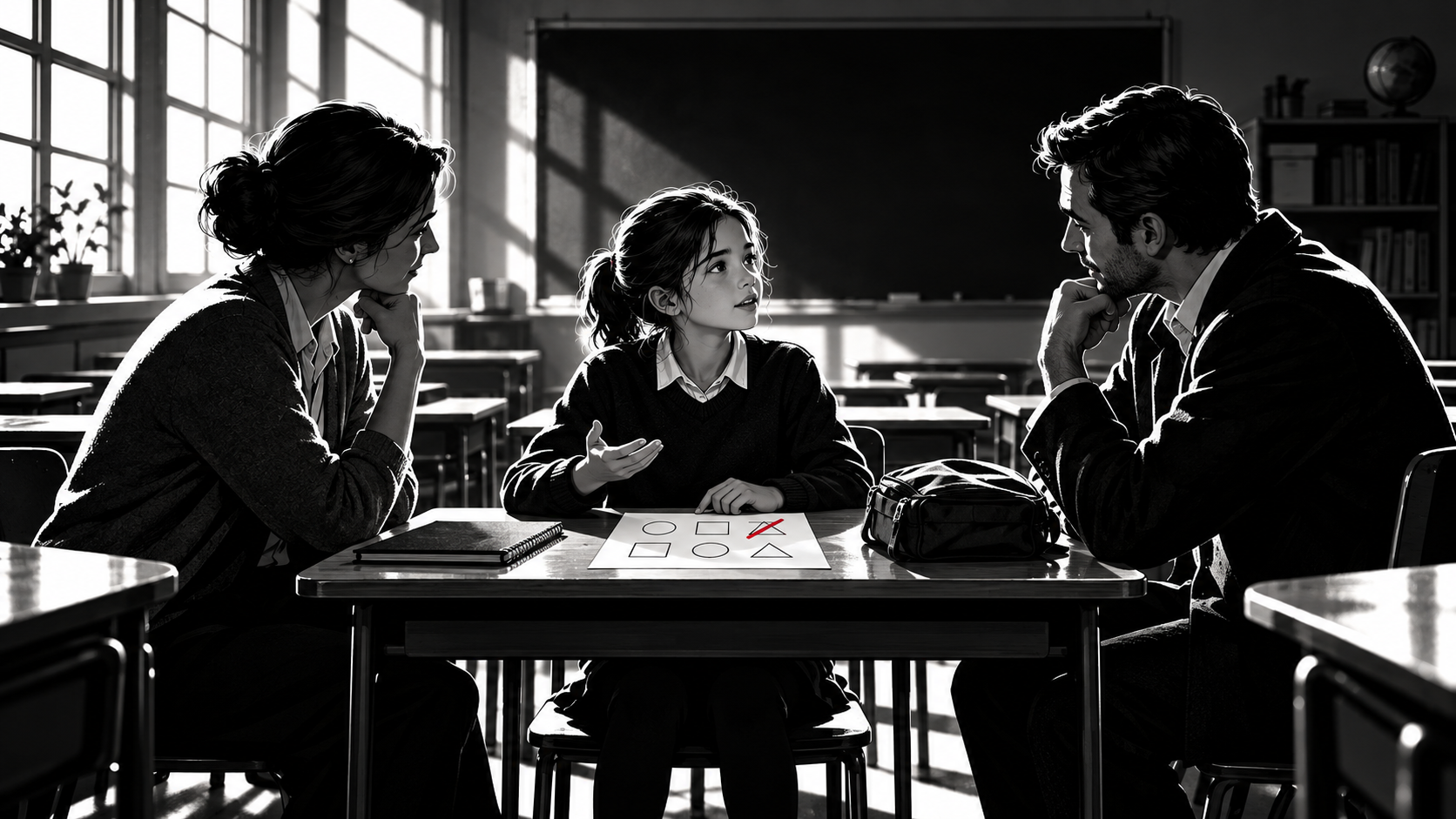
In this fictional example, twelve-year-old Nika receives a low mark for mathematics. Her teacher identifies an error, but the adults then begin discussing her character rather than the solution. One proposes excluding her from a trip; another would suspend her attendance at the club until she becomes more serious. Nika knows she got the problem wrong and cannot understand why everything she values is now being discussed. An assessment, a disciplinary measure and adult decisions about her life have become entangled.
This article helps separate them. A low mark is not necessarily unfair, a demand is not necessarily humiliating, and not every wish a child expresses can be fulfilled. Yet an error does not establish personal worth, and adults' teaching and protective responsibilities do not disappear after disobedience. A child is not an independent adult who can simply be advised to refuse a relationship or change environments. Possibilities depend on age, conditions and help. Adults have duties they cannot hand over with advice to become more confident.
All particular cases here are invented; no country or school rules are specified. The article may help adults making decisions or providing support, and older pupils seeking clearer distinctions. It does not determine the legality of a particular punishment or guarantee a safe appeal or a changed mark. Its questions are what happened, which decision is needed, how the child can be heard, and which adults are responsible for teaching, protection and the consequences of their choices.
I. A grade concerns work, rather than the whole person
Nika's work may contain a particular error: an incorrect operation, missing explanation or unclear notation. A teacher can identify it and assess the work under applicable requirements. Respect does not require calling an incorrect answer correct or abandoning assessment. But identifying what the child has not yet learned differs from judging what kind of person she is. Feedback about a specific step can return attention to the task. A claim of complete incapacity changes the subject and needs separate consideration.
A grade can affect opportunities, so it should not be dismissed as an empty convention. What does it represent here: one assignment, a period of learning or a particular skill? Nika's failure to understand the criterion does not establish that none exists. A written criterion does not establish correct application either. An adult can help distinguish these questions and clarify the permissible route for explanation. The child need not become an expert in school documents before her uncertainty merits an attentive answer.
Repeated low results can prompt questions about learning conditions, accessible explanations, time and the particular help needed. Repetition does not permit this article to determine a child's health or abilities remotely. Nor does the label “lazy” become an adequate learning plan because a problem recurs. Effort can be expected and learning assessed while obstacles are examined. Similar visible results may call for different forms of participation. Those conditions need exploration rather than a convenient label that substitutes for understanding the actual task.
The opposite error would be treating every unpleasant comment as humiliation. A teacher may communicate a truth that is difficult to hear. Content, manner, necessity and continuation matter: does the feedback identify something to improve, or is the child repeatedly displayed as generally inadequate? Distress alone does not establish a violation, while a useful subject does not justify every manner of addressing it. Both distinctions help preserve learning without making educational seriousness permission to lower a child's standing indefinitely.
II. A disciplinary measure needs a definite subject
An additional decision about the trip is separate from the assessment. Who proposes it, on what basis, and for what purpose? In the fictional setting, the trip could be part of ordinary education or a separate event; the consequences differ. This article does not determine its status. Losing another opportunity should not simply be assumed a natural extension of a low mark. Adults introducing a measure must explain its connection to conduct and applicable rules rather than expect the child to infer a hidden purpose.
Stopping dangerous conduct, imposing a temporary organisational restriction and punishing a past act differ. Preventing conduct that currently threatens others is not the same as publicly punishing a notebook error. Calling a measure “safety” does not complete its examination, however. Necessity, limits and future participation remain relevant. Adults may need to act quickly. That initial decision should not then be treated as indefinite permission to exclude the child from everything without further grounds or consideration of what remains necessary.
In another invented episode, a pupil damages a classmate's possession. The other child also has interests and needs protection. Attention to the first child's dignity should not make the second invisible. Facts can be examined, harm stopped and feasible repair considered without making public humiliation a compulsory lesson. Particular responsibility depends on age, circumstances and applicable conditions. This article neither removes it nor selects punishment remotely. It maintains the connection between conduct, help, consequences and the people affected by what happened.
A measure also needs an understandable end or review arrangement where one exists. “Until you improve” may not explain what is required or who will decide. Participation is difficult when the task changes after every response. An exact date does not establish fairness by itself either. Grounds and content matter alongside duration. The adult's question concerns more than obedience today: how does this decision relate to learning, protection and responsibility, and what does the child reasonably understand about its continuing effect?
III. Hearing a child does not transfer the whole decision
Nika may say she misunderstood the task, disputes an account or fears losing her club. Her words matter even when adults decide the outcome. Listening does not promise to fulfil every wish. Asking an opinion for appearances is insufficient too, if it receives no consideration. Relevant elements include a clear subject and an adult able to explain what was heard, what remains to be established and which decisions fall within their authority. Participation needs no promise that every answer will be favourable.
A child need not speak like a lawyer or teacher for a question to count. Help can identify one episode without supplying a preferred story or demanding every detail immediately. Nika may confuse times or not know rules. This calls for careful clarification, rather than automatically declaring the whole account false or established. The adult remains responsible for the conversation. Assistance should not become rehearsal of desired answers, and the child should not be rewarded for matching an adult's preferred version of the dispute.
Age and capacities matter, but this article offers no table determining a day when children can decide everything themselves. The same pupil may understand what she fears without knowing a transfer's legal consequences. Recognising the first does not require handing her the second. Explanation should fit the question and available understanding. Where communication support is needed, suitable provision depends on actual conditions. Difficulty expressing a view does not mean the view does not exist, or make the child responsible for overcoming every barrier alone.
Disagreement with a child can coexist with a substantive response. Preserving Nika's club can be considered separately from the learning result she needs to improve. If a decision remains, an adult need not pretend agreement. Compliance, however, does not establish that she understood and accepted the reasons. Participation matters beyond winning an argument. It preserves the child's place as a person whose situation receives consideration, while leaving the adult responsible for the explanation and action rather than calling obedience proof that everything was understood.
IV. Protection should not depend on perfect behaviour
The Convention on the Rights of the Child connects children's interests, guidance reflecting development, participation, protection from violence and dignity in school discipline. These are distinct provisions in articles 3, 5, 12, 19 and 28.2, not a rule that children always determine outcomes. UNICEF text. They concern obligations of States Parties; local procedures, applicability and implementation need separate examination. A treaty link establishes neither a safe reporting route nor the legality of a particular school measure.
A child may have broken a rule and still need protection against violence and humiliation. Misconduct does not answer whether every adult response is permissible. Equally, an inappropriate adult response does not make everything the child did to others correct. Adults must retain both questions. Protection is not a prize for high marks or a perfect account. Responsibility for teaching and treatment does not transfer to the child because she argues, stays silent or responds differently from what an adult expected.
An adult noticing danger cannot discharge the whole task by advising better boundaries. Appropriate action depends on role, location and urgency; actual reporting and protective duties may apply. These require clarification, rather than cancellation through general advice to wait. Children should not be assigned responsibility for stopping an adult's dangerous conduct, finding accommodation or leaving an institution safely on their own. Immediate danger calls for suitable local protection and urgent help. This article's optional exercise neither replaces these nor postpones real duties.
Parent, teacher, school leader and specialist service have different functions. Not every nearby adult is safe or able to change a school decision. An instruction to tell a particular relative everything may therefore ignore real conditions. A different suitable responsible adult or available protective help may be needed. This does not require the child to identify an infallible recipient alone. Adults approached need to consider their roles, possible duties and next actions carefully, making no promise of conditions they cannot actually ensure.
V. Children should not have to resolve adults' disputes
A teacher may prioritise correcting the work, a parent withdrawing her from the club, and administrators maintaining order. Each may have reasons; their combination is not yet an agreed decision. Nika should not carry accusations between them or prove to each that another adult is not an enemy. Where discussion between responsible participants is needed, adults undertake its organisation and content within their roles. A child can describe her experience without becoming a mediator responsible for peace between the parties.
Adults sometimes speak for a child in opposite ways. One trusts strictness; another rejects every restriction. Returning to a definite question helps: what happened, what learning or protection requires, which consequences are confirmed, and what the child says she wants. Anxiety or position does not establish one account in advance. Discussion must not delay necessary protection in urgent danger either. Unanimous adult agreement is not a universal prerequisite for action where an actual duty applies. Responsible disagreement still requires adults to attend to that duty.
Nika's affection for a teacher or reluctance to change schools does not disprove an account of an unpleasant episode. Wanting to leave does not establish all facts or transfer availability either. Relationships and preferences may be more complex than the question “Whose side are you on?” They deserve attention without a promise that they settle every decision. An adult should not require rejection of an attachment as evidence of seriousness, or complete loyalty to the institution as the price of continued assistance.
Adult responsibility should not become a public contest in which a child proves somebody right. Schoolwork and private history need not become material for a general trial. Possible mandatory reporting and permissible information exchange require examination separately from a wish to demonstrate injustice to everyone. Parties may have real limitations. These do not justify blaming the child because adults have not reached agreement. Responsibility for their decisions remains theirs even when the outcome fails to be calm, convenient or reassuring to everyone involved.
VI. An assessment should leave room for further learning
Once an error is established, the next question concerns learning. What needs to be understood, which explanation is available, and how will progress become recognisable? An extra lesson or a changed mark is not necessarily the answer. A general instruction to become serious, however, does not explain how to approach a particular difficulty. Adults can help clarify the task and check whether the proposed participation is accessible. Immediate improvement should not be promised: suitable help and honest effort do not establish a particular result in advance.
Needing help establishes neither illness nor a complete lack of independence. If particular educational needs are suspected, appropriate consideration is required, rather than a label based on one grade. This article prescribes no assessment, diagnosis or corrective treatment. A noticed difficulty should not become permission to stop explaining. Support also needs to consider teachers' and others' actual capacities. A resource limit can be stated honestly without presenting it as evidence that the child deserves no help at all or must independently solve the shortage.
An attractive offer of another club, tutor or school does not establish availability. Actual participation conditions, time, costs and necessary adult decisions matter. Nika need not provide them herself. Her preference helps clarify the situation but does not create a resource. Conversely, the absence of a replacement does not make present treatment unimportant. Limited help can still matter. It should be described in terms of what is genuinely possible, rather than a pleasing future result offered as though it had already been achieved.
Keeping education available also means avoiding making punishment the sole subject of every day. Other lessons, activities and relationships remain. This does not require forgetting a serious episode or removing responsibility. It concerns scale: one problem should not automatically describe an entire life. Which activities continue, what is restricted, and on which grounds are separate questions. Clarifying them belongs to adults' organisation of conditions. The child should not have to earn a return to ordinary life by demonstrating complete freedom from error.
VII. A concern needs a suitable recipient and a clear subject
An adult can help formulate a small question: what does the mark mean, why is a measure proposed, or who is responsible for particular treatment? These subjects differ. Clarifying assessment criteria is not always reporting danger, and someone receiving a learning question may lack power to examine conduct. The actual local process needs checking. This article specifies no universal address or deadline. A child need not prepare a perfect document before a responsible adult takes her situation seriously or considers what protection may be necessary.
As far as possible, explain in advance what may happen to information shared. Absolute secrecy cannot be promised without knowing a recipient's duties. Necessary action does not justify indiscriminate circulation either. Permissible content and transfer depend on role and applicable rules. A child should not receive false assurance that a conversation remains between two people when that cannot be ensured. Explanation should be understandable, preserving participation where possible without expecting the child to settle every legal detail before adults accept their responsibilities.
Another meeting with the person whose behaviour causes concern, covert recording or collecting private messages should not become compulsory conditions of help. A dangerous episode need not be repeated to produce evidence. Keeping already permissible material differs from acquiring restricted information; recording and transfer require checking local rules. Adults should not assign children a dossier, a demand to obtain a confession, or a provocation testing somebody else. Lacking perfect evidence does not remove the need to consider a reported threat seriously within actual powers and duties.
A prepared question, a sent message, receipt, examination and decision are separate results. An adult's promise to make contact does not tell the child whether it happened. Receipt establishes neither every circumstance reported nor a changed measure. Actual status, uncertainty and limits should be named honestly. This cannot guarantee success. It does help avoid asking a child to wait for a supposedly resolved problem when all that has actually been confirmed is a conversation, intention or delivered text.
VIII. Accuracy and fairness matter to every child
When Nika recalls a teacher's words, exact memory and a paraphrase of meaning can be distinguished. An adult present has a different source of observation. Gaps should not be filled with convenient certainty. This does not test whether the child deserves assistance. Support and establishing facts differ. An account can receive attention and suitable protection be sought without every inference being declared proven. Circumstances can be checked without humiliating a child for failing to recall everything in the expected order.
Other children may be witnesses or participants with protective needs of their own. They should not be required to take sides, repeat somebody else's words or assess Nika publicly. One confident adult version does not establish consensus. Clarifying circumstances belongs to suitable responsible participants under applicable rules and privacy conditions. This article prescribes no independent investigation by parents or pupils. Names, images and other children's private information do not become unrestricted material simply because the stated purpose is justice or a wish to correct an institutional failure.
Attentive consideration need not assume a teacher's guilt. The teacher may have explanations, information and actual responsibilities towards the class. Position also does not make that account final without considering the particular question. Fairness to a person differs from refusing to discuss their conduct. Respect for teachers' work does not cancel protection, while protection does not require invented findings. These distinctions resist a contest in which preserving one party's dignity supposedly requires the other to disappear entirely from consideration.
Where an adult error is established, correction should concern what was actually found. An apology, changed record, cancelled measure and return to activities can require different actions. They should not substitute for each other. Nor must the child immediately trust again or confirm that everything is now fine. Responsibility includes further conditions within the adult's role. A promise to pay greater attention matters as a promise. Actual change is established through what has happened, rather than goodwill alone or an expectation of the child's gratitude.
IX. A decision and life afterwards change differently
The mark may remain while humiliating discussion stops. A measure may be cancelled while difficulty learning the topic continues. Other combinations are possible. Such a result need not be contradictory: different questions were considered. The response's content and current conditions need clarification. This article does not promise complete reversal through one report or treat every partial outcome as failure. A limited improvement can be recognised without requiring proof that it has repaired the child's entire school life.
A transfer to another group or school is not established through a contact alone. Actual conditions, permissible decisions and continued education matter. Adults are responsible for checking them; a child should not manage her own transfer as an independent adult. Her view matters without replacing organisation and protection. Remaining temporarily does not establish agreement to every form of treatment. Departure, if achieved, also does not establish that every earlier event was assessed correctly or all consequences have ended. These are distinct outcomes with their own limits.
Nika may still enjoy the club, feel awkward after a discussion or worry before a lesson. These feelings establish neither a diagnosis nor a new danger automatically. Adults can attend to present conditions and available help without demanding immediate forgetting or celebration of a decision. Restored trust, learning the topic and actual changes to rules need not coincide. A child should not have to display a correct emotion as a report demonstrating that adults' assistance succeeded. Her response remains part of her experience rather than their performance certificate.
X. Development is more than preparation for unconditional obedience
In the selected part of Dewey's chapter IV, immaturity includes a possibility of development, rather than mere deficiency against an adult standard. Here it opens a philosophical question: which conditions allow further learning and participation? Historical writing does not become contemporary psychology or establish a particular method's effectiveness. Its age, biological and hierarchical generalisations are not adopted as current science. Respect for development should not become a promise that children solve every difficulty themselves if adults simply stop interfering.
In the selected teaching saying, Confucius rejects distinctions of class. This is a bounded historical reference for asking who is considered worthy of learning in advance. It establishes neither equal grades nor current legal protection or agreement with every child. The text also contains hierarchies and other conduct this article does not adopt as a model. One welcome sentence cannot turn an entire tradition into a unified modern safeguarding standard. Comparison remains useful when its limits are stated alongside the similarity being explored.
The practical question stays specific: what was assessed, which conduct was restricted, what help was provided, and which adults are responsible for future conditions? Dignity requires neither an absence of rules nor an absence of errors. It calls for seeing more than marks and obedience while retaining adult responsibility. An understandable explanation, clarified grounds or actual assistance may be a small next result. Thinking about dignity does not replace protection, education or practical action wherever these are needed.
What this means in practice
For optional reflection, an adult or older pupil can choose one episode. Was a piece of work, an action or an entire person being assessed? Which measure is proposed, who decides it, and what is known about its basis? Do not repeat danger, provoke an error or start a dispute for the exercise. Immediate danger calls for suitable protection and urgent help. Reflection does not replace adults' actual duties.
Consider separately what the child says and understands. Participation does not require choosing the outcome, proving flawless behaviour or reconciling adults. Do not supply desired words or demand every detail immediately. Helping expression differs from preparing convenient testimony. Where the first adult is unsuitable or unhelpful, available support from another suitable responsible adult or protective service matters, taking actual conditions into account.
Distinguish explanation of a mark, examination of a measure and reporting danger. Recipient powers, permissible information and confidentiality limits matter. Do not assign a child covert recording, private correspondence, a dossier or public disclosure. Safe reporting, complaint, transfer or disclosure, a changed mark and retained place are not guaranteed. Support must consider risk, rather than require children to secure their own protection.
One checkable closing question is what continued learning needs and which adult undertakes that responsibility. Preparation, receipt, a decision and actual change are different states. Children can make mistakes and still deserve protection and respect. A high mark, a perfect account and successful completion of this exercise are not payments required in exchange.
Key quotation
“…no distinction of classes.”
Confucius, The Analects, book XV, teaching saying, James Legge. The electronic edition, line 489, labels it CHAP. XXXVIII. The whole saying and selected context were read. It requires neither equal grades nor adoption of the entire historical text as a standard for treating children.
Connections between traditions
| Comparison | Useful question | Limit |
|---|---|---|
| Dewey IV / the selected Confucian saying | Can today's result or position conceal a capacity to learn? | Different philosophical frames, not an established shared educational theory |
| Dewey / school assessment | Which conditions support the next learning step? | The author's current application, not proven method effectiveness |
| Confucius / disciplinary dignity in the Convention | Has a child been treated as unworthy of participation in advance? | Ethical comparison does not make the ancient text a source of current law |
Three bounded comparisons without inventing unity between traditions and legal norms.
Sources
- John Dewey. Democracy and Education, 1916, chapter IV, section 1; selected reading 371–398, especially 373 and 378, within actually delivered and read 358–411. Project Gutenberg 852. Header and transcriber's warning of possible errors read; not the whole chapter or book. Historical biological, colonial and evaluative generalisations were not adopted.
- Confucius. The Analects, James Legge, book XV, teaching without class distinction, electronic label XXXVIII, line 489. Project Gutenberg 3330. Whole saying, context 470–490 and book heading 443 read; this edition's numbering is stated explicitly. Not the entire work or Chinese. Historical hierarchies and physical force in an adjacent passage are not adopted.
- Convention on the Rights of the Child. Official UNICEF text, accessed 20 October 2026. Whole selected articles 3, 5, 12, 19, 28 and 29 read in the bounded context recorded in RESEARCH. Articles 3, 5, 12, 19 and 28.2 briefly used; educational purpose in 29.1 considered without extended paraphrase. State-party obligations do not establish local procedures, applicability or implementation. National law, ratifications and an actual case were not checked; the entire Convention was not read.
Tags
child, school, grades, punishment, adult decisions, learning, dignity, error, conduct, responsibility, protection, participation, child voice, age, development, criteria, authority, teacher, parent, administration, support, confidentiality, facts, examination, consequences, continued education, Dewey, Confucius, Convention on the Rights of the Child, boundaries
About the authors
Andrey Zarinsh is the author and founder of United Wisdom. He explores inner transformation, the unity of traditions, intercultural dialogue and contemporary spiritual discipline. Instagram: @andrey.zarinsh.
Maria Evilkut is a co-author of United Wisdom. Alongside research, she seeks to test these ideas in practice and observe how principles of unity and mutual understanding work in everyday relationships between people and cultures. Instagram: @ilkutki.