
Growing up
“That was pretend”: play, invention and a child's account of an event
Four-year-old Asya says a dragon gave her a ride home from nursery. An adult can join the adventure, explain that dragons do not exist or demand that she never lie again. First, however, it helps to ask what the words are doing. Is Asya inviting someone to play, reporting an…
Epigraph
The true difference is that one relates what has happened, the other what may happen.
Aristotle, Poetics, IX, translated by S. H. Butcher. The subjects are the historian and the poet, not the assessment of children's reports.
What this article is about
Four-year-old Asya says a dragon gave her a ride home from nursery. An adult can join the adventure, explain that dragons do not exist or demand that she never lie again. First, however, it helps to ask what the words are doing. Is Asya inviting someone to play, reporting an event, expressing a wish or leaving the frame of the story unclear? An unusual word alone cannot settle which possibility applies.
This article is for parents, early years educators and other caring adults alongside children roughly three to six. We distinguish an imagined plot from a report about an actual event, uncertainty from established deception, and attention to a worrying account from a household investigation. Freedom to play coexists with adult responsibility to take possible harm seriously. The reader gains ways to clarify an ordinary story's frame, acknowledge what they do not know and choose a safe next step. This is neither a truth test nor an investigator's manual. A child need not tell a perfectly consistent story before receiving help; an adult need not declare everything proven before taking precautions.
I. The same words can belong to different activities
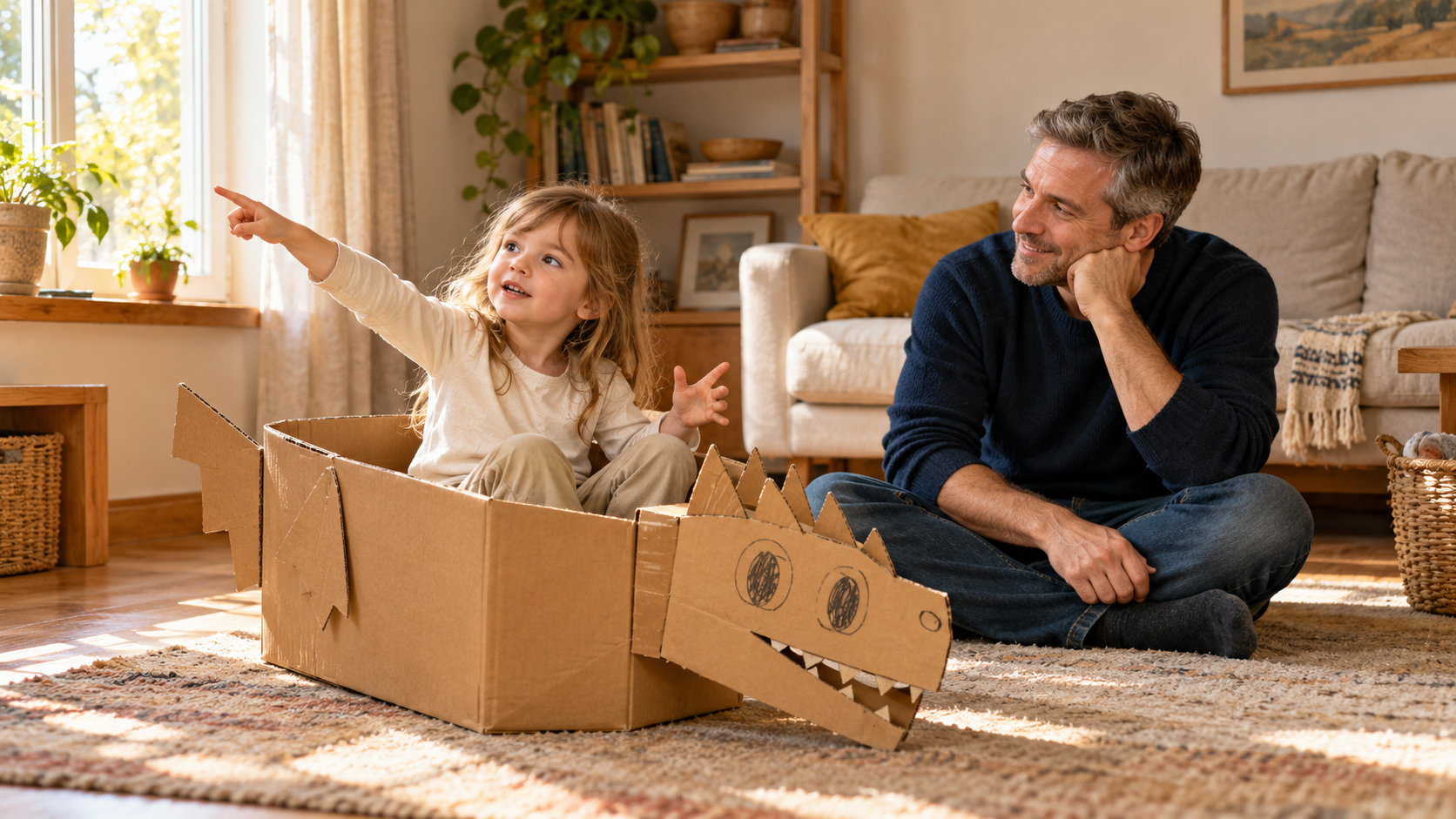
In a fictional scene, Asya sits on an upturned box holding a cord and says she is steering a dragon. Her father suggests landing near the kitchen. Both are participating in an invented journey. “The dragon is flying” is not being offered as evidence of a real creature outside the window. It continues the game. Requiring proof at every turn answers a question nobody has asked. Imagination does not become deception simply because it contains things absent from the room.
Now Asya tells her grandmother on the telephone that she flew home from nursery with a dragon. The shared frame is less obvious; her grandmother did not see the box and cord. Someone can gently clarify, “Are you telling our pretend adventure?” This is not a compulsory formula or a developmental test. It identifies the activity in which the speakers are participating. If Asya says she invented the flight, the story can continue as a story, without punishment for her capacity to imagine something different.
An answer may remain unclear. The adult can then state their own knowledge: “I know we walked home. We can invent a dragon story.” This identifies a known part of the encounter, not the whole structure of childhood thinking. There is no need to claim that the child never distinguishes imagination from reality, or already must use every nuance of speech without error. Age cannot replace understanding this conversation. A child may signal pretend play clearly while still struggling with the sequence of a day.
Audiences also differ. Inside a game, someone can be a dragon. A clinician asking about an injury needs information about a body and an event. Switching need not become a dramatic exposure: “Now we're talking about what happened to your knee; we can continue the story later.” Explaining the frame supports participation unless it becomes a demand for the answer the adult prefers. The child can still say they do not remember or do not know, rather than having to fill a gap with another detail.
II. What exactly do we know about the account?
An adult listening to a child initially has the words heard and whatever context they know. “Asya said someone pushed her” differs from “A particular person caused Asya's injury.” The first records a report; the second concludes something about an event. Further information and assistance may be needed between them. Preserving this distinction does not devalue the child. It prevents adult certainty from being added unnoticed and subsequently treated as part of the original account rather than as a later interpretation.
A mismatch with an external fact does not alone establish an intention to deceive. A person may be mistaken, use an unclear time reference, repeat someone else's account, continue an invention or deliberately conceal their action. These are different possibilities, not diagnoses of Asya. Adults do not always need to settle intention immediately. Sometimes they need to identify what is known and change an available action: wipe up water, find a missing object or arrange somewhere safe. That task can remain possible while a motive remains uncertain.
In an ordinary safe situation, an adult can state what they know: “I saw the glass fall. Let's clear up the water.” Asking “Are you sure you didn't touch anything?” when the answer is already known may invite a defensive response rather than gather information. This is an editorial distinction, not an established explanation for every child's lie. It asks the adult to examine the purpose of their question. If the information is available, what is a further confession intended to provide: clarification or moral victory?
Incomplete knowledge does not make every version equally supported. If the adult walked home with Asya, they directly observed part of the route. If absent, “That couldn't have happened” needs another basis. Adult convenience is not evidence. Uncertainty permits precaution and further appropriate inquiry. Children should not be required to express certainty beyond what the adult can justify for their own account. An assumption should not be presented as an independently established fact merely because it helps the adult bring an uncomfortable conversation to a close.
III. Play and an account of the day can coexist
CDC's milestones for four-year-olds include both pretending to be someone else and talking about an event during the day. A checklist does not replace individual assessment. It establishes neither that a particular child always reports accurately nor that every unusual account should be classed as play. The useful distinction is that these activities are not mutually exclusive. A child can enjoy invented roles and still need adults to listen to an actual experience, including something difficult to describe.
Asya can play doctor and later report a genuinely painful knee. The word “doctor” in her game does not invalidate her pain report. Likewise, a dragon drawing alone proves neither fear, trauma nor a hidden event. An adult can be interested without assigning diagnostic meaning. “Would you like to tell me about the picture?” preserves the child's authorship. “Is that dragon someone you're frightened of?” introduces an adult hypothesis that the picture itself may not support. Interest does not require a predetermined interpretation.
Imagination need not earn its place solely as skills training. Children can invent an amusing creature, enjoy an impossible bridge or change a fairy tale for pleasure itself. Adults need not turn every plot into a covert test of the child's condition. Play then does not depend on willingness to disclose private experiences. A child may prefer that the dragon simply likes soup. Declining to supply a profound meaning is neither a failure to cooperate nor a reason for the adult to search harder for symbolism.
A pretend frame does not remove real bodies. If someone bites painfully during a dragon game, stop the bite and attend to the injured child. It is unnecessary first to determine how completely the other child inhabited the role. “We're pretending; real biting is not allowed” distinguishes an invented action from an actual consequence. Freedom of plot remains within safety. One child need not prove complete understanding before another receives assistance, and the injured participant need not smile so that everyone else can continue playing.
IV. A wish need not be presented as an event to deserve attention
Asya says everyone at nursery was given a puppy today. The adult knows only that she has wanted a dog for a long time. A wish alone cannot establish that the report was invented; a gift could have occurred. Two conversations can nevertheless be separated. What happened in the group may, if necessary, be checked with an appropriate adult. Wanting a dog can be discussed regardless. A wish need not pass a factual test to deserve attention; neither does hearing it oblige the family to acquire an animal.
“I don't know about a puppy at nursery yet. I remember that you really want a dog” keeps uncertainty while recognising an interest. It confirms no event for kindness's sake and applies no accusation for accuracy's sake. An available next step might be inventing a puppy story, learning about care or watching a friend's dog with the owner's permission. If none is currently possible, the wish can still be acknowledged without compensation. Care does not always produce the particular result a child wants or create resources the family lacks.
Sometimes a child wants to avoid an unwelcome responsibility. An invented account does not become correct because it protects against shame. Adults can still discuss a specific action without a verdict on the whole person. “The toy is broken. Let's see whether it can be repaired” need not first determine what kind of child this is forever. If the responsible action is known, name it calmly. If unknown, do not maintain punishment in case somebody eventually confesses. Uncertainty requires a proportionate decision, not automatic collective guilt.
It matters not to promise an absence of every consequence for truth when that is outside our control. Reporting damage may require clearing up; reporting danger may require protective help. Promise only an available action of your own: listening without humiliation, helping to understand, not leaving the child to manage alone. “Nothing will happen” can conceal the actual next step. Adult accuracy is part of a trustworthy exchange, rather than solely a requirement imposed on the child's account. Wishes and promises need distinguishing on both sides.
V. Inventing a story and understanding an event need different questions
During play, an adult can suggest, “Does the dragon have a sister?” It invites an imagined detail. In a concerning report about a real person, a similar form can supply content. “Did he also lock you in?” introduces an action the child has not named. The distinction is not a single forbidden word but the purpose of the conversation. Joint storytelling expands a plot; understanding a possible event should avoid replacing a child's information with material supplied by the adult and then mistaken for the child's own account.
The official British resource Police.uk advises listening, keeping records and avoiding leading questions or one's own investigation. This is not a universal procedure for every country. We use limited principles for handling words; an appropriate local protective pathway depends on circumstances. Parents need not become interviewers to take a report seriously. Their task is immediate safety and communicating what actually became known to suitable people, while preserving the difference between information and what remains unknown.
For an ordinary harmless story, a brief clarification may distinguish reporting, inventing and wishing. It must not become a rigid test in which an incorrect answer means everything was made up. Children may not understand adult categories, may change wording or may decline a conversation. An adult can then name what is known and leave a gap if it can wait. Not every inaccurate time of a walk requires immediate correction. Information should support a particular decision, rather than continuous surveillance of every spoken word.
In a concerning encounter, “I don't understand” does not authorise endless repetition until a desired answer appears. Listen to what can be offered without interrupting a freely given account or requiring a performance for every relative. The article supplies no professional interview technique and promises no preservation of evidence at any cost. It limits household improvisation. Where possible harm is reported, safety matters more than perfect classification of the speech. An ordinary educational exercise about truthfulness yields to relevant help when the consequences of error change.
VI. Taking a report seriously does not declare everything proven
Asya says another child pushed her, then adds that wings grew from his back. An adult could seize on the impossible detail and dismiss the whole account, or affirm that the named child certainly did everything alleged. Both jump over uncertainty. Check separately whether Asya is hurt, needs assistance or faces a present danger; pass on information without additions. A fantastic detail proves neither the absence of a push nor the accuracy of everything else. Its presence does not settle the practical task of care.
This does not invite the adult to treat every word as a concealed sign of abuse. Children do play, make mistakes and have ordinary disagreements. The opposite automatic response, in which a drawing turns an adult into an accuser, is unhelpful too. Keep the scale of information clear: this was reported, this is observed and the rest remains unknown. Precautions depend on actual risk. Sometimes listening and checking an ordinary organisational matter with an educator is sufficient; sometimes another available protective pathway is needed. The article cannot select one without the circumstances.
For an ordinary nursery incident, information can be passed without assigning a motive: “Asya said she was pushed near the slide. I didn't see it. What did you observe?” That differs from accusation or demanding confirmation at any cost. If the intended recipient may themselves be causing harm, however, talking to them is not a mandatory first step. Safety and appropriate assistance come first. One communication formula cannot serve both an everyday misunderstanding and a threat from someone to whom the child is subject.
Preserve the distinction in a note too. Briefly record the date, circumstances and available exact words; separate your question and interpretation. Do not improve the account with a neat causal chain that was never given. Do not circulate it in a parents' group or turn a child's experience into public content. Participation does not amount to consent to unlimited repetition. The purpose of a note is to support a necessary next action; access should fit that purpose, rather than adult curiosity or a wish to gather an audience.
Several adults repeating a report do not create several independent observations. If a grandmother, father and neighbour all repeat Asya's words, there is one initial account and three transmissions. This makes the report neither false nor multiply witnessed. Checking its origin prevents confidence growing merely through repetition. If an educator observed a separate part of the event, record that distinctly and retain its exact scope: what was seen directly, what was heard from the child and what remains unknown. Different sources should not be merged into one apparently complete witness.
VII. Adults can say “I don't know” too
A confident adult voice can sound like the final version of events. It therefore matters not to fill gaps with adult invention and present that as recovered fact. In Analects II.17, Confucius connects knowledge with recognising what is known and unknown. This is ethical instruction in a historical educational setting, not a forensic method. For our reader, it prompts a question about their own statement: do I know this, or is it presently what I think may have happened?
“I wasn't in the group and don't yet know how it happened. I heard that you were hurt” can acknowledge a report without pretending to know the event. If the child did not mention pain, however, do not supply it on their behalf. Preserve what was actually said more precisely. A warm response need not be long or certain about every circumstance. Sometimes dependable support is an available action with an honestly acknowledged gap, rather than a rapidly completed story whose clarity comes from adult additions.
Some unknowns can safely remain unknown. Who first invented the amusing dragon, yesterday's block colour or the order in which children called themselves captains need not always be established. Other unknowns affect immediate safety. Distinguishing them helps allocate attention and time, particularly with few resources. Adults do not need a household archive of every utterance. Identify the decision for which information is being sought and whether that question can safely wait. The distinction allows both care for important facts and freedom from unnecessary scrutiny.
If an adult has already accused a child of lying and recognises insufficient grounds, they can correct their conclusion: “I decided too quickly that you were deceiving me. I didn't know that.” They need not declare the opposite proven. The correction concerns a hasty accusation, not complete reconstruction of an event. A child need not immediately repeat everything or reassure the adult. Allowing an unfinished account can be more honest than obtaining agreement through pressure and naming that agreement restored trust. The adult can change their action without securing a gratifying response.
VIII. Imagination and fact need not compete for existence
In chapter IX of the Poetics, Aristotle distinguishes the poet's possible events from the historian's actual ones. This clarifies different purposes of speech without turning preschool play into tragedy or providing a standard for testimony. A dragon flight can be valued as invention without a verified itinerary. Words about an injured knee need another response. Valuing one activity does not require erasing the other or deciding that the child belongs permanently to only one category of speech.
An adult can support the frame with simple transitions: “That's our story”; “Now I'm asking about the actual day”; “I don't know that.” These need not accompany every sentence when speakers already understand each other. Their purpose is to open a path, not stamp each utterance. Children can also invent alone. Constant adult presence, commentary about benefits or a check on what was learned is unnecessary. Pleasure need not be followed by a report explaining why the activity deserved its place in the day.
Play has real agreements too. One child wants the dragon always to win; another wants to be captain. Discuss these as conditions of a shared activity, rather than ask whose invention is truer. If a participant does not want to play, refusal is real. Someone else's consent cannot be made pretend: “In our story, you agreed” does not replace an actual available response. An adult can help offer another plot or end this game while keeping an invented role distinct from a real person who may dislike what is happening.
Imagination thus gains room and facts retain precision. There is no need to choose between a dull world without dragons and a world in which nothing can be checked. Ordinary life contains creation and reports on which action depends. Adults benefit from distinguishing their tasks and acknowledging when they have confused them. This cannot guarantee every story's accuracy. It can reduce the confusion adults themselves produce when answering play as though it were a crime, or a concerning report as though it were entertainment for the listener.
IX. Where the household distinction reaches its limit
Possible abuse, serious injury or a current threat must not wait for this exercise to be completed. Urgent danger calls for local emergency assistance; other substantial concerns call for an appropriate available local pathway. The language of the article selects no country or service. Care need not wait for a fully consistent narrative. Seeking assessment also does not mean the adult has proven an allegation or may publicly announce a culprit. Precaution and an unsupported public verdict remain different actions even when both begin from the same concerning report.
Concerns about speech, loss of previously available skills or persistent everyday difficulties can be discussed with a paediatrician or another accessible relevant professional using concrete observations. A milestone checklist cannot replace assessment. One unusual story or an imaginary friend is not treated here as a diagnostic sign. The article establishes no threshold of normality and attributes no entire pattern to the family environment. Help can be considered without a label; the aim is understanding needs rather than exposing the child or demanding better performance before support is available.
Privacy has limits too. An adult should not promise absolute secrecy where protective help may become necessary. “I won't tell everyone. If we need help to keep you safe, I'll speak to people who can help” is a possible explanation. Do not guarantee an unknown outcome from a service or require advance agreement to every later decision. Care preserves participation where possible without shifting to the child the burden of deciding alone who must intervene and which risks are acceptable for everyone involved.
Finally, a conversation needs an ending. Children need not live as continuously tested witnesses. After necessary actions, ordinary food, rest, play or quiet can resume. The adult may leave a nonessential question unanswered. Useful accuracy is not the greatest possible detail; it avoids presenting invention as established fact while keeping possible danger in view. Between these responsibilities is room for calm ordinary life, where a dragon can simply be a dragon from a story and not a compulsory disclosure of something else.
What this means in practice
Begin with an ordinary safe situation: an incredible adventure whose details do not determine protection. Clarify its frame without accusation, or name the part you know: “We walked home; we can invent the flight.” Join the story without representing it as an event. There is no need to make children choose the correct speech category every time. It may be sufficient that an adult stops answering an invitation to play with a moral verdict, leaving both the imagined adventure and the known walk intact.
In a second ordinary situation, an object broke or something was lost. Separate what you saw, heard and assumed. If you saw the fall, state that instead of asking a trap question. If the cause is unknown, leave it unknown while checking safety and possible repair. A child's wish to avoid trouble does not prove every motive. Promise no absence of all consequences, only your own available treatment without humiliation. With little time, one clear next action is more useful than a long examination of conscience or repeated retelling.
For a concerning report, do not turn the account into shared invention. Hear what can be told without supplying new actions or arranging performances before relatives. Where necessary, briefly retain exact words and separate interpretation. Seek appropriate help according to actual risk; urgent danger calls for local emergency assistance. Do not require complete proof first or insist that the child speak independently to a possible source of harm. Imagination during other games cannot cancel the child's right to protection. An adult need not settle every unknown before taking that responsibility seriously.
Accept a limited outcome: an ordinary story's frame is clearer, a known fact more accurately stated or a protective step begun. None is a certificate of credibility or a promise of no recurrence. A safely postponed question may remain open; necessary assessment should not be delayed by the article. Play needs no special purchase, and an initial careful response needs no household investigation. What is needed is attention to what words are doing, an available action and an honest boundary around the adult's own knowledge.
Key quotation
When you know a thing, to hold that you know it; and when you do not know a thing, to allow that you do not know it;— this is knowledge.
Confucius, Analects, II.17, translated by James Legge. Instruction to an adult pupil about knowledge, not a demand that a child prove the credibility of a report.
Connections between traditions
| Comparison | What it helps distinguish | Limit |
|---|---|---|
| Aristotle, Poetics, IX / the dragon story's frame | A possible plot and an account of an event have different purposes | Literary theory is neither developmental memory research nor a rule of evidence |
| Confucius, II.17 / the listening adult's position | Known and unknown need not be merged to produce certainty | Historical ethical education, not a diagnostic method; children need not respond as adult pupils |
| CDC / play and an account of the day | Both activities can appear within one developmental guide | A checklist establishes neither individual credibility nor delay nor a universal age of complete distinction |
| Police.uk / a concerning report | Listening and protection differ from a leading household investigation | British context is not exported as local law; general principles do not replace relevant help |
Four rows reflect sources actually read. Similar tasks establish neither common origins nor a single doctrine; unsupported esoteric explanations of children's accounts have not been added.
Sources
- Aristotle, The Poetics of Aristotle, translated by S. H. Butcher, electronic edition 1974, updated 20 September 2016. Chapter IX with adjacent VIII–XI context and identification were read, not the full book. The epigraph is a complete sentence from IX; its subjects, poet and historian, are identified.
- Confucius, The Analects, translated by James Legge, electronic edition 3330, updated 8 January 2021. II.17 and surrounding context were read. The precise print basis is unidentified; Chinese text and notes are absent in this version. The key quotation is attributed without a claim to reading the Chinese original.
- CDC, Milestones by 4 Years, updated/reviewed May 2026. Social and language milestones, checklist limitations and the clinician discussion section were read. Videos were not viewed; no child screening was performed.
- Police.uk, Advice for parents, guardians and professionals. The short page was read; used narrowly for listening, recording and avoiding one's own investigation. British schemes, numbers and legal definitions are not transferred here. All web sources checked 23 October 2026.
Tags
preschool childhood, imagination, pretend play, invention, account, event, fact, unknown, lying, intention, memory, speech, dragon, plot, wish, observation, listening, question, leading question, safety, protection, privacy, trust, adult example, help, Aristotle, Poetics, Confucius, Analects, CDC, child's perspective, pleasure
About the authors
Andrey Zarinsh is the author and founder of United Wisdom. He explores inner transformation, the unity of traditions, intercultural dialogue and contemporary spiritual discipline. Instagram: @andrey.zarinsh.
Maria Evilkut is a co-author of United Wisdom. Alongside research, she seeks to test these ideas in practice and observe how principles of unity and mutual understanding work in real life between people and cultures. Instagram: @ilkutki.